Tanzania Advertising Market Size, Share & Growth Rate
The Tanzania Advertising Market was estimated at USD 422 Million in 2025 and is projected to reach USD 597 Million by 2032, growing at a CAGR of 5.1% from 2026 to 2032. This upward trajectory is primarily fueled by the burgeoning internet and mobile penetration, which are reshaping how advertisers connect with consumers. Additionally, the increasing disposable incomes and a young, tech-savvy population are driving demand for innovative advertising solutions.
Tanzania Advertising Market Year-wise Growth Rate and Key Drivers
This graph highlights how the Tanzania Advertising Market has steadily grown over the years, supported by major growth factors.
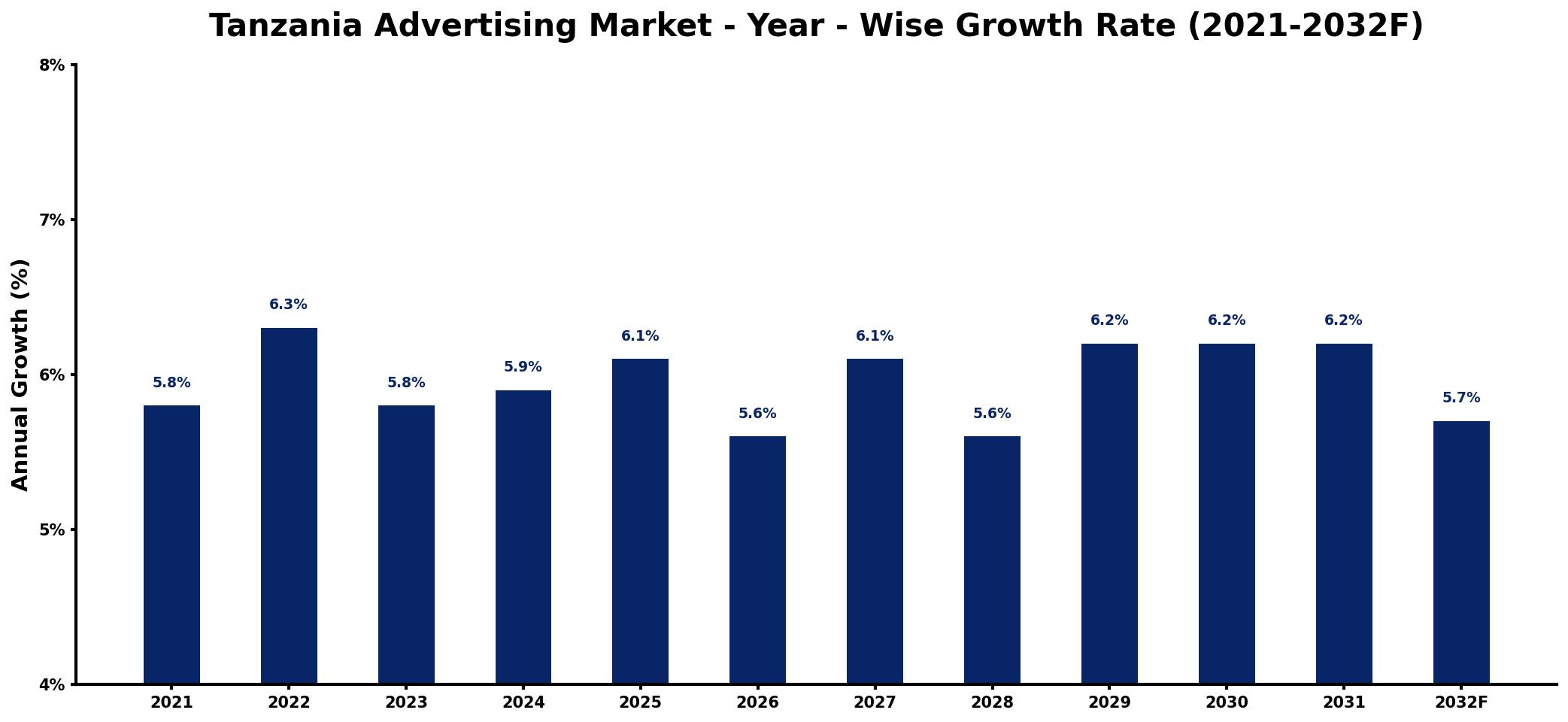
The table below presents the year‑wise growth rates along with the key drivers influencing the market
| Year | Growth Rate | Major Drivers |
| 2021 | 5.8% | Rising digital media consumption |
| 2022 | 6.3% | Increased mobile internet penetration |
| 2023 | 5.8% | Growth in e-commerce platforms |
| 2024 | 5.9% | Expansion of local content creation |
| 2025 | 6.1% | Investment in innovative technologies |
| 2026 | 5.6% | Diversification of media channels |
| 2027 | 6.1% | Emergence of influencer marketing |
| 2028 | 5.6% | Higher brand engagement strategies |
| 2029 | 6.2% | Boost in regional market collaborations |
| 2030 | 6.2% | Growth of experiential marketing |
| 2031 | 6.2% | Increased focus on sustainability |
| 2032 | 5.7% | expanding healthcare application demand |
Note: Market size estimations and growth projections presented in this report are based on 6Wresearch's proprietary forecasting methodology, utilizing the latest available industry data, government publications, and primary research inputs.
Tanzania Advertising Market Synopsis
The landscape of advertising in Tanzania is characterized by a significant reliance on traditional media, with television and radio remaining the most influential platforms for reaching mass audiences. However, as the digital ecosystem expands, the shift towards online advertising channels is becoming more pronounced, particularly among brands targeting younger demographics.
Urban centers, especially Dar es Salaam, are witnessing a notable rise in outdoor advertising, with billboards and transit ads becoming commonplace. These developments signal a growing appetite for diverse advertising mediums that can effectively engage the country's dynamic consumer base.
Tanzania Advertising Market Key Takeaways
- The shift toward digital platforms is accelerating, driven by increasing internet access and mobile phone usage.
- Outdoor advertising remains a significant player, particularly in urban environments with high foot traffic.
- Influencer marketing is on the rise, with brands increasingly collaborating with local social media personalities.
- Government regulations aim to enhance the ethical standards and transparency of advertising practices.
- As disposable incomes rise, brands are adapting their strategies to meet the diverse needs of Tanzanian consumers.
Evaluation of Restraints in Tanzania Advertising Market
Despite the promising growth of the Tanzania advertising market, several restraints remain. A significant challenge is the lack of reliable data and analytical tools necessary for effective campaign targeting and performance measurement. This deficiency impacts advertisers' abilities to reach audiences efficiently. The fragmented media landscape, combined with the increasing complexity of navigating both traditional and digital avenues, further complicates advertising strategies. Additionally, cultural diversity within Tanzania necessitates tailored content, which can be difficult to create amidst these constraints.
Tanzania Advertising Market Trends
The ongoing digital transformation is the most salient trend, as brands recognize the necessity of transitioning to online platforms. Mobile advertising is emerging as a particularly effective tool due to the widespread use of smartphones across various demographics. Moreover, there is an increasing focus on sustainability within advertising, as consumers in Tanzania show heightened awareness of environmental and social issues, compelling brands to craft campaigns that resonate with these values.
Tanzania Advertising Market Opportunities
Investment opportunities abound within the Tanzania Advertising Market, particularly in the realms of digital and mobile advertising. As more consumers go online, businesses that invest in targeted digital strategies will likely see substantial returns. The effectiveness of outdoor advertising also remains strong, especially in urban areas where visibility can drive brand recognition. Influencer marketing presents another lucrative opportunity, with brands increasingly leveraging social media figures to enhance their outreach.
Government Initiatives in the Tanzania Advertising Market
The Tanzanian government has established the Tanzania Communications Regulatory Authority (TCRA) to oversee advertising standards and ensure compliance across various media. The Fair Competition Act is also in place to promote a competitive advertising environment by preventing unfair practices. Such initiatives aim to bolster consumer protection while fostering an ethical and competitive market landscape.
Future Insights of the Tanzania Advertising Market
Looking ahead to 2026-2032, the Tanzania advertising market is anticipated to undergo significant evolution. As digitalization continues to increase and infrastructure improves, brands will have greater opportunities to engage with consumers through innovative marketing strategies. The expansion of the middle class will likely drive demand for diverse and tailored advertising approaches, ensuring that companies that adapt to these changes will thrive in a competitive landscape.
Tanzania Advertising Market Latest Developments (2025 - 2026)
Recent developments in the Tanzanian advertising landscape include a marked increase in partnerships between brands and local influencers, reflecting a shift towards more relatable and engaging marketing strategies. In addition, there has been a noticeable push for enhanced transparency in advertising practices, spurred by both consumer demand and regulatory requirements. These trends signal an evolving market that is increasingly attuned to the preferences and values of its audience.
Tanzania Advertising Market - Key Attractiveness of the Report
- 10 Years of Market Numbers
- Historical Data Starting from 2022 to 2025
- Base Year: 2025
- Forecast Data until 2032
- Key Performance Indicators Impacting the Market
- Major Upcoming Developments and Projects
Key Highlights of the Report:
- Tanzania Advertising Market Outlook
- Market Size of Tanzania Advertising Market, 2025
- Forecast of Tanzania Advertising Market, 2032
- Historical Data and Forecast of Tanzania Advertising Revenues & Volume for the Period 2022-2032F
- Tanzania Advertising Market Trend Evolution
- Tanzania Advertising Market Drivers and Challenges
- Tanzania Advertising Price Trends
- Tanzania Advertising Porter's Five Forces
- Tanzania Advertising Industry Life Cycle
- Historical Data and Forecast of Tanzania Advertising Market Revenues & Volume By Type for the Period 2022-2032F
- Historical Data and Forecast of Tanzania Advertising Market Revenues & Volume By Television for the Period 2022-2032F
- Historical Data and Forecast of Tanzania Advertising Market Revenues & Volume By Print (Newspaper and Magazine) for the Period 2022-2032F
- Historical Data and Forecast of Tanzania Advertising Market Revenues & Volume By Radio for the Period 2022-2032F
- Historical Data and Forecast of Tanzania Advertising Market Revenues & Volume By Outdoor for the Period 2022-2032F
- Historical Data and Forecast of Tanzania Advertising Market Revenues & Volume By Internet (Search, Display, Classified, Video) for the Period 2022-2032F
- Historical Data and Forecast of Tanzania Advertising Market Revenues & Volume By Mobile for the Period 2022-2032F
- Historical Data and Forecast of Tanzania Advertising Market Revenues & Volume By Cinema for the Period 2022-2032F
- Tanzania Advertising Import Export Trade Statistics
- Market Opportunity Assessment By Type
- Tanzania Advertising Top Companies Market Share
- Tanzania Advertising Competitive Benchmarking By Technical and Operational Parameters
- Tanzania Advertising Company Profiles
- Tanzania Advertising Key Strategic Recommendations






































