Tanzania Base Metals Market Size, Share & Growth Rate
The Tanzania Base Metals Market was estimated at USD 258 Million in 2025 and is projected to reach USD 342 Million by 2032, growing at a CAGR of 4.1% from 2026 to 2032. This trajectory is primarily fueled by a surge in global demand for essential base metals such as copper and nickel, which are pivotal for infrastructure development and technological advancements. Additionally, the governments commitment to improving regulatory frameworks and investing in infrastructure is further energizing the market.
Tanzania Base Metals Market Year-wise Growth Rate and Key Drivers
This graph highlights how the Tanzania Base Metals Market has steadily grown over the years, supported by major growth factors.
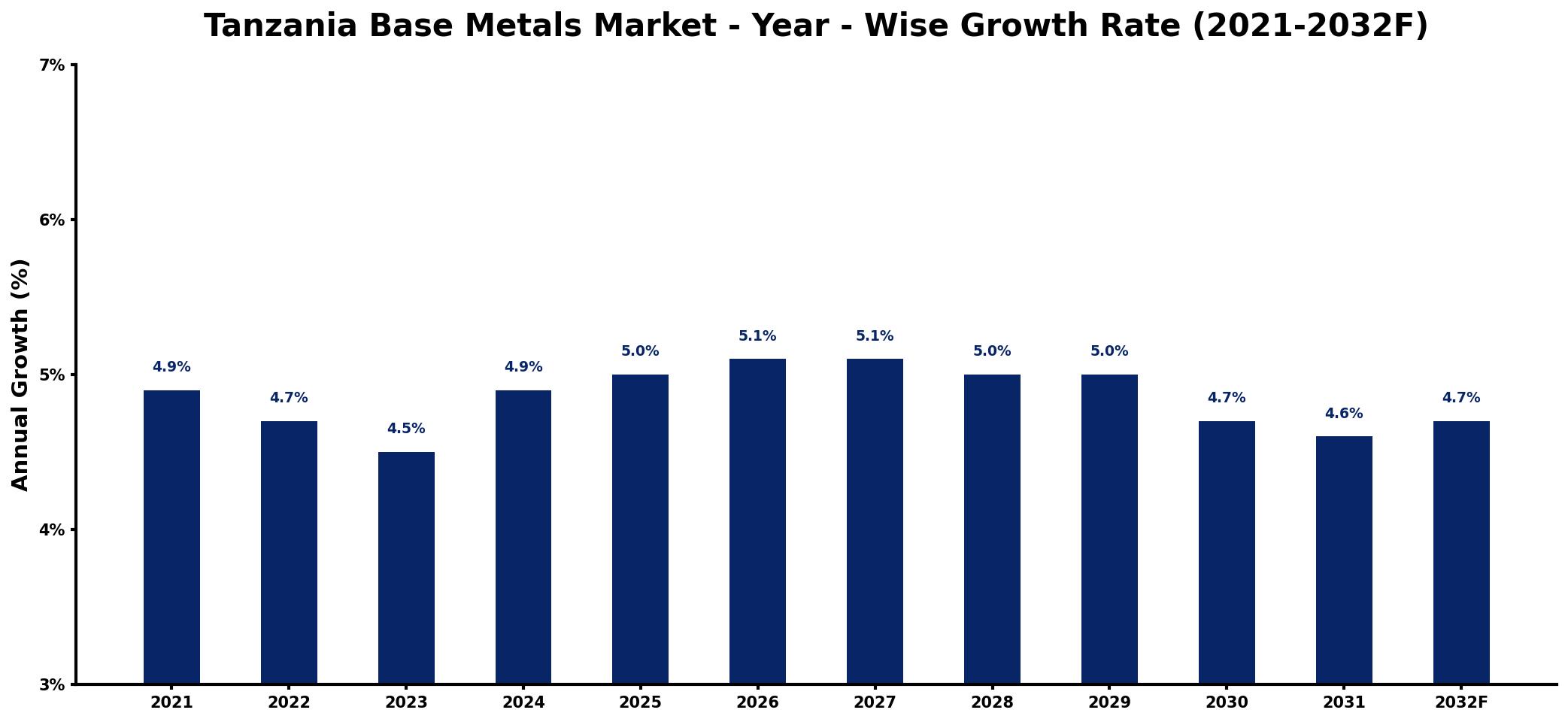
The table below presents the year‑wise growth rates along with the key drivers influencing the market
| Year | Growth Rate | Major Drivers |
| 2021 | 4.9% | Rising construction sector investments |
| 2022 | 4.7% | Increased infrastructure development projects |
| 2023 | 4.5% | Growing renewable energy initiatives |
| 2024 | 4.9% | Expansion of mining operations |
| 2025 | 5.0% | Surge in automotive manufacturing demand |
| 2026 | 5.1% | Growth in electronics production capacity |
| 2027 | 5.1% | Increased demand for green technologies |
| 2028 | 5.0% | Boost in housing market activities |
| 2029 | 5.0% | Rising global industrial production rates |
| 2030 | 4.7% | Enhanced governmental support programs |
| 2031 | 4.6% | improved processing technologies adoption |
| 2032 | 4.7% | Increased focus on sustainable practices |
Note: Market size estimations and growth projections presented in this report are based on 6Wresearch's proprietary forecasting methodology, utilizing the latest available industry data, government publications, and primary research inputs.
Tanzania Base Metals Market Synopsis
The most significant force shaping the Tanzania Base Metals Market right now is the robust activity within the mining sector. With vast mineral deposits, particularly in copper, lead, nickel, and zinc, Tanzania is increasingly attracting foreign direct investment, providing a solid foundation for growth.
Government initiatives aimed at refining regulatory practices and enhancing infrastructure are critical in fostering this growth. As the global demand for these metals increases, Tanzanias ability to adapt and provide a competitive landscape becomes paramount in positioning the country as a key player in the regional market.
Tanzania Base Metals Market Key Takeaways
- The market is bolstered by significant mineral deposits and a supportive regulatory environment.
- Growing global infrastructure projects are driving increased demand for base metals.
- Investment opportunities are present across exploration, mining, and mineral processing.
- Regulatory reforms aim to encourage local participation and sustainable practices.
- Infrastructure enhancements are essential for addressing current logistical challenges.
Evaluation of Restraints in Tanzania Base Metals Market
Despite its potential, the Tanzania Base Metals Market faces notable constraints that hinder its full capabilities. Infrastructure inadequacies, particularly concerning transportation and power supply, limit efficient operations in exploration and extraction. Additionally, the mining sector struggles with limited access to financing, which stifles project development and innovation. Regulatory uncertainties, characterized by fluctuating policies and delays in permits, create a challenging investment climate. Addressing these barriers is critical for the sector to realize its growth potential.
Tanzania Base Metals Market Trends
Current trends within the Tanzania Base Metals Market show a pronounced shift towards sustainability and local value addition. Companies are increasingly adopting environmentally responsible practices, driven by regulatory pressures and market demand for ethically sourced materials. Furthermore, the expansion of the manufacturing sector is amplifying the demand for metals, while infrastructural developments in East Africa create additional consumption avenues. Innovations in extraction and processing technologies are also beginning to reshape operations, leading to increased efficiency and reduced environmental impact.
Tanzania Base Metals Market Opportunities
Significant investment opportunities lie within the Tanzania Base Metals Market, particularly in the exploration and development of copper and nickel deposits. The government's favorable policies, such as tax incentives for foreign investors, enhance the attractiveness of this market. Moreover, as global industries increasingly require a reliable supply of base metals for renewable energy projects, Tanzanias position as a resource-rich nation can be leveraged to meet this demand. Partnerships with international mining firms also present avenues for technological transfer and skill development.
Government Initiatives in the Tanzania Base Metals Market
The Tanzanian government has been proactive in implementing policies aimed at regulating and enhancing the base metals market. The Mining Act of 2010 enforces strict environmental and social responsibility standards, promoting local content and community engagement. Additionally, the Mining (Local Content) Regulations of 2018 aim to increase the participation of Tanzanian citizens in the sector. Export bans on certain base metals further promote local processing and value addition, highlighting the government's commitment to ensuring sustainable development within the mining industry.
Future Insights of the Tanzania Base Metals Market
Looking ahead to 2026-2032, the Tanzania Base Metals Market is anticipated to experience steady growth, bolstered by increasing investor interest and favorable global market conditions. With ongoing improvements in regulatory frameworks and infrastructure, Tanzania is poised to capitalize on its mineral wealth. However, overcoming persistent infrastructural challenges and navigating regulatory complexities will be critical in sustaining this growth trajectory. As international demand for base metals continues to rise, Tanzania is well-positioned to emerge as a key supplier in the East African region.
Tanzania Base Metals Market Latest Developments (2025 - 2026)
Recent developments in the Tanzania Base Metals Market indicate a strong upward momentum in mining activities, with several new exploration projects gaining traction. The government continues to refine its regulatory framework to facilitate smoother operations for mining companies. Additionally, collaborations with international stakeholders are becoming more prevalent, further enhancing technology transfer and operational efficiencies. These trends highlight the dynamic nature of the market as it adjusts to both local and global demands.
Tanzania Base Metals Market - Key Attractiveness of the Report
- 10 Years of Market Numbers
- Historical Data Starting from 2022 to 2025
- Base Year: 2025
- Forecast Data until 2032
- Key Performance Indicators Impacting the Market
- Major Upcoming Developments and Projects
Key Highlights of the Report:
- Tanzania Base Metals Market Outlook
- Market Size of Tanzania Base Metals Market, 2025
- Forecast of Tanzania Base Metals Market, 2032
- Historical Data and Forecast of Tanzania Base Metals Revenues & Volume for the Period 2022-2032F
- Tanzania Base Metals Market Trend Evolution
- Tanzania Base Metals Market Drivers and Challenges
- Tanzania Base Metals Price Trends
- Tanzania Base Metals Porter's Five Forces
- Tanzania Base Metals Industry Life Cycle
- Historical Data and Forecast of Tanzania Base Metals Market Revenues & Volume By Type for the Period 2022-2032F
- Historical Data and Forecast of Tanzania Base Metals Market Revenues & Volume By Copper for the Period 2022-2032F
- Historical Data and Forecast of Tanzania Base Metals Market Revenues & Volume By Zinc for the Period 2022-2032F
- Historical Data and Forecast of Tanzania Base Metals Market Revenues & Volume By Lead for the Period 2022-2032F
- Historical Data and Forecast of Tanzania Base Metals Market Revenues & Volume By Nickel for the Period 2022-2032F
- Historical Data and Forecast of Tanzania Base Metals Market Revenues & Volume By Aluminum for the Period 2022-2032F
- Historical Data and Forecast of Tanzania Base Metals Market Revenues & Volume By Tin for the Period 2022-2032F
- Historical Data and Forecast of Tanzania Base Metals Market Revenues & Volume By End-user Industry for the Period 2022-2032F
- Historical Data and Forecast of Tanzania Base Metals Market Revenues & Volume By Construction for the Period 2022-2032F
- Historical Data and Forecast of Tanzania Base Metals Market Revenues & Volume By Automotive and Transportation for the Period 2022-2032F
- Historical Data and Forecast of Tanzania Base Metals Market Revenues & Volume By Electrical and Electronics for the Period 2022-2032F
- Historical Data and Forecast of Tanzania Base Metals Market Revenues & Volume By Consumer Products for the Period 2022-2032F
- Historical Data and Forecast of Tanzania Base Metals Market Revenues & Volume By Medical Devices for the Period 2022-2032F
- Historical Data and Forecast of Tanzania Base Metals Market Revenues & Volume By Others for the Period 2022-2032F
- Tanzania Base Metals Import Export Trade Statistics
- Market Opportunity Assessment By Type
- Market Opportunity Assessment By End-user Industry
- Tanzania Base Metals Top Companies Market Share
- Tanzania Base Metals Competitive Benchmarking By Technical and Operational Parameters
- Tanzania Base Metals Company Profiles
- Tanzania Base Metals Key Strategic Recommendations






































