Tanzania Commercial Vehicles Market: Top 5 Importing Countries and Market Competition (HHI) Analysis
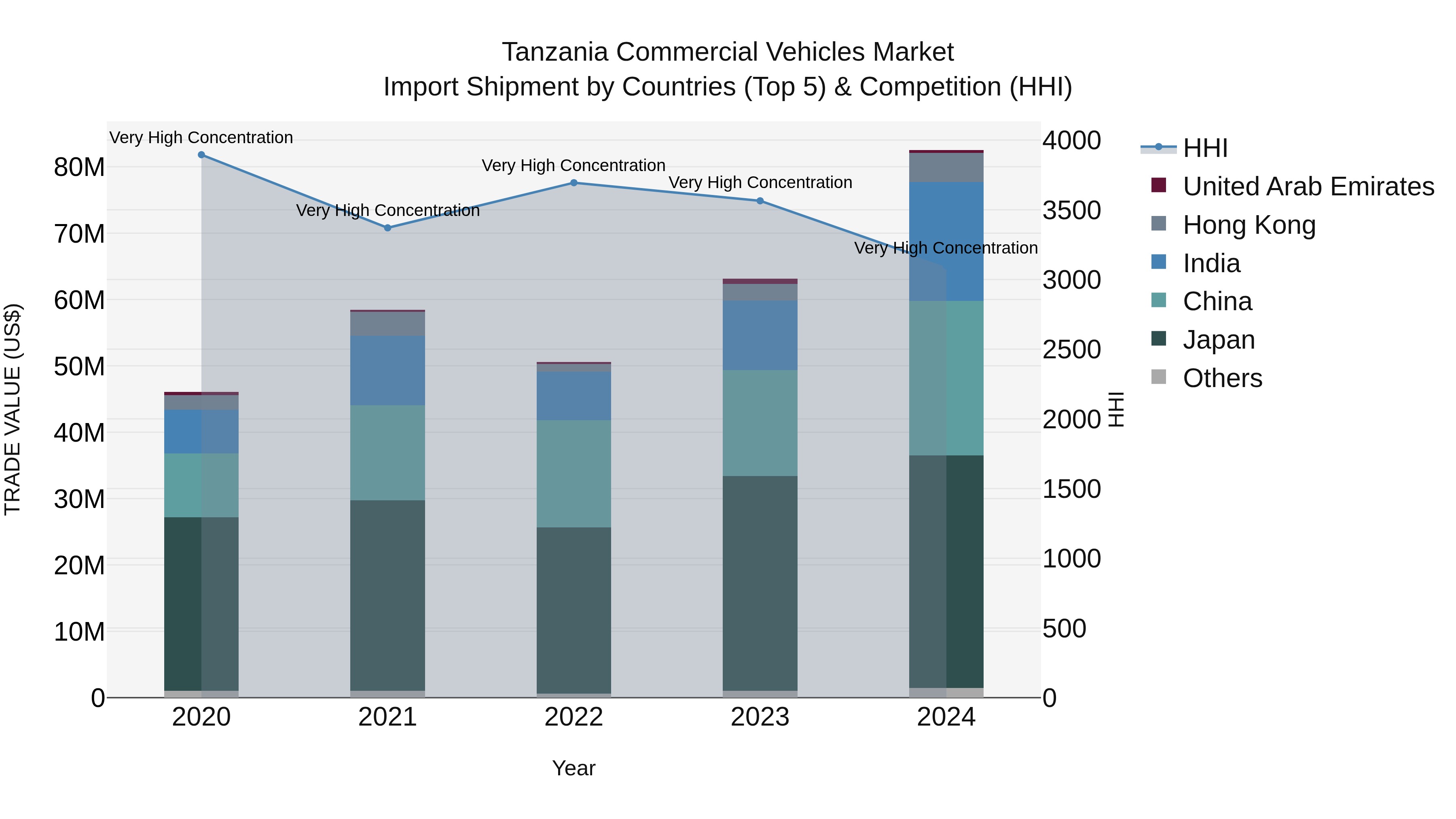
Tanzania`s commercial vehicles import market continued to see strong growth in 2024, with top exporting countries including Japan, China, India, Hong Kong, and Kenya. The high Herfindahl-Hirschman Index (HHI) indicates a concentrated market with limited competition. The impressive compound annual growth rate (CAGR) of 15.68% from 2020-2024 highlights sustained expansion, while the growth rate of 30.73% from 2023-2024 demonstrates accelerating momentum. This data suggests a thriving market for commercial vehicles in Tanzania, driven by imports from key global players.
Key Highlights of the Report:
- Tanzania Commercial vehicles Market Outlook
- Market Size of Tanzania Commercial vehicles Market, 2019
- Forecast of Tanzania Commercial vehicles Market, 2026
- Historical Data and Forecast of Tanzania Commercial vehicles Revenues & Volume for the Period 2016 - 2026
- Tanzania Commercial vehicles Market Trend Evolution
- Tanzania Commercial vehicles Market Drivers and Challenges
- Tanzania Commercial vehicles Price Trends
- Tanzania Commercial vehicles Porter's Five Forces
- Tanzania Commercial vehicles Industry Life Cycle
- Historical Data and Forecast of Tanzania Commercial vehicles Market Revenues & Volume By Product for the Period 2016 - 2026
- Historical Data and Forecast of Tanzania Commercial vehicles Market Revenues & Volume By Light Commercial Vehicles (LCVs) for the Period 2016 - 2026
- Historical Data and Forecast of Tanzania Commercial vehicles Market Revenues & Volume By Heavy Trucks for the Period 2016 - 2026
- Historical Data and Forecast of Tanzania Commercial vehicles Market Revenues & Volume By Buses & Coaches for the Period 2016 - 2026
- Historical Data and Forecast of Tanzania Commercial vehicles Market Revenues & Volume By End-Users for the Period 2016 - 2026
- Historical Data and Forecast of Tanzania Commercial vehicles Market Revenues & Volume By Industrial for the Period 2016 - 2026
- Historical Data and Forecast of Tanzania Commercial vehicles Market Revenues & Volume By Mining & Construction for the Period 2016 - 2026
- Historical Data and Forecast of Tanzania Commercial vehicles Market Revenues & Volume By Logistics for the Period 2016 - 2026
- Historical Data and Forecast of Tanzania Commercial vehicles Market Revenues & Volume By Passenger Transportation for the Period 2016 - 2026
- Historical Data and Forecast of Tanzania Commercial vehicles Market Revenues & Volume By Others for the Period 2016 - 2026
- Tanzania Commercial vehicles Import Export Trade Statistics
- Market Opportunity Assessment By Product
- Market Opportunity Assessment By End-Users
- Tanzania Commercial vehicles Top Companies Market Share
- Tanzania Commercial vehicles Competitive Benchmarking By Technical and Operational Parameters
- Tanzania Commercial vehicles Company Profiles
- Tanzania Commercial vehicles Key Strategic Recommendations






































