Tanzania Curtains and Window Blinds Market Size, Share & Growth Rate
The Tanzania Curtains and Window Blinds Market was estimated at USD 1347 Million in 2025 and is projected to reach USD 2533 Million by 2032, growing at a CAGR of 9.4% from 2026 to 2032. This growth trajectory can be attributed to the rapid urbanization taking place within Tanzania, alongside the rise of a burgeoning middle class that increasingly values stylish and functional interior design. Moreover, the transition towards energy-efficient home solutions and smart technology integration is further propelling demand in this evolving market.
Tanzania Curtains and Window Blinds Market Year-wise Growth Rate and Key Drivers
This graph highlights how the Tanzania Curtains and Window Blinds Market has steadily grown over the years, supported by major growth factors.
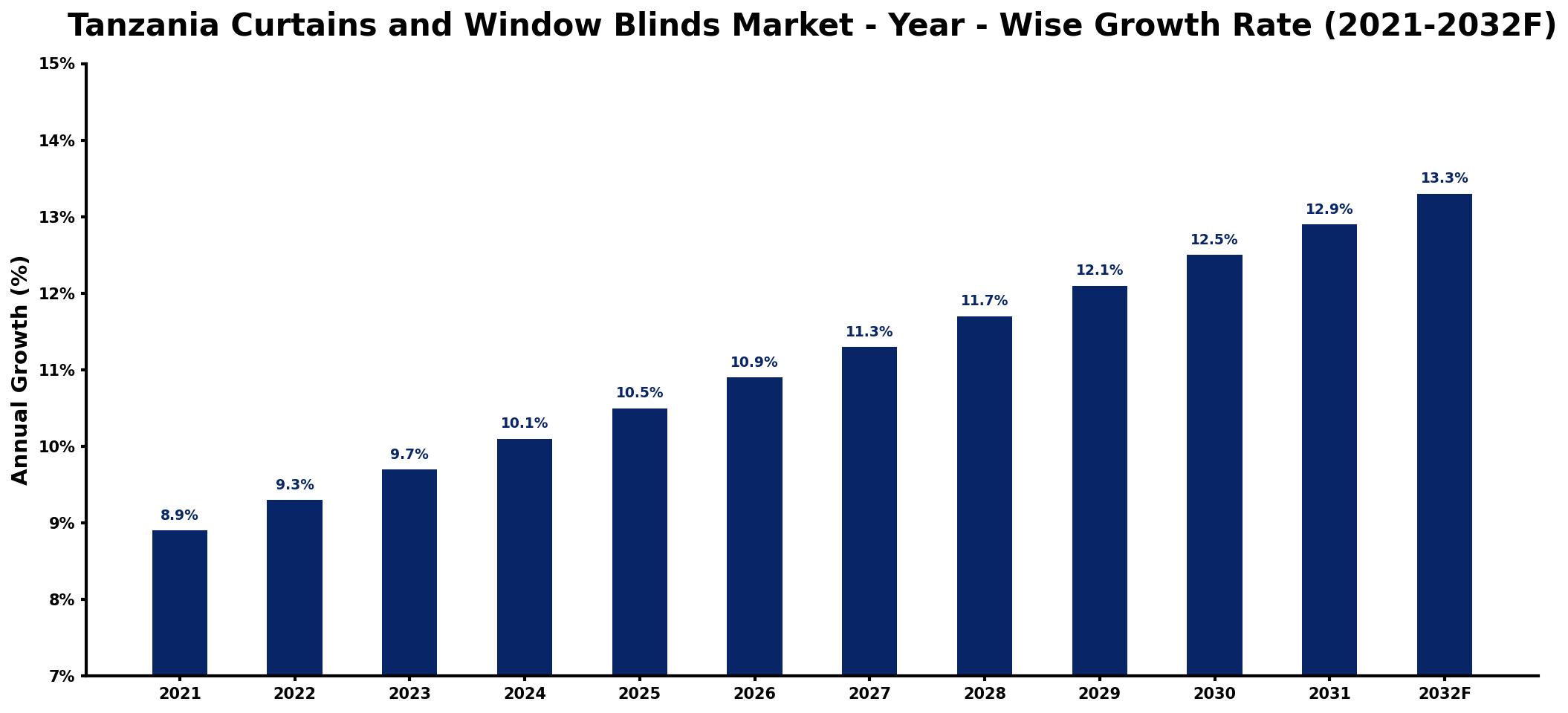
The table below presents the year‑wise growth rates along with the key drivers influencing the market
| Year | Growth Rate | Major Drivers |
| 2021 | 8.9% | Rising urbanization and development projects |
| 2022 | 9.3% | Increased disposable income levels |
| 2023 | 9.7% | Growing interest in home decor |
| 2024 | 10.1% | Expansion of retail distribution channels |
| 2025 | 10.5% | Surge in construction activities |
| 2026 | 10.9% | Increasing consumer awareness sustainability |
| 2027 | 11.3% | Development of innovative design trends |
| 2028 | 11.7% | Enhancement of online shopping platforms |
| 2029 | 12.1% | Growth in real estate investments |
| 2030 | 12.5% | Emergence of eco-friendly materials |
| 2031 | 12.9% | growing downstream application demand |
| 2032 | 13.3% | rising procurement volume requirements |
Note: Market size estimations and growth projections presented in this report are based on 6Wresearch's proprietary forecasting methodology, utilizing the latest available industry data, government publications, and primary research inputs.
Tanzania Curtains and Window Blinds Market Synopsis
The Tanzania Curtains and Window Blinds market is witnessing a significant transformation, as consumer preferences shift towards modern and minimalist designs. This growing inclination towards high-quality fabrics and customizable options signifies a departure from traditional approaches, reflecting changing aesthetic values in both residential and commercial settings.
As urban centers expand and disposable incomes rise, the demand for premium window treatments is increasing. Consumers are not only looking for functionality but also for products that enhance the overall aesthetic appeal of their spaces. Consequently, this market is becoming increasingly competitive, with local manufacturers and international brands alike striving to meet diverse consumer needs.
Tanzania Curtains and Window Blinds Market Key Takeaways
- The market is projected to grow significantly, driven by urbanization and increasing disposable incomes.
- There is a notable shift towards eco-friendly and energy-efficient window treatment solutions.
- Smart technology integration, such as motorized blinds, is becoming a prevalent trend.
- Customization and high-quality materials are key consumer demands in the current landscape.
- Government policies are favoring local manufacturing, thereby supporting domestic market growth.
Evaluation of Restraints in Tanzania Curtains and Window Blinds Market
Despite the promising outlook, the Tanzania Curtains and Window Blinds market faces significant restraints. One of the primary challenges is the fragmented nature of the market, with many small and unorganized players that can lead to inconsistent product quality. Additionally, many consumers remain unaware of the functional benefits of curtains and blinds in enhancing interior design and providing privacy. Import restrictions and high duties on raw materials further complicate the competitive landscape, preventing local manufacturers from effectively competing with imported options. Fluctuations in exchange rates and economic instability also dampen consumer purchasing power, creating uncertainty in market demand.
Tanzania Curtains and Window Blinds Market Trends
The current trends shaping the Tanzania Curtains and Window Blinds market reveal a clear consumer preference for modern aesthetics. Minimalistic designs using sustainable materials like organic cotton and bamboo are gaining popularity. Furthermore, the integration of smart technologies into window treatments is becoming more common, catering to tech-savvy consumers. As home decor continues to evolve, there is also a significant uptick in interest for customizable options that reflect personal style while meeting functional needs.
Tanzania Curtains and Window Blinds Market Opportunities
The landscape of the Tanzania Curtains and Window Blinds market is ripe with investment opportunities, especially for those looking to capitalize on the growing real estate sector. Investors can explore the potential of high-quality, aesthetically pleasing window treatments, tapping into the trend for environmentally friendly solutions. Collaborating with interior designers and real estate developers can further enhance market penetration. The focus on sustainable living and energy-efficient homes presents an avenue for innovation, particularly in developing smart window treatment technologies that align with consumer demands.
Government Initiatives in the Tanzania Curtains and Window Blinds Market
The Tanzanian government has adopted several policies to bolster the curtains and window blinds market. These include import tariffs on materials used in production, aimed at encouraging local manufacturing. Regulations surrounding quality standards and safety requirements ensure consumer protection, while incentives for domestic production support local manufacturers. Additionally, there is a concerted effort to promote sustainability within the industry, incentivizing the use of eco-friendly materials and practices.
Future Insights of the Tanzania Curtains and Window Blinds Market
Looking ahead to 2026-2032, the Tanzania Curtains and Window Blinds Market is expected to maintain a robust growth trajectory. Factors such as rising disposable incomes, urbanization, and a continued focus on home decor will fuel demand. The rise of e-commerce platforms will expand market accessibility, allowing consumers to explore diverse options from the comfort of their homes. To remain competitive, companies will need to innovate and adapt, focusing on sustainability, customization, and high-quality offerings to meet the dynamic demands of consumers in this vibrant market.
Tanzania Curtains and Window Blinds Market Latest Developments (2025 - 2026)
Recent developments in the Tanzania Curtains and Window Blinds market reflect a growing emphasis on innovation and sustainability. Companies are increasingly introducing eco-friendly product lines to cater to environmentally conscious consumers. The adoption of smart technologies, such as automated and voice-controlled blinds, has also gained momentum, enhancing user convenience. Furthermore, there is a noticeable trend towards collaboration between manufacturers and interior design professionals to create customized solutions that resonate with current consumer tastes.
Tanzania Curtains and Window Blinds Market - Key Attractiveness of the Report
- 10 Years of Market Numbers
- Historical Data Starting from 2022 to 2025
- Base Year: 2025
- Forecast Data until 2032
- Key Performance Indicators Impacting the Market
- Major Upcoming Developments and Projects
Key Highlights of the Report:
- Tanzania Curtains and Window Blinds Market Outlook
- Market Size of Tanzania Curtains and Window Blinds Market, 2025
- Forecast of Tanzania Curtains and Window Blinds Market, 2032
- Historical Data and Forecast of Tanzania Curtains and Window Blinds Revenues & Volume for the Period 2022-2032F
- Tanzania Curtains and Window Blinds Market Trend Evolution
- Tanzania Curtains and Window Blinds Market Drivers and Challenges
- Tanzania Curtains and Window Blinds Price Trends
- Tanzania Curtains and Window Blinds Porter's Five Forces
- Tanzania Curtains and Window Blinds Industry Life Cycle
- Historical Data and Forecast of Tanzania Curtains and Window Blinds Market Revenues & Volume By Materials for the Period 2022-2032F
- Historical Data and Forecast of Tanzania Curtains and Window Blinds Market Revenues & Volume By Curtains (Cotton, Linen, Polyester) for the Period 2022-2032F
- Historical Data and Forecast of Tanzania Curtains and Window Blinds Market Revenues & Volume By Window Blinds (Cotton, Linen, Wood, PVC, Metal) for the Period 2022-2032F
- Historical Data and Forecast of Tanzania Curtains and Window Blinds Market Revenues & Volume By Product for the Period 2022-2032F
- Historical Data and Forecast of Tanzania Curtains and Window Blinds Market Revenues & Volume By Curtains (Box pleat curtains, Pinch pleat curtains & drapery, Goblet pleat curtains & drapery, Eyelet curtains & drapery) for the Period 2022-2032F
- Historical Data and Forecast of Tanzania Curtains and Window Blinds Market Revenues & Volume By Window Blinds (Window Shades,, Window Screens, Connected) for the Period 2022-2032F
- Historical Data and Forecast of Tanzania Curtains and Window Blinds Market Revenues & Volume By Distribution Channel for the Period 2022-2032F
- Historical Data and Forecast of Tanzania Curtains and Window Blinds Market Revenues & Volume By B2B for the Period 2022-2032F
- Historical Data and Forecast of Tanzania Curtains and Window Blinds Market Revenues & Volume By B2C for the Period 2022-2032F
- Historical Data and Forecast of Tanzania Curtains and Window Blinds Market Revenues & Volume By E-commerce for the Period 2022-2032F
- Historical Data and Forecast of Tanzania Curtains and Window Blinds Market Revenues & Volume By Price Range for the Period 2022-2032F
- Historical Data and Forecast of Tanzania Curtains and Window Blinds Market Revenues & Volume By High for the Period 2022-2032F
- Historical Data and Forecast of Tanzania Curtains and Window Blinds Market Revenues & Volume By Medium for the Period 2022-2032F
- Historical Data and Forecast of Tanzania Curtains and Window Blinds Market Revenues & Volume By Low for the Period 2022-2032F
- Tanzania Curtains and Window Blinds Import Export Trade Statistics
- Market Opportunity Assessment By Materials
- Market Opportunity Assessment By Product
- Market Opportunity Assessment By Distribution Channel
- Market Opportunity Assessment By Price Range
- Tanzania Curtains and Window Blinds Top Companies Market Share
- Tanzania Curtains and Window Blinds Competitive Benchmarking By Technical and Operational Parameters
- Tanzania Curtains and Window Blinds Company Profiles
- Tanzania Curtains and Window Blinds Key Strategic Recommendations






































