Tanzania Data Protection Market Size & Growth Rate (2026-2032)
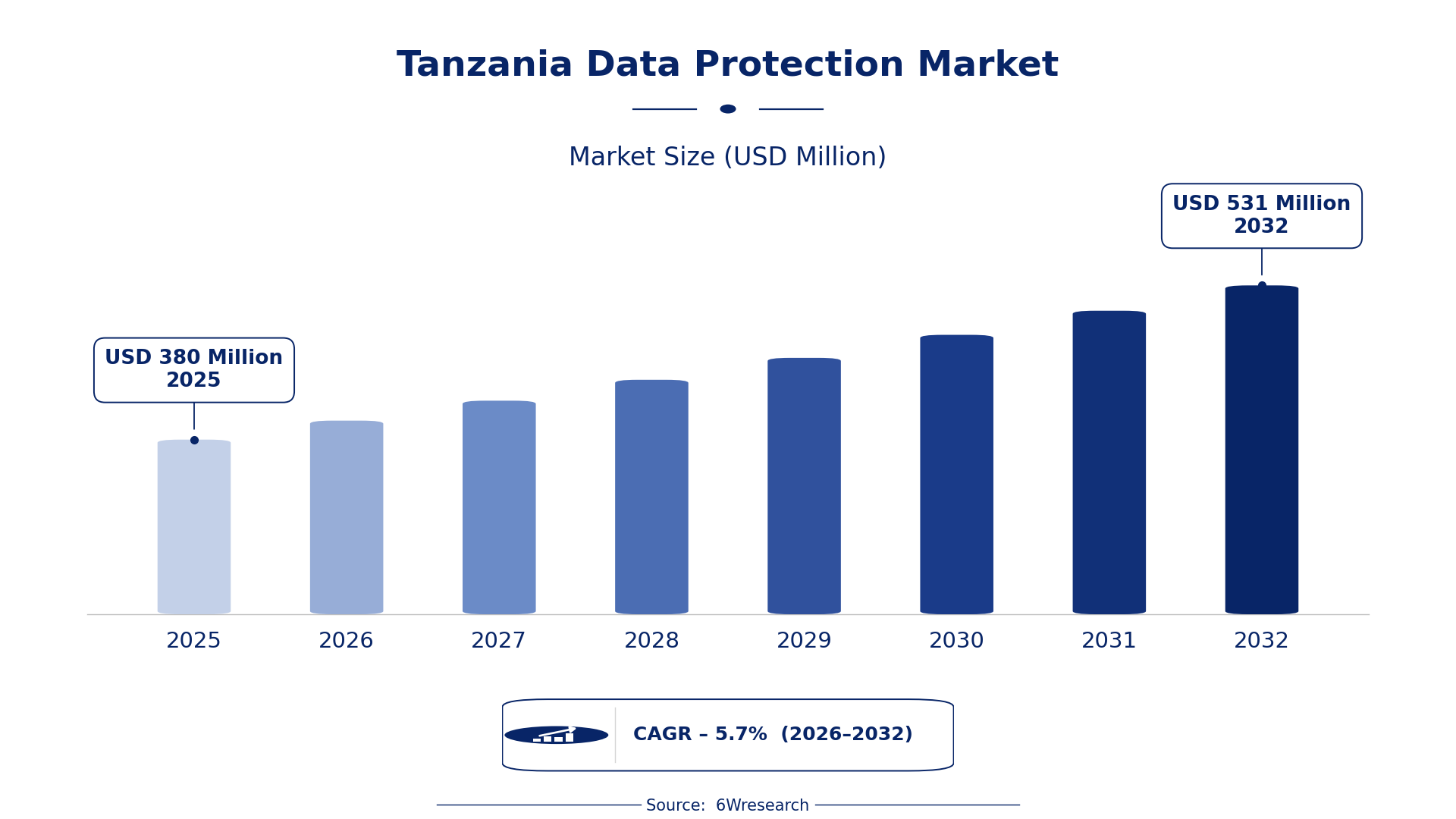
The Tanzania Data Protection Market was estimated at USD 380 Million in 2025 and is projected to reach USD 531 Million by 2032, growing at a CAGR of 5.7% from 2026 to 2032.
Tanzania Data Protection Market Synopsis
The Tanzania Data Protection Market is increasingly pivotal as organizations recognize the necessity of safeguarding personal data. With the implementation of the Data Protection Act in 2019, awareness is rising among both businesses and individuals regarding data privacy and security, leading to enhanced investment in protective measures.
As digital transformation accelerates, the market is witnessing a shift. Businesses, particularly small and medium-sized enterprises, are actively adopting advanced technologies like encryption and data loss prevention tools to comply with regulatory frameworks. This growing focus on data security is expected to propel the market forward.
Tanzania Data Protection Market Year-wise Growth Rate and Key Drivers
This graph illustrates the annual growth rates of the Tanzania Data Protection Market from 2021 to 2032, highlighting a steady upward trajectory and projected expansion over the forecast period.
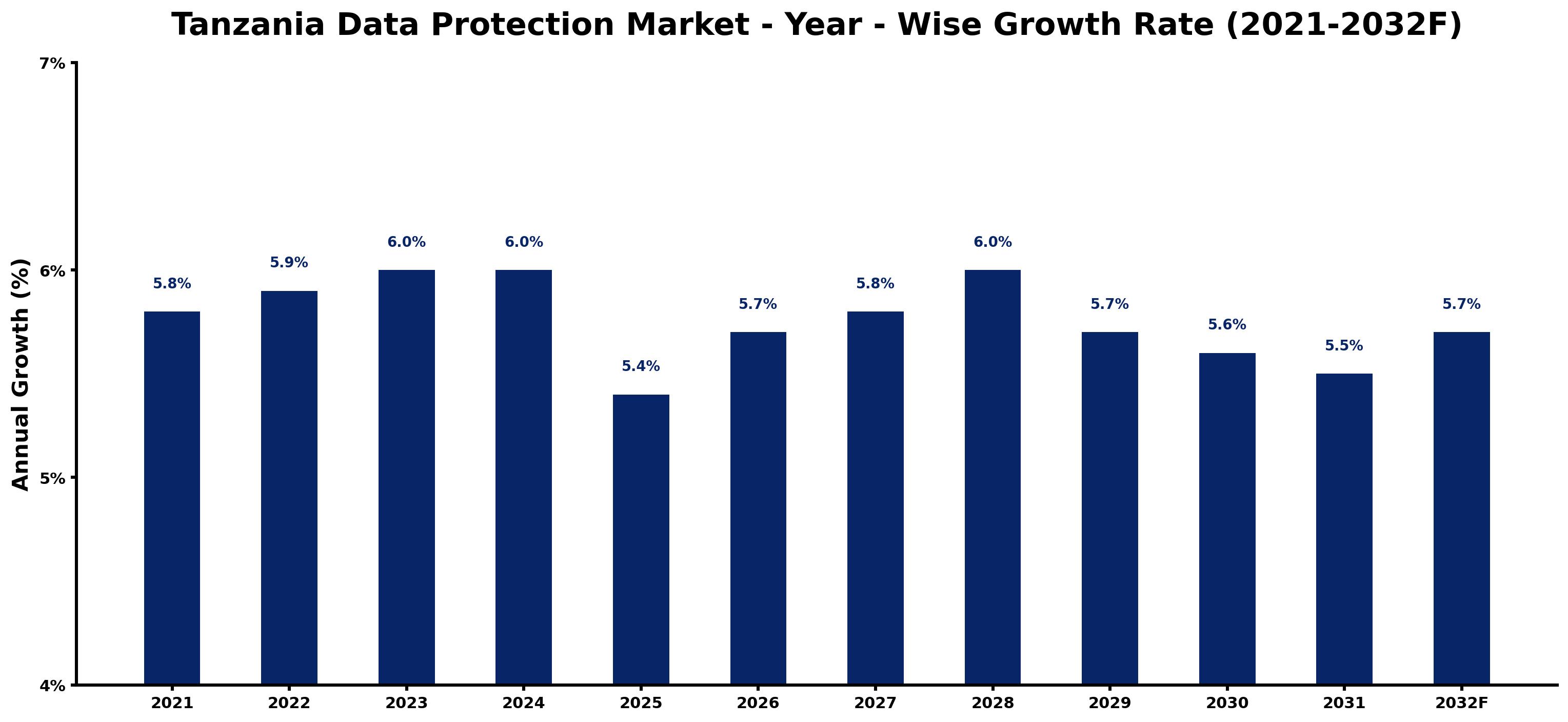
The table below presents the year‑wise growth rates along with the key drivers influencing the market
| Year | Growth Rate | Major Drivers |
| 2021 | 5.8% | Adoption of the Data Protection Act by government |
| 2022 | 5.9% | Growing concerns over personal data privacy violations |
| 2023 | 6.0% | Increased awareness of cybersecurity among businesses |
| 2024 | 6.0% | Launch of national data protection awareness campaigns |
| 2025 | 5.4% | Heightened regulatory scrutiny of data handling practices |
| 2026 | 5.7% | Rise in mobile internet penetration driving data usage |
| 2027 | 5.8% | Implementation of GDPR-aligned frameworks in corporations |
| 2028 | 6.0% | Boost in digital business services requiring data protection |
| 2029 | 5.7% | Promotion of digital finance services needing data security |
| 2030 | 5.6% | Corporate investments in data compliance and governance |
| 2031 | 5.5% | Public sector digitization accelerating data protection efforts |
| 2032 | 5.7% | Increased enforcement of data rights and consumer protections |
Note: Market size estimations and growth projections presented in this report are based on 6Wresearch's proprietary forecasting methodology, utilizing the latest available industry data, government publications, and primary research inputs.
Tanzania Data Protection Market Key Takeaways
Below are some of the specific key takeaways from the market, including:
- The Data Protection Act of 2019 is central to compliance efforts across sectors.
- Increasingly, organizations are investing in technologies to protect sensitive data.
- Awareness of data privacy is driving demand for data protection solutions.
- Investment in cybersecurity and training is on the rise, particularly among SMEs.
- Government initiatives are further shaping the regulatory environment for data protection.
Evaluation of Restraints in Tanzania Data Protection Market
Despite growth potential, the Tanzania Data Protection Market faces notable constraints. A pervasive lack of awareness and understanding among businesses regarding data protection laws significantly hinders effective implementation. Additionally, many organizations, particularly smaller enterprises, struggle with limited resources and expertise in data management. This gap results in inadequate safeguarding of sensitive information, leaving them vulnerable to breaches. As technology evolves rapidly, keeping pace with the latest security measures remains a formidable challenge for the market.
Tanzania Data Protection Market Trends
The demand for comprehensive data protection solutions is intensifying, driven by an increased understanding of the critical nature of data privacy and security. Organizations are now prioritizing adherence to the Data Protection Act by investing in state-of-the-art technologies that secure data across various platforms. The rise of remote work has also catalyzed a focus on data security across diverse devices, leading service providers to tailor solutions specific to industry needs.
Tanzania Data Protection Market Opportunities
The landscape presents fertile ground for investment, especially as businesses increasingly adopt data-driven technologies. The implementation of the Data Protection Act has opened avenues for services that help organizations ensure compliance with legal requirements. Opportunities exist in providing cybersecurity services, data encryption solutions, and compliance consulting. Investing in training programs focused on data protection will further support organizations in building internal capabilities.
Government Initiatives in the Tanzania Data Protection Market
Government action in Tanzania is a driving force in the Data Protection Market. The regulatory framework emphasizes the importance of personal data privacy, while the establishment of the Office of the Data Protection Commissioner signifies a commitment to oversight and enforcement. As compliance becomes non-negotiable, these initiatives shape how organizations approach data security.
- A national awareness campaign launched in early 2025 aims to educate businesses and the public about data protection laws.
- The Office of the Data Protection Commissioner is currently overseeing compliance assessments across various sectors.
- A public-private partnership initiative focused on enhancing data protection infrastructure is in the planning stages for 2026.
- A regulatory framework introduced in 2019 mandates all organizations to implement specific data security measures.
- Ongoing workshops and training sessions are being conducted to equip SMEs with essential knowledge about data protection.
Future Insights of the Tanzania Data Protection Market
Looking ahead to 2026-2032, the Tanzania Data Protection Market is set for substantial growth as the importance of data security escalates. Organizations will increasingly digitize operations and collect extensive customer information, thereby intensifying the demand for rigorous data protection solutions. As compliance with the Data Protection Act becomes ingrained in business practices, vendors will have the opportunity to introduce innovative technologies and services that meet the evolving needs of Tanzanian organizations.
Tanzania Data Protection Market Latest Developments
Recent developments in the Tanzania Data Protection Market reflect an industry adapting to new challenges and opportunities. Over the past year, significant activities have centered around enhancing compliance mechanisms and increasing awareness regarding data security.
- A major technology vendor initiated a rollout of advanced encryption solutions across multiple sectors in early 2025, enhancing data security for numerous organizations.
- In mid-2025, a leading consulting firm began offering specialized training programs focused on the Data Protection Act, targeting small and medium enterprises.
- A public workshop held in late 2025 gathered industry experts to discuss emerging trends in data protection, fostering collaboration among stakeholders.
- A comprehensive assessment of compliance levels is currently being undertaken by the Office of the Data Protection Commissioner to evaluate businesses’ readiness.
- An initiative aimed at developing a national data security protocol is expected to begin its preliminary phase in early 2026.
Tanzania Data Protection Market - Key Attractiveness of the Report
- 10 Years of Market Numbers
- Historical Data Starting from 2022 to 2025
- Base Year: 2025
- Forecast Data until 2032
- Key Performance Indicators Impacting the Market
- Major Upcoming Developments and Projects
There are promising opportunities in providing cybersecurity services, data encryption tools, compliance consulting, and training programs designed to enhance organizations’ internal data management capabilities.
Key Highlights of the Report:
- Tanzania Data Protection Market Outlook
- Market Size of Tanzania Data Protection Market, 2025
- Forecast of Tanzania Data Protection Market, 2032
- Historical Data and Forecast of Tanzania Data Protection Revenues & Volume for the Period 2022-2032F
- Tanzania Data Protection Market Trend Evolution
- Tanzania Data Protection Market Drivers and Challenges
- Tanzania Data Protection Price Trends
- Tanzania Data Protection Porter's Five Forces
- Tanzania Data Protection Industry Life Cycle
- Historical Data and Forecast of Tanzania Data Protection Market Revenues & Volume By Component for the Period 2022-2032F
- Historical Data and Forecast of Tanzania Data Protection Market Revenues & Volume By Solutions for the Period 2022-2032F
- Historical Data and Forecast of Tanzania Data Protection Market Revenues & Volume By Services (Professional Services and Managed Services) for the Period 2022-2032F
- Historical Data and Forecast of Tanzania Data Protection Market Revenues & Volume By Deployment Mode for the Period 2022-2032F
- Historical Data and Forecast of Tanzania Data Protection Market Revenues & Volume By On-premises for the Period 2022-2032F
- Historical Data and Forecast of Tanzania Data Protection Market Revenues & Volume By Cloud for the Period 2022-2032F
- Historical Data and Forecast of Tanzania Data Protection Market Revenues & Volume By Industry Vertical for the Period 2022-2032F
- Historical Data and Forecast of Tanzania Data Protection Market Revenues & Volume By Government and defense for the Period 2022-2032F
- Historical Data and Forecast of Tanzania Data Protection Market Revenues & Volume By Banking, Financial Services, and Insurance (BFSI) for the Period 2022-2032F
- Historical Data and Forecast of Tanzania Data Protection Market Revenues & Volume By Healthcare for the Period 2022-2032F
- Historical Data and Forecast of Tanzania Data Protection Market Revenues & Volume By IT and telecom for the Period 2022-2032F
- Historical Data and Forecast of Tanzania Data Protection Market Revenues & Volume By Consumer goods and retail for the Period 2022-2032F
- Historical Data and Forecast of Tanzania Data Protection Market Revenues & Volume By Education for the Period 2022-2032F
- Historical Data and Forecast of Tanzania Data Protection Market Revenues & Volume By Media and entertainment for the Period 2022-2032F
- Historical Data and Forecast of Tanzania Data Protection Market Revenues & Volume By Organization Size Large Enterprises for the Period 2022-2032F
- Historical Data and Forecast of Tanzania Data Protection Market Revenues & Volume By SMEs for the Period 2022-2032F
- Historical Data and Forecast of Tanzania Data Protection Market Revenues & Volume By Large Enterprises for the Period 2022-2032F
- Tanzania Data Protection Import Export Trade Statistics
- Market Opportunity Assessment By Component
- Market Opportunity Assessment By Deployment Mode
- Market Opportunity Assessment By Industry Vertical
- Market Opportunity Assessment By Organization Size Large Enterprises
- Tanzania Data Protection Top Companies Market Share
- Tanzania Data Protection Competitive Benchmarking By Technical and Operational Parameters
- Tanzania Data Protection Company Profiles
- Tanzania Data Protection Key Strategic Recommendations






































