Gallium Market: Tanzania vs Top 5 Major Economies in 2027 (Africa)
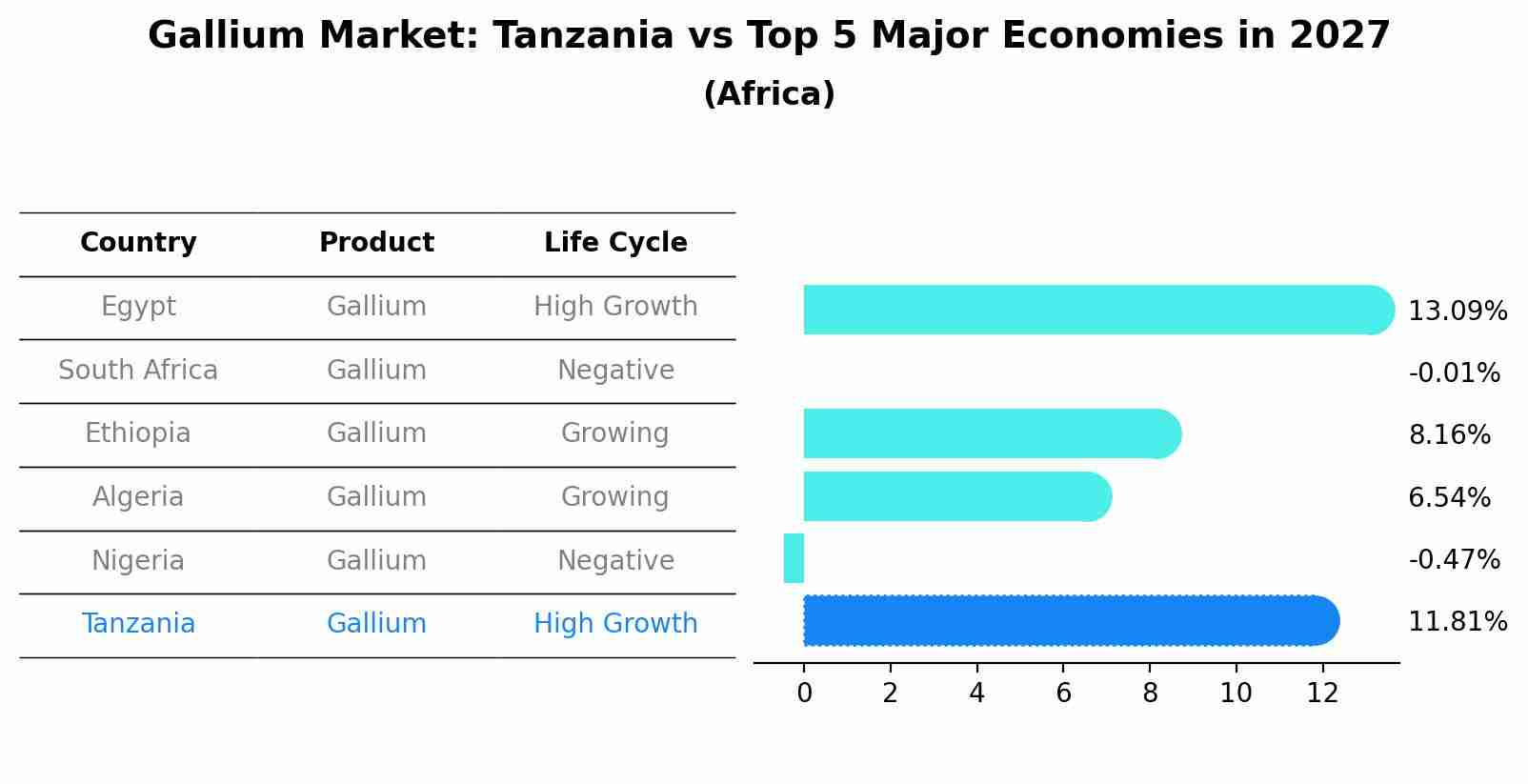
By 2027, Tanzania's Gallium market is forecasted to achieve a high growth rate of 11.81%, with Egypt leading the Africa region, followed by South Africa, Ethiopia, Algeria and Nigeria.
Tanzania Gallium Market Overview
The Tanzania Gallium market is relatively niche but growing steadily due to the increasing demand for gallium in various high-tech applications. Gallium is primarily used in the production of semiconductors, LEDs, and solar panels, driving its demand in the electronics and renewable energy sectors. The market is influenced by global trends in technology and sustainable energy, with a focus on reducing carbon footprint and enhancing energy efficiency. Tanzania`s gallium market is expected to experience moderate growth in the coming years, supported by advancements in the electronics industry and the shift towards renewable energy sources. However, challenges such as limited local production capacity and the need for technological expertise may impact the market`s expansion potential in the region.
Tanzania Gallium Market Trends
The Tanzania Gallium market is currently experiencing steady growth due to the increasing demand for gallium in the electronics industry, particularly for use in semiconductors and LEDs. The market is witnessing a rise in research and development activities focused on exploring new applications of gallium in emerging technologies such as solar cells and advanced materials. Additionally, the country`s abundant natural resources, including bauxite and zinc ores which are sources of gallium, are contributing to the growth of the market. However, challenges such as fluctuating prices of gallium and competition from other global suppliers are impacting the market dynamics. Overall, the Tanzania Gallium market is poised for further expansion driven by technological advancements and industrial applications.
Tanzania Gallium Market Challenges
In the Tanzania Gallium market, challenges include limited domestic production capacity, reliance on imports, and fluctuating global prices. The lack of local production facilities results in high dependency on foreign suppliers, making the market vulnerable to supply chain disruptions and price fluctuations. Additionally, the limited availability of skilled labor and technological expertise in processing Gallium further hinders the industry`s growth potential. Infrastructure constraints, such as inadequate transportation networks and inconsistent power supply, also pose challenges in the efficient distribution of Gallium products within the country. Addressing these challenges through investment in local production capabilities, skills development, and infrastructure improvements will be crucial for the Tanzania Gallium market to achieve sustainable growth and competitiveness in the global market.
Tanzania Gallium Market Investment Opportunities
The Tanzania Gallium market presents promising investment opportunities due to the increasing demand for gallium in the electronics and renewable energy sectors. Gallium is a crucial component in the production of semiconductors, LEDs, and solar panels, driving its market growth. With Tanzania`s abundant natural resources and potential for gallium extraction, investors can capitalize on this growing market by funding mining projects or establishing partnerships with local mining companies. Additionally, as the global focus on sustainability and clean energy continues to rise, investments in gallium production in Tanzania could yield significant returns in the long term. Conducting thorough market research and due diligence on potential partners and projects will be essential for successful investments in the Tanzania Gallium market.
Tanzania Gallium Market Government Policy
The Tanzanian government does not currently have specific policies directly targeting the Gallium market. However, the country has a regulatory framework governing the mining sector, which indirectly impacts the production and export of Gallium. The Mining Act of 2010 and subsequent regulations control mining activities, including licensing, royalties, and environmental protection measures. Tanzania is known to have significant mineral resources, including Gallium potential, and the government`s policies focus on promoting local beneficiation, value addition, and ensuring that mining activities benefit the country`s economy and local communities. In recent years, the government has taken steps to increase transparency and accountability in the mining sector, including the establishment of the Tanzania Mineral Audit Agency to oversee mineral production and exports.
Tanzania Gallium Market Future Outlook
The Tanzania Gallium market is poised for growth in the coming years due to increasing demand for gallium-based products in electronics and other advanced technologies. The market is expected to benefit from the expanding applications of gallium in areas such as semiconductors, solar panels, and LED lighting. Additionally, the country`s abundant natural resources of gallium provide a competitive advantage for local production. With ongoing technological advancements and investments in research and development, Tanzania is well-positioned to capitalize on the growing demand for gallium globally. However, challenges such as volatility in prices and competition from other gallium-producing regions may impact the market`s growth trajectory. Overall, the Tanzania Gallium market shows promise for expansion in the foreseeable future.
Key Highlights of the Report:
- Tanzania Gallium Market Outlook
- Market Size of Tanzania Gallium Market, 2024
- Forecast of Tanzania Gallium Market, 2031
- Historical Data and Forecast of Tanzania Gallium Revenues & Volume for the Period 2021 - 2031
- Tanzania Gallium Market Trend Evolution
- Tanzania Gallium Market Drivers and Challenges
- Tanzania Gallium Price Trends
- Tanzania Gallium Porter's Five Forces
- Tanzania Gallium Industry Life Cycle
- Historical Data and Forecast of Tanzania Gallium Market Revenues & Volume By Applications for the Period 2021 - 2031
- Historical Data and Forecast of Tanzania Gallium Market Revenues & Volume By LED for the Period 2021 - 2031
- Historical Data and Forecast of Tanzania Gallium Market Revenues & Volume By Laser Diodes for the Period 2021 - 2031
- Historical Data and Forecast of Tanzania Gallium Market Revenues & Volume By Integrated Circuits for the Period 2021 - 2031
- Historical Data and Forecast of Tanzania Gallium Market Revenues & Volume By Solar Cells for the Period 2021 - 2031
- Tanzania Gallium Import Export Trade Statistics
- Market Opportunity Assessment By Applications
- Tanzania Gallium Top Companies Market Share
- Tanzania Gallium Competitive Benchmarking By Technical and Operational Parameters
- Tanzania Gallium Company Profiles
- Tanzania Gallium Key Strategic Recommendations






































