Tanzania Hepatitis Vaccine Market Size, Share & Growth Rate
The Tanzania Hepatitis Vaccine Market was estimated at USD 432 Million in 2025 and is projected to reach USD 580 Million by 2032, growing at a CAGR of 4.3% from 2026 to 2032. This anticipated growth is fueled by a significant increase in hepatitis awareness campaigns, along with government-backed vaccination initiatives aimed at combating the high prevalence of hepatitis infections across the nation. As preventive healthcare gains traction, vaccination rates are expected to rise, further propelling market expansion.
Tanzania Hepatitis Vaccine Market Year-wise Growth Rate and Key Drivers
This graph highlights how the Tanzania Hepatitis Vaccine Market has steadily grown over the years, supported by major growth factors.
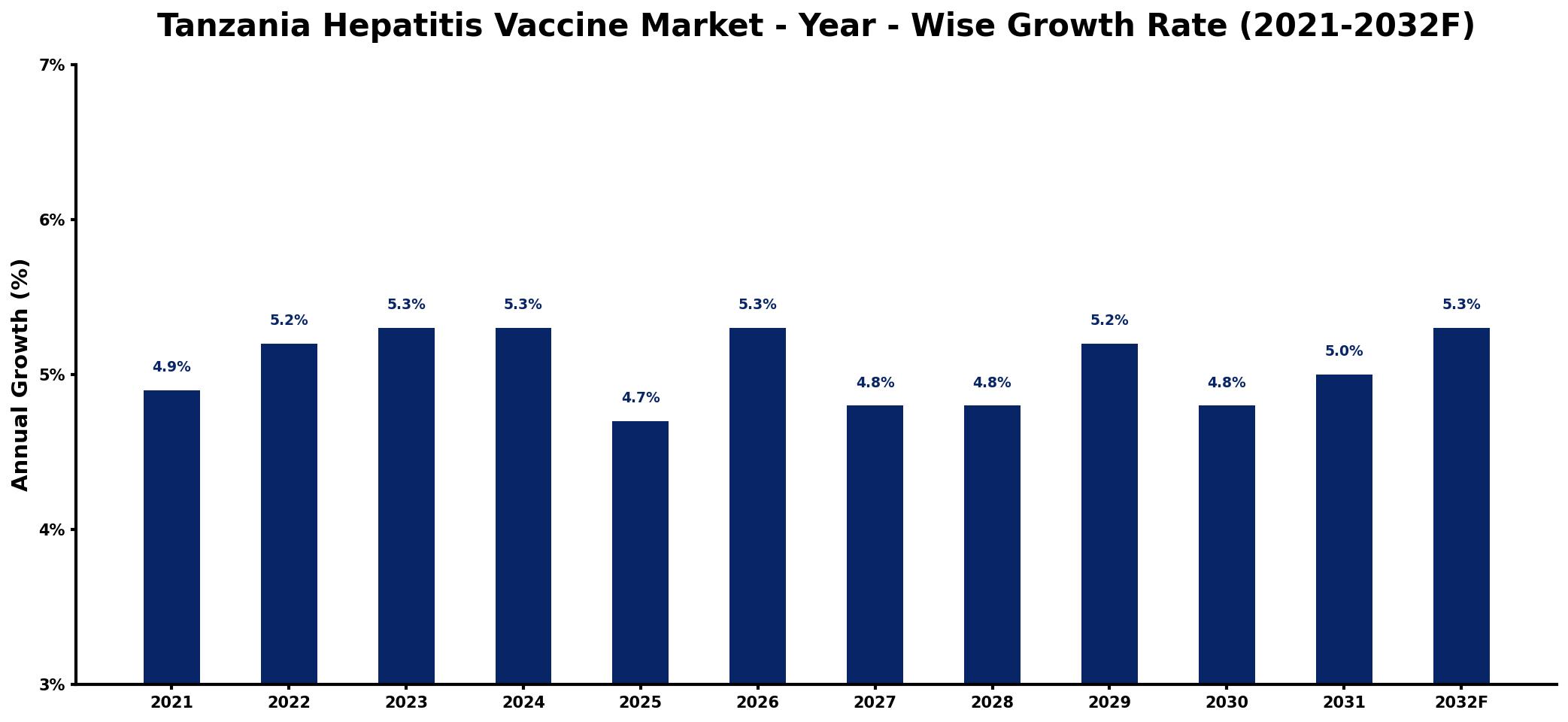
The table below presents the year‑wise growth rates along with the key drivers influencing the market
| Year | Growth Rate | Major Drivers |
| 2021 | 4.9% | Increased healthcare funding initiatives |
| 2022 | 5.2% | Growing public health awareness campaigns |
| 2023 | 5.3% | Expansion of immunization programs |
| 2024 | 5.3% | Rising demand for preventive healthcare |
| 2025 | 4.7% | Emergence of new healthcare partnerships |
| 2026 | 5.3% | Investment in healthcare infrastructure growth |
| 2027 | 4.8% | Enhanced distribution network capabilities |
| 2028 | 4.8% | Strengthened international collaboration efforts |
| 2029 | 5.2% | Increased private sector participation |
| 2030 | 4.8% | Advancements in medical technology adoption |
| 2031 | 5.0% | Growing emphasis on community health |
| 2032 | 5.3% | Focus on sustainable health practices |
Note: Market size estimations and growth projections presented in this report are based on 6Wresearch's proprietary forecasting methodology, utilizing the latest available industry data, government publications, and primary research inputs.
Tanzania Hepatitis Vaccine Market Synopsis
The demand for hepatitis vaccines in Tanzania is underpinned by alarming infection rates, necessitating effective vaccination strategies for both children and adults. Government-led immunization programs are evolving, incorporating a range of vaccines that address the needs of diverse populations across urban and rural landscapes.
Efforts are being made to enhance public health education, aiming to mitigate the stigma surrounding hepatitis and increase the overall awareness about preventive measures. With collaborative efforts between healthcare providers and government agencies, the framework for vaccine distribution is steadily improving, aiming to bolster accessibility across remote areas.
Tanzania Hepatitis Vaccine Market Key Takeaways
- The Tanzania Hepatitis Vaccine Market is driven by high prevalence rates and increasing awareness of hepatitis infections.
- Government initiatives are pivotal in expanding immunization programs and improving public health infrastructure.
- Accessibility and affordability remain significant barriers, especially in rural areas, necessitating focused interventions.
- Investment opportunities are on the rise, with a growing demand for hepatitis vaccines expected in the coming years.
- Collaborative efforts between private and public sectors are essential for enhancing vaccine distribution and education.
Evaluation of Restraints in Tanzania Hepatitis Vaccine Market
Despite the promising growth trajectory, the Tanzania Hepatitis Vaccine Market faces several challenges. Limited awareness and education about hepatitis among the general populace contribute to lower vaccination rates, particularly in underserved communities. Additionally, logistical constraints hinder the consistent availability and distribution of vaccines, making it difficult to reach individuals in remote areas. The financial aspect also plays a crucial role, as the high cost of vaccines can deter many, especially those from lower-income households. Addressing these hurdles requires a multifaceted approach, emphasizing public health campaigns, improved infrastructure, and affordability strategies.
Tanzania Hepatitis Vaccine Market Trends
Current trends indicate a marked increase in government-led vaccination drives, targeting both children and high-risk populations. The introduction of more effective vaccine formulations is also reshaping the landscape, as healthcare providers seek to enhance immunization efficacy. Furthermore, there is a noticeable shift towards preventive healthcare, with healthcare practitioners advocating for proactive vaccination as a means to reduce the incidence of hepatitis-related illnesses. Partnerships between pharmaceutical companies and health agencies are becoming more common, fostering improved accessibility and education surrounding hepatitis vaccination.
Tanzania Hepatitis Vaccine Market Opportunities
The Tanzania Hepatitis Vaccine Market offers significant investment opportunities as awareness about hepatitis infections continues to rise. The governments commitment to expanding immunization programs presents a favorable environment for investment in vaccine production and distribution. Collaborations with local health organizations and international agencies could enhance market penetration, particularly in underserved regions. With the ongoing enhancements in healthcare infrastructure, there's a strong potential for entities looking to capitalize on this growing market segment.
Government Initiatives in the Tanzania Hepatitis Vaccine Market
The Tanzanian government has made substantial strides in addressing hepatitis through policy reforms and national immunization programs. The inclusion of the Hepatitis B vaccine in the national vaccination schedule, offered free to infants and at-risk groups, underscores the governments proactive stance. Additionally, guidelines for screening and treatment have been established, along with regulations on medical waste management to mitigate infection risks. Such initiatives not only reflect a commitment to combating hepatitis but also facilitate greater healthcare access for the population.
Future Insights of the Tanzania Hepatitis Vaccine Market
Looking ahead to 2026-2032, the Tanzania Hepatitis Vaccine Market is positioned for substantial growth driven by increased public awareness and enhanced healthcare initiatives. Continued government support for vaccination efforts, coupled with rising healthcare expenditure, will likely further stimulate demand. Innovations in vaccine development and distribution methods will play a critical role in overcoming existing barriers, ensuring wider accessibility and uptake of vaccines. As the healthcare landscape evolves, a focus on preventive measures will remain at the forefront of public health strategies.
Tanzania Hepatitis Vaccine Market Latest Developments (2025 - 2026)
Recent developments in the Tanzania Hepatitis Vaccine Market have included strengthened government partnerships with health organizations to enhance public awareness campaigns. Additionally, healthcare providers are increasingly focused on community engagement initiatives to promote vaccination. As new vaccines enter the market, there is ongoing research aimed at optimizing distribution networks, ensuring vaccines reach even the most remote regions effectively. These movements signal a proactive approach to combating hepatitis and improving overall public health.
Tanzania Hepatitis Vaccine Market - Key Attractiveness of the Report
- 10 Years of Market Numbers
- Historical Data Starting from 2022 to 2025
- Base Year: 2025
- Forecast Data until 2032
- Key Performance Indicators Impacting the Market
- Major Upcoming Developments and Projects
Key Highlights of the Report:
- Tanzania Hepatitis Vaccine Market Outlook
- Market Size of Tanzania Hepatitis Vaccine Market, 2025
- Forecast of Tanzania Hepatitis Vaccine Market, 2032
- Historical Data and Forecast of Tanzania Hepatitis Vaccine Revenues & Volume for the Period 2022-2032F
- Tanzania Hepatitis Vaccine Market Trend Evolution
- Tanzania Hepatitis Vaccine Market Drivers and Challenges
- Tanzania Hepatitis Vaccine Price Trends
- Tanzania Hepatitis Vaccine Porter's Five Forces
- Tanzania Hepatitis Vaccine Industry Life Cycle
- Historical Data and Forecast of Tanzania Hepatitis Vaccine Market Revenues & Volume By Indication for the Period 2022-2032F
- Historical Data and Forecast of Tanzania Hepatitis Vaccine Market Revenues & Volume By Hepatitis A for the Period 2022-2032F
- Historical Data and Forecast of Tanzania Hepatitis Vaccine Market Revenues & Volume By Hepatitis B for the Period 2022-2032F
- Historical Data and Forecast of Tanzania Hepatitis Vaccine Market Revenues & Volume By Vaccine Type for the Period 2022-2032F
- Historical Data and Forecast of Tanzania Hepatitis Vaccine Market Revenues & Volume By Recombinant Vaccine for the Period 2022-2032F
- Historical Data and Forecast of Tanzania Hepatitis Vaccine Market Revenues & Volume By Inactivated Vaccine for the Period 2022-2032F
- Historical Data and Forecast of Tanzania Hepatitis Vaccine Market Revenues & Volume By Distribution Channel for the Period 2022-2032F
- Historical Data and Forecast of Tanzania Hepatitis Vaccine Market Revenues & Volume By Hospitals for the Period 2022-2032F
- Historical Data and Forecast of Tanzania Hepatitis Vaccine Market Revenues & Volume By Retail Pharmacy for the Period 2022-2032F
- Historical Data and Forecast of Tanzania Hepatitis Vaccine Market Revenues & Volume By Online Pharmacy for the Period 2022-2032F
- Tanzania Hepatitis Vaccine Import Export Trade Statistics
- Market Opportunity Assessment By Indication
- Market Opportunity Assessment By Vaccine Type
- Market Opportunity Assessment By Distribution Channel
- Tanzania Hepatitis Vaccine Top Companies Market Share
- Tanzania Hepatitis Vaccine Competitive Benchmarking By Technical and Operational Parameters
- Tanzania Hepatitis Vaccine Company Profiles
- Tanzania Hepatitis Vaccine Key Strategic Recommendations






































