Tanzania Manufacturing Analytics Market Size & Growth Rate (2026-2032)
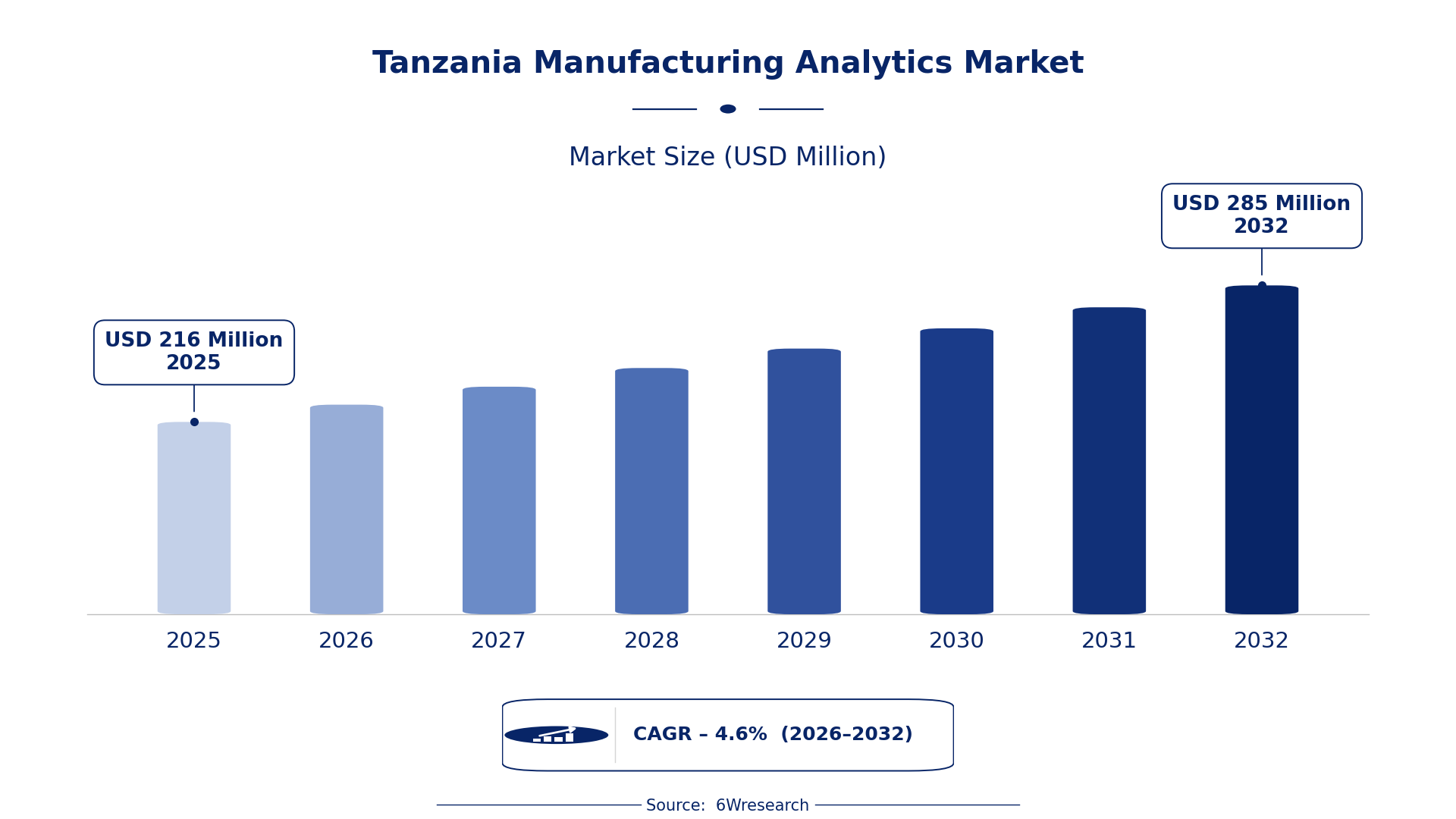
The Tanzania Manufacturing Analytics Market was estimated at USD 216 Million in 2025 and is projected to reach USD 285 Million by 2032, growing at a CAGR of 4.6% from 2026 to 2032.
Tanzania Manufacturing Analytics Market Synopsis
The Tanzania Manufacturing Analytics Market is currently experiencing a vibrant phase, characterized by a surge in the adoption of advanced analytics tools among manufacturers. This trend is driven by the need for enhanced operational efficiency and better decision-making capabilities. However, as the sector evolves, it faces challenges that could temper its growth trajectory.
Looking ahead, the market is expected to continue its upward momentum, propelled by an increasing focus on data-driven decision-making. Manufacturers are more than ever seeking innovative solutions to optimize processes and maintain competitiveness in a rapidly changing environment.
Tanzania Manufacturing Analytics Market Year-wise Growth Rate and Key Drivers
This graph illustrates the annual growth rates of the Tanzania Manufacturing Analytics Market from 2021 to 2032, highlighting a steady upward trajectory and projected expansion over the forecast period.
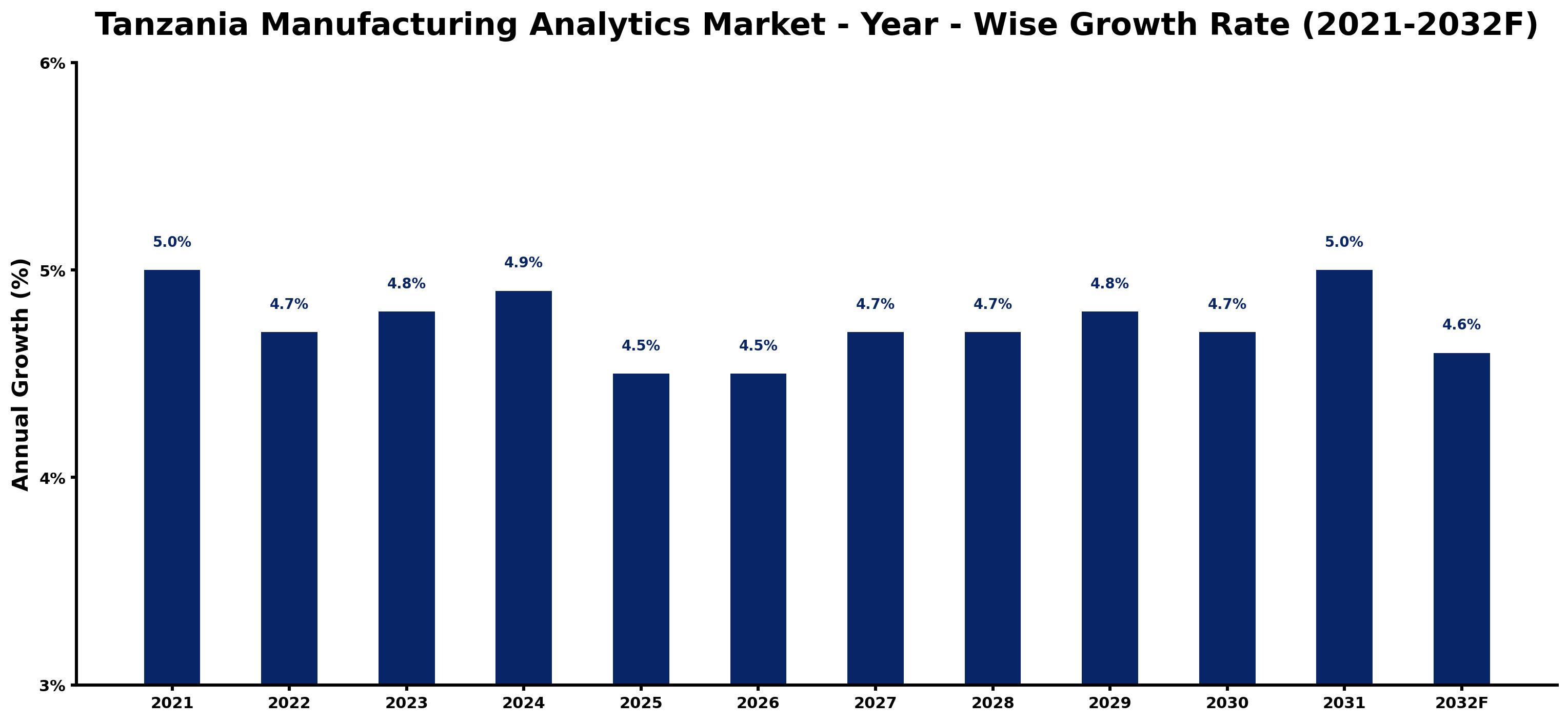
The table below presents the year‑wise growth rates along with the key drivers influencing the market
| Year | Growth Rate | Major Drivers |
| 2021 | 5.0% | Tanzania's Vision 2025 boosting manufacturing sector development. |
| 2022 | 4.7% | Increased mobile connectivity enhancing analytics adoption. |
| 2023 | 4.8% | Growing local talent in data analytics and AI. |
| 2024 | 4.9% | Emergence of public-private partnerships in tech innovation. |
| 2025 | 4.5% | Rise in small manufacturing enterprises utilizing analytics. |
| 2026 | 4.5% | Enhanced focus on sustainable manufacturing practices. |
| 2027 | 4.7% | Expanding access to affordable cloud computing solutions. |
| 2028 | 4.7% | Local universities promoting analytics-driven curriculums. |
| 2029 | 4.8% | Government initiatives targeting export-led manufacturing growth. |
| 2030 | 4.7% | Increased foreign investment in Tanzanian manufacturing sectors. |
| 2031 | 5.0% | Rise in demand for quality compliance analytics tools. |
| 2032 | 4.6% | Adoption of smart manufacturing practices across industries. |
Note: Market size estimations and growth projections presented in this report are based on 6Wresearch's proprietary forecasting methodology, utilizing the latest available industry data, government publications, and primary research inputs.
Tanzania Manufacturing Analytics Market Key Takeaways
Below are some of the specific key takeaways from the market, including:
- Manufacturers are increasingly leveraging predictive analytics and IoT technologies to drive efficiency.
- Real-time data insights are becoming essential for effective risk mitigation and quality control.
- Investment in analytics tools is directly correlated with improvements in operational performance.
- The Tanzanian government is actively supporting the digital transformation of the manufacturing sector.
- There is a growing demand for advanced analytics solutions tailored for local manufacturing challenges.
Evaluation of Restraints in Tanzania Manufacturing Analytics Market
Despite its growth potential, the Tanzania Manufacturing Analytics Market faces several significant barriers. A notable challenge is the limited access to advanced analytics tools, which constrains manufacturers from fully harnessing the power of data. The lack of robust data infrastructure often results in inefficient data management practices. Additionally, there’s a critical shortage of skilled data analysts and scientists, which hampers the ability of companies to interpret data effectively. Without addressing these gaps, manufacturers may struggle to implement the analytics solutions that drive efficiency and innovation.
Tanzania Manufacturing Analytics Market Trends
Several key trends are shaping the Tanzania Manufacturing Analytics Market. A prominent trend is the shift towards predictive maintenance strategies, which help manufacturers minimize downtime and reduce maintenance costs. Companies are also integrating IoT devices with machine learning algorithms to gain real-time insights into their production processes. on top of that, there's an increasing emphasis on analytics for demand forecasting and inventory management, which is essential for staying competitive in a demanding market.
Tanzania Manufacturing Analytics Market Opportunities
The opportunities for investment in the Tanzania Manufacturing Analytics Market are substantial. As manufacturers look to modernize, there's a heightened demand for advanced data analytics solutions that optimize operations and reduce costs. Companies focused on Industry 4.0 technologies stand to benefit significantly from this trend. Investing in analytics can empower manufacturers to gain actionable insights, streamline production processes, and ultimately enhance their market positioning.
Government Initiatives in the Tanzania Manufacturing Analytics Market
The Tanzanian government is taking proactive steps to foster growth in the manufacturing analytics sector. By prioritizing digital transformation initiatives, the government aims to create a conducive environment for innovation and competitiveness. These policies not only support manufacturers but also align with broader economic goals.
- A recently completed initiative is the Tanzania Industrialization Policy 2016-2025, which focuses on enhancing manufacturing capabilities through technology transfer.
- Currently ongoing is the establishment of the Tanzania Industrial Research and Development Organization (TIRDO), aimed at promoting research and innovation in manufacturing.
- A planned public-private partnership expected to launch in 2026 will focus on expanding digital infrastructure in rural manufacturing areas.
- The National Industrial Competitiveness Framework (NICF) is currently under implementation, aiming to boost the competitiveness of Tanzanian industries, including those utilizing analytics.
- Upcoming is a technology training program aimed at building a skilled workforce proficient in data analytics, set to begin in late 2026.
Future Insights of the Tanzania Manufacturing Analytics Market
Looking towards 2026-2032, the Tanzania Manufacturing Analytics Market is expected to undergo significant transformation. As manufacturers increasingly embrace automation and data-driven practices, the demand for analytics solutions will rise. The integration of smart technologies will further facilitate operational efficiency. Manufacturers focused on quality improvement and cost reduction will find analytics to be an invaluable tool. This evolution reflects a broader trend towards embracing technology in manufacturing, setting the stage for a competitive edge in the global marketplace.
Tanzania Manufacturing Analytics Market Latest Developments
In the past year, the Tanzania Manufacturing Analytics Market has witnessed a flurry of activity, signaling a commitment to innovation and growth. Companies are increasingly focused on adopting analytics solutions that enhance productivity and decision-making capabilities.
- A major technology vendor launched a new analytics platform tailored for local manufacturers in Q2 2025, aimed at improving operational insights.
- An ongoing collaboration between several manufacturing firms and a local university aims to develop predictive maintenance technologies, with results expected by early 2026.
- A rollout of a cloud-based analytics service is planned for mid-2026, targeting small to medium-sized enterprises in the manufacturing sector.
- In late 2025, a consortium of local manufacturers initiated a project to integrate IoT devices across production lines to enhance data collection capabilities.
- A public awareness campaign promoting the benefits of manufacturing analytics is currently underway, aiming to educate businesses about data utilization strategies.
Tanzania Manufacturing Analytics Market - Key Attractiveness of the Report
- 10 Years of Market Numbers
- Historical Data Starting from 2022 to 2025
- Base Year: 2025
- Forecast Data until 2032
- Key Performance Indicators Impacting the Market
- Major Upcoming Developments and Projects
Key Highlights of the Report:
- Tanzania Manufacturing Analytics Market Outlook
- Market Size of Tanzania Manufacturing Analytics Market, 2025
- Forecast of Tanzania Manufacturing Analytics Market, 2032
- Historical Data and Forecast of Tanzania Manufacturing Analytics Revenues & Volume for the Period 2022-2032F
- Tanzania Manufacturing Analytics Market Trend Evolution
- Tanzania Manufacturing Analytics Market Drivers and Challenges
- Tanzania Manufacturing Analytics Price Trends
- Tanzania Manufacturing Analytics Porter's Five Forces
- Tanzania Manufacturing Analytics Industry Life Cycle
- Historical Data and Forecast of Tanzania Manufacturing Analytics Market Revenues & Volume By Type for the Period 2022-2032F
- Historical Data and Forecast of Tanzania Manufacturing Analytics Market Revenues & Volume By Software for the Period 2022-2032F
- Historical Data and Forecast of Tanzania Manufacturing Analytics Market Revenues & Volume By Service for the Period 2022-2032F
- Historical Data and Forecast of Tanzania Manufacturing Analytics Market Revenues & Volume By Deployment Models for the Period 2022-2032F
- Historical Data and Forecast of Tanzania Manufacturing Analytics Market Revenues & Volume By On-premises for the Period 2022-2032F
- Historical Data and Forecast of Tanzania Manufacturing Analytics Market Revenues & Volume By On-demand for the Period 2022-2032F
- Historical Data and Forecast of Tanzania Manufacturing Analytics Market Revenues & Volume By Applications for the Period 2022-2032F
- Historical Data and Forecast of Tanzania Manufacturing Analytics Market Revenues & Volume By Predictive maintenance & asset management for the Period 2022-2032F
- Historical Data and Forecast of Tanzania Manufacturing Analytics Market Revenues & Volume By Inventory management for the Period 2022-2032F
- Historical Data and Forecast of Tanzania Manufacturing Analytics Market Revenues & Volume By Supply chain planning & procurement for the Period 2022-2032F
- Historical Data and Forecast of Tanzania Manufacturing Analytics Market Revenues & Volume By Energy management for the Period 2022-2032F
- Historical Data and Forecast of Tanzania Manufacturing Analytics Market Revenues & Volume By Emergency management for the Period 2022-2032F
- Historical Data and Forecast of Tanzania Manufacturing Analytics Market Revenues & Volume By Sales & customer management for the Period 2022-2032F
- Historical Data and Forecast of Tanzania Manufacturing Analytics Market Revenues & Volume By Other applications for the Period 2022-2032F
- Historical Data and Forecast of Tanzania Manufacturing Analytics Market Revenues & Volume By Industry Vertical for the Period 2022-2032F
- Historical Data and Forecast of Tanzania Manufacturing Analytics Market Revenues & Volume By Automotive & aerospace manufacturing for the Period 2022-2032F
- Historical Data and Forecast of Tanzania Manufacturing Analytics Market Revenues & Volume By Electronics equipment manufacturing for the Period 2022-2032F
- Historical Data and Forecast of Tanzania Manufacturing Analytics Market Revenues & Volume By Food & beverages manufacturing for the Period 2022-2032F
- Historical Data and Forecast of Tanzania Manufacturing Analytics Market Revenues & Volume By Chemicals & materials manufacturing for the Period 2022-2032F
- Historical Data and Forecast of Tanzania Manufacturing Analytics Market Revenues & Volume By Machinery & industrial equipment manufacturing for the Period 2022-2032F
- Historical Data and Forecast of Tanzania Manufacturing Analytics Market Revenues & Volume By Pharma and life sciences for the Period 2022-2032F
- Historical Data and Forecast of Tanzania Manufacturing Analytics Market Revenues & Volume By Paper, pulp, plastic and rubber manufacturing for the Period 2022-2032F
- Historical Data and Forecast of Tanzania Manufacturing Analytics Market Revenues & Volume By Others for the Period 2022-2032F
- Tanzania Manufacturing Analytics Import Export Trade Statistics
- Market Opportunity Assessment By Type
- Market Opportunity Assessment By Deployment Models
- Market Opportunity Assessment By Applications
- Market Opportunity Assessment By Industry Vertical
- Tanzania Manufacturing Analytics Top Companies Market Share
- Tanzania Manufacturing Analytics Competitive Benchmarking By Technical and Operational Parameters
- Tanzania Manufacturing Analytics Company Profiles
- Tanzania Manufacturing Analytics Key Strategic Recommendations






































