Tanzania Printed Signage Market: Top 5 Importing Countries and Market Competition (HHI) Analysis
In 2024, Tanzania continued to rely heavily on imports of printed signage, with top exporters being India, China, Sweden, Germany, and Hong Kong. The high Herfindahl-Hirschman Index (HHI) indicates a concentrated market. Despite a strong compound annual growth rate (CAGR) of 14.74% from 2020 to 2024, the negative growth rate of -51.39% from 2023 to 2024 raises concerns about the recent performance of the market. Tanzanian businesses should closely monitor these trends to navigate potential challenges and capitalize on future opportunities in the printed signage industry.
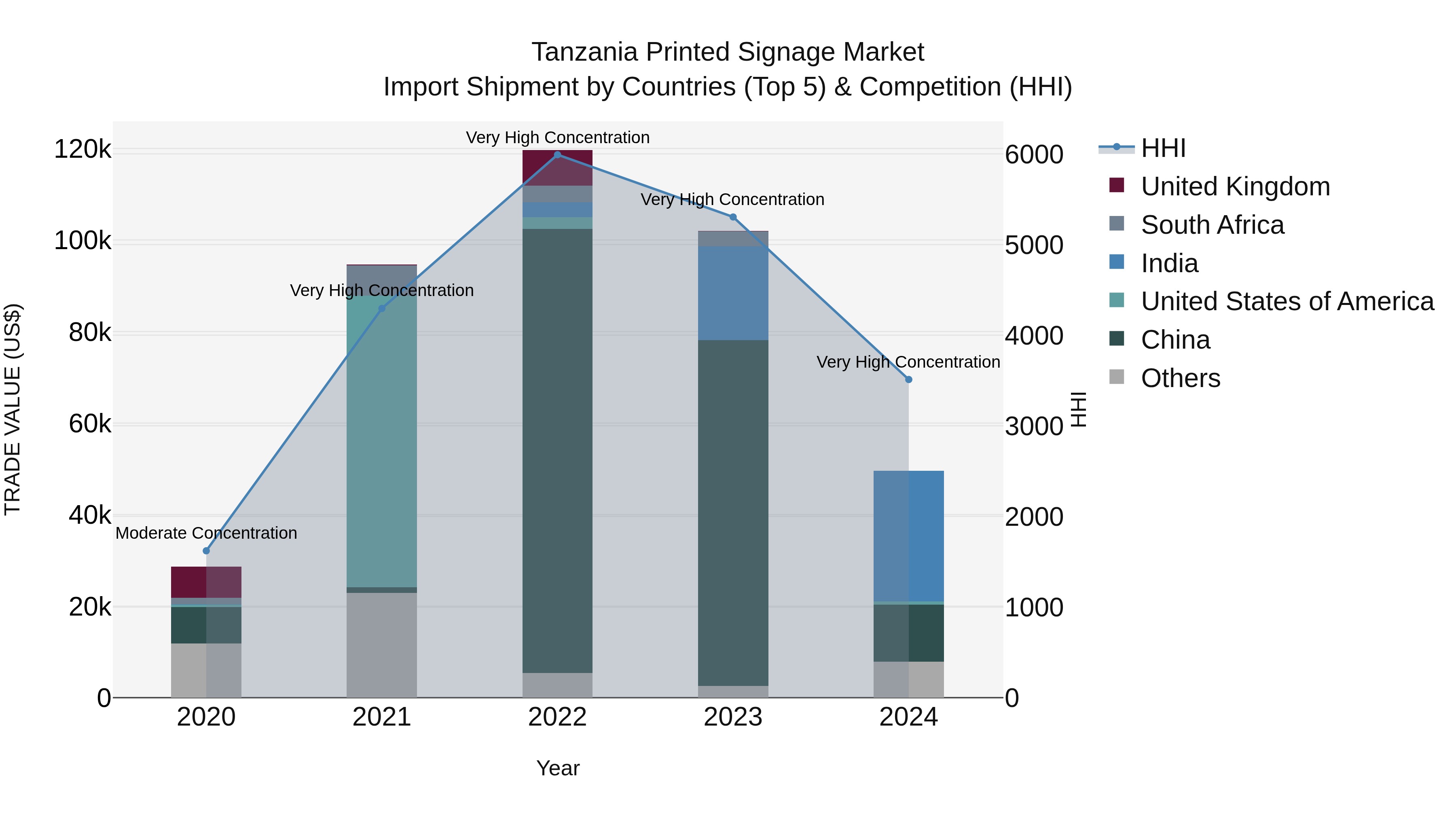
Tanzania Printed Signage Market Synopsis
The Tanzania Printed Signage Market is witnessing steady growth driven by increasing demand from various industries including retail, hospitality, and corporate sectors. The market offers a wide range of printed signage solutions such as banners, posters, billboards, and vehicle wraps. Key factors contributing to market growth include urbanization, infrastructure development, and the rise of small and medium enterprises. Additionally, advancements in printing technology and the growing trend of digital signage are shaping the market landscape. Competition among local and international players is intensifying, leading to innovations in materials and design techniques. Overall, the Tanzania Printed Signage Market presents opportunities for vendors to expand their product offerings and cater to the evolving needs of businesses in the country.
Tanzania Printed Signage Market Trends
The Tanzania Printed Signage Market is experiencing a shift towards digital signage, driven by advancements in technology and increasing demand for dynamic and interactive displays. Businesses are increasingly investing in digital signage solutions to enhance customer engagement and deliver targeted messaging. Additionally, there is a growing focus on sustainability in the printed signage market, with eco-friendly materials and practices gaining popularity among consumers. Personalization and customization are also emerging trends, as businesses seek to differentiate themselves and create unique branding opportunities. Overall, the market is witnessing a transition towards innovative, visually appealing, and environmentally conscious printed signage solutions to meet the evolving needs of businesses and consumers in Tanzania.
Tanzania Printed Signage Market Challenges
In the Tanzania Printed Signage Market, challenges include a lack of standardized quality control measures leading to inconsistencies in print quality across providers, limited access to advanced printing technology and materials resulting in lower quality products, and a fragmented market with many small players often unable to invest in modern equipment or marketing efforts. Additionally, the industry faces difficulties in meeting demand due to unreliable supply chains and inconsistent government regulations. Overall, these challenges contribute to a market environment where quality, pricing, and delivery timelines can vary significantly, making it challenging for businesses to find reliable and consistent signage solutions in Tanzania.
Tanzania Printed Signage Market Investment Opportunities
The Tanzania Printed Signage Market offers several investment opportunities for potential investors. With the country`s growing urbanization and increasing number of businesses, there is a rising demand for printed signage for advertising and branding purposes. Investing in state-of-the-art printing equipment and technology to offer high-quality signage services can be a lucrative opportunity. Additionally, the tourism industry in Tanzania is expanding, providing opportunities for signage companies to cater to hotels, resorts, and tourist attractions. Collaborating with local businesses and government entities for projects such as road signs, billboards, and event signage can also be a profitable venture. Overall, tapping into the Tanzania Printed Signage Market presents a promising investment opportunity with the potential for long-term growth and profitability.
Jordan Agar Market Government Policies
The Tanzanian government has established various policies related to the Printed Signage Market to ensure compliance with quality standards and environmental regulations. The Tanzania Bureau of Standards (TBS) is responsible for setting and enforcing quality standards for printed signage products to protect consumers and promote fair trade practices. Additionally, the government has implemented environmental regulations to promote sustainable practices within the signage industry, such as encouraging the use of eco-friendly materials and production processes. It also requires signage companies to obtain permits and licenses to operate legally in the market, ensuring adherence to safety and labor standards. Overall, these policies aim to promote a competitive and sustainable Printed Signage Market in Tanzania while safeguarding consumer interests and environmental concerns.
Tanzania Printed Signage Market Future Outlook
The Tanzania Printed Signage Market is poised for steady growth in the coming years, driven by increasing urbanization and a growing number of businesses requiring signage for marketing and branding purposes. The market is expected to benefit from advancements in printing technology, leading to more cost-effective and high-quality signage solutions. With the rise of digital printing capabilities, personalized and innovative signage options are likely to gain popularity among businesses looking to stand out in a competitive market. Additionally, the government`s focus on infrastructure development and tourism promotion is expected to further boost the demand for printed signage in Tanzania. Overall, the market is forecasted to experience a positive trajectory, presenting opportunities for both local and international signage companies to expand their presence in the region.
Key Highlights of the Report:
- Tanzania Printed Signage Market Outlook
- Market Size of Tanzania Printed Signage Market, 2024
- Forecast of Tanzania Printed Signage Market, 2031
- Historical Data and Forecast of Tanzania Printed Signage Revenues & Volume for the Period 2021- 2031
- Tanzania Printed Signage Market Trend Evolution
- Tanzania Printed Signage Market Drivers and Challenges
- Tanzania Printed Signage Price Trends
- Tanzania Printed Signage Porter's Five Forces
- Tanzania Printed Signage Industry Life Cycle
- Historical Data and Forecast of Tanzania Printed Signage Market Revenues & Volume By Product for the Period 2021- 2031
- Historical Data and Forecast of Tanzania Printed Signage Market Revenues & Volume By Billboard for the Period 2021- 2031
- Historical Data and Forecast of Tanzania Printed Signage Market Revenues & Volume By Backlit Display for the Period 2021- 2031
- Historical Data and Forecast of Tanzania Printed Signage Market Revenues & Volume By Pop Display for the Period 2021- 2031
- Historical Data and Forecast of Tanzania Printed Signage Market Revenues & Volume By Banner for the Period 2021- 2031
- Historical Data and Forecast of Tanzania Printed Signage Market Revenues & Volume By Corporate Graphics for the Period 2021- 2031
- Historical Data and Forecast of Tanzania Printed Signage Market Revenues & Volume By Others for the Period 2021- 2031
- Historical Data and Forecast of Tanzania Printed Signage Market Revenues & Volume By Type for the Period 2021- 2031
- Historical Data and Forecast of Tanzania Printed Signage Market Revenues & Volume By Indoor Printed Signage for the Period 2021- 2031
- Historical Data and Forecast of Tanzania Printed Signage Market Revenues & Volume By Outdoor Printed Signage for the Period 2021- 2031
- Historical Data and Forecast of Tanzania Printed Signage Market Revenues & Volume By End-user Vertical for the Period 2021- 2031
- Historical Data and Forecast of Tanzania Printed Signage Market Revenues & Volume By BFSI for the Period 2021- 2031
- Historical Data and Forecast of Tanzania Printed Signage Market Revenues & Volume By Retail for the Period 2021- 2031
- Historical Data and Forecast of Tanzania Printed Signage Market Revenues & Volume By Sports and Leisure for the Period 2021- 2031
- Historical Data and Forecast of Tanzania Printed Signage Market Revenues & Volume By Entertainment for the Period 2021- 2031
- Historical Data and Forecast of Tanzania Printed Signage Market Revenues & Volume By Transportation and Logistics for the Period 2021- 2031
- Historical Data and Forecast of Tanzania Printed Signage Market Revenues & Volume By Healthcare for the Period 2021- 2031
- Historical Data and Forecast of Tanzania Printed Signage Market Revenues & Volume By Others for the Period 2021- 2031
- Tanzania Printed Signage Import Export Trade Statistics
- Market Opportunity Assessment By Product
- Market Opportunity Assessment By Type
- Market Opportunity Assessment By End-user Vertical
- Tanzania Printed Signage Top Companies Market Share
- Tanzania Printed Signage Competitive Benchmarking By Technical and Operational Parameters
- Tanzania Printed Signage Company Profiles
- Tanzania Printed Signage Key Strategic Recommendations






































