Tanzania Trolley Market Size, Share & Growth Rate
The Tanzania Trolley Market was estimated at USD 396 Million in 2025 and is projected to reach USD 577 Million by 2032, growing at a CAGR of 5.5% from 2026 to 2032. This growth is primarily fueled by urbanization and the rapid expansion of commercial spaces, creating a heightened demand for efficient transport solutions. Additionally, the evolving retail landscape and increased focus on sustainability are significant factors propelling market momentum.
Tanzania Trolley Market Year-wise Growth Rate and Key Drivers
This graph highlights how the Tanzania Trolley Market has steadily grown over the years, supported by major growth factors.
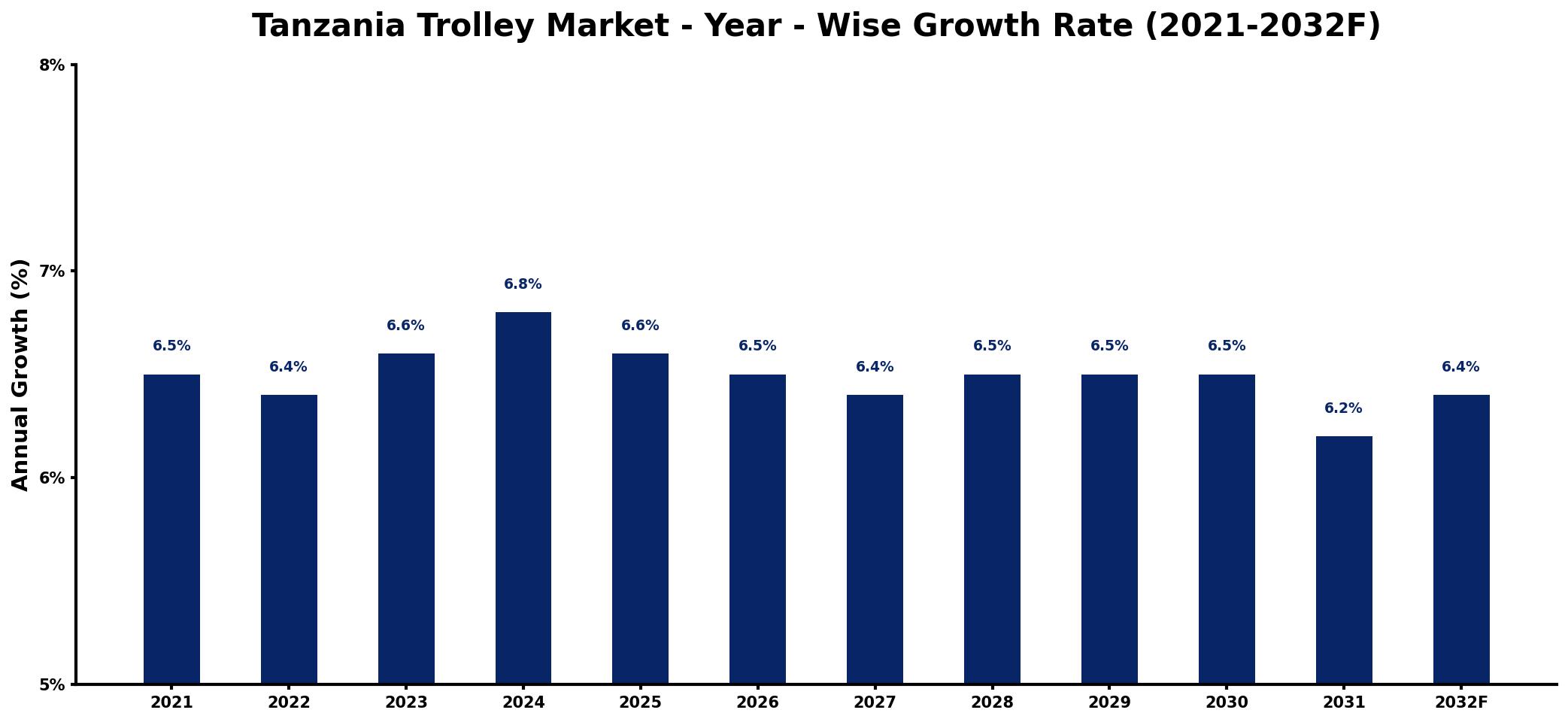
The table below presents the year‑wise growth rates along with the key drivers influencing the market
| Year | Growth Rate | Major Drivers |
| 2021 | 6.5% | Rising demand for logistics solutions |
| 2022 | 6.4% | Investment in retail infrastructure growth |
| 2023 | 6.6% | Expansion of e-commerce operations |
| 2024 | 6.8% | Increased urbanization and mobility |
| 2025 | 6.6% | Growth in food delivery services |
| 2026 | 6.5% | Surge in hospitality sector investments |
| 2027 | 6.4% | Demand from event management companies |
| 2028 | 6.5% | Boost in tourism and travel |
| 2029 | 6.5% | Rise in warehouse automation needs |
| 2030 | 6.5% | increased pharmaceutical industry usage |
| 2031 | 6.2% | growing commercial sector adoption |
| 2032 | 6.4% | Increase in community markets popularity |
Note: Market size estimations and growth projections presented in this report are based on 6Wresearch's proprietary forecasting methodology, utilizing the latest available industry data, government publications, and primary research inputs.
Tanzania Trolley Market Synopsis
The Tanzania trolley market is undergoing a transformation, characterized by a surge in demand driven by the booming retail and hospitality sectors. Trolleys serve essential functions across various industries, facilitating the smooth movement of goods in environments ranging from bustling supermarkets to medical facilities.
The ongoing emphasis on ergonomic designs and durability reflects an industry responsive to consumer needs. As manufacturers pivot towards eco-friendly materials and sustainable practices, the market is aligning itself with global environmental trends, ensuring a competitive edge in both local and international arenas.
Tanzania Trolley Market Key Takeaways
- The market is witnessing a steady rise, driven by urban development and diverse applications in retail, healthcare, and hospitality.
- Product innovation focusing on ergonomics and sustainability is reshaping consumer preferences in trolley designs.
- Investment opportunities abound as demand for efficient and sustainable transportation solutions escalates.
- The government is actively promoting regulatory frameworks to enhance safety and environmental sustainability in the trolley sector.
- Competition from imports and informal markets presents challenges that local manufacturers must navigate to thrive.
Evaluation of Restraints in Tanzania Trolley Market
Despite promising growth, the Tanzania trolley market faces significant restraints. Access to quality raw materials remains limited, posing hurdles in production quality and increasing costs. Furthermore, a lack of skilled labor hampers manufacturers' ability to innovate and maintain competitive advantage. Inadequate infrastructure for distribution exacerbates these challenges, making it difficult for local players to efficiently reach their markets. Fluctuating exchange rates and increasing competition from low-cost imports further threaten the viability of domestic trolley manufacturing.
Tanzania Trolley Market Trends
Current trends in the Tanzania trolley market highlight a shift towards multifunctional designs that accommodate various needs, enhancing versatility and consumer appeal. Manufacturers are increasingly incorporating features such as adjustable handles and foldable designs, reflecting a demand for convenience and efficient storage. Additionally, a growing awareness of environmental issues is driving the preference for trolleys made from sustainable materials, aligning with the broader global trend towards eco-conscious products.
Tanzania Trolley Market Opportunities
The Tanzania trolley market is ripe with investment opportunities, particularly in the realm of eco-friendly transportation solutions. The government's push for improved public infrastructure offers a favorable environment for manufacturers and investors. Moreover, the development of urban centers increases the need for specialized trolleys catering to diverse sectors. Collaborations with local businesses and municipalities present avenues for innovative service delivery, capturing a growing commuter market seeking convenience.
Government Initiatives in the Tanzania Trolley Market
The Tanzanian government is actively engaged in fostering the growth of the trolley market through various policies aimed at enhancing safety and quality standards in trolley manufacturing. Licensing requirements for trolley operators ensure compliance with operational standards, contributing to a safer market environment. Additionally, initiatives promoting sustainable transportation methods seek to incentivize trolley usage in urban settings, directly addressing traffic congestion and environmental concerns.
Future Insights of the Tanzania Trolley Market
Looking ahead to 2026-2032, the Tanzania trolley market is set for continued expansion as modern retail formats proliferate. The rise in disposable incomes and changing consumer lifestyles will likely intensify the demand for efficient shopping experiences. Manufacturers who prioritize innovation and sustainability will find themselves well-positioned to capitalize on this evolving landscape. As urbanization continues to reshape consumer habits, the need for versatile trolley solutions will remain a key driver of market growth.
Tanzania Trolley Market Latest Developments (2025 - 2026)
In recent months, the Tanzania trolley market has seen several noteworthy developments. Companies are increasingly adopting advanced manufacturing technologies to enhance production efficiency and product quality. Additionally, there has been a rising trend towards customization, allowing businesses to meet specific client needs more effectively. Eco-friendly initiatives are also gaining traction, with manufacturers exploring sustainable materials in their designs to appeal to environmentally conscious consumers.
Tanzania Trolley Market - Key Attractiveness of the Report
- 10 Years of Market Numbers
- Historical Data Starting from 2022 to 2025
- Base Year: 2025
- Forecast Data until 2032
- Key Performance Indicators Impacting the Market
- Major Upcoming Developments and Projects
Key Highlights of the Report:
- Tanzania Trolley Market Outlook
- Market Size of Tanzania Trolley Market, 2025
- Forecast of Tanzania Trolley Market, 2032
- Historical Data and Forecast of Tanzania Trolley Revenues & Volume for the Period 2022-2032F
- Tanzania Trolley Market Trend Evolution
- Tanzania Trolley Market Drivers and Challenges
- Tanzania Trolley Price Trends
- Tanzania Trolley Porter's Five Forces
- Tanzania Trolley Industry Life Cycle
- Historical Data and Forecast of Tanzania Trolley Market Revenues & Volume By Product for the Period 2022-2032F
- Historical Data and Forecast of Tanzania Trolley Market Revenues & Volume By Manual for the Period 2022-2032F
- Historical Data and Forecast of Tanzania Trolley Market Revenues & Volume By Electric for the Period 2022-2032F
- Historical Data and Forecast of Tanzania Trolley Market Revenues & Volume By Application for the Period 2022-2032F
- Historical Data and Forecast of Tanzania Trolley Market Revenues & Volume By Commercial for the Period 2022-2032F
- Historical Data and Forecast of Tanzania Trolley Market Revenues & Volume By Non-commercial for the Period 2022-2032F
- Historical Data and Forecast of Tanzania Trolley Market Revenues & Volume By Distribution for the Period 2022-2032F
- Historical Data and Forecast of Tanzania Trolley Market Revenues & Volume By Offline for the Period 2022-2032F
- Historical Data and Forecast of Tanzania Trolley Market Revenues & Volume By Online for the Period 2022-2032F
- Tanzania Trolley Import Export Trade Statistics
- Market Opportunity Assessment By Product
- Market Opportunity Assessment By Application
- Market Opportunity Assessment By Distribution
- Tanzania Trolley Top Companies Market Share
- Tanzania Trolley Competitive Benchmarking By Technical and Operational Parameters
- Tanzania Trolley Company Profiles
- Tanzania Trolley Key Strategic Recommendations






































