Thailand 3D Construction Printing Market (2026-2032) | Trends, Revenue, Value, Outlook, Share, Investment Trends, Opportunities, Industry, Segments, Strategy, Drivers, Consumer Insights, Segmentation, Companies, Challenges, Pricing Analysis, Analysis, Demand, Growth, Competition, Supply, Strategic Insights, Competitive, Forecast, Restraints, Size
Market Forecast By Material (Concrete, Metals, Plastics, Composites), By Application (Residential, Commercial, Industrial, Infrastructure), By Technology (Fused Deposition Modeling, Powder Bonding, Extrusion-based), By End User (Construction Companies, Contractors, Governments) And Competitive Landscape
| Product Code: ETC11484975 | Publication Date: Apr 2025 | Updated Date: May 2026 | Product Type: Market Research Report | |
| Publisher: 6Wresearch | Author: Bhawna Singh | No. of Pages: 70 | No. of Figures: 35 | No. of Tables: 5 |
Thailand 3D Construction Printing Market Growth Rate
According to 6Wresearch internal database and industry insights, the Thailand 3D Construction Printing Market is projected to grow at a compound annual growth rate (CAGR) of 12.5% during the forecast period (2026–2032).
Thailand 3D Construction Printing Market Year-wise Growth Rate and Key Drivers
This graph highlights how the Thailand 3D Construction Printing Market has steadily grown over the past five years, supported by major growth factors.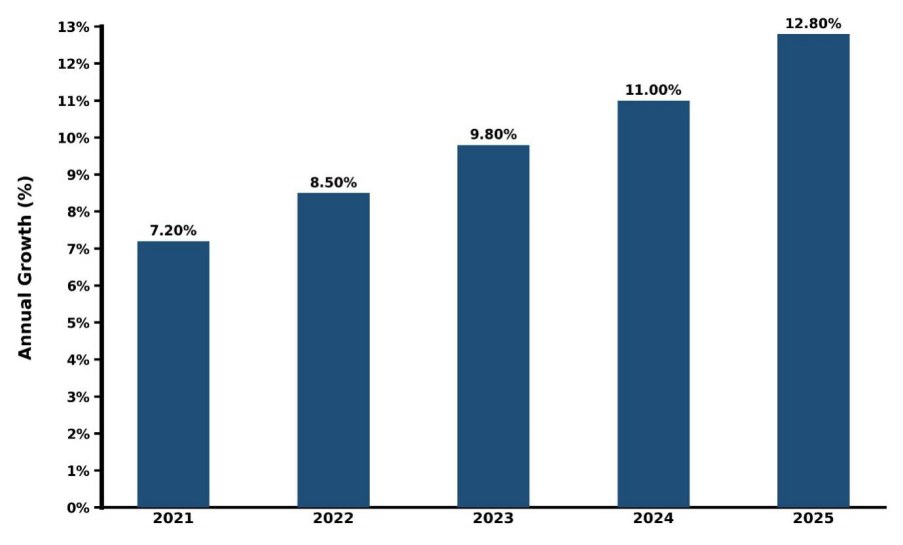
Below mentioned is an evaluation of year-wise growth rate along with growth drivers:
| Year | Est. Annual Growth (%) | Growth Drivers |
| 2021 | 7.2% | Early experimentation with 3D-printed concrete structures and pilot residential projects |
| 2022 | 8.5% | Increasing adoption of extrusion-based printing for small-scale commercial and residential buildings |
| 2023 | 9.8% | Development of advanced materials such as reinforced concrete and composites for structural integrity |
| 2024 | 11% | Integration of powder-bonding and FDM technologies for industrial and infrastructure projects |
| 2025 | 12.8% | Government incentives for sustainable construction and large-scale deployment in commercial and infrastructure sectors |
Topics Covered in the Thailand 3D Construction Printing Market Report
The Thailand 3D Construction Printing Market report covers by Material, Application, Technology, and End User, highlighting strategic opportunities and market trends for stakeholders aiming to leverage 3D construction printing innovations.
Thailand 3D Construction Printing Market Highlights
| Report Name | Thailand 3D Construction Printing Market |
| Forecast period | 2026-2032 |
| CAGR | 12.5% |
| Growing Sector | Construction & Advanced Manufacturing |
Thailand 3D Construction Printing Market Synopsis
There are various crucial drivers that are anticipated to propel the growth of the Thailand 3D Construction Printing Market in the upcoming years. Firstly, an increase in demand for low-cost and fast-building solutions, high adoption of automation in construction activities, and the increased usage of 3D printing technologies for constructing prototypes, structural elements, and even full-sized buildings. The advantages of 3D construction printing technology like the reduced construction process and improved safety at construction sites have led to the adoption of this technology over traditional construction methods.
Evaluation of Growth Drivers in Thailand 3D Construction Printing Market (2026–2032)
Below mentioned are some major drivers and their influence on the market dynamics:
| Drivers | Primary Segment Affected | Why It Matters (Evidence) |
| Adoption of Sustainable & Eco-Friendly Construction | Residential, Commercial, Infrastructure | 3D printing reduces material waste, enables use of recycled and composite materials, and supports green building initiatives. |
| Demand for Rapid Construction & Cost Reduction | Contractors & Construction Companies | 3D construction printing accelerates project timelines, lowers labor costs, and enables faster deployment of buildings and infrastructure. |
| Government Support for Smart & Digital Construction | Infrastructure Projects & Public Works | Thailand’s Thailand 4.0 promotes digital and sustainable construction methods which provide incentives for 3D printing adoption. |
| Development of Advanced Materials & Printing Technologies | Industrial & Commercial Projects | Innovations in concrete and composites allow stronger and larger-scale printed structures. |
| Increasing Use in Modular & Customizable Buildings | Residential & Commercial Sector | 3D printing enables modular construction, custom designs, and flexibility in architecture, meeting growing market demand for unique structures. |
The Thailand 3D Construction Printing Market growth is expected to reach at a CAGR of 14.6% during 2026–2032. The growth in the market will be fueled by the increasing focus on developing smart infrastructures and urbanizing constructions under national development programs of the country. Furthermore, growing demand for disaster-resistant construction materials and affordable housing solutions will contribute to the market’s growth in the coming years due to increased demand from real estate players and other stakeholders.
Evaluation of Restraints in Thailand 3D Construction Printing Market
Below mentioned are some major restraints and their influence on the market dynamics:
| Restraints | Primary Segment Affected | What This Means (Evidence) |
| High Initial Investment Costs | SMEs & Small Contractors | Industrial-grade 3D construction printers and specialized materials require substantial capital, limiting adoption among smaller players. |
| Limited Large-Scale Adoption | Infrastructure & Industrial Projects | While suitable for small- to medium-scale projects, current 3D printing methods are slower than traditional large-scale construction techniques. |
| Shortage of Skilled Workforce | Engineering, Design & On-Site Construction | Limited trained professionals in 3D printing and digital construction technologies restrict the pace of adoption. |
| Regulatory & Building Code Limitations | Residential & Commercial Construction | Lack of standardized regulations for 3D-printed structures slows integration into mainstream construction. |
| Material Limitations & Structural Challenges | High-Rise & Load-Bearing Projects | Current printable materials (e.g., concrete, composites) may not yet meet all structural, fire safety, and durability standards required for large-scale or high-rise construction. |
Challenges in the Thailand 3D Construction Printing Market
The major obstacles that the Thailand 3D Construction Printing market faces include the high cost associated with setting up and acquiring construction printers and the unavailability of skilled experts in construction additive manufacturing technologies. In addition, uncertainties in regulations regarding construction codes and safety standards have proved to be major barriers to adoption. However, with increased focus on smart city initiatives by the government, these issues will be gradually addressed.
Significant Trends in the Thailand 3D Construction Printing Market
Some of the notable trends impacting the growth of the market are the following:
- Growing Adoption in Residential Structures: 3D printing technology is gaining prominence in the construction of residential buildings as well as affordable housing owing to the considerable reduction in construction time and costs involved.
- Use in Infrastructure Projects: The demand for using 3D printing in infrastructure projects including bridges, walkways, and other architectural elements is increasing with governments adopting measures to modernize infrastructure.
- Increased Adoption of Advanced Construction Material: The adoption of high-quality material including reinforced composites and advanced concrete used in constructing robust structures is increasing, enabling stronger and more complex printed structures.
Investment Opportunities in Thailand 3D Construction Printing Market
The following are some of the prominent opportunities that will contribute to the growth of the market:
- Opportunity to Build Affordable Housing: There is significant opportunity in addressing the country’s housing demand through cost-efficient, fast-deployment 3D-printed residential units.
- Modern Infrastructure Projects: Various infrastructure modernization projects being undertaken by the government provide substantial demand for sustainable construction technologies.
- Integration into Smart Construction Ecosystems: There is a growing adoption of Building Information Modeling (BIM) and Industry 4.0 construction ecosystems, which provides major opportunities for 3D printing technology providers.
Top 5 Leading Players in Thailand 3D Construction Printing Market
Stated below are some of the leading companies holding majority of Thailand 3D Construction Printing Market Share:
1. SCG (Siam Cement Group)
| Company Name | SCG (Siam Cement Group) |
|---|---|
| Established Year | 1913 |
| Headquarters | Bangkok, Thailand |
| Website | Click Here |
SCG is a leading Thai conglomerate with a focus on building materials and advanced manufacturing. SCG is actively exploring 3D printing technologies for automotive components, construction, and industrial applications, positioning itself as a regional hub for additive manufacturing innovation.
2. Stratasys Ltd.
| Company Name | Stratasys Ltd. |
|---|---|
| Established Year | 1989 |
| Headquarters | Eden Prairie, USA |
| Website | Click Here |
Stratasys is a global leader in additive manufacturing, offering advanced 3D printing solutions for automotive prototyping and production.
3. EOS GmbH
| Company Name | EOS GmbH |
|---|---|
| Established Year | 1989 |
| Headquarters | Krailling, Germany |
| Website | Click Here |
EOS specializes in metal and polymer 3D printing technologies, supporting high-performance automotive part production.
4. 3D Systems Corporation
| Company Name | 3D Systems Corporation |
|---|---|
| Established Year | 1986 |
| Headquarters | Rock Hill, USA |
| Website | Click Here |
3D Systems provides a wide range of industrial 3D printers and materials used extensively in automotive design and manufacturing.
5. HP Inc.
| Company Name | HP Inc. |
|---|---|
| Established Year | 1939 |
| Headquarters | Palo Alto, USA |
| Website | Click Here |
HP offers Multi Jet Fusion technology, widely used for producing functional automotive components with speed and precision.
Government Policies Supporting Thailand 3D Construction Printing Market
According to Thai government data, the market for Thailand 3D Construction Printing benefits from several national policies focused on transforming the country into Thailand 4.0, which aims at promoting smart manufacturing, digital construction, and innovation-led infrastructural development. Projects such as the EEC Smart Park in Rayong, designed to foster high-tech industrial estates and sustainable construction projects according to Industry 4.0 concept, are created. Furthermore, pilot projects such as the Wangchan Valley Smart City, which aims at developing digital infrastructures according to the smart construction principle in the EEC zones, are conducted in Thailand according to the Thailand 4.0 concept.
Source Links:
EEC Investment Framework (Thailand 4.0 & industrial strategy): https://thailand.go.th/issue-focus-detail/002_008
EEC Smart Park Project (smart industrial estate under Thailand 4.0): https://www.nationthailand.com/business/40014033
Wangchan Valley Smart City (EEC innovation & smart infrastructure pilot): https://www.nationthailand.com/tech/40013207
Future Outlook of the Thailand 3D Construction Printing Market
The future forecast for the Thailand 3D Construction Printing Market is extremely positive due to increasing requirements for fast construction techniques, sustainable building practices, and cost-effective infrastructure development. Technologies such as AI-driven structural designs, multi-material concrete printing, and autonomous construction will contribute to increased efficiency and scalability. As the regulatory framework develops and innovations regarding material improve, 3D construction printing is expected to shift from pilot projects towards large-scale application in residential, commercial, and infrastructural construction sectors in Thailand.
Market Segmentation Analysis
The report provides a detailed study of the Thailand 3D Construction Printing Market across the following segments:
By Material — Concrete Segment to Lead the Market
Concrete is the largest material segment in the Thailand 3D construction printing market due to its structural strength, cost-effectiveness, and wide applicability in residential, commercial, and infrastructure projects. Metals and composites are increasingly used for specialized industrial structures, while plastics are mainly used for non-structural decorative components.
By Application — Infrastructure Segment Dominates the Market
According to Sachin, Senior Research Analyst, 6Wresearch, The infrastructure segment holds the largest share in the market as governments and construction companies are increasingly adopting 3D printing for bridges, tunnels, and public utility projects to reduce labor costs, accelerate construction timelines, and improve sustainability.
Key Attractiveness of the Report
- 10 Years of Market Numbers
- Historical Data Starting from 2022 to 2025
- Base Year: 2025
- Forecast Data until 2032
- Key Performance Indicators Impacting the Market
- Major Upcoming Developments and Projects
Key Highlights of the Report:
- Thailand 3D Construction Printing Market Outlook
- Market Size of Thailand 3D Construction Printing Market, 2025
- Forecast of Thailand 3D Construction Printing Market, 2032
- Historical Data and Forecast of Thailand 3D Construction Printing Revenues & Volume for the Period 2022-2032
- Thailand 3D Construction Printing Market Trend Evolution
- Thailand 3D Construction Printing Market Drivers and Challenges
- Thailand 3D Construction Printing Price Trends
- Thailand 3D Construction Printing Porter's Five Forces
- Thailand 3D Construction Printing Industry Life Cycle
- Historical Data and Forecast of Thailand 3D Construction Printing Market Revenues & Volume By Material for the Period 2022-2032
- Historical Data and Forecast of Thailand 3D Construction Printing Market Revenues & Volume By Concrete for the Period 2022-2032
- Historical Data and Forecast of Thailand 3D Construction Printing Market Revenues & Volume By Metals for the Period 2022-2032
- Historical Data and Forecast of Thailand 3D Construction Printing Market Revenues & Volume By Plastics for the Period 2022-2032
- Historical Data and Forecast of Thailand 3D Construction Printing Market Revenues & Volume By Composites for the Period 2022-2032
- Historical Data and Forecast of Thailand 3D Construction Printing Market Revenues & Volume By Application for the Period 2022-2032
- Historical Data and Forecast of Thailand 3D Construction Printing Market Revenues & Volume By Residential for the Period 2022-2032
- Historical Data and Forecast of Thailand 3D Construction Printing Market Revenues & Volume By Commercial for the Period 2022-2032
- Historical Data and Forecast of Thailand 3D Construction Printing Market Revenues & Volume By Industrial for the Period 2022-2032
- Historical Data and Forecast of Thailand 3D Construction Printing Market Revenues & Volume By Infrastructure for the Period 2022-2032
- Historical Data and Forecast of Thailand 3D Construction Printing Market Revenues & Volume By Technology for the Period 2022-2032
- Historical Data and Forecast of Thailand 3D Construction Printing Market Revenues & Volume By Fused Deposition Modeling for the Period 2022-2032
- Historical Data and Forecast of Thailand 3D Construction Printing Market Revenues & Volume By Powder Bonding for the Period 2022-2032
- Historical Data and Forecast of Thailand 3D Construction Printing Market Revenues & Volume By Extrusion-based for the Period 2022-2032
- Historical Data and Forecast of Thailand 3D Construction Printing Market Revenues & Volume By End User for the Period 2022-2032
- Historical Data and Forecast of Thailand 3D Construction Printing Market Revenues & Volume By Construction Companies for the Period 2022-2032
- Historical Data and Forecast of Thailand 3D Construction Printing Market Revenues & Volume By Contractors for the Period 2022-2032
- Historical Data and Forecast of Thailand 3D Construction Printing Market Revenues & Volume By Governments for the Period 2022-2032
- Thailand 3D Construction Printing Import Export Trade Statistics
- Market Opportunity Assessment By Material
- Market Opportunity Assessment By Application
- Market Opportunity Assessment By Technology
- Market Opportunity Assessment By End User
- Thailand 3D Construction Printing Top Companies Market Share
- Thailand 3D Construction Printing Competitive Benchmarking By Technical and Operational Parameters
- Thailand 3D Construction Printing Company Profiles
- Thailand 3D Construction Printing Key Strategic Recommendations
Market Covered
The report offers an extensive study of the following market segments:
By Material
- Concrete
- Metals
- Plastics
- Composites
By Application
- Residential
- Commercial
- Industrial
- Infrastructure
By Technology
- Fused Deposition Modeling (FDM)
- Powder Bonding
- Extrusion-based
By End User
- Construction Companies
- Contractors
- Governments
Thailand 3D Construction Printing Market (2026-2032): FAQs
The Thailand 3D Construction Printing Market is expected to grow at a CAGR of 12.5% during the forecast period (2026–2032).
Key drivers include adoption of sustainable construction practices and advancements in printable materials and technologies.
High initial investment costs, limited large-scale adoption and lack of standardized regulations are major market challenges.
Concrete dominates due to its structural strength and wide application across residential, commercial, industrial, and infrastructure projects.
6Wresearch actively monitors the Thailand 3D Construction Printing Market and publishes its comprehensive annual report, highlighting emerging trends, growth drivers, revenue analysis, and forecast outlook. Our insights help businesses to make data-backed strategic decisions with ongoing market dynamics. Our analysts track relevent industries related to the Thailand 3D Construction Printing Market, allowing our clients with actionable intelligence and reliable forecasts tailored to emerging regional needs.
Yes, we provide customisation as per your requirements. To learn more, feel free to contact us on sales@6wresearch.com
| 1 Executive Summary |
| 2 Introduction |
| 2.1 Key Highlights of the Report |
| 2.2 Report Description |
| 2.3 Market Scope & Segmentation |
| 2.4 Research Methodology |
| 2.5 Assumptions |
| 3 Thailand 3D Construction Printing Market Overview |
| 3.1 Thailand Country Macro Economic Indicators |
| 3.2 Thailand 3D Construction Printing Market Revenues & Volume, 2022 & 2032F |
| 3.3 Thailand 3D Construction Printing Market - Industry Life Cycle |
| 3.4 Thailand 3D Construction Printing Market - Porter's Five Forces |
| 3.5 Thailand 3D Construction Printing Market Revenues & Volume Share, By Material, 2022 & 2032F |
| 3.6 Thailand 3D Construction Printing Market Revenues & Volume Share, By Application, 2022 & 2032F |
| 3.7 Thailand 3D Construction Printing Market Revenues & Volume Share, By Technology, 2022 & 2032F |
| 3.8 Thailand 3D Construction Printing Market Revenues & Volume Share, By End User, 2022 & 2032F |
| 4 Thailand 3D Construction Printing Market Dynamics |
| 4.1 Impact Analysis |
| 4.2 Market Drivers |
| 4.2.1 Increasing demand for sustainable and cost-effective construction solutions |
| 4.2.2 Government support and incentives for adopting advanced construction technologies |
| 4.2.3 Growing awareness and adoption of 3D printing technology in the construction sector |
| 4.3 Market Restraints |
| 4.3.1 High initial investment cost for setting up 3D construction printing facilities |
| 4.3.2 Limited availability of skilled workforce for operating and maintaining 3D printing equipment |
| 4.3.3 Regulatory challenges and building code restrictions related to 3D printed structures |
| 5 Thailand 3D Construction Printing Market Trends |
| 6 Thailand 3D Construction Printing Market, By Types |
| 6.1 Thailand 3D Construction Printing Market, By Material |
| 6.1.1 Overview and Analysis |
| 6.1.2 Thailand 3D Construction Printing Market Revenues & Volume, By Material, 2022 - 2032F |
| 6.1.3 Thailand 3D Construction Printing Market Revenues & Volume, By Concrete, 2022 - 2032F |
| 6.1.4 Thailand 3D Construction Printing Market Revenues & Volume, By Metals, 2022 - 2032F |
| 6.1.5 Thailand 3D Construction Printing Market Revenues & Volume, By Plastics, 2022 - 2032F |
| 6.1.6 Thailand 3D Construction Printing Market Revenues & Volume, By Composites, 2022 - 2032F |
| 6.2 Thailand 3D Construction Printing Market, By Application |
| 6.2.1 Overview and Analysis |
| 6.2.2 Thailand 3D Construction Printing Market Revenues & Volume, By Residential, 2022 - 2032F |
| 6.2.3 Thailand 3D Construction Printing Market Revenues & Volume, By Commercial, 2022 - 2032F |
| 6.2.4 Thailand 3D Construction Printing Market Revenues & Volume, By Industrial, 2022 - 2032F |
| 6.2.5 Thailand 3D Construction Printing Market Revenues & Volume, By Infrastructure, 2022 - 2032F |
| 6.3 Thailand 3D Construction Printing Market, By Technology |
| 6.3.1 Overview and Analysis |
| 6.3.2 Thailand 3D Construction Printing Market Revenues & Volume, By Fused Deposition Modeling, 2022 - 2032F |
| 6.3.3 Thailand 3D Construction Printing Market Revenues & Volume, By Powder Bonding, 2022 - 2032F |
| 6.3.4 Thailand 3D Construction Printing Market Revenues & Volume, By Extrusion-based, 2022 - 2032F |
| 6.4 Thailand 3D Construction Printing Market, By End User |
| 6.4.1 Overview and Analysis |
| 6.4.2 Thailand 3D Construction Printing Market Revenues & Volume, By Construction Companies, 2022 - 2032F |
| 6.4.3 Thailand 3D Construction Printing Market Revenues & Volume, By Contractors, 2022 - 2032F |
| 6.4.4 Thailand 3D Construction Printing Market Revenues & Volume, By Governments, 2022 - 2032F |
| 7 Thailand 3D Construction Printing Market Import-Export Trade Statistics |
| 7.1 Thailand 3D Construction Printing Market Export to Major Countries |
| 7.2 Thailand 3D Construction Printing Market Imports from Major Countries |
| 8 Thailand 3D Construction Printing Market Key Performance Indicators |
| 8.1 Percentage increase in the number of construction projects utilizing 3D printing technology |
| 8.2 Average reduction in construction time and cost achieved through 3D printing |
| 8.3 Number of partnerships and collaborations between construction companies and 3D printing technology providers |
| 9 Thailand 3D Construction Printing Market - Opportunity Assessment |
| 9.1 Thailand 3D Construction Printing Market Opportunity Assessment, By Material, 2022 & 2032F |
| 9.2 Thailand 3D Construction Printing Market Opportunity Assessment, By Application, 2022 & 2032F |
| 9.3 Thailand 3D Construction Printing Market Opportunity Assessment, By Technology, 2022 & 2032F |
| 9.4 Thailand 3D Construction Printing Market Opportunity Assessment, By End User, 2022 & 2032F |
| 10 Thailand 3D Construction Printing Market - Competitive Landscape |
| 10.1 Thailand 3D Construction Printing Market Revenue Share, By Companies, 2025 |
| 10.2 Thailand 3D Construction Printing Market Competitive Benchmarking, By Operating and Technical Parameters |
| 11 Company Profiles |
| 12 Recommendations |
| 13 Disclaimer |
Global Go To Market Strategy - 2030
Export potential enables firms to identify high-growth global markets with greater confidence by combining advanced trade intelligence with a structured quantitative methodology. The framework analyzes emerging demand trends and country-level import patterns while integrating macroeconomic and trade datasets such as GDP and population forecasts, bilateral import–export flows, tariff structures, elasticity differentials between developed and developing economies, geographic distance, and import demand projections. Using weighted trade values from 2020–2024 as the base period to project country-to-country export potential for 2030, these inputs are operationalized through calculated drivers such as gravity model parameters, tariff impact factors, and projected GDP per-capita growth. Through an analysis of hidden potentials, demand hotspots, and market conditions that are most favorable to success, this method enables firms to focus on target countries, maximize returns, and global expansion with data, backed by accuracy.
By factoring in the projected importer demand gap that is currently unmet and could be potential opportunity, it identifies the potential for the Exporter (Country) among 190 countries, against the general trade analysis, which identifies the biggest importer or exporter.
To discover high-growth global markets and optimize your business strategy:
Click Here
Pricing
- Single User License$ 1,995
- Department License$ 2,400
- Site License$ 3,120
- Global License$ 3,795

Leadership Perspectives from Industry Events
Search
Thought Leadership and Analyst Meet





Our Clients








6WResearch In News
- Doha a strategic location for EV manufacturing hub: IPA Qatar
- Demand for luxury TVs surging in the GCC, says Samsung
- Empowering Growth: The Thriving Journey of Bangladesh’s Cable Industry
- Demand for luxury TVs surging in the GCC, says Samsung
- Video call with a traditional healer? Once unthinkable, it’s now common in South Africa
- Intelligent Buildings To Smooth GCC’s Path To Net Zero
Latest Reports
- Taiwan Airport Wireless Infrastructure Market (2026-2032)
- Vietnam Airport Wireless Infrastructure Market (2026-2032)
- Thailand Airport Wireless Infrastructure Market (2026-2032)
- South Korea Airport Wireless Infrastructure Market (2026-2032)
- Romania Airport Wireless Infrastructure Market (2026-2032)
- Qatar Airport Wireless Infrastructure Market (2026-2032)
- Philippines Airport Wireless Infrastructure Market (2026-2032)
- Japan Airport Wireless Infrastructure Market (2026-2032)
- Taiwan Airport Winter Services Market (2026-2032)
- Vietnam Airport Winter Services Market (2026-2032)
Industry Events and Analyst Meet

HIMTEX 2026

India Refining Summit 2026

India EV Show 2026

EV tech India Expo 2026

Auto Tech Asia 2026
Whitepaper
- Middle East & Africa Commercial Security Market Click here to view more.
- Middle East & Africa Fire Safety Systems & Equipment Market Click here to view more.
- GCC Drone Market Click here to view more.
- Middle East Lighting Fixture Market Click here to view more.
- GCC Physical & Perimeter Security Market Click here to view more.


