Thailand 3D Technology Market Growth Rate
According to 6Wresearch internal databases and industry insights, the Thailand 3D Technology Market is projected to grow at a substantial compound annual growth rate (CAGR) of 7.9% during the forecast period 2026–2032.
Thailand 3D Technology Market Year-wise Growth Rate and Key Drivers
This graph illustrates the annual growth rates of the Thailand 3D Technology Market from 2021 to 2032, highlighting a steady upward trajectory and projected market expansion over the forecast period.
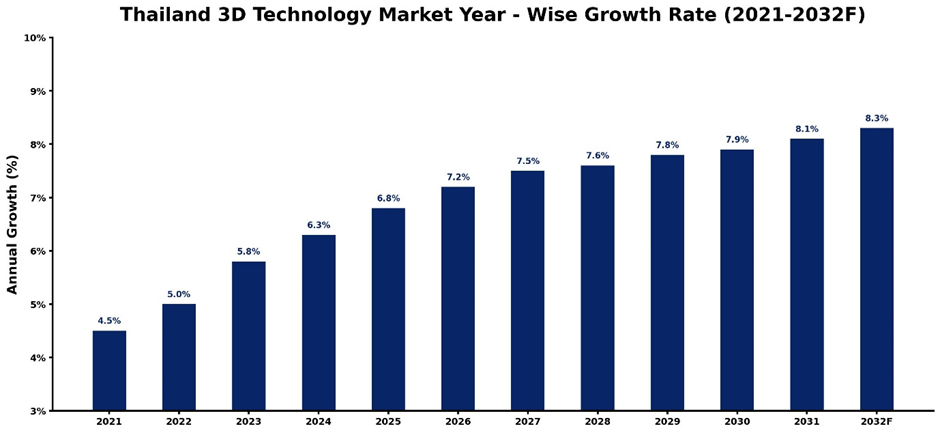
The following table summarizes the historical and forecasted growth rates of the Thailand 3D Technology Market, along with the rationale behind each year’s performance.
| Year | Estimated Growth (%) | Market Rationale |
| 2021 | 4.5% | Early adoption in healthcare, gaming, and construction; limited awareness and high costs slow growth. |
| 2022 | 5% | Increased AR/VR and industrial applications, along with government programs like Thailand 4.0, drive adoption. |
| 2023 | 5.8% | Integration with AI, cloud, and IoT improves efficiency and visualization, boosting market demand. |
| 2024 | 6.3% | Rising industrial digitization and smart city pilot projects accelerate investments in 3D technologies. |
| 2025 | 6.8% | Adoption in digital twins, urban planning, and immersive gaming applications expands market reach. |
| 2026 | 7.2% | Growth driven by healthcare 3D solutions, AR/VR adoption, and industrial digital twin projects. |
| 2027 | 7.5% | Expansion across education, manufacturing, and entertainment; increased government support fuels growth. |
| 2028 | 7.8% | SMEs and startups adopt cost-effective 3D modeling software; cloud-based solutions increase accessibility. |
| 2029 | 7.6% | Slight stabilization as early adopters have implemented solutions; new growth in advanced applications continues. |
| 2030 | 7.9% | Innovations in AI-assisted 3D modeling and simulation create renewed market momentum. |
| 2031 | 8.1% | Local production of 3D hardware and software reduces imports, increasing domestic adoption. |
| 2032 | 8.3% | Strong adoption across industrial, healthcare, and entertainment sectors; government and consumer demand remains high. |
Topics Covered in the Thailand 3D Technology Market Report
The Thailand 3D Technology Market report covers the market by type and application. The report provides a detailed analysis of ongoing market trends, opportunities/high-growth areas, and market drivers that will help stakeholders align strategies based on current and future market dynamics.
Thailand 3D Technology Market Highlights
| Report Name | Thailand 3D Technology Market |
| Forecast period | 2026-2032 |
| CAGR | 7.9% |
| Growing Sector | Construction |
Thailand 3D Technology Market Synopsis
The Thailand 3D Technology Market is estimated to surge in the coming years, which is backed by some major factors, such as the rising adoption across healthcare, construction, manufacturing, and entertainment sectors and increasing demand for advanced visualization, 3D modeling, AR/VR applications. Other major factors are increasing integration with AI, IoT, and cloud-based platforms enables real-time collaboration and improved analytics and growing consumer awareness of immersive solutions and innovative 3D applications.
Evaluation of Growth Drivers in Thailand 3D Technology Market (2026–2032)
Below are some major drivers and their influence on the market dynamics:
| Drivers | Primary Segment Affected | Why It Matters (Evidence) |
| Rising Demand for Smart Cities | Government & Urban Infrastructure | Increasing government initiatives for smart city projects, IoT integration, and traffic surveillance drives the adoption of 3D sensing and imaging technologies. |
| High adoption rate of Advanced Industrial Automation | Manufacturing & Industrial | 3D vision systems enable precise robotics and automated inspection, which improves operational efficiency. |
| Growth in Augmented & Virtual Reality | Consumer Electronics & Gaming | AR/VR devices require accurate 3D sensors for immersive experiences, boosting demand for 3D imaging modules. |
| Expansion of Healthcare & Medical Imaging | Healthcare & Diagnostics | Hospitals and diagnostic centers adopt 3D scanning for surgical planning, imaging, and patient monitoring. |
| Advanced Automotive Safety Systems | Automotive | Increasing integration of 3D LiDAR and camera-based systems for autonomous driving and advanced driver-assistance systems (ADAS). |
The Thailand 3D Technology Market growth is projected to boost at a CAGR of 7.9% during 2026–2032, as it is backed by an increase in the adoption of 3D solutions across industries such as healthcare, construction, and entertainment. Increased demand for advanced visualization, digital twins, and precise modeling boosts industry development. Besides that, government initiatives promoting digital infrastructure, smart city projects, and industrial automation push investment in 3D technologies. Also, there is a rising integration with AI, IoT, and cloud technologies, which improves accuracy, efficiency, and collaboration.
Evaluation of Restraints in Thailand 3D Technology Market
Below mentioned are some major restraints and their influence on the market dynamics:
| Restraints | Primary Segment Affected | What This Means (Evidence) |
| High Equipment Costs | SMEs & Local Manufacturers | 3D sensors, LiDAR, and imaging devices are expensive, which may limit adoption by smaller companies. |
| Integration Complexity | Industrial & IT | Advanced 3D technologies require specialized software and firmware integration, demanding skilled workforce. |
| Limited Skilled Workforce | R&D & Technical Services | Due to a lack of trained engineers and technicians, there is a slow down in maintenance of 3D systems. |
| Regulatory & Data Privacy Concerns | Government & Commercial | Use of 3D surveillance and imaging systems is subject to strict data privacy and compliance regulations. |
| Supply Chain Vulnerabilities | Hardware Manufacturers | Dependence on imported 3D sensors, components, and high-precision optics can lead to production delays and cost fluctuations. |
Challenges of Thailand 3D Technology Market
Key challenges include the high cost (implementation and maintenance) of utilizing 3D technology for businesses, the complexity of 3D technologies, the lack of qualified/professional employees experienced with 3D modeling/software. The interoperability challenges caused by different 3D technologies, the general lack of awareness of 3D technologies among small and medium businesses, and the requirement for ongoing software updates as technology evolves. The rapid change in 3D hardware will also affect the cost of 3D technologies used by businesses, therefore, rising prices caused by hardware fluctuations and rapid advancements in 3D technologies will likely impede future investments into 3D technologies and projects.
Trends in the Thailand 3D Technology Market
Listed below are the major trends responsible for Thailand 3D Technology Market Growth:
- Adoption in Healthcare & Medical Imaging: 3D technology has become increasingly prevalent in healthcare technology and medical imaging for surgical planning and diagnostics. The use of 3D will reduce errors, and improves patient outcomes.
- Integration with AI and Machine Learning: AI-powered 3D solutions automate modelling and enhance predictive analytics. Industries benefit from faster and more accurate decision-making.
- Growth in AR/VR Applications: 3D technology fuels immersive experiences in gaming, education, and entertainment. Virtual simulations and interactive environments are driving consumer adoption.
Investment Opportunities in the Thailand 3D Technology Market
Given below are the investment opportunities available in Thailand 3D Technology Market:
- Healthcare 3D Solutions: Investment in developing medical 3D solutions for medical imaging and prosthetics, given the recent trend toward healthcare modernization, is a major initiative for investment as the market is growing rapidly.
- AR/VR and Gaming Development: Investment in AR/VR and gaming is also a smart investment due to the overall growth potential for successful AR/VR applications in gaming, education, and entertainment.
- Industrial Digital Twins: Investing in developing digital twin solutions for manufacturing, logistics, and smart factories will help increase businesses' efficiencies while reducing their overall operational costs.
Top 5 Leading Players in Thailand 3D Technology Market
Stated below are some of the leading companies holding majority of Thailand 3D Technology Market shares:
1. SCG (Siam Cement Group)
| Company Name | SCG (Siam Cement Group) |
|---|---|
| Established Year | 1913 |
| Headquarters | Bangkok, Thailand |
| Official Website | Click Here |
SCG integrates 3D modeling, visualization, and simulation technologies into construction, cement, and packaging operations. Its 3D solutions enhance project planning and workflow efficiency, positioning it as a key player in Thailand’s industrial and infrastructure sectors.
2. X3D Technology (Palawatr Co., Ltd.)
| Company Name | X3D Technology (Palawatr Co., Ltd.) |
|---|---|
| Established Year | 2010 |
| Headquarters | Bangkok, Thailand |
| Official Website | Click Here |
X3D Technology provides 3D scanning, modeling, and visualization software for industrial, construction, and educational applications. Its innovative solutions support digital twin creation and immersive training, strengthening Thailand’s adoption of advanced 3D technology.
3. Cad Cast Co., Ltd.
| Company Name | Cad Cast Co., Ltd. |
|---|---|
| Established Year | 2005 |
| Headquarters | Bangkok, Thailand |
| Official Website | Click Here |
Cad Cast specializes in 3D CAD/CAM software, 3D printing, and additive manufacturing solutions. Its technology aids industrial prototyping and simulation services, contributing significantly to Thailand’s manufacturing and industrial innovation ecosystem.
4. Septillion Co., Ltd.
| Company Name | Septillion Co., Ltd. |
|---|---|
| Established Year | 2012 |
| Headquarters | Bangkok, Thailand |
| Official Website | Click Here |
Septillion delivers 3D visualization, AR/VR, and modeling software for engineering, construction, and entertainment industries. Its immersive solutions enhance project design and interactive experiences, establishing it as a growing player in Thailand’s 3D technology market.
5. Rabbit Prototype Co., Ltd.
| Company Name | Rabbit Prototype Co., Ltd. |
|---|---|
| Established Year | 2015 |
| Headquarters | Bangkok, Thailand |
| Official Website | Click Here |
Rabbit Prototype offers 3D prototyping, scanning, and rapid manufacturing services. Its solutions support R&D, product testing, and industrial design, driving Thailand’s adoption of advanced 3D technologies in SMEs and startups.
Government Initiatives in Thailand 3D Technology Market
According to Thai government data, is promoting digital innovation through programs like Thailand 4.0 and Digital Economy Promotion Agency (DEPA). Which not only encourage the adoption of advanced technologies including 3D solutions in manufacturing, construction, and healthcare but also supports startups and SMEs to implement digital and 3D technologies. Here are some initiatives in smart cities, industrial automation, and educational programs for AR/VR skills development, which further strengthen market growth. These programs aim to improve productivity, global competitiveness, and adoption of next-gen 3D solutions across sectors.
Future Insights of Thailand 3D Technology Market
Looking into the future, the growth of Thailand 3D technology will be on an upward trend due to improvements in artificial intelligence-based modeling systems, cloud-based collaborative tools for 3D modeling, and real-time simulation technology. Business sectors such as industrial, health care, and entertainment will expand their use of 3D technologies, which results in an increased demand for these products. Manufacturing capabilities within Thailand for both hardware and software solutions will help Thailand become self-sufficient in its use of 3D technology, creating demand for 3D technology-based products within the country.
Market Segmentation Analysis
The report offers a comprehensive study of the following market segments and their leading categories:
By Type
According to Rishil, Senior Research Analyst, 6Wresearch, 3D Printing claimed a dominant 35.70% of the Thailand 3D Technology market value in 2025 due to rapid adoption in manufacturing, prototyping, and healthcare modeling; conversely, 3D Imaging is projected to progress at the fastest CAGR of 8.20% from 2026 to 2032 as hospitals, industrial inspection units, and automotive manufacturers increasingly rely on high-precision 3D imaging solutions.
By Application
By application, the Healthcare segment commanded 38.50% of the Thailand 3D Technology market share in 2025, on account of adoption of 3D printing for prosthetics, surgical models, and personalized implants; meanwhile, the Automotive category is anticipated to grow at a CAGR of 7.45% through 2032 due to increasing use of 3D scanning and imaging for design, quality control, and autonomous vehicle systems.
Note: Market size estimations and growth projections presented in this report are based on 6Wresearch’s advanced forecasting approach, validated with industry datasets as of June 2026.
Key Attractiveness of the Report:
- 10 Years of Market Numbers
- Historical Data Starting from 2022 to 2025
- Base Year: 2025
- Forecast Data until 2032
- Key Performance Indicators Impacting the Market
- Major Upcoming Developments and Projects
Key Highlights of the Report:
- Thailand 3D Technology Market Outlook
- Market Size of Thailand 3D Technology Market, 2025
- Forecast of Thailand 3D Technology Market, 2032
- Historical Data and Forecast of Thailand 3D Technology Revenues & Volume for the Period 2022-2032
- Thailand 3D Technology Market Trend Evolution
- Thailand 3D Technology Market Drivers and Challenges
- Thailand 3D Technology Price Trends
- Thailand 3D Technology Porter's Five Forces
- Thailand 3D Technology Industry Life Cycle
- Historical Data and Forecast of Thailand 3D Technology Market Revenues & Volume By Type for the Period 2022-2032
- Historical Data and Forecast of Thailand 3D Technology Market Revenues & Volume By 3D Printing for the Period 2022-2032
- Historical Data and Forecast of Thailand 3D Technology Market Revenues & Volume By 3D Display for the Period 2022-2032
- Historical Data and Forecast of Thailand 3D Technology Market Revenues & Volume By 3D Scanning for the Period 2022-2032
- Historical Data and Forecast of Thailand 3D Technology Market Revenues & Volume By 3D Imaging for the Period 2022-2032
- Historical Data and Forecast of Thailand 3D Technology Market Revenues & Volume By Others for the Period 2021 - 2031
- Historical Data and Forecast of Thailand 3D Technology Market Revenues & Volume By Application for the Period 2022-2032
- Historical Data and Forecast of Thailand 3D Technology Market Revenues & Volume By Healthcare for the Period 2022-2032
- Historical Data and Forecast of Thailand 3D Technology Market Revenues & Volume By Automotive for the Period 2022-2032
- Historical Data and Forecast of Thailand 3D Technology Market Revenues & Volume By Aerospace & Defense for the Period 2022-2032
- Historical Data and Forecast of Thailand 3D Technology Market Revenues & Volume By Consumer Electronics for the Period 2022-2032
- Historical Data and Forecast of Thailand 3D Technology Market Revenues & Volume By Others for the Period 2021 - 2031
- Thailand 3D Technology Import Export Trade Statistics
- Market Opportunity Assessment By Type
- Market Opportunity Assessment By Application
- Thailand 3D Technology Top Companies Market Share
- Thailand 3D Technology Competitive Benchmarking By Technical and Operational Parameters
- Thailand 3D Technology Company Profiles
- Thailand 3D Technology Key Strategic Recommendations
Market Covered
The report offers an extensive study of the following market segments:
By Type
- 3D Printing
- 3D Display
- 3D Scanning
- 3D Imaging
- Others
By Application
- Healthcare
- Automotive
- Aerospace & Defense
- Consumer Electronics
- Others






































