Thailand 4D Imaging Radar Market Growth Rate
According to 6Wresearch internal database and industry insights, the Thailand 4D Imaging Radar Market is projected to grow at a compound annual growth rate (CAGR) of 5.97% during the forecast period of 2026–2032.
Thailand 4D Imaging Radar Market Year-wise Growth Rate and Key Drivers
This graph illustrates the annual growth rates of the Thailand 4D Imaging Radar Market from 2021 to 2032, highlighting a steady upward trajectory and projected market expansion over the forecast period.
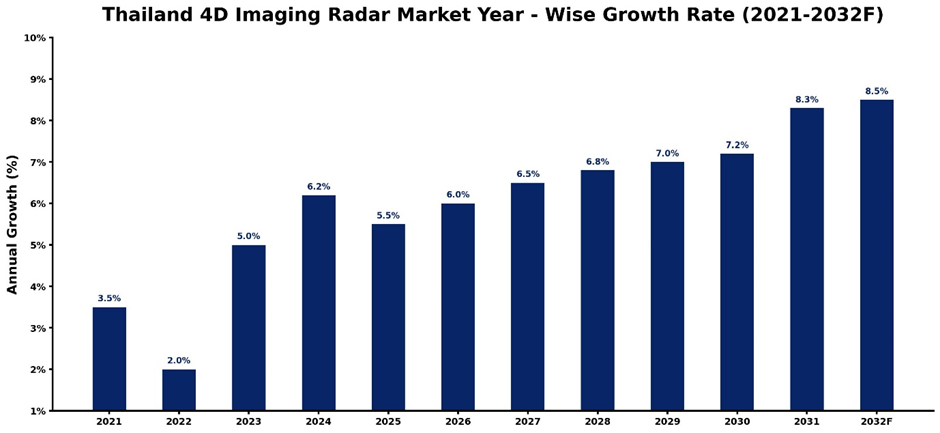
The following table summarizes the historical and forecasted growth rates of the Thailand 4D Imaging Radar Market, along with the rationale behind each year’s performance.
| Year | Estimated Growth (%) | Market Rationale |
| 2021 | 3.5% | Early-stage adoption; demand primarily from defense and high-end automotive segments. |
| 2022 | 2% | Global supply chain disruptions and semiconductor shortages slowed radar shipments. |
| 2023 | 5% | Recovery in automotive production and defense procurement programs. |
| 2024 | 6.2% | Growing interest in ADAS (Advanced Driver Assistance Systems) and autonomous vehicle testing in Thailand. |
| 2025 | 5.5% | Expansion of smart infrastructure projects and pilot deployments in urban mobility initiatives. |
| 2026 | 6% | Rising automotive safety regulations and higher integration of 4D radar in luxury & commercial vehicles. |
| 2027 | 6.5% | Technological improvements in radar resolution and detection range; increased adoption in defense applications. |
| 2028 | 6.8% | Automotive, industrial automation, and robotics sectors invest in radar systems; awareness grows. |
| 2029 | 7% | Increasing smart city projects and autonomous mobility trials; government incentives for advanced tech. |
| 2030 | 7.2% | Wider adoption in electric vehicles (EVs) and last-mile delivery robots; cost of radar systems decreases. |
| 2031 | 8.3% | Integration with AI-based predictive systems for automotive and industrial applications enhances market adoption. |
| 2032 | 8.5% | Market matures; high penetration in automotive, defense, industrial automation, and urban mobility sectors. |
Topics Covered in the Thailand 4D Imaging Radar Market Report
The Thailand 4D Imaging Radar Market report covers the market by Component, application, and end user. The report provides a detailed analysis of ongoing market trends, opportunities/high-growth areas, and market drivers that will help stakeholders align strategies based on current and future market dynamics.
Thailand 4D Imaging Radar Market Highlights
| Report Name | Thailand 4D Imaging Radar Market |
| Forecast period | 2026-2032 |
| CAGR | 5.97% |
| Growing Sector | Automotive |
Thailand 4D Imaging Radar Market Synopsis
The Thailand 4D Imaging Radar Market is a market consisting of cutting-edge radar systems capable of providing detection of objects with high-resolution space, velocity, and time data. In contrast to the conventional 3D radar technology, 4D imaging incorporates motion tracking, which makes it safer and more accurate. Some of the applications include automotive, industrial, and medical sectors such as collision avoidance, autonomous driving, industry automation, and medical diagnostics.
Evaluation of Growth Drivers in Thailand 4D Imaging Radar Market (2026–2032)
Below are some major drivers and their influence on the market dynamics:
| Drivers | Primary Segment Affected | Why It Matters (Evidence) |
| Increasing Automotive Safety Adoption | Automotive & Transportation | Advanced driver assistance systems (ADAS) and autonomous vehicles are using 4D radar for enhanced safety, driving demand. |
| Military & Defense Modernization | Defense & Security | Governments are upgrading surveillance and defense capabilities using high-resolution 4D radar systems. |
| Urban Infrastructure & Smart Cities | Industrial & Infrastructure | 4D radar aids traffic management and automated systems in smart city projects. |
| Technological Advancements | Automotive & Electronics | Improved sensor resolution, detection range, and integration with AI increases radar adoption. |
| Growing R&D Investments | Industrial & Aerospace | Ongoing research in automotive radar, robotics, and autonomous systems fuels market expansion. |
Thailand 4D Imaging Radar Market is projected to grow at a CAGR of 5.97% during 2026–2032. Factors like investments made in research and development, measures by the government to provide safe transportation systems, as well as advancements made in technology such as radar sensors and AI integration will also drive adoption. There is an increase in demand for healthcare and logistic industries due to accurate monitoring, detecting objects, and regional trade. This makes Thailand one of the countries leading in the innovation of 4D radars.
Evaluation of Restraints in Thailand 4D Imaging Radar Market
Below is the tabular representation of some major restraints and their influence on market dynamics:
| Restraints | Primary Segment Affected | What This Means (Evidence) |
| High System Costs | Automotive & Defense | Advanced 4D radar systems are expensive, limiting deployment in cost-sensitive segments. |
| Integration Complexity | Industrial & Automotive | Integrating radar with existing vehicle or infrastructure systems requires specialized expertise. |
| Regulatory Barriers | Automotive & Aerospace | Compliance with safety and communication standards may slow adoption. |
| Limited Awareness | SMEs & Start-ups | Small manufacturers and technology firms may lack knowledge of 4D radar benefits. |
| Technology Maturity | Consumer & Industrial | Early-stage technology adoption may lead to performance inconsistencies. |
Thailand 4D Imaging Radar Market Challenges
There are some major obstacles which include high capital investment, interoperability issues between new technologies and existing ones, and compliance. Achieving consistent operation of the radar in complex environments like urban traffic or industrial plants is technically demanding. Other challenges include training skilled personnel, maintaining accuracy under adverse conditions, and integrating AI and IoT systems present additional hurdles. These issues can delay product deployment and affect the ROI for enterprises, which limit the market’s short-term scalability despite strong technological potential and growing demand.
Thailand 4D Imaging Radar Market Trends
Listed below are the major trends responsible for Thailand 4D Imaging Radar Market Growth:
- Car Applications & ADAS Compatibility: Growing application of 4D radar in automobiles, especially in autonomous cars, and ADAS to improve collision detection and adaptive cruise control systems.
- Industrial Automation: There is a rising adoption rate in smart factories and warehouses, which allows precise motion tracking, and real-time monitoring of equipment and personnel.
- IoT and AI Integration: Utilization in conjunction with IoT and artificial intelligence platforms offers better decision-making abilities and enhances safety in complex environments.
Investment Opportunities in the Thailand 4D Imaging Radar Market
Given below are the investment opportunities available in Thailand 4D Imaging Radar Market:
- Sensors & Modules for Autonomous Vehicles: The growing need for advanced driver assistance systems and self-drive cars opens up opportunities for manufacturing and software development of radar sensors.
- Smart City and Traffic Infrastructure: To support traffic safety, congestion management, and smart city initiatives, there is a rising investment in urban radar networks.
- Patient Monitoring in Hospitals: Usage of non-intrusive patient monitoring systems will offer growth opportunities in hospitals and nursing homes, particularly for elderly care and motion analysis.
Top 4 Leading Players in Thailand 4D Imaging Radar Market
Stated below are some of the leading companies holding majority of Thailand 4D Imaging Radar Market Share:
1. Continental AG
| Company Name | Continental AG |
|---|---|
| Established Year | 1871 |
| Headquarters | Hanover, Germany |
| Official Website | Click Here |
Continental AG develops 4D imaging radar systems for automotive applications, including advanced driver assistance systems (ADAS) and autonomous driving.
2. Robert Bosch GmbH
| Company Name | Robert Bosch GmbH |
|---|---|
| Established Year | 1886 |
| Headquarters | Gerlingen, Germany |
| Official Website | Click Here |
Bosch provides 4D imaging radar technology for automotive, industrial, and defense applications in Thailand. The company focuses on precision sensing and integration with vehicle electronics for autonomous and semi-autonomous systems.
3. Denso Corporation
| Company Name | Denso Corporation |
|---|---|
| Established Year | 1949 |
| Headquarters | Kariya, Japan |
| Official Website | Click Here |
Denso develops 4D radar sensors for automotive safety and ADAS applications, emphasizing compact design, high accuracy, and long-range detection.
4. Valeo SA
| Company Name | Valeo SA |
|---|---|
| Established Year | 1923 |
| Headquarters | Paris, France |
| Official Website | Click Here |
Valeo provides automotive 4D radar systems for advanced safety and autonomous driving applications. Their solutions in Thailand focus on high-resolution imaging, sensor fusion, and integration with electric and hybrid vehicles.
Government Initiatives being implemented in the Thailand 4D Imaging Radar Market
According to the data from the Thai government, there have been active promotion measures regarding the development and application of the 4D imaging radar technology. Some examples include the development of projects related to the implementation of smart transportation, autonomous vehicle technologies, and industrial automation in the country. Some of the initiatives involve supporting research and development projects of university programs and incentives for domestic production and technology adoption in the automotive and industrial sectors, supported by the Thailand Board of Investment (BOI).
Future Insights of the Thailand 4D Imaging Radar Market
The market is expected to grow steadily in the future, as it will be supported by demand from automotive, industrial, and healthcare sectors. The use of 4D imaging radar technologies in integration with AI and IoT platforms would lead to increased efficiency and effectiveness of operations as well as improved safety. The market will see expansion in autonomous vehicles, smart factories, and healthcare applications. Government support, technological advancements, and regional trade growth will continue to fuel demand, establishing Thailand as a key radar innovation hub.
Segmentation Analysis
The report offers a comprehensive study of the following market segments and their leading categories in Thailand 4D Imaging Radar Market:
By Component - Market Dominated by Antenna modules, Signal processors Set for Rapid Expansion
According to Sachin, Senior Research Analyst, 6Wresearch, Antenna modules dominated the Thailand 4D Imaging Radar Market till 2025 with an estimated share of 35%, owing to their critical role in signal transmission and reception, and ease of integration into automotive and industrial systems. For the forecast period 2026–2032, Signal processors are projected to lead the market with a CAGR of 18%, driven by increasing demand for high-resolution, real-time 4D imaging in autonomous vehicles, industrial automation, and defense applications.
By Application - Market Dominated by Automotive, Aerospace & Defense Set for Rapid Expansion
The Automotive segment dominated the market till 2025 with an estimated share of 40%, supported by rising adoption of advanced driver assistance systems (ADAS) and autonomous vehicle testing in Thailand. Moving forward, Aerospace & Defense is expected to witness the fastest growth during 2026–2032, projected at a CAGR of 20%, fueled by modernization of military radar systems and expanding surveillance requirements.
By End User - Market Dominated by Automotive, Industrial Set for Rapid Expansion
Automotive end users accounted for the largest market share till 2025, estimated at 42%, due to increasing vehicle safety regulations and integration of 4D radar into luxury and commercial vehicles. During the forecast period 2026–2032, Industrial end users are projected to dominate the market with a CAGR of 19% owing to adoption of 4D radar for robotics, smart factories, and industrial automation projects.
Note: Market size estimations and growth projections presented in this report are based on 6Wresearch’s advanced forecasting approach, validated with industry datasets as of June 2026.
Key Attractiveness of the Report:
- 10 Years of Market Numbers
- Historical Data Starting from 2022 to 2025
- Base Year: 2025
- Forecast Data until 2032
- Key Performance Indicators Impacting the Market
- Major Upcoming Developments and Projects
Key Highlights of the Report:
- Thailand 4D Imaging Radar Market Outlook
- Market Size of Thailand 4D Imaging Radar Market, 2025
- Forecast of Thailand 4D Imaging Radar Market, 2032
- Historical Data and Forecast of Thailand 4D Imaging Radar Revenues & Volume for the Period 2022-2032
- Thailand 4D Imaging Radar Market Trend Evolution
- Thailand 4D Imaging Radar Market Drivers and Challenges
- Thailand 4D Imaging Radar Price Trends
- Thailand 4D Imaging Radar Porter's Five Forces
- Thailand 4D Imaging Radar Industry Life Cycle
- Historical Data and Forecast of Thailand 4D Imaging Radar Market Revenues & Volume By Component for the Period 2022-2032
- Historical Data and Forecast of Thailand 4D Imaging Radar Market Revenues & Volume By Antenna for the Period 2022-2032
- Historical Data and Forecast of Thailand 4D Imaging Radar Market Revenues & Volume By Transmitter for the Period 2022-2032
- Historical Data and Forecast of Thailand 4D Imaging Radar Market Revenues & Volume By Receiver for the Period 2022-2032
- Historical Data and Forecast of Thailand 4D Imaging Radar Market Revenues & Volume By Signal for the Period 2022-2032
- Historical Data and Forecast of Thailand 4D Imaging Radar Market Revenues & Volume By Processor for the Period 2022-2032
- Historical Data and Forecast of Thailand 4D Imaging Radar Market Revenues & Volume By Others for the Period 2022-2032
- Historical Data and Forecast of Thailand 4D Imaging Radar Market Revenues & Volume By Application for the Period 2022-2032
- Historical Data and Forecast of Thailand 4D Imaging Radar Market Revenues & Volume By Automotive for the Period 2022-2032
- Historical Data and Forecast of Thailand 4D Imaging Radar Market Revenues & Volume By Aerospace & Defense for the Period 2022-2032
- Historical Data and Forecast of Thailand 4D Imaging Radar Market Revenues & Volume By Industrial for the Period 2022-2032
- Historical Data and Forecast of Thailand 4D Imaging Radar Market Revenues & Volume By Security & Surveillance for the Period 2022-2032
- Historical Data and Forecast of Thailand 4D Imaging Radar Market Revenues & Volume By others for the Period 2022-2032
- Historical Data and Forecast of Thailand 4D Imaging Radar Market Revenues & Volume By End user for the Period 2022-2032
- Historical Data and Forecast of Thailand 4D Imaging Radar Market Revenues & Volume By Automotive for the Period 2022-2032
- Historical Data and Forecast of Thailand 4D Imaging Radar Market Revenues & Volume By Aerospace & Defense for the Period 2022-2032
- Historical Data and Forecast of Thailand 4D Imaging Radar Market Revenues & Volume By Industrial for the Period 2022-2032
- Historical Data and Forecast of Thailand 4D Imaging Radar Market Revenues & Volume By Security & Surveillance for the Period 2022-2032
- Historical Data and Forecast of Thailand 4D Imaging Radar Market Revenues & Volume By others for the Period 2022-2032
- Thailand 4D Imaging Radar Import Export Trade Statistics
- Market Opportunity Assessment By Component
- Market Opportunity Assessment By Application
- Market Opportunity Assessment By End user
- Thailand 4D Imaging Radar Top Companies Market Share
- Thailand 4D Imaging Radar Competitive Benchmarking By Technical and Operational Parameters
- Thailand 4D Imaging Radar Company Profiles
- Thailand 4D Imaging Radar Key Strategic Recommendations
Market Covered
The report offers an extensive study of the following market segments:
By Component
- Antenna
- Transmitter
- Receiver
- Signal
- Processor
- Others
By Application
- Automotive
- Aerospace & Defense
- Industrial
- Security & Surveillance
- Others
By End User
- Automotive
- Aerospace & Defense
- Industrial
- Security & Surveillance
- Others






































