Thailand Acoustic Guitar Market Size, Share & Growth Rate
The Thailand Acoustic Guitar Market was estimated at USD 152 Million in 2025 and is projected to reach USD 174 Million by 2032, growing at a CAGR of 1.9% from 2026 to 2032. This trajectory reflects a growing integration of acoustic guitars in both traditional and contemporary music, coupled with a surge in music education initiatives. Increased accessibility through e-commerce platforms and the influence of major brands has further driven consumer interest, thus solidifying the market's upward momentum.
Thailand Acoustic Guitar Market Year-wise Growth Rate and Key Drivers
This graph highlights how the Thailand Acoustic Guitar Market has steadily grown over the years, supported by major growth factors.
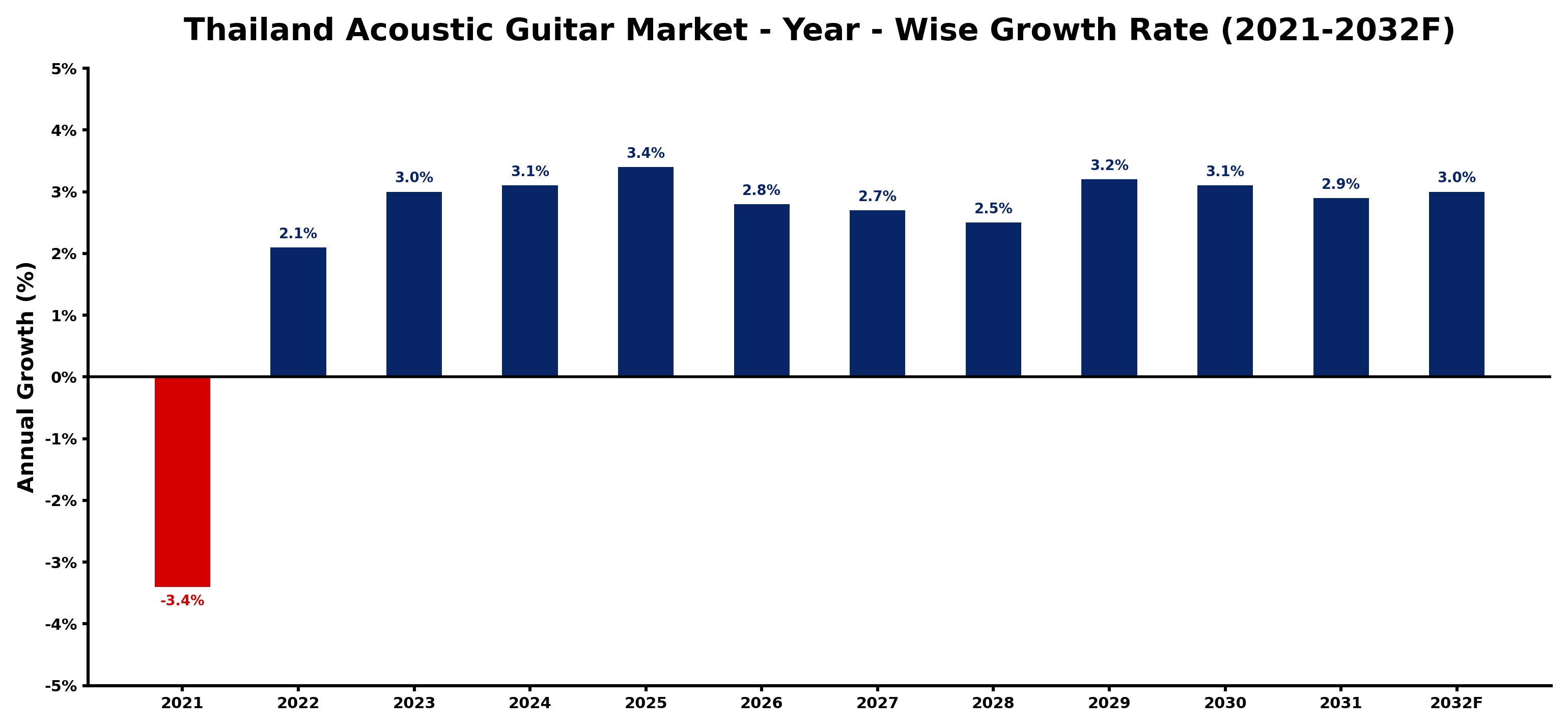
The table below presents the year‑wise growth rates along with the key drivers influencing the market
| Year | Growth Rate | Major Drivers |
| 2021 | -3.4% | Supply chain disruptions hinder acoustic guitar manufacturing capabilities |
| 2022 | 2.1% | Local guitar manufacturers adopt CNC technology for precision wood cutting |
| 2023 | 3.0% | Technological upgrades in woodworking machinery boosted acoustic guitar production efficiency |
| 2024 | 3.1% | Export driven demand for quality wood enhanced guitar production capabilities |
| 2025 | 3.4% | Higher local craftsmanship demand drives acoustic guitar production volume |
| 2026 | 2.8% | New guitar factory openings boost local wood sourcing activities |
| 2027 | 2.7% | Increased automation in guitar manufacturing enhances production capacity and efficiency |
| 2028 | 2.5% | Manufacturing investments in sustainable materials boost guitar production efficiency |
| 2029 | 3.2% | Local luthiers adopt advanced techniques for superior guitar production |
| 2030 | 3.1% | Wood sourcing efficiency boosts acoustic guitar manufacturing output capacity |
| 2031 | 2.9% | Domestic music festivals boosted local acoustic guitar production volume |
| 2032 | 3.0% | Domestic guitar manufacturers adopt CNC technology for precision craftsmanship |
Note - Market size estimations and growth projections presented in this report are based on 6Wresearch’s advanced forecasting approach, validated with industry datasets as of June 2026.
Thailand Acoustic Guitar Market Synopsis
Following a period of heightened interest during the pandemic, the Thailand Acoustic Guitar Market is entering a transformative phase. The combination of rising music enthusiasts and technological advancements in instrument production is setting the stage for substantial growth.
As brands and manufacturers adapt to changing consumer preferences, the market is witnessing a proliferation of innovative designs and features. This evolution not only enhances the acoustic guitar playing experience but also broadens its appeal among diverse demographic segments across the country.
Thailand Acoustic Guitar Market Key Takeaways
- The acoustic guitar market in Thailand is projected to thrive as music education and self-expression continue to gain traction.
- Online sales have become a significant channel, reshaping how consumers purchase instruments.
- New trends like fingerstyle playing are energizing interest and participation in guitar music.
- Renowned artists are increasingly endorsing acoustic guitars, enhancing brand visibility and desirability.
- Competitive pricing across various sales channels supports wider accessibility for consumers.
Evaluation of Restraints in Thailand Acoustic Guitar Market
While the Thailand acoustic guitar market exhibits promising growth prospects, several restraints persist. The increasing number of manufacturers and suppliers creates a competitive landscape where differentiation becomes paramount. As players vie for market share, maintaining consistent quality while balancing pricing can be challenging. Furthermore, enhancing public interest in music education remains crucial; insufficient emphasis on promoting local talent may stifle growth potential. Addressing these challenges will be essential for fostering a vibrant market atmosphere.
Thailand Acoustic Guitar Market Trends
Current trends indicate a shift towards personalization and customization in acoustic guitars, allowing musicians to express their unique styles. Additionally, the rise of digital platforms is facilitating virtual guitar lessons and community engagement, further popularizing the instrument. Emerging genres and playing styles are driving innovative design choices that resonate with younger audiences. Moreover, social media is playing a pivotal role in connecting aspiring musicians with experienced artists, fostering a culture of collaboration and sharing.
Thailand Acoustic Guitar Market Opportunities
The Thailand acoustic guitar market is ripe with opportunities for investment and innovation. Expanding e-commerce capabilities and enhancing online marketing strategies can open new customer segments. Manufacturers can benefit from collaboration with music schools and local artists to promote educational programs, thereby fostering community engagement. Moreover, capitalizing on emerging trends, such as sustainable materials and eco-friendly production processes, could provide a competitive edge in a growing eco-conscious consumer base.
Government Initiatives in the Thailand Acoustic Guitar Market
The Thai government has shown commitment to promoting the arts and culture, which includes support for music education and local talent development. Policies aimed at enhancing access to musical instruments, including acoustic guitars, are being evaluated. Government funding for arts programs, along with initiatives to encourage music festivals and cultural exchanges, can further stimulate interest in acoustic music and its associated instruments across diverse communities.
Future Insights of the Thailand Acoustic Guitar Market
Looking forward to the 2026-2032 period, the Thailand acoustic guitar market is set to experience substantial growth fueled by increasing music education initiatives and community engagement. As technology continues to enhance the manufacturing processes, consumers can expect a wider variety of high-quality instruments tailored to their preferences. The emphasis on music as a vital cultural element will likely drive demand, positioning acoustic guitars as a mainstay in both personal and educational settings.
Thailand Acoustic Guitar Market Latest Developments (May 2025 - June 2026)
Recent developments in the Thailand acoustic guitar market reflect an ongoing adaptation to consumer needs. Enhanced digital marketing strategies have emerged as brands seek to engage younger audiences through social media platforms. Moreover, partnerships with educational institutions are being explored to introduce innovative teaching methodologies, fostering interest in guitar playing from an early age. Manufacturers are also investing in sustainable practices, responding to growing demand for environmentally friendly products.
Thailand Acoustic Guitar Market - Key Attractiveness of the Report
- 10 Years of Market Numbers
- Historical Data Starting from 2022 to 2025
- Base Year: 2025
- Forecast Data until 2032
- Key Performance Indicators Impacting the Market
- Major Upcoming Developments and Projects
Key Highlights of the Report:
- Thailand Acoustic Guitar Market Outlook
- Market Size of Thailand Acoustic Guitar Market, 2025
- Forecast of Thailand Acoustic Guitar Market, 2032
- Historical Data and Forecast of Thailand Acoustic Guitar Revenues & Volume for the Period 2022-2032F
- Thailand Acoustic Guitar Market Trend Evolution
- Thailand Acoustic Guitar Market Drivers and Challenges
- Thailand Acoustic Guitar Price Trends
- Thailand Acoustic Guitar Porter's Five Forces
- Thailand Acoustic Guitar Industry Life Cycle
- Historical Data and Forecast of Thailand Acoustic Guitar Market Revenues & Volume By Product for the Period 2022-2032F
- Historical Data and Forecast of Thailand Acoustic Guitar Market Revenues & Volume By Nylon/gut Stringed Guitars for the Period 2022-2032F
- Historical Data and Forecast of Thailand Acoustic Guitar Market Revenues & Volume By Steel Stringed Guitars for the Period 2022-2032F
- Historical Data and Forecast of Thailand Acoustic Guitar Market Revenues & Volume By Other for the Period 2022-2032F
- Historical Data and Forecast of Thailand Acoustic Guitar Market Revenues & Volume By Application for the Period 2022-2032F
- Historical Data and Forecast of Thailand Acoustic Guitar Market Revenues & Volume By Perform for the Period 2022-2032F
- Historical Data and Forecast of Thailand Acoustic Guitar Market Revenues & Volume By Teaching for the Period 2022-2032F
- Historical Data and Forecast of Thailand Acoustic Guitar Market Revenues & Volume By Other for the Period 2022-2032F
- Thailand Acoustic Guitar Import Export Trade Statistics
- Market Opportunity Assessment By Product
- Market Opportunity Assessment By Application
- Thailand Acoustic Guitar Top Companies Market Share
- Thailand Acoustic Guitar Competitive Benchmarking By Technical and Operational Parameters
- Thailand Acoustic Guitar Company Profiles
- Thailand Acoustic Guitar Key Strategic Recommendations






































