Thailand Active Phased Array Radar Market Growth Rate
According to 6Wresearch internal database and industry insights, The Thailand Active Phased Array Radar Market is projected to grow at a CAGR of approximately 8.6% during 2026–2032.
Thailand Active Phased Array Radar Market Year-wise Growth Rate and Key Drivers (2022-2032)
This graph illustrates the annual growth rates of the Thailand Active Phased Array Radar Market from 2022 to 2032, highlighting a steady upward trajectory and projected market expansion over the forecast period.
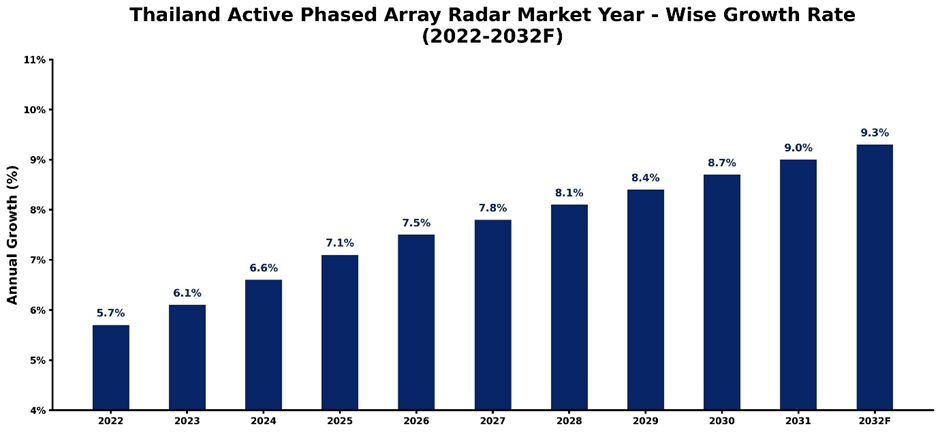
The following table presents the estimated annual growth rates of the market for each year, along with the key factors influencing market performance during the respective period. The values are intended to highlight year-wise drivers rather than provide a direct comparison between individual years.
| Year | Estimated Annual Growth (%) | Market Rationale |
| 2022 | 5.7% | Increasing requirements for airspace monitoring supported gradual market development. |
| 2023 | 6.1% | Growing defense expenditure and greater attention toward advanced detection and tracking systems contributed to market expansion. |
| 2024 | 6.6% | Demand for three-dimensional surveillance and modernization of aging radar equipment strengthened adoption. |
| 2025 | 7.1% | Increasing procurement of advanced defense electronics and growing requirements for multi-mission radar systems. |
| 2026 | 7.5% | Rising investment in air-defense modernization and electronically scanned radar technologies is expected to accelerate demand. |
| 2027 | 7.8% | Greater adoption of digitally controlled radar systems and network-connected surveillance platforms is expected to support market expansion. |
| 2028 | 8.1% | Increasing deployment of unmanned aerial systems and the need for faster detection and tracking are likely to encourage advanced radar adoption. |
| 2029 | 8.4% | Expansion of integrated air-defense networks and growing requirements for low-observable target detection are expected to strengthen market development. |
| 2030 | 8.7% | Integration of radar with command-and-control systems, electronic warfare platforms, and counter-drone technologies is projected to generate additional demand. |
| 2031 | 9% | Continued modernization of military and aerospace infrastructure is expected to maintain a strong growth trajectory for advanced radar solutions. |
| 2032 | 9.3% | Long-term market development is expected to be supported by digital radar adoption and advanced surveillance requirements. |
Topics Covered in the Thailand Active Phased Array Radar Market Report
The Thailand Active Phased Array Radar Market report covers the Market by type and end user. It provides an in-depth analysis of technological advancements, competitive landscape, market opportunities, industry trends, and key growth drivers, enabling stakeholders to understand current and future market dynamics.
Thailand Active Phased Array Radar Market Overview
The Thailand Active Phased Array Radar Market growth is boosting as the country growing focus on modern surveillance, air-defense, aerospace, and security infrastructure. Active phased array radar technology provides rapid electronic beam steering, simultaneous target tracking, high detection accuracy, and multi-function operation, which make it suitable for monitoring complex airspace environments. The increasing number of unmanned aerial vehicles and more sophisticated aerial threats are driving demand for radar systems that can detect multiple targets at different ranges and altitudes.
Thailand Active Phased Array Radar Market Highlights
| Report Name | Thailand Active Phased Array Radar Market |
| Forecast period | 2026-2032 |
| CAGR | 8.6% |
| Growing Sector | Aerospace |
Evaluation of Drivers in Thailand Active Phased Array Radar Market (2026–2032)
Below mentioned are some major drivers and their influence on the market dynamics:
| Market Driver | Major Benefiting Segment | What it Means |
| Defense modernization | Military & Defense | Replacement of conventional radar systems with electronically scanned platforms is increasing demand for advanced detection and tracking capabilities. |
| Rising drone and UAV activity | Military & Defense | The need to identify small and low-altitude aerial targets is encouraging deployment of high-resolution radar technologies. |
| Growth in aerospace modernization | Aerospace | Aircraft modernization programs are creating opportunities for advanced electronically scanned radar systems and mission sensors. |
| Increasing digitalization | Digital Radar | Digital processing provides greater flexibility in beam management, target classification, signal processing, and software upgrades. |
| Expansion of aviation infrastructure | Civil Aviation | Increasing aircraft movements and airport-security requirements are generating demand for advanced surveillance technologies. |
The Thailand Active Phased Array Radar Market is expected to expand at approximately 8.6% CAGR between 2026 and 2032 as the country increases investment in advanced defense electronics and surveillance infrastructure. Defense modernization, rising surveillance requirements, and expanding aviation activity are some other major drivers contributing to the market growth. Thailand spends around 1% of GDP to defense, with approximately 18% of the defense budget directed to the Royal Thai Air Force, supporting advanced radar procurement. Increasing counter-UAS requirements, aerospace modernization, and digital radar adoption are further accelerating market opportunities.
Evaluation of Restraints in Thailand Active Phased Array Radar Market
Below mentioned are some major restraints and their influence on market dynamics:
| Market Challenge | Most Affected Segment | Impact on Market |
| High system acquisition cost | Digital Radar | Advanced phased array systems require substantial investment, which can restrict adoption among organizations with limited budgets. |
| Complex system integration | Military & Defense | Integration with existing command-and-control and communication infrastructure can increase deployment time and project costs. |
| Lengthy procurement procedures | Military & Defense | Government procurement processes and budget approvals can delay large-scale radar modernization projects. |
| Requirement for specialized expertise | Aerospace | Operation and maintenance of sophisticated radar platforms require highly trained technical personnel. |
| Technology dependency | Civil Aviation | Dependence on specialized electronic components and external technology providers can increase lifecycle costs. |
Challenges in Thailand Active Phased Array Radar Market
High technology costs represent one of the major challenges facing the Thailand Active Phased Array Radar Market. Active phased array systems incorporate sophisticated antenna elements, transmit-receive modules, processors, software, and electronic components, making them more expensive than conventional radar technologies. Another challenge is the difficulty that is involved in integrating new radar platforms with existing surveillance infrastructure. Military and aviation operators often require compatibility with communication networks, command-and-control platforms, air-defense systems, and other sensors.
Trends in Thailand Active Phased Array Radar Market
Some of the notable trends impacting the market are mentioned below:
- Growing Demand for Counter-UAS Radar: Increasing deployment of drones for commercial, recreational, and military purposes is creating demand for radar systems capable of detecting small, slow-moving, and low-altitude targets.
- Growing Need for Multi-Mission Radar Platforms: End users are increasingly demanding for radar platforms that are capable of performing multiple surveillance and tracking functions rather than individual systems for each application.
- Development of Advanced Radar Processing: Improvements in digital signal processing and artificial-intelligence-supported target classification are expected to improve detection, tracking, and identification capabilities.
Investment Opportunities in Thailand Active Phased Array Radar Market
Below mentioned are some of the investment opportunities, which include:
- Military Surveillance Systems: Companies developing air-defense radar, long-range surveillance systems, counter-UAS solutions, and integrated radar networks can benefit from increasing defense requirements.
- Aerospace Radar Technologies: Aircraft surveillance, mission systems, airborne radar, and fighter aircraft modernization represent additional areas for technology providers and system integrators.
- Civil Aviation Surveillance: Airport surveillance, airspace monitoring, perimeter security and counter-drone systems present opportunities to radar suppliers to the aviation sector.
Leading Players in Thailand Active Phased Array Radar Market
Stated below are some of the leading companies contributing significantly to the Thailand Active Phased Array Radar Market share:
1. Indra
| Company Name | Indra |
|---|---|
| Established Year | 1993 |
| Headquarters | Alcobendas, Spain |
| Official Website | Click Here |
Indra develops advanced radar, surveillance, air-defense, aerospace, and defense technologies for military and civil applications.
2. Leonardo S.p.A.
| Company Name | Leonardo S.p.A. |
|---|---|
| Established Year | 1948 |
| Headquarters | Rome, Italy |
| Official Website | Click Here |
Leonardo provides radar, defense electronics, aerospace systems, and integrated surveillance technologies for military, security, and aerospace applications.
3. Saab AB
| Company Name | Saab AB |
|---|---|
| Established Year | 1937 |
| Headquarters | Stockholm, Sweden |
| Official Website | Click Here |
Saab develops radar, airborne surveillance, electronic warfare, command-and-control, and aerospace technologies. Its radar portfolio supports military surveillance and air-defense requirements across diverse operating environments.
4. Thales Group
| Company Name | Thales Group |
|---|---|
| Established Year | 2000 |
| Headquarters | Paris, France |
| Official Website | Click Here |
Thales Group provides radar and surveillance systems for defense, aerospace, air traffic management, and security applications, supporting airspace monitoring, target detection, and integrated surveillance operations.
5. RV Connex
| Company Name | RV Connex |
|---|---|
| Established Year | 2006 |
| Headquarters | Thailand |
| Official Website | Click Here |
RV Connex is a Thai aerospace and defense technology company involved in engineering, unmanned systems, defense technologies, and systems integration.
Government Initiatives in the Thailand Active Phased Array Radar Market
According to Thai government data, authorities is strengthening its defense technology ecosystem through initiatives focused on radar modernization, domestic research, and reduced dependence on imported defense technologies. The Royal Thai Air Force White Paper includes projects for mobile radar, air-defense radar at multiple locations, and future passive radar development. The National Research Council of Thailand has also funded 85 defense and security research projects during 2020–2026, including radar technology and surveillance systems. In addition, THAIDEF-EX 2026 promotes local defense manufacturing, research commercialization, and public-private technology collaboration.
Future Outlook of Thailand Active Phased Array Radar Market
The Thailand Active Phased Array Radar Market is expected to maintain a positive growth landscape, on account of ongoing defense modernization, airspace surveillance requirements, and increasing demand for advanced multi-mission radar systems. Digital radar solutions are likely to gain greater adoption due to their flexibility, faster signal processing, and integration capabilities. Rising counter-UAS requirements, aerospace modernization, and network-centric defense infrastructure will further create opportunities, while planned radar procurement and research programs are expected to encourage technology development and local system-integration capabilities.
Market Segmentation Analysis
This report presents a detailed analysis of the Market across key segments along with their leading categories.
By Type – Analog Radar Held a Significant Share, Digital Radar Expected to Witness Strong Growth
As per Bhawna Singh, Assistant Manager, 6Wresearch, The Analog Radar segment accounted for an estimated 42.8% share of the Thailand Active Phased Array Radar Market in 2025, supported by continued utilization of established radar infrastructure across defense and surveillance applications. However, during 2026–2032, the Digital Radar segment is projected to register a stronger CAGR of approximately 9.4%, driven by increasing demand for advanced signal processing.
By End User – Military & Defense Dominated the Market, Aerospace Expected to Expand Rapidly
The Military & Defense segment represented approximately 61.7% of the Thailand Active Phased Array Radar Market in 2025, primarily due to rising requirements for air-defense surveillance. Over 2026–2032, the Aerospace segment is expected to grow at a CAGR of around 9.1%, on account of aircraft modernization.
Note: Market size estimations and growth projections presented in this report are based on 6Wresearch's proprietary forecasting methodology, utilizing the latest available industry data, government publications, and primary research inputs.
Key Attractiveness of the Report:
- 10 Years of Market Numbers
- Historical Data Starting from 2022 to 2025
- Base Year: 2025
- Forecast Data until 2032
- Key Performance Indicators Impacting the Market
- Major Upcoming Developments and Projects
Key Highlights of the Report:
- Thailand Active Phased Array Radar Market Outlook
- Market Size of Thailand Active Phased Array Radar Market, 2025
- Forecast of Thailand Active Phased Array Radar Market, 2032
- Historical Data and Forecast of Thailand Active Phased Array Radar Revenues & Volume for the Period 2022-2032
- Thailand Active Phased Array Radar Market Trend Evolution
- Thailand Active Phased Array Radar Market Drivers and Challenges
- Thailand Active Phased Array Radar Price Trends
- Thailand Active Phased Array Radar Porter's Five Forces
- Thailand Active Phased Array Radar Industry Life Cycle
- Historical Data and Forecast of Thailand Active Phased Array Radar Market Revenues & Volume By Type for the Period 2022-2032
- Historical Data and Forecast of Thailand Active Phased Array Radar Market Revenues & Volume By Analog Radar for the Period 2022-2032
- Historical Data and Forecast of Thailand Active Phased Array Radar Market Revenues & Volume By Digital Radar for the Period 2022-2032
- Historical Data and Forecast of Thailand Active Phased Array Radar Market Revenues & Volume By End User for the Period 2022-2032
- Historical Data and Forecast of Thailand Active Phased Array Radar Market Revenues & Volume By Military & Defense for the Period 2022-2032
- Historical Data and Forecast of Thailand Active Phased Array Radar Market Revenues & Volume By Aerospace for the Period 2022-2032
- Historical Data and Forecast of Thailand Active Phased Array Radar Market Revenues & Volume By Automotive for the Period 2022-2032
- Historical Data and Forecast of Thailand Active Phased Array Radar Market Revenues & Volume By Civil Aviation for the Period 2022-2032
- Thailand Active Phased Array Radar Import Export Trade Statistics
- Market Opportunity Assessment By Type
- Market Opportunity Assessment By End User
- Thailand Active Phased Array Radar Top Companies Market Share
- Thailand Active Phased Array Radar Competitive Benchmarking By Technical and Operational Parameters
- Thailand Active Phased Array Radar Company Profiles
- Thailand Active Phased Array Radar Key Strategic Recommendations
Market Covered
The report provides comprehensive coverage of the following market segments:
By Type
- Analog Radar
- Digital Radar
By End User
- Military & Defense
- Aerospace
- Automotive
- Civil Aviation






































