Thailand Aluminum Market: Import Trend Analysis
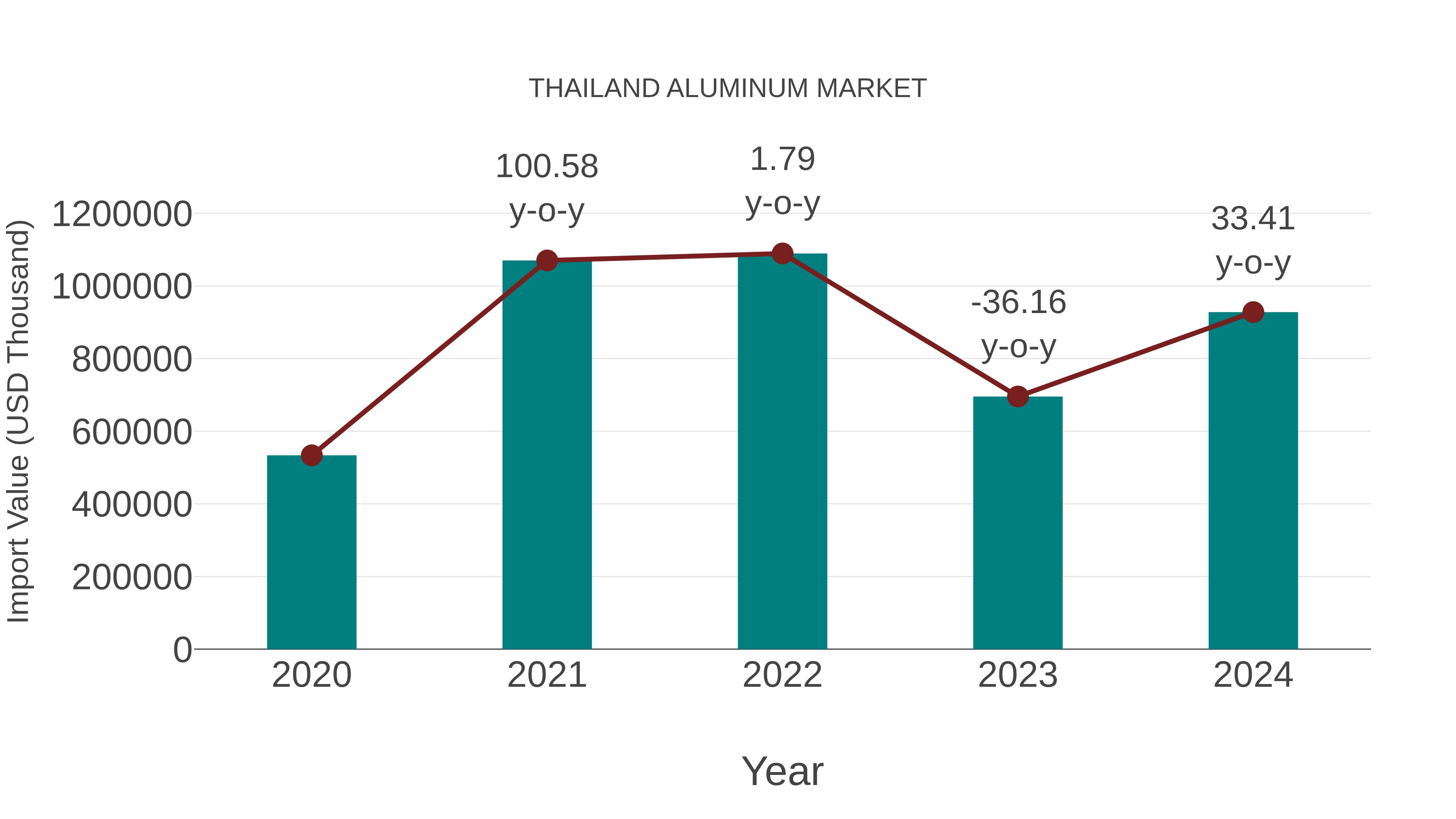
Thailand aluminum market witnessed a notable import momentum from 2023 to 2024, with a growth rate of 33.41%. The compound annual growth rate (CAGR) for imports during the period of 2020 to 2024 stood at 14.84%. This surge in imports can be attributed to a shift in demand dynamics, reflecting evolving market conditions and trade patterns within the industry.
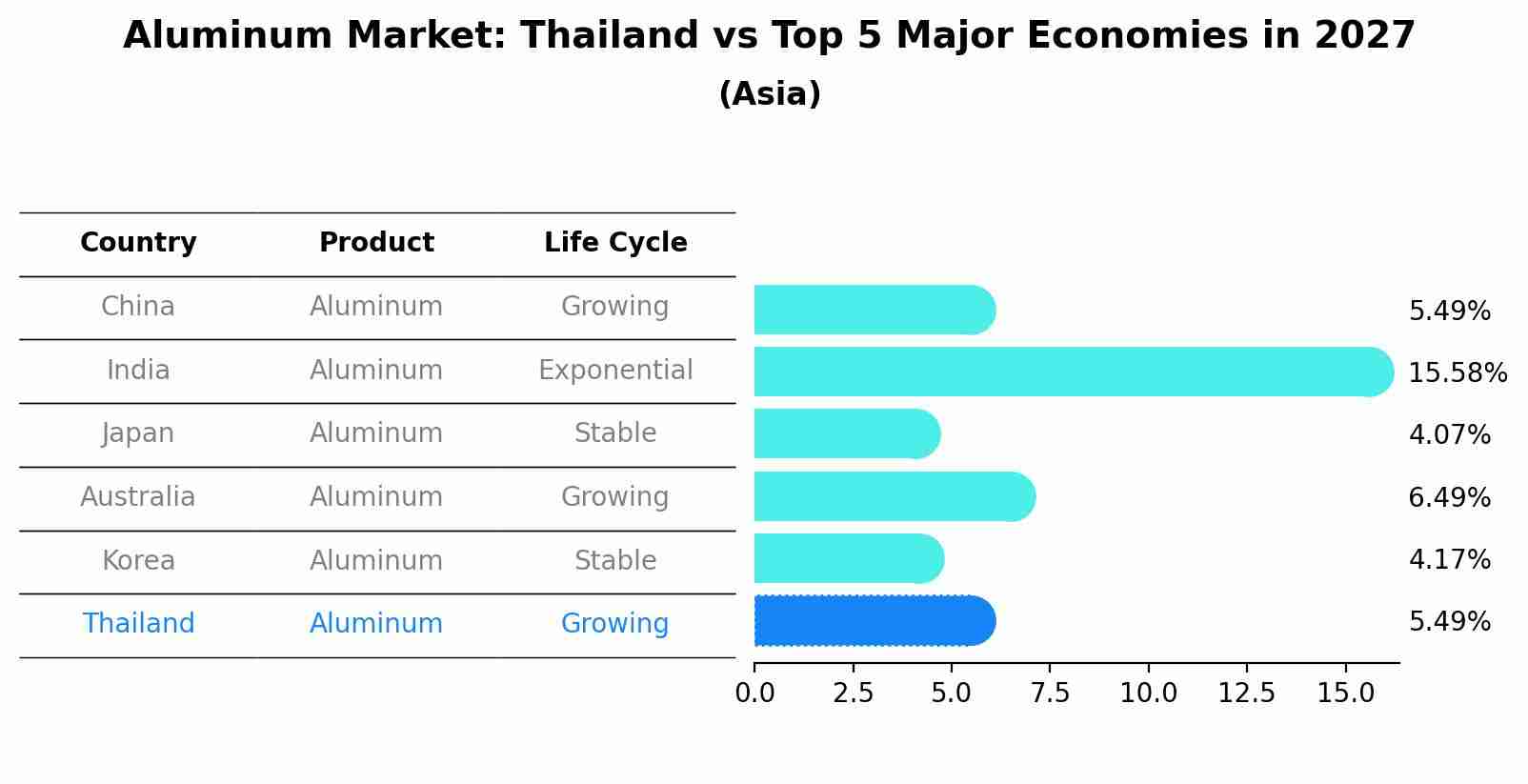
Aluminum Market: Thailand vs Top 5 Major Economies in 2027 (Asia)
In the Asia region, the Aluminum market in Thailand is projected to expand at a growing growth rate of 5.49% by 2027. The largest economy is China, followed by India, Japan, Australia and South Korea.
Thailand Aluminum Market Synopsis
Thailand is one of the world???s major aluminum producers, ranking fifth in terms of production volume. The country produces around 1.08 million metric tons annually and has a market size of USD 7 billion in 2025. Thailand aluminum industry is driven by strong demand from consumer products, automotive parts and construction sectors.
Market Drivers
The primary drivers for the growth of Thailand aluminum market are increasing automobile production due to rising domestic vehicle sales, growing infrastructure investment creating new opportunities for the construction sector as well as expanding industrial activities that are driving up consumption of aluminum products such as pipes and cylinders. The government also provides incentives such as tax breaks or exemptions to encourage companies to invest in the development of energy efficient buildings using materials like aluminum sheets/panels which further fuel its demand growth. In addition, technological advancements and innovations in packaging solutions along with an increase in applications related to building envelopes are expected to drive further growth over the forecast period (2025-2031).
Challenges of the Market
Despite these positive factors, there are some challenges faced by Thailand Aluminum Market including high cost and low productivity associated with local suppliers; rising competition from China; fluctuations in prices due to limited raw material availability; environmental restrictions on mining operations leading to higher operational costs; lack of skilled labor force among others. These issues need adequate attention if Thailand wants to maintain its competitive edge over other markets globally when it comes to producing quality alumina at competitive rates.
Covid-19 Impact on the Market
Due Covid-19 pandemic outbreak since 2025 across countries have significantly impacted several industries including metal & mining segment specifically aluminium industry due global lockdown situation resulting disruption supply chain network & fall down economic activity across countries worldwide affecting overall market dynamics adversely during 2025???2025 time frame however according recent report publisheb by 6Wresearch indicating global aluminium smelting capacity grew 6% YoY during 2025 Q1 amid recovering regional demand post covid 19 pandemic while anticipating strong outlook towards 2025 timeframe onwards driven by recovery global economy.
Key Players of the Market
Some key players identified include Thailand Aluminium Co Ltd., Indochina Aluminium Co Ltd., Asia Aluminium Industry Public Co., Bangkok Cable Public Company Limited, CP All PCL etc
Key Highlights of the Report:
- Thailand Aluminum Market Outlook
- Market Size of Thailand Aluminum Market, 2025
- Forecast of Thailand Aluminum Market, 2032
- Historical Data and Forecast of Thailand Aluminum Revenues & Volume for the Period 2022-2032F
- Thailand Aluminum Market Trend Evolution
- Thailand Aluminum Market Drivers and Challenges
- Thailand Aluminum Price Trends
- Thailand Aluminum Porter's Five Forces
- Thailand Aluminum Industry Life Cycle
- Historical Data and Forecast of Thailand Aluminum Market Revenues & Volume By Type for the Period 2022-2032F
- Historical Data and Forecast of Thailand Aluminum Market Revenues & Volume By Primary for the Period 2022-2032F
- Historical Data and Forecast of Thailand Aluminum Market Revenues & Volume By Secondary for the Period 2022-2032F
- Historical Data and Forecast of Thailand Aluminum Market Revenues & Volume By Product Type for the Period 2022-2032F
- Historical Data and Forecast of Thailand Aluminum Market Revenues & Volume By Flat Rolled for the Period 2022-2032F
- Historical Data and Forecast of Thailand Aluminum Market Revenues & Volume By Castings for the Period 2022-2032F
- Historical Data and Forecast of Thailand Aluminum Market Revenues & Volume By Extrusions for the Period 2022-2032F
- Historical Data and Forecast of Thailand Aluminum Market Revenues & Volume By Forgings for the Period 2022-2032F
- Historical Data and Forecast of Thailand Aluminum Market Revenues & Volume By Pigments & Powder for the Period 2022-2032F
- Historical Data and Forecast of Thailand Aluminum Market Revenues & Volume By Rod & Bar for the Period 2022-2032F
- Historical Data and Forecast of Thailand Aluminum Market Revenues & Volume By End-users for the Period 2022-2032F
- Historical Data and Forecast of Thailand Aluminum Market Revenues & Volume By Transport for the Period 2022-2032F
- Historical Data and Forecast of Thailand Aluminum Market Revenues & Volume By Building & Construction for the Period 2022-2032F
- Historical Data and Forecast of Thailand Aluminum Market Revenues & Volume By Electrical Engineering for the Period 2022-2032F
- Historical Data and Forecast of Thailand Aluminum Market Revenues & Volume By Consumer Goods for the Period 2022-2032F
- Historical Data and Forecast of Thailand Aluminum Market Revenues & Volume By Foil & Packaging for the Period 2022-2032F
- Historical Data and Forecast of Thailand Aluminum Market Revenues & Volume By Machinery & Equipment for the Period 2022-2032F
- Historical Data and Forecast of Thailand Aluminum Market Revenues & Volume By Others for the Period 2022-2032F
- Thailand Aluminum Import Export Trade Statistics
- Market Opportunity Assessment By Type
- Market Opportunity Assessment By Product Type
- Market Opportunity Assessment By End-users
- Thailand Aluminum Top Companies Market Share
- Thailand Aluminum Competitive Benchmarking By Technical and Operational Parameters
- Thailand Aluminum Company Profiles
- Thailand Aluminum Key Strategic Recommendations






































