Thailand Anti Reflective Glass Market Size, Share & Growth Rate
The Thailand Anti Reflective Glass Market was estimated at USD 113 Million in 2025 and is projected to reach USD 129 Million by 2032, growing at a CAGR of 1.9% from 2026 to 2032. This growth trajectory is significantly propelled by the booming electronic gadget industry, which necessitates high-quality displays, and the automotive sector's increasing incorporation of advanced optics. Moreover, the surge in demand for efficient solar panel systems is further driving the adoption of anti-reflective glass, solidifying its position in the Thai market.
Thailand Anti Reflective Glass Market Year-wise Growth Rate and Key Drivers
This graph highlights how the Thailand Anti Reflective Glass Market has steadily grown over the years, supported by major growth factors.
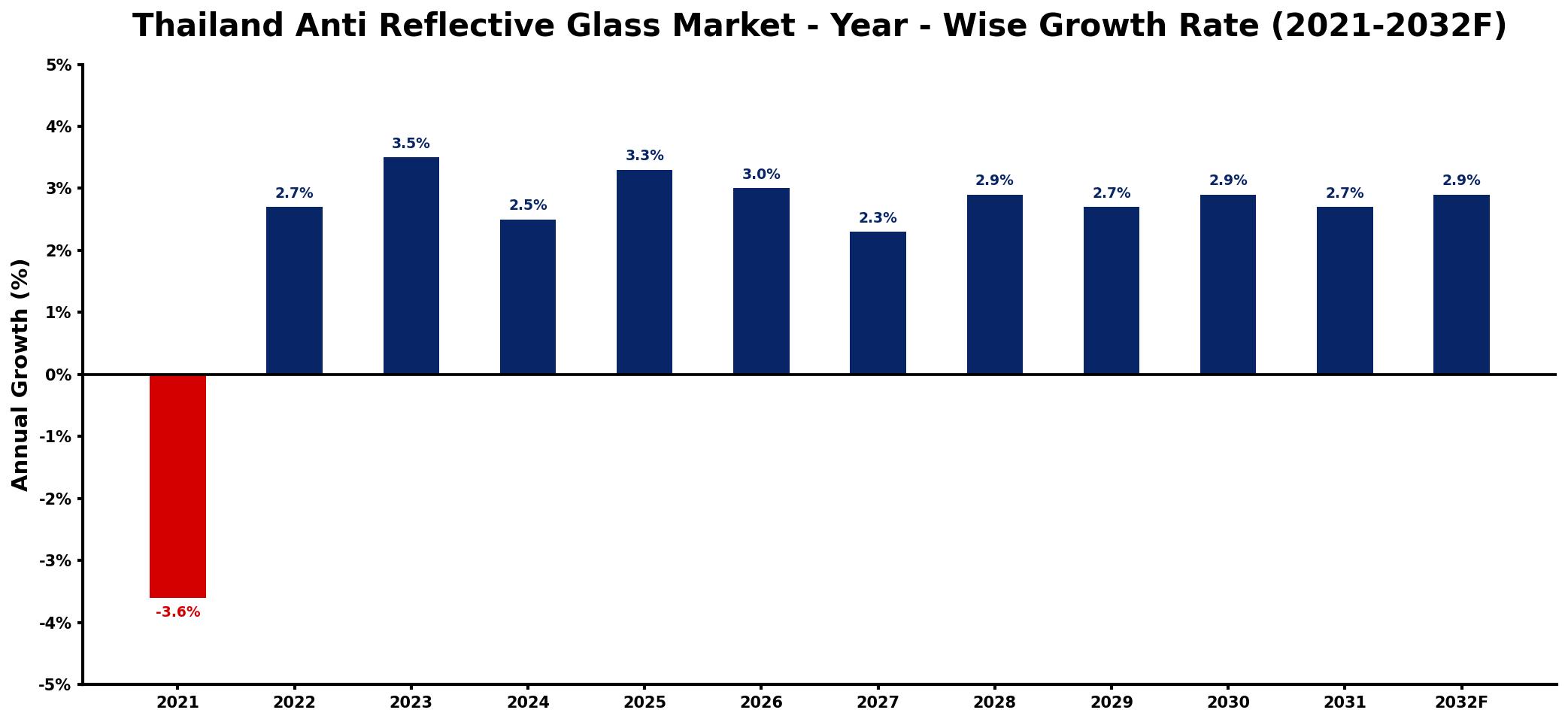
The table below presents the year‑wise growth rates along with the key drivers influencing the market
| Year | Growth Rate | Major Drivers |
| 2021 | -3.6% | decreased construction projects nationwide |
| 2022 | 2.7% | rising demand from automotive sector |
| 2023 | 3.5% | increased investments in infrastructure |
| 2024 | 2.5% | growing popularity in electronics market |
| 2025 | 3.3% | expansion of renewable energy sector |
| 2026 | 3.0% | stronger focus on energy efficiency |
| 2027 | 2.3% | increased residential remodeling activities |
| 2028 | 2.9% | rising urbanization and development |
| 2029 | 2.7% | growing preference for premium products |
| 2030 | 2.9% | enhanced technological advancements emerging |
| 2031 | 2.7% | increased collaborations with manufacturers |
| 2032 | 2.9% | expanding applications in healthcare industry |
Note: Market size estimations and growth projections presented in this report are based on 6Wresearch's proprietary forecasting methodology, utilizing the latest available industry data, government publications, and primary research inputs.
Thailand Anti Reflective Glass Market Synopsis
The anti-reflective glass market in Thailand has gained momentum, largely owing to the rising popularity of electronic devices that require enhanced visibility and reduced glare. This demand extends across various applications including smartphones, tablets, and high-definition televisions, making anti-reflective glass a crucial component.
In addition to consumer electronics, there is a notable uptick in the use of anti-reflective coatings in optics and healthcare instruments. With manufacturers focusing on innovative coatings that promise improved durability and scratch resistance, the market is set to meet the growing needs of diverse sectors effectively.
Thailand Anti Reflective Glass Market Key Takeaways
- The market is witnessing strong growth driven by the electronics and automotive industries.
- Innovations in anti-reflective coatings are enhancing product performance and durability.
- Increased solar panel adoption is opening new avenues for anti-reflective glass applications.
- Market players are prioritizing technological advancements to remain competitive.
- Consumer demand for high-quality displays continues to shape market dynamics.
Evaluation of Restraints in Thailand Anti Reflective Glass Market
Despite the robust growth potential, the Thailand Anti Reflective Glass Market faces several restraints that could hinder its progress. The competitive landscape is intense, requiring manufacturers to consistently innovate and upgrade their technologies to meet changing customer expectations. Furthermore, the challenge of intellectual property rights in such a technologically driven sector can lead to legal complications, which may pose risks to market players. Price sensitivity in specific industries could also limit market expansion, necessitating a balanced approach to pricing strategies.
Thailand Anti Reflective Glass Market Trends
Current trends indicate a shift towards more advanced anti-reflective coating technologies that offer superior performance. Manufacturers are increasingly investing in R&D to develop coatings that enhance not just visibility but also durability and resistance to scratches. Moreover, the rising interest in sustainable energy solutions is likely to drive further demand for anti-reflective coatings in solar panels, as they significantly boost energy absorption efficiency.
Thailand Anti Reflective Glass Market Opportunities
The market presents considerable growth opportunities particularly in the sectors of renewable energy and high-end consumer electronics. As Thailand continues to bolster its renewable energy initiatives, the integration of anti-reflective coatings in solar panel production can significantly enhance market penetration. Additionally, the rapid evolution of display technologies in electronics offers a fertile ground for manufacturers to introduce innovative anti-reflective solutions tailored to emerging products.
Government Initiatives in the Thailand Anti Reflective Glass Market
The Thai government is actively promoting the adoption of advanced technologies across various sectors, including renewable energy and electronics. Programs aimed at enhancing energy efficiency and sustainability have been initiated, creating a favorable environment for the anti-reflective glass market. Incentives for research and development, alongside public investments in technology, are expected to bolster market growth and encourage local manufacturers to innovate.
Future Insights of the Thailand Anti Reflective Glass Market
Looking ahead to 2026-2032, the Thailand Anti Reflective Glass Market is positioned for continued expansion. The ongoing integration of smart technologies into consumer electronics will necessitate even higher quality optics, driving demand for anti-reflective glass. Furthermore, as the automotive industry transitions towards advanced driver assistance systems and electric vehicles, the need for superior visibility solutions will further enhance market prospects.
Thailand Anti Reflective Glass Market Latest Developments (2025 - 2026)
Recent developments in the Thai anti-reflective glass market highlight a surge in partnerships between manufacturers and technology firms aimed at advancing coating technologies. There is a growing emphasis on sustainability, with manufacturers exploring eco-friendly materials for anti-reflective coatings. Furthermore, initiatives to enhance the performance of coatings for solar panels are gaining traction, reflecting the industry's shift towards renewable energy solutions.
Thailand Anti Reflective Glass Market - Key Attractiveness of the Report
- 10 Years of Market Numbers
- Historical Data Starting from 2022 to 2025
- Base Year: 2025
- Forecast Data until 2032
- Key Performance Indicators Impacting the Market
- Major Upcoming Developments and Projects
Key Highlights of the Report:
- Thailand Anti Reflective Glass Market Outlook
- Market Size of Thailand Anti Reflective Glass Market, 2025
- Forecast of Thailand Anti Reflective Glass Market, 2032
- Historical Data and Forecast of Thailand Anti Reflective Glass Revenues & Volume for the Period 2022-2032F
- Thailand Anti Reflective Glass Market Trend Evolution
- Thailand Anti Reflective Glass Market Drivers and Challenges
- Thailand Anti Reflective Glass Price Trends
- Thailand Anti Reflective Glass Porter's Five Forces
- Thailand Anti Reflective Glass Industry Life Cycle
- Historical Data and Forecast of Thailand Anti Reflective Glass Market Revenues & Volume By Type for the Period 2022-2032F
- Historical Data and Forecast of Thailand Anti Reflective Glass Market Revenues & Volume By Double Layers for the Period 2022-2032F
- Historical Data and Forecast of Thailand Anti Reflective Glass Market Revenues & Volume By Four Layers for the Period 2022-2032F
- Historical Data and Forecast of Thailand Anti Reflective Glass Market Revenues & Volume By Others for the Period 2022-2032F
- Historical Data and Forecast of Thailand Anti Reflective Glass Market Revenues & Volume By Application for the Period 2022-2032F
- Historical Data and Forecast of Thailand Anti Reflective Glass Market Revenues & Volume By Architectural Windows for the Period 2022-2032F
- Historical Data and Forecast of Thailand Anti Reflective Glass Market Revenues & Volume By Instrumentation Windows for the Period 2022-2032F
- Historical Data and Forecast of Thailand Anti Reflective Glass Market Revenues & Volume By Electronic Displays for the Period 2022-2032F
- Historical Data and Forecast of Thailand Anti Reflective Glass Market Revenues & Volume By Picture Framing Glass for the Period 2022-2032F
- Historical Data and Forecast of Thailand Anti Reflective Glass Market Revenues & Volume By Showcase Glass for the Period 2022-2032F
- Historical Data and Forecast of Thailand Anti Reflective Glass Market Revenues & Volume By Cold Storage Displays for the Period 2022-2032F
- Historical Data and Forecast of Thailand Anti Reflective Glass Market Revenues & Volume By Lamps Glass for the Period 2022-2032F
- Historical Data and Forecast of Thailand Anti Reflective Glass Market Revenues & Volume By Others for the Period 2022-2032F
- Thailand Anti Reflective Glass Import Export Trade Statistics
- Market Opportunity Assessment By Type
- Market Opportunity Assessment By Application
- Thailand Anti Reflective Glass Top Companies Market Share
- Thailand Anti Reflective Glass Competitive Benchmarking By Technical and Operational Parameters
- Thailand Anti Reflective Glass Company Profiles
- Thailand Anti Reflective Glass Key Strategic Recommendations






































