Thailand Aquaculture & Marine Products Market: Import Trend Analysis
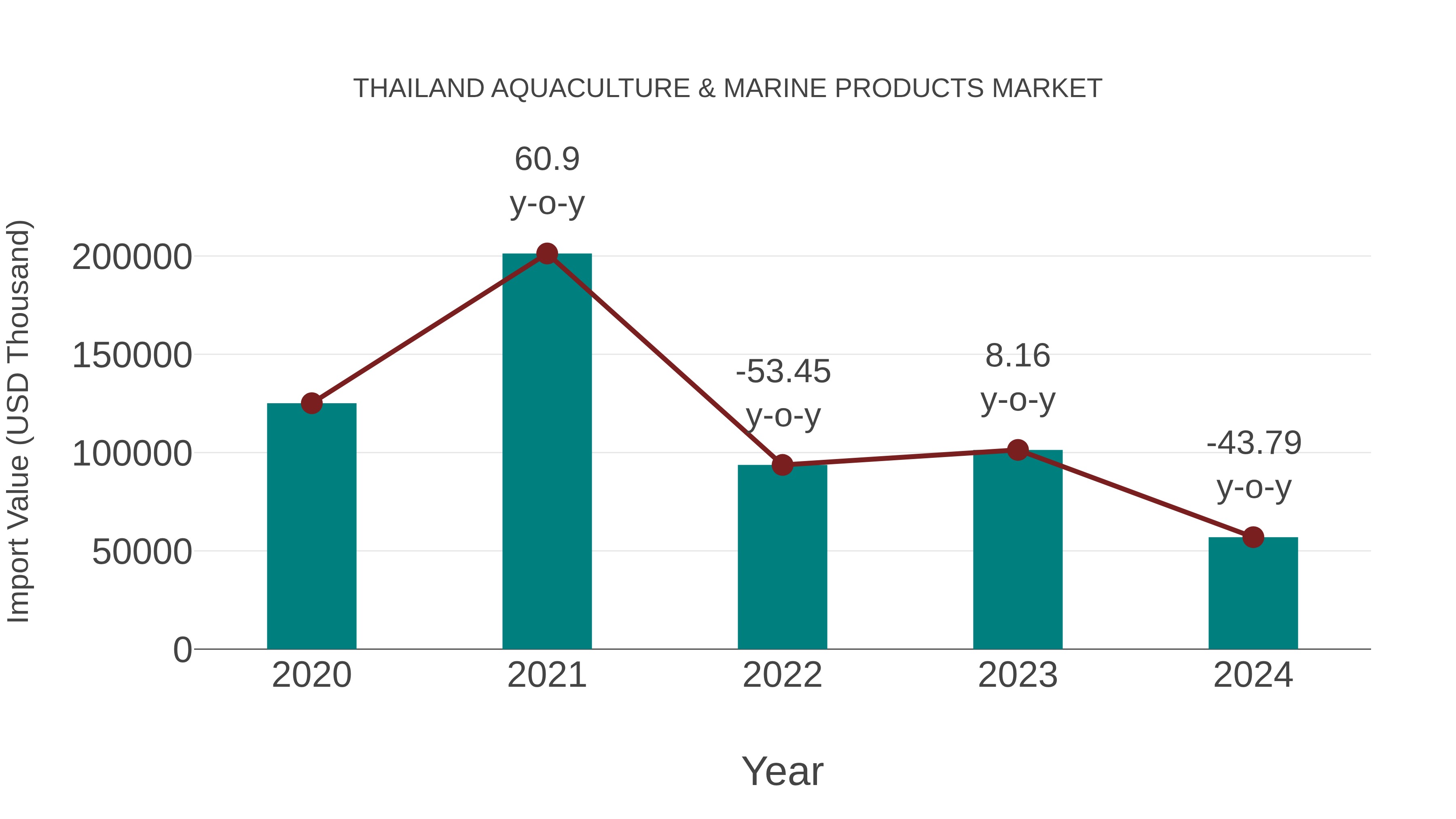
Thailand import trend for aquaculture and marine products experienced a notable decline from 2023 to 2024, with a growth rate of -43.79% during this period. The compound annual growth rate (CAGR) for 2020-2024 stood at -17.85%. This significant contraction could be attributed to shifts in demand dynamics or changes in trade policies impacting market stability.
Thailand Aquaculture Marine Products Market Synopsis
The aquaculture marine products market in Thailand reflects the country`s prominence in the global seafood industry. Thailand is a leading producer and exporter of aquaculture products, including shrimp, fish, and other marine species. The market`s growth is driven by increasing global demand for seafood, advancements in aquaculture technology, and a focus on sustainable seafood production. The government`s support for aquaculture development further strengthens this market`s position.
Drivers of the Market
Thailand aquaculture marine products market is expanding rapidly due to various drivers. First, the global demand for seafood continues to rise, and Thailand is a significant player in the seafood industry. Second, the country`s favorable climate and geographical location make it conducive for aquaculture operations. Third, government initiatives to promote sustainable aquaculture practices are driving investment in the sector. Additionally, the adoption of advanced technologies in aquaculture, such as water quality management and disease control, contributes to increased production and market growth.
Challenges of the Market
The aquaculture marine products market in Thailand faces multifaceted challenges. Overfishing, environmental degradation, and climate change impact the availability of marine resources. Rising production costs and competition from other seafood-producing nations add to the complexity. Moreover, maintaining product quality and safety standards while meeting export requirements is a significant challenge for the industry.
COVID-19 Impact on the Market
The aquaculture marine products market in Thailand was affected by the pandemic as it heavily relies on exports. Disruptions in international trade and transportation impacted the market`s ability to reach global consumers. Additionally, some domestic seafood restaurants and markets faced reduced demand. Producers in this market had to pivot towards local consumption and explore online sales channels to adapt to changing conditions.
Key Players in the Market
The Thailand aquaculture marine products market is supported by leading players like Thai Union Group, Charoen Pokphand Group (CP Group), and Thai Fishsauce Factory (Squid Brand). These companies are pivotal in the production and distribution of marine products for the aquaculture industry, contributing to Thailand position as a significant seafood exporter.
Key Highlights of the Report:
- Thailand Aquaculture & Marine Products Market Outlook
- Market Size of Thailand Aquaculture & Marine Products Market, 2025
- Forecast of Thailand Aquaculture & Marine Products Market, 2032
- Historical Data and Forecast of Thailand Aquaculture & Marine Products Revenues & Volume for the Period 2022-2032F
- Thailand Aquaculture & Marine Products Market Trend Evolution
- Thailand Aquaculture & Marine Products Market Drivers and Challenges
- Thailand Aquaculture & Marine Products Price Trends
- Thailand Aquaculture & Marine Products Porter's Five Forces
- Thailand Aquaculture & Marine Products Industry Life Cycle
- Historical Data and Forecast of Thailand Aquaculture & Marine Products Market Revenues & Volume By Rearing Product Type for the Period 2022-2032F
- Historical Data and Forecast of Thailand Aquaculture & Marine Products Market Revenues & Volume By Equipment for the Period 2022-2032F
- Historical Data and Forecast of Thailand Aquaculture & Marine Products Market Revenues & Volume By Chemicals for the Period 2022-2032F
- Historical Data and Forecast of Thailand Aquaculture & Marine Products Market Revenues & Volume By Pharmaceuticals for the Period 2022-2032F
- Historical Data and Forecast of Thailand Aquaculture & Marine Products Market Revenues & Volume By Fertilizers for the Period 2022-2032F
- Historical Data and Forecast of Thailand Aquaculture & Marine Products Market Revenues & Volume By Others for the Period 2022-2032F
- Historical Data and Forecast of Thailand Aquaculture & Marine Products Market Revenues & Volume By Type for the Period 2022-2032F
- Historical Data and Forecast of Thailand Aquaculture & Marine Products Market Revenues & Volume By Fisheries for the Period 2022-2032F
- Historical Data and Forecast of Thailand Aquaculture & Marine Products Market Revenues & Volume By Seaweeds for the Period 2022-2032F
- Historical Data and Forecast of Thailand Aquaculture & Marine Products Market Revenues & Volume By Microalgae for the Period 2022-2032F
- Historical Data and Forecast of Thailand Aquaculture & Marine Products Market Revenues & Volume By Crustaceans for the Period 2022-2032F
- Historical Data and Forecast of Thailand Aquaculture & Marine Products Market Revenues & Volume By Molluscs for the Period 2022-2032F
- Historical Data and Forecast of Thailand Aquaculture & Marine Products Market Revenues & Volume By Others for the Period 2022-2032F
- Historical Data and Forecast of Thailand Aquaculture & Marine Products Market Revenues & Volume By Production Type for the Period 2022-2032F
- Historical Data and Forecast of Thailand Aquaculture & Marine Products Market Revenues & Volume By Small-Scale for the Period 2022-2032F
- Historical Data and Forecast of Thailand Aquaculture & Marine Products Market Revenues & Volume By Medium & Large Scale for the Period 2022-2032F
- Historical Data and Forecast of Thailand Aquaculture & Marine Products Market Revenues & Volume By Culture for the Period 2022-2032F
- Historical Data and Forecast of Thailand Aquaculture & Marine Products Market Revenues & Volume By Freshwater for the Period 2022-2032F
- Historical Data and Forecast of Thailand Aquaculture & Marine Products Market Revenues & Volume By Brackish Water for the Period 2022-2032F
- Historical Data and Forecast of Thailand Aquaculture & Marine Products Market Revenues & Volume By Marine for the Period 2022-2032F
- Thailand Aquaculture & Marine Products Import Export Trade Statistics
- Market Opportunity Assessment By Rearing Product Type
- Market Opportunity Assessment By Type
- Market Opportunity Assessment By Production Type
- Market Opportunity Assessment By Culture
- Thailand Aquaculture & Marine Products Top Companies Market Share
- Thailand Aquaculture & Marine Products Competitive Benchmarking By Technical and Operational Parameters
- Thailand Aquaculture & Marine Products Company Profiles
- Thailand Aquaculture & Marine Products Key Strategic Recommendations






































