Thailand Artificial Organs Market: Import Trend Analysis
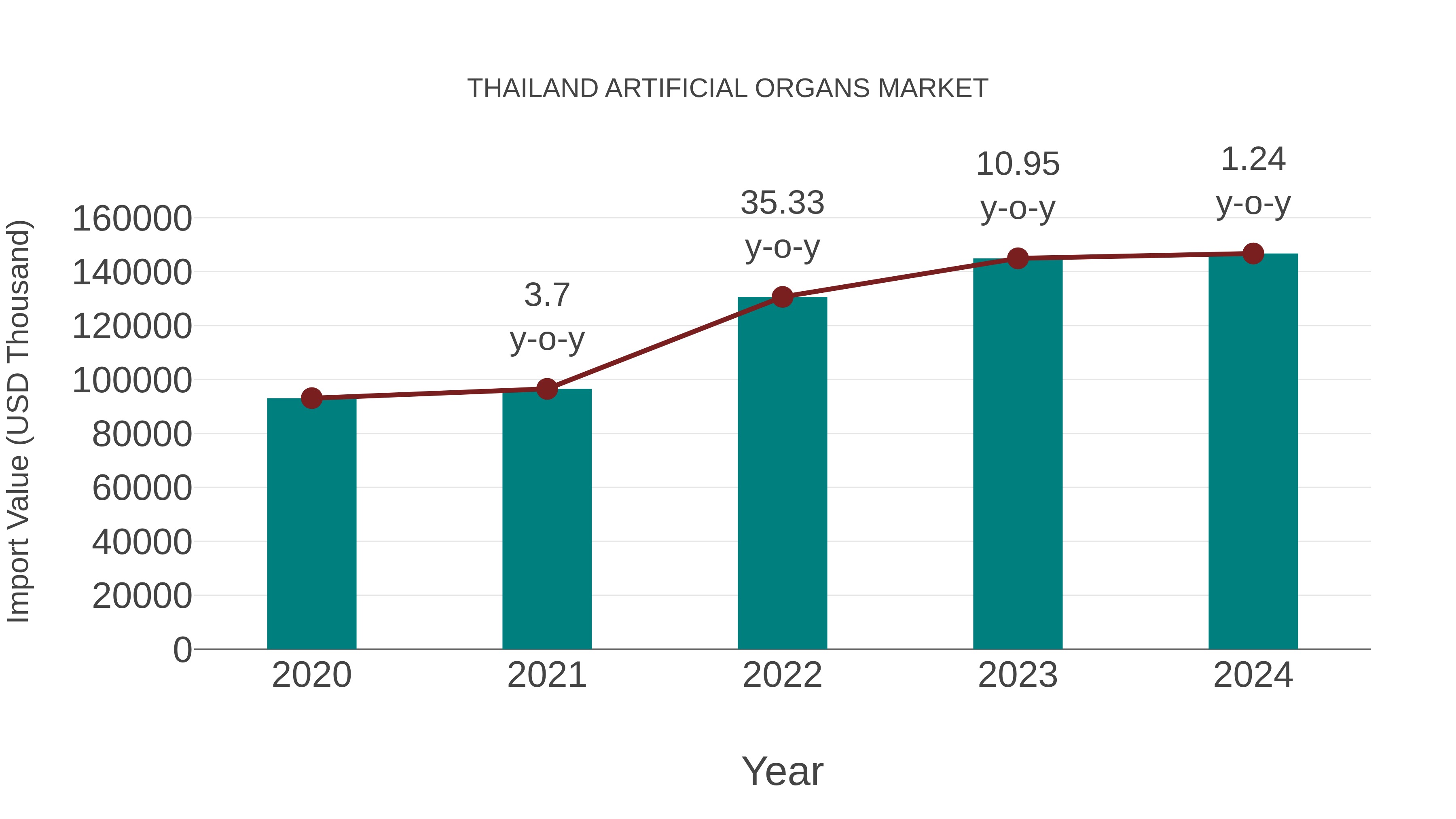
In the Thailand artificial organs market, the import trend exhibited a growth rate of 1.24% from 2023 to 2024, with a compound annual growth rate (CAGR) of 12.05% for the period 2020-2024. This upward import momentum can be attributed to the increasing demand for advanced medical technologies in Thailand healthcare sector, driving market stability and fostering trade growth.
Thailand Artificial Organs Market Synopsis
The Thailand artificial organs market is a critical component of the healthcare sector, addressing the needs of patients with organ failure or dysfunction. Artificial organs, such as artificial hearts, kidneys, and limbs, have made significant advancements in improving the quality of life and increasing survival rates. Thailand healthcare system has witnessed a growing demand for these devices, driven by an aging population and advancements in medical technology. This market involves manufacturers, medical institutions, and research organizations collaborating to develop and provide innovative artificial organ solutions to patients.
Drivers of the Market
The artificial organs market in Thailand is growing due to factors like an aging population and advancements in medical technology. As the population ages, there is a higher incidence of organ failure, leading to increased demand for artificial organs such as pacemakers, artificial limbs, and dialysis machines. Technological innovations and improved healthcare infrastructure contribute to the expansion of this market, providing patients with better treatment options.
Challenges of the Market
The artificial organs market in Thailand confronts challenges associated with healthcare infrastructure and organ transplantation policies. Access to advanced healthcare facilities and the legal and ethical considerations of organ transplantation impact the market`s growth. Collaboration with healthcare providers and regulatory bodies is crucial.
COVID-19 Impact on the Market
The Thailand artificial organs market witnessed a significant impact from the COVID-19 pandemic. As the healthcare system was strained to accommodate COVID-19 patients, elective surgeries, including those involving artificial organs, experienced delays and cancellations. This led to a dip in the demand for artificial organs during the initial phases of the pandemic. However, as the healthcare system adapted to the new normal, there was a gradual recovery in the market. Manufacturers and healthcare providers implemented stringent safety protocols to ensure the safety of patients, which bolstered consumer confidence.
Key Players in the Market
The market for artificial organs in Thailand is vital for healthcare and includes companies like Bangkok Artificial Organ Co., Ltd. and SupraTech Scientific Co., Ltd.
Key Highlights of the Report:
- Thailand Artificial Organs Market Outlook
- Market Size of Thailand Artificial Organs Market, 2025
- Forecast of Thailand Artificial Organs Market, 2032
- Historical Data and Forecast of Thailand Artificial Organs Revenues & Volume for the Period 2022-2032F
- Thailand Artificial Organs Market Trend Evolution
- Thailand Artificial Organs Market Drivers and Challenges
- Thailand Artificial Organs Price Trends
- Thailand Artificial Organs Porter's Five Forces
- Thailand Artificial Organs Industry Life Cycle
- Historical Data and Forecast of Thailand Artificial Organs Market Revenues & Volume By Product Type for the Period 2022-2032F
- Historical Data and Forecast of Thailand Artificial Organs Market Revenues & Volume By Artificial Kidney for the Period 2022-2032F
- Historical Data and Forecast of Thailand Artificial Organs Market Revenues & Volume By Artificial Heart for the Period 2022-2032F
- Historical Data and Forecast of Thailand Artificial Organs Market Revenues & Volume By Artificial Pancreas for the Period 2022-2032F
- Historical Data and Forecast of Thailand Artificial Organs Market Revenues & Volume By Cochlear Implants for the Period 2022-2032F
- Historical Data and Forecast of Thailand Artificial Organs Market Revenues & Volume By Others for the Period 2022-2032F
- Thailand Artificial Organs Import Export Trade Statistics
- Market Opportunity Assessment By Product Type
- Thailand Artificial Organs Top Companies Market Share
- Thailand Artificial Organs Competitive Benchmarking By Technical and Operational Parameters
- Thailand Artificial Organs Company Profiles
- Thailand Artificial Organs Key Strategic Recommendations






































