Thailand Auto Parts And Accessories Market Size, Share & Growth Rate
The Thailand Auto Parts And Accessories Market was estimated at USD 177 Million in 2025 and is projected to reach USD 203 Million by 2032, growing at a CAGR of 2.0% from 2026 to 2032. This positive trajectory is primarily fueled by Thailands strategic position as a manufacturing hub for both domestic and international automotive companies. With the rising demand for innovative automotive technologies and increased vehicle ownership among the growing middle class, the market is set to expand in response to evolving consumer preferences.
Thailand Auto Parts And Accessories Market Year-wise Growth Rate and Key Drivers
This graph highlights how the Thailand Auto Parts And Accessories Market has steadily grown over the years, supported by major growth factors.
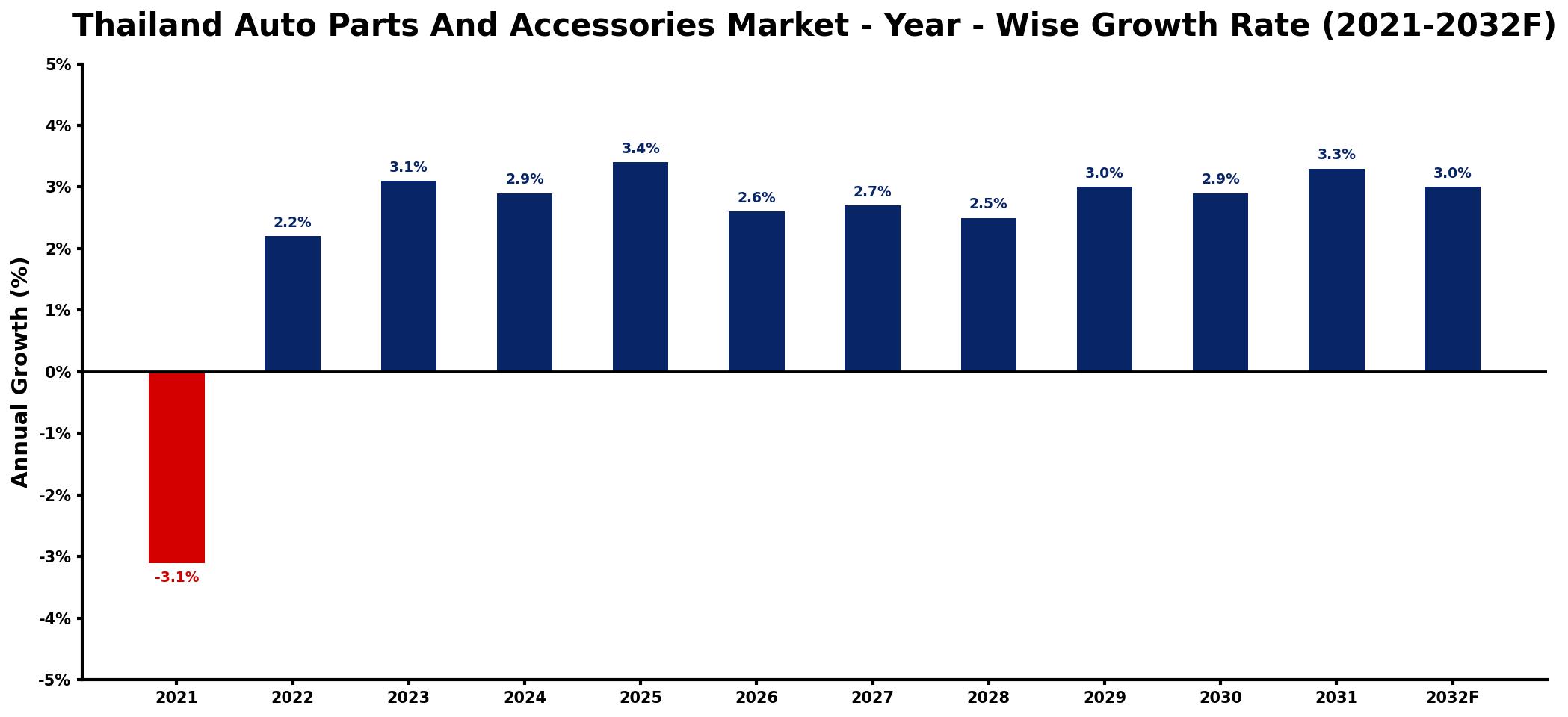
The table below presents the year‑wise growth rates along with the key drivers influencing the market
| Year | Growth Rate | Major Drivers |
| 2021 | -3.1% | decreased consumer spending on vehicles |
| 2022 | 2.2% | rising demand for electric vehicles |
| 2023 | 3.1% | increased investments in manufacturing |
| 2024 | 2.9% | growing popularity of online sales |
| 2025 | 3.4% | expansion of logistics infrastructure |
| 2026 | 2.6% | increased focus on sustainability practices |
| 2027 | 2.7% | growing regional consumption patterns |
| 2028 | 2.5% | rising interest in vehicle customizations |
| 2029 | 3.0% | rising export shipment volumes |
| 2030 | 2.9% | growing demand for fuel efficiency |
| 2031 | 3.3% | increased production capacity expansions |
| 2032 | 3.0% | strengthening international trade flows |
Note: Market size estimations and growth projections presented in this report are based on 6Wresearch's proprietary forecasting methodology, utilizing the latest available industry data, government publications, and primary research inputs.
Thailand Auto Parts And Accessories Market Synopsis
In recent years, the Thailand auto parts and accessories market has demonstrated resilience amidst fluctuating consumer behavior and market dynamics. The pandemic-induced disruptions have subsided, allowing the market to regain its momentum with a focus on health and safety-enhancing products.
Looking ahead, the market is poised for sustained growth, driven by both local demand and the export potential. Innovations in electric and hybrid vehicle components are becoming essential, indicating a shift in focus for manufacturers toward sustainability and technological advancement.
Thailand Auto Parts And Accessories Market Key Takeaways
- The market is anticipated to grow steadily, driven by the increasing vehicle ownership and innovative automotive technologies.
- Government initiatives supporting eco-friendly vehicles are likely to open new avenues for growth.
- The focus on quality and adherence to international standards remains a cornerstone for industry players in Thailand.
- Adaptation to the rise of electric vehicles is critical for traditional manufacturers to maintain market relevance.
- Consumer safety concerns post-pandemic have led to an uptick in demand for specific automotive accessories.
Evaluation of Restraints in Thailand Auto Parts And Accessories Market
Despite the positive outlook, the Thailand auto parts and accessories market faces significant restraints. The rapid shift towards electric vehicles necessitates substantial investment in new technologies, which may strain existing manufacturers. Additionally, the prevalence of counterfeit parts poses a persistent risk, undermining market credibility and consumer trust. Environmental regulations also introduce complexities, requiring manufacturers to realign their strategies and production processes to comply with heightened standards.
Thailand Auto Parts And Accessories Market Trends
Several trends are shaping the Thailand auto parts and accessories market. The push towards electric and hybrid vehicles is leading to increased demand for specialized components. Additionally, technological advancements in automotive electronics, such as smart sensors and advanced driver-assistance systems, are revolutionizing the accessory landscape. Furthermore, consumer preferences are shifting towards personalized vehicle modifications, fostering a thriving aftermarket segment.
Thailand Auto Parts And Accessories Market Opportunities
Opportunities within the Thailand auto parts and accessories market are abundant, especially for businesses willing to innovate. The growth of the electric vehicle segment presents an opportunity for manufacturers to develop and supply new components tailored to these technologies. Moreover, expanding the e-commerce channel allows companies to reach a broader customer base, enhancing sales and market penetration. Investments in R&D for sustainable materials and practices can also provide long-term advantages in a competitive market.
Government Initiatives in the Thailand Auto Parts And Accessories Market
The Thai government has implemented various initiatives to bolster the auto parts and accessories sector. Policies aimed at promoting electric vehicles, such as tax incentives and subsidies, are designed to encourage manufacturers to invest in greener technologies. Public spending on infrastructure improvements and the establishment of automotive industry clusters further support growth. Additionally, regulatory frameworks are being developed to ensure safety and quality standards in auto parts manufacturing, aligning with global practices.
Future Insights of the Thailand Auto Parts And Accessories Market
Between 2026 and 2032, the Thailand auto parts and accessories market is expected to evolve rapidly. The continued rise of electric and hybrid vehicles will necessitate a shift in production strategies, with a strong emphasis on sustainable practices. As the middle class expands, consumer demand will increasingly favor innovative and customized parts, pushing manufacturers to adapt. By embracing technological advancements and focusing on quality, stakeholders can position themselves for success in this dynamic landscape.
Thailand Auto Parts And Accessories Market Latest Developments (2025 - 2026)
In the most recent developments, the Thailand auto parts and accessories market has seen an uptick in collaboration between local manufacturers and international brands, focused on developing advanced components for electric vehicles. Additionally, an increased emphasis on sustainable manufacturing practices is being observed, with firms investing in eco-friendly materials. The market is also witnessing a surge in digital solutions that enhance customer engagement, particularly in online sales platforms.
Thailand Auto Parts And Accessories Market - Key Attractiveness of the Report
- 10 Years of Market Numbers
- Historical Data Starting from 2022 to 2025
- Base Year: 2025
- Forecast Data until 2032
- Key Performance Indicators Impacting the Market
- Major Upcoming Developments and Projects
Key Highlights of the Report:
- Thailand Auto Parts And Accessories Market Outlook
- Market Size of Thailand Auto Parts And Accessories Market, 2025
- Forecast of Thailand Auto Parts And Accessories Market, 2032
- Historical Data and Forecast of Thailand Auto Parts And Accessories Revenues & Volume for the Period 2022-2032F
- Thailand Auto Parts And Accessories Market Trend Evolution
- Thailand Auto Parts And Accessories Market Drivers and Challenges
- Thailand Auto Parts And Accessories Price Trends
- Thailand Auto Parts And Accessories Porter's Five Forces
- Thailand Auto Parts And Accessories Industry Life Cycle
- Historical Data and Forecast of Thailand Auto Parts And Accessories Market Revenues & Volume By Product for the Period 2022-2032F
- Historical Data and Forecast of Thailand Auto Parts And Accessories Market Revenues & Volume By Driveline & Powertrain for the Period 2022-2032F
- Historical Data and Forecast of Thailand Auto Parts And Accessories Market Revenues & Volume By Interiors & Exteriors for the Period 2022-2032F
- Historical Data and Forecast of Thailand Auto Parts And Accessories Market Revenues & Volume By Electronics for the Period 2022-2032F
- Historical Data and Forecast of Thailand Auto Parts And Accessories Market Revenues & Volume By Bodies & Chassis for the Period 2022-2032F
- Historical Data and Forecast of Thailand Auto Parts And Accessories Market Revenues & Volume By Wheel & Tires for the Period 2022-2032F
- Historical Data and Forecast of Thailand Auto Parts And Accessories Market Revenues & Volume By Others for the Period 2022-2032F
- Historical Data and Forecast of Thailand Auto Parts And Accessories Market Revenues & Volume By Application for the Period 2022-2032F
- Historical Data and Forecast of Thailand Auto Parts And Accessories Market Revenues & Volume By OEMs for the Period 2022-2032F
- Historical Data and Forecast of Thailand Auto Parts And Accessories Market Revenues & Volume By Aftermarket for the Period 2022-2032F
- Thailand Auto Parts And Accessories Import Export Trade Statistics
- Market Opportunity Assessment By Product
- Market Opportunity Assessment By Application
- Thailand Auto Parts And Accessories Top Companies Market Share
- Thailand Auto Parts And Accessories Competitive Benchmarking By Technical and Operational Parameters
- Thailand Auto Parts And Accessories Company Profiles
- Thailand Auto Parts And Accessories Key Strategic Recommendations






































