Thailand Aviation Market Size, Share & Growth Rate
The Thailand Aviation Market was estimated at USD 220 Million in 2025 and is projected to reach USD 253 Million by 2032, growing at a CAGR of 2.0% from 2026 to 2032. This growth trajectory is significantly influenced by the surge in both domestic tourism and international travel, driven by Thailand's strategic geographical position. The government's efforts to bolster the aviation sector through infrastructure enhancements and supportive policies further enhance market prospects.
Thailand Aviation Market Year-wise Growth Rate and Key Drivers
This graph highlights how the Thailand Aviation Market has steadily grown over the years, supported by major growth factors.
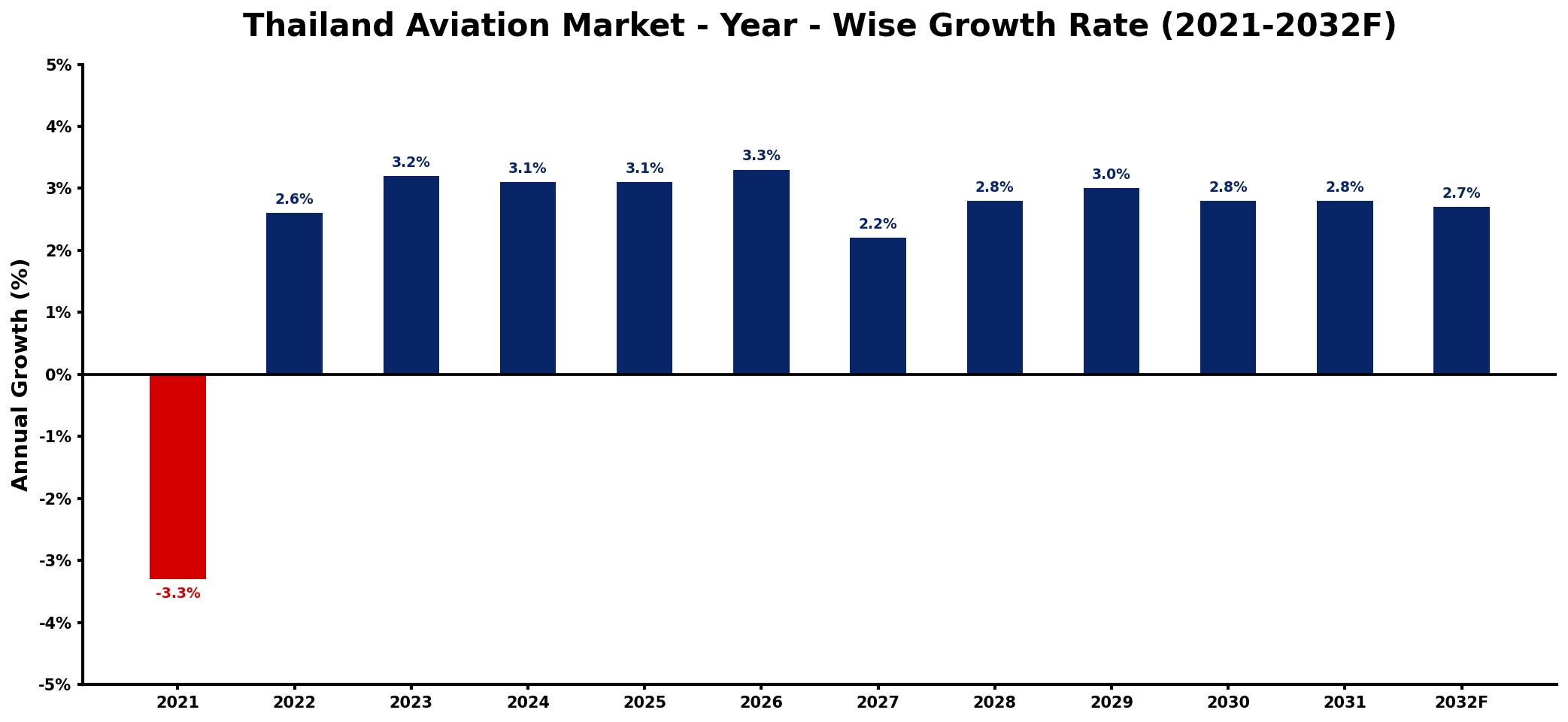
The table below presents the year‑wise growth rates along with the key drivers influencing the market
| Year | Growth Rate | Major Drivers |
| 2021 | -3.3% | reduced travel demand from restrictions |
| 2022 | 2.6% | increased domestic travel preferences |
| 2023 | 3.2% | expansion of international routes |
| 2024 | 3.1% | growing tourism sector recovery |
| 2025 | 3.1% | rising cargo transport opportunities |
| 2026 | 3.3% | enhanced infrastructure development projects |
| 2027 | 2.2% | increased business travel activities |
| 2028 | 2.8% | growing environmental sustainability initiatives |
| 2029 | 3.0% | improved processing technologies adoption |
| 2030 | 2.8% | increased investments in technology |
| 2031 | 2.8% | growing demand for private travel |
| 2032 | 2.7% | enhanced regional connectivity improvements |
Note: Market size estimations and growth projections presented in this report are based on 6Wresearch's proprietary forecasting methodology, utilizing the latest available industry data, government publications, and primary research inputs.
Thailand Aviation Market Synopsis
The most powerful force currently shaping the Thailand Aviation Market is the burgeoning growth of the tourism sector. This boom has stimulated demand for air travel, positioning Thailand as a preferred destination for millions of travelers worldwide.
Additionally, the competitive landscape continues to evolve, with domestic airlines expanding their fleets to cater to increasing passenger numbers. Coupled with a proliferation of international carriers, these developments are propelling the aviation industry towards a robust future.
Thailand Aviation Market Key Takeaways
- The aviation market in Thailand is poised for steady growth, fueled by its strong tourism sector.
- International travel demand remains high, supported by Thailand's strategic location as an aviation hub.
- Investment in airport infrastructure is crucial for managing increased passenger and cargo traffic.
- Airlines are focusing on fleet expansion and service enhancements to remain competitive.
- Government initiatives play a key role in attracting investment and facilitating market development.
Evaluation of Restraints in Thailand Aviation Market
Despite its growth potential, the Thailand Aviation Market grapples with several significant restraints. Infrastructure development has not kept pace with the soaring passenger demand, necessitating substantial investments to modernize existing airports and expand capacities. Additionally, effective air traffic management is critical to avert congestion and delays that could hinder operational efficiency. Competition from neighboring aviation hubs poses further challenges, diverting potential travelers and impacting local airline revenues.
Thailand Aviation Market Trends
Current trends indicate a shift towards sustainability in the aviation sector, with airlines increasingly investing in fuel-efficient aircraft and sustainable aviation fuels. Technological advancements in digital ticketing and contactless check-in processes are enhancing passenger convenience, aligning with post-pandemic expectations. Additionally, the rise of low-cost carriers continues to reshape market dynamics, making air travel more accessible to a broader audience.
Thailand Aviation Market Opportunities
The Thailand Aviation Market presents numerous investment opportunities, particularly in airport infrastructure development and maintenance services. There is an increasing demand for advanced air traffic management systems, which can streamline operations and improve safety. Furthermore, the growing interest in regional tourism opens avenues for airlines to introduce new routes, capitalizing on underserved markets.
Government Initiatives in the Thailand Aviation Market
The Thai government has actively prioritized the aviation sector through various initiatives aimed at infrastructure enhancement and regulatory support. Programs designed to modernize airports and improve overall passenger experience are in focus. Additionally, policies encouraging foreign investment and collaborations are facilitating a more competitive environment in the aviation landscape.
Future Insights of the Thailand Aviation Market
Looking ahead to 2026-2032, the Thailand Aviation Market is expected to continue its upward trajectory, underpinned by robust tourism growth and strategic investments in aviation infrastructure. As travel restrictions ease and consumer confidence rebounds, the demand for air travel is anticipated to surge, further solidifying Thailands position as a regional aviation leader. The integration of technology will also drive operational efficiencies and enhance customer experiences, setting the stage for sustained growth.
Thailand Aviation Market Latest Developments (2025 - 2026)
Recent developments in the Thailand aviation sector reveal a continued push towards modernization and expansion. New airport projects are underway to accommodate increasing air traffic, while airlines are innovating their service offerings to attract travelers. Investment in digital technologies for passenger convenience is also trending, reflecting a broader adaptation to new travel behaviors and preferences.
Thailand Aviation Market - Key Attractiveness of the Report
- 10 Years of Market Numbers
- Historical Data Starting from 2022 to 2025
- Base Year: 2025
- Forecast Data until 2032
- Key Performance Indicators Impacting the Market
- Major Upcoming Developments and Projects
Key Highlights of the Report:
- Thailand Aviation Market Outlook
- Market Size of Thailand Aviation Market, 2025
- Forecast of Thailand Aviation Market, 2032
- Historical Data and Forecast of Thailand Aviation Revenues & Volume for the Period 2022-2032F
- Thailand Aviation Market Trend Evolution
- Thailand Aviation Market Drivers and Challenges
- Thailand Aviation Price Trends
- Thailand Aviation Porter's Five Forces
- Thailand Aviation Industry Life Cycle
- Historical Data and Forecast of Thailand Aviation Market Revenues & Volume By Type for the Period 2022-2032F
- Historical Data and Forecast of Thailand Aviation Market Revenues & Volume By Commercial Aviation for the Period 2022-2032F
- Historical Data and Forecast of Thailand Aviation Market Revenues & Volume By Military Aviation for the Period 2022-2032F
- Historical Data and Forecast of Thailand Aviation Market Revenues & Volume By General Aviation for the Period 2022-2032F
- Thailand Aviation Import Export Trade Statistics
- Market Opportunity Assessment By Type
- Thailand Aviation Top Companies Market Share
- Thailand Aviation Competitive Benchmarking By Technical and Operational Parameters
- Thailand Aviation Company Profiles
- Thailand Aviation Key Strategic Recommendations






































