Thailand Aviation Test Equipment Market Size, Share & Growth Rate
The Thailand Aviation Test Equipment Market was estimated at USD 125 Million in 2025 and is projected to reach USD 143 Million by 2032, growing at a CAGR of 1.9% from 2026 to 2032. This growth trajectory is largely driven by the increasing complexity of aircraft systems and the consequent demand for advanced testing and diagnostic tools. As the aviation sector in Thailand expands, the urgency for cutting-edge test equipment to ensure safety and compliance becomes even more pronounced.
Thailand Aviation Test Equipment Market Year-wise Growth Rate and Key Drivers
This graph highlights how the Thailand Aviation Test Equipment Market has steadily grown over the years, supported by major growth factors.
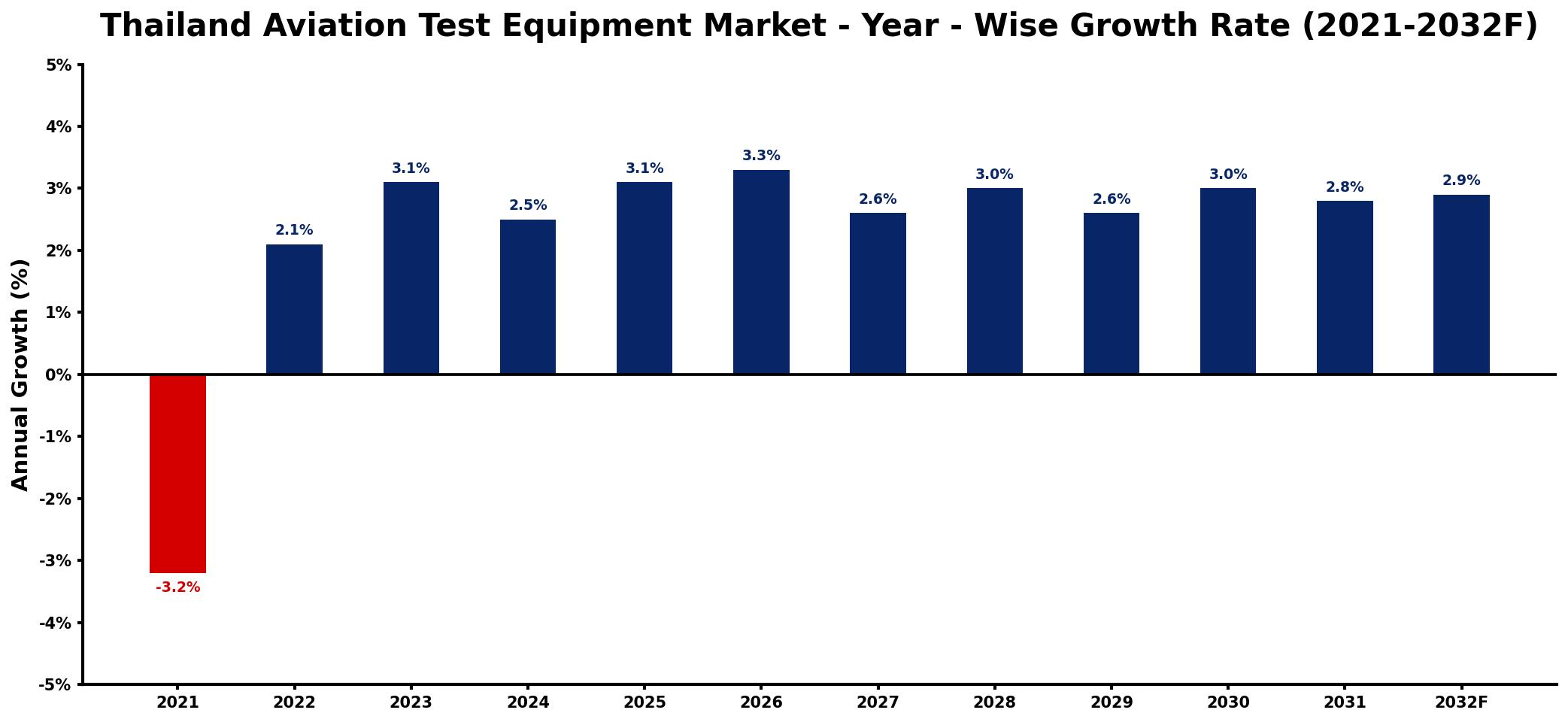
The table below presents the year‑wise growth rates along with the key drivers influencing the market
| Year | Growth Rate | Major Drivers |
| 2021 | -3.2% | decreased investment in technology |
| 2022 | 2.1% | increased demand for safety standards |
| 2023 | 3.1% | growing commercial airline operations |
| 2024 | 2.5% | expansion of training facilities |
| 2025 | 3.1% | rising focus on innovation |
| 2026 | 3.3% | increased regulatory compliance requirements |
| 2027 | 2.6% | growing market for simulation tools |
| 2028 | 3.0% | enhanced collaboration with manufacturers |
| 2029 | 2.6% | boost in regional air travel |
| 2030 | 3.0% | growth in maintenance services |
| 2031 | 2.8% | increased partnerships in research |
| 2032 | 2.9% | enhanced product quality standards |
Note: Market size estimations and growth projections presented in this report are based on 6Wresearch's proprietary forecasting methodology, utilizing the latest available industry data, government publications, and primary research inputs.
Thailand Aviation Test Equipment Market Synopsis
Recent momentum in the Thailand Aviation Test Equipment Market reflects a robust investment from aircraft manufacturers and maintenance providers, focusing on sophisticated testing solutions. As these entities adapt to the evolving landscape of aviation technology, the market is poised for significant innovation, particularly in non-destructive testing and avionics equipment.
Looking ahead, the demand for reliable and precise testing instruments is expected to escalate. This is not only due to the need for stringent safety measures but also a response to international aviation standards that govern the industry. The market is thus positioned at an inflection point where traditional practices meet the advent of advanced technological solutions.
Thailand Aviation Test Equipment Market Key Takeaways
- The market is driven by the imperative for safety and operational efficiency in aircraft systems and components.
- Innovations in testing technology are anticipated to cater to the increasing complexity of modern aircraft.
- The commitment to international aviation safety standards fuels demand for advanced testing solutions.
- Investment in non-destructive and avionics testing equipment is expected to rise significantly.
- Post-pandemic recovery initiatives will lead to heightened focus on compliance and safety measures.
Evaluation of Restraints in Thailand Aviation Test Equipment Market
The Thailand Aviation Test Equipment Market faces notable constraints, primarily linked to rapid technological advancements. As aircraft technologies evolve, the need for testing equipment to keep pace becomes crucial, often presenting a financial burden for manufacturers and maintenance providers. Additionally, the constant need for calibration and adherence to stringent international safety standards presents ongoing challenges, complicating the procurement and maintenance of testing tools.
Thailand Aviation Test Equipment Market Trends
Emerging trends in the Thailand Aviation Test Equipment Market include a significant shift toward digital solutions and remote testing capabilities. As companies explore innovative technologies, the integration of smart diagnostics and automated testing is gaining traction. Furthermore, the growing emphasis on sustainability is prompting a rise in eco-friendly testing equipment, ensuring compliance with evolving environmental regulations.
Thailand Aviation Test Equipment Market Opportunities
Genuine growth opportunities lie in the adoption of next-generation testing technologies that can provide higher accuracy and reliability. The push for upgrades in testing equipment to enhance safety and performance can lead to substantial investments in R&D. Additionally, as Thailand enhances its aviation infrastructure, there will be an increasing need for comprehensive testing solutions to support new aircraft models and maintenance practices.
Government Initiatives in the Thailand Aviation Test Equipment Market
The Thai government is actively fostering a supportive environment for the aviation sector through various policies and public spending initiatives. These include funding for infrastructure improvements and incentives for companies to invest in state-of-the-art testing equipment. By promoting compliance with international standards, the government aims to enhance the safety and efficiency of the aviation industry, thereby indirectly bolstering demand for advanced test equipment.
Future Insights of the Thailand Aviation Test Equipment Market
From 2026 to 2032, the Thailand Aviation Test Equipment Market is expected to evolve significantly, driven by technological advancements and the aviation industry's recovery post-pandemic. The demand for specialized testing equipment will continue to rise, particularly as Thailand's aviation sector looks to attract more international traffic. With ongoing investments in safety and innovation, the market will likely expand, offering new opportunities for both established players and new entrants.
Thailand Aviation Test Equipment Market Latest Developments (2025 - 2026)
Recent industry developments indicate a growing focus on adopting digital testing solutions within Thailand's aviation sector. The trend towards remote diagnostics has become prominent as companies seek to optimize operational efficiency. Furthermore, collaborations between domestic firms and international technology providers have emerged, aiming to enhance the quality and variety of test equipment available in the market.
Thailand Aviation Test Equipment Market - Key Attractiveness of the Report
- 10 Years of Market Numbers
- Historical Data Starting from 2022 to 2025
- Base Year: 2025
- Forecast Data until 2032
- Key Performance Indicators Impacting the Market
- Major Upcoming Developments and Projects
Key Highlights of the Report:
- Thailand Aviation Test Equipment Market Outlook
- Market Size of Thailand Aviation Test Equipment Market, 2025
- Forecast of Thailand Aviation Test Equipment Market, 2032
- Historical Data and Forecast of Thailand Aviation Test Equipment Revenues & Volume for the Period 2022-2032F
- Thailand Aviation Test Equipment Market Trend Evolution
- Thailand Aviation Test Equipment Market Drivers and Challenges
- Thailand Aviation Test Equipment Price Trends
- Thailand Aviation Test Equipment Porter's Five Forces
- Thailand Aviation Test Equipment Industry Life Cycle
- Historical Data and Forecast of Thailand Aviation Test Equipment Market Revenues & Volume By Product for the Period 2022-2032F
- Historical Data and Forecast of Thailand Aviation Test Equipment Market Revenues & Volume By Electrical Aviation Test Equipment for the Period 2022-2032F
- Historical Data and Forecast of Thailand Aviation Test Equipment Market Revenues & Volume By Hydraulic Aviation Test Equipment for the Period 2022-2032F
- Historical Data and Forecast of Thailand Aviation Test Equipment Market Revenues & Volume By Power Aviation Test Equipment for the Period 2022-2032F
- Historical Data and Forecast of Thailand Aviation Test Equipment Market Revenues & Volume By Pneumatic Aviation Test Equipment for the Period 2022-2032F
- Historical Data and Forecast of Thailand Aviation Test Equipment Market Revenues & Volume By End User for the Period 2022-2032F
- Historical Data and Forecast of Thailand Aviation Test Equipment Market Revenues & Volume By Commercial for the Period 2022-2032F
- Historical Data and Forecast of Thailand Aviation Test Equipment Market Revenues & Volume By Defense/Military Sector for the Period 2022-2032F
- Thailand Aviation Test Equipment Import Export Trade Statistics
- Market Opportunity Assessment By Product
- Market Opportunity Assessment By End User
- Thailand Aviation Test Equipment Top Companies Market Share
- Thailand Aviation Test Equipment Competitive Benchmarking By Technical and Operational Parameters
- Thailand Aviation Test Equipment Company Profiles
- Thailand Aviation Test Equipment Key Strategic Recommendations






































