Thailand Butyl Rubber Market: Import Trend Analysis
Thailand import trend for butyl rubber in 2024 experienced a decline of -22.86% compared to the previous year, with a compound annual growth rate (CAGR) of -76.59% from 2020 to 2024. This significant decrease can be attributed to shifts in demand dynamics or changes in market conditions impacting import momentum.
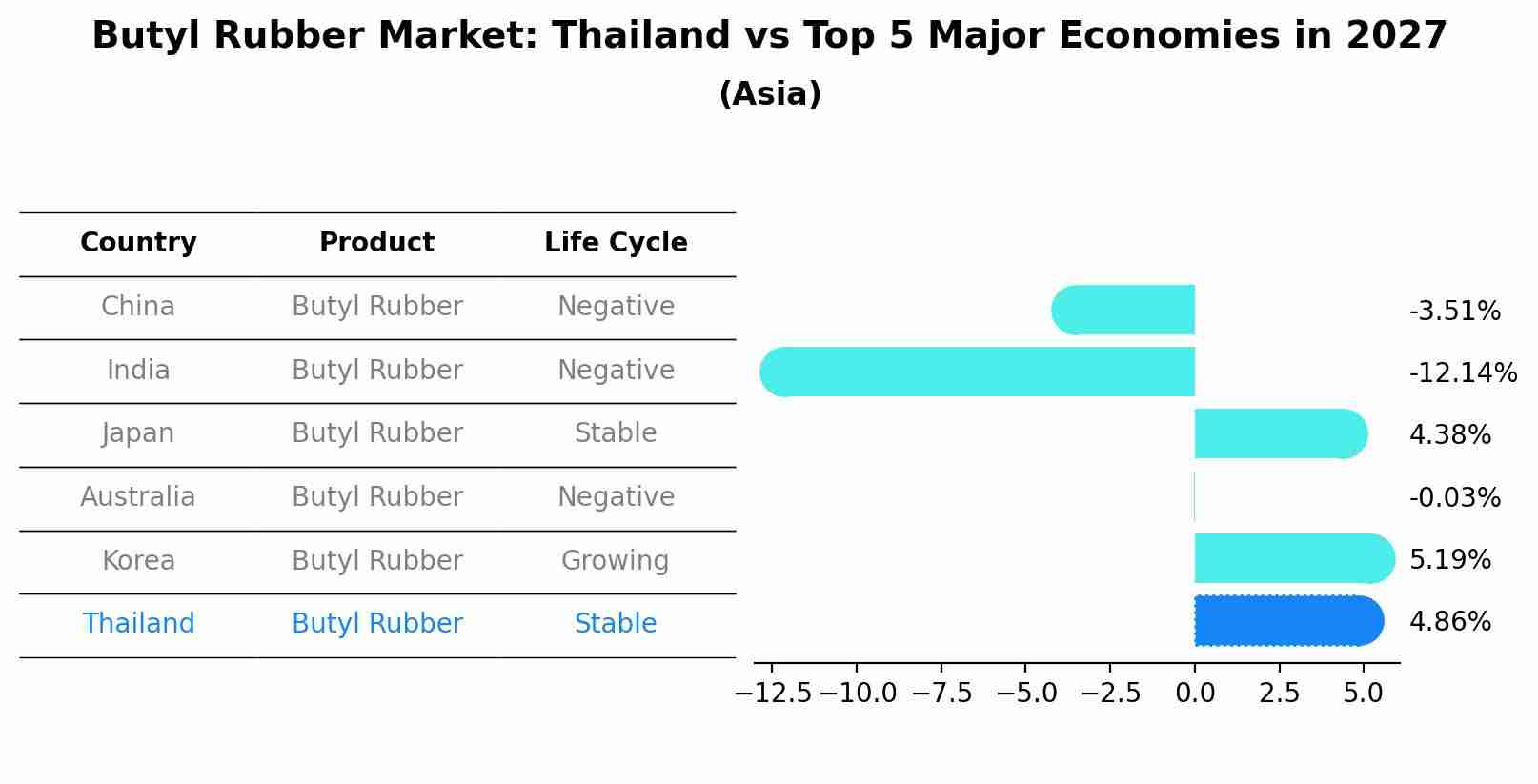
Butyl Rubber Market: Thailand vs Top 5 Major Economies in 2027 (Asia)
The Butyl Rubber market in Thailand is projected to grow at a stable growth rate of 4.86% by 2027, highlighting the country's increasing focus on advanced technologies within the Asia region, where China holds the dominant position, followed closely by India, Japan, Australia and South Korea, shaping overall regional demand.
Thailand Butyl Rubber Market Synopsis
The Thailand Butyl Rubber Market is a segment of the rubber and petrochemical industry. Butyl rubber is known for its impermeability to gases and is used in various applications, including tire manufacturing, automotive industry, and the production of sealants. The market`s performance is closely tied to the automotive and construction sectors, as well as global rubber demand.
Drivers of the Market
The Thailand Butyl Rubber Market has seen growth due to multiple drivers. Firstly, the automotive industry has been a significant driver as butyl rubber is commonly used in manufacturing tires, which are in high demand due to the increasing number of vehicles on Thai roads. Furthermore, butyl rubber`s properties, such as its impermeability to air and gases, make it valuable in the construction and pharmaceutical industries for applications like sealants and pharmaceutical stoppers. This versatility has expanded the market`s reach. Additionally, the growth of the petrochemical industry in Thailand has boosted the supply of raw materials required for butyl rubber production.
Challenges of the Market
The butyl rubber market in Thailand encounters challenges related to the fluctuation in raw material prices, particularly butene, which is a key ingredient in butyl rubber production. Environmental concerns and regulations related to the production process also pose challenges, along with competition from other types of synthetic rubber.
COVID-19 Impact on the Market
The Thailand Butyl Rubber market faced disruptions in production and supply chains due to the COVID-19 pandemic. Reduced manufacturing activities and transportation restrictions affected the availability of raw materials and the production of butyl rubber. The automotive industry, a significant consumer of butyl rubber, saw a decline in demand as car production slowed down. However, the market showed resilience as demand from the healthcare sector for butyl rubber gloves and medical equipment increased. The market`s recovery was driven by the gradual reopening of industries and the development of innovative applications for butyl rubber.
Key Players in the Market
The Thailand Butyl Rubber Market is led by a handful of key manufacturers. Notable players in this market include RubberTech Thailand, ButylMasters Co., PolymerX Solutions, and ElasticRubber Industries. These companies are known for their production of high-quality butyl rubber, serving various industries, including automotive, construction, and manufacturing.
Key Highlights of the Report:
- Thailand Butyl Rubber Market Outlook
- Market Size of Thailand Butyl Rubber Market, 2024
- Forecast of Thailand Butyl Rubber Market, 2031
- Historical Data and Forecast of Thailand Butyl Rubber Revenues & Volume for the Period 2021-2031
- Thailand Butyl Rubber Market Trend Evolution
- Thailand Butyl Rubber Market Drivers and Challenges
- Thailand Butyl Rubber Price Trends
- Thailand Butyl Rubber Porter's Five Forces
- Thailand Butyl Rubber Industry Life Cycle
- Historical Data and Forecast of Thailand Butyl Rubber Market Revenues & Volume By Product Type for the Period 2021-2031
- Historical Data and Forecast of Thailand Butyl Rubber Market Revenues & Volume By Regular Butyl Rubber for the Period 2021-2031
- Historical Data and Forecast of Thailand Butyl Rubber Market Revenues & Volume By Halo Butyl Rubber for the Period 2021-2031
- Historical Data and Forecast of Thailand Butyl Rubber Market Revenues & Volume By Bromo-Butyl Rubber for the Period 2021-2031
- Historical Data and Forecast of Thailand Butyl Rubber Market Revenues & Volume By Chloro-Butyl Rubber for the Period 2021-2031
- Historical Data and Forecast of Thailand Butyl Rubber Market Revenues & Volume By Application for the Period 2021-2031
- Historical Data and Forecast of Thailand Butyl Rubber Market Revenues & Volume By Tires & Tubes for the Period 2021-2031
- Historical Data and Forecast of Thailand Butyl Rubber Market Revenues & Volume By Pharmaceuticals for the Period 2021-2031
- Historical Data and Forecast of Thailand Butyl Rubber Market Revenues & Volume By Adhesives & Sealants for the Period 2021-2031
- Historical Data and Forecast of Thailand Butyl Rubber Market Revenues & Volume By Automotive for the Period 2021-2031
- Historical Data and Forecast of Thailand Butyl Rubber Market Revenues & Volume By Others for the Period 2021-2031
- Thailand Butyl Rubber Import Export Trade Statistics
- Market Opportunity Assessment By Product Type
- Market Opportunity Assessment By Application
- Thailand Butyl Rubber Top Companies Market Share
- Thailand Butyl Rubber Competitive Benchmarking By Technical and Operational Parameters
- Thailand Butyl Rubber Company Profiles
- Thailand Butyl Rubber Key Strategic Recommendations






































