Thailand Chlorofluorocarbon Market Size, Share & Growth Rate
The Thailand Chlorofluorocarbon Market was estimated at USD 223 Million in 2025 and is projected to reach USD 257 Million by 2032, growing at a CAGR of 2.0% from 2026 to 2032. This modest growth trajectory reflects the ongoing transition away from CFCs, driven by both regulatory pressures and the increasing adoption of alternative refrigerants. As Thailand continues to adhere to international environmental agreements, the demand for sustainable practices in CFC disposal and recycling is becoming increasingly relevant.
Thailand Chlorofluorocarbon Market Year-wise Growth Rate and Key Drivers
This graph highlights how the Thailand Chlorofluorocarbon Market has steadily grown over the years, supported by major growth factors.
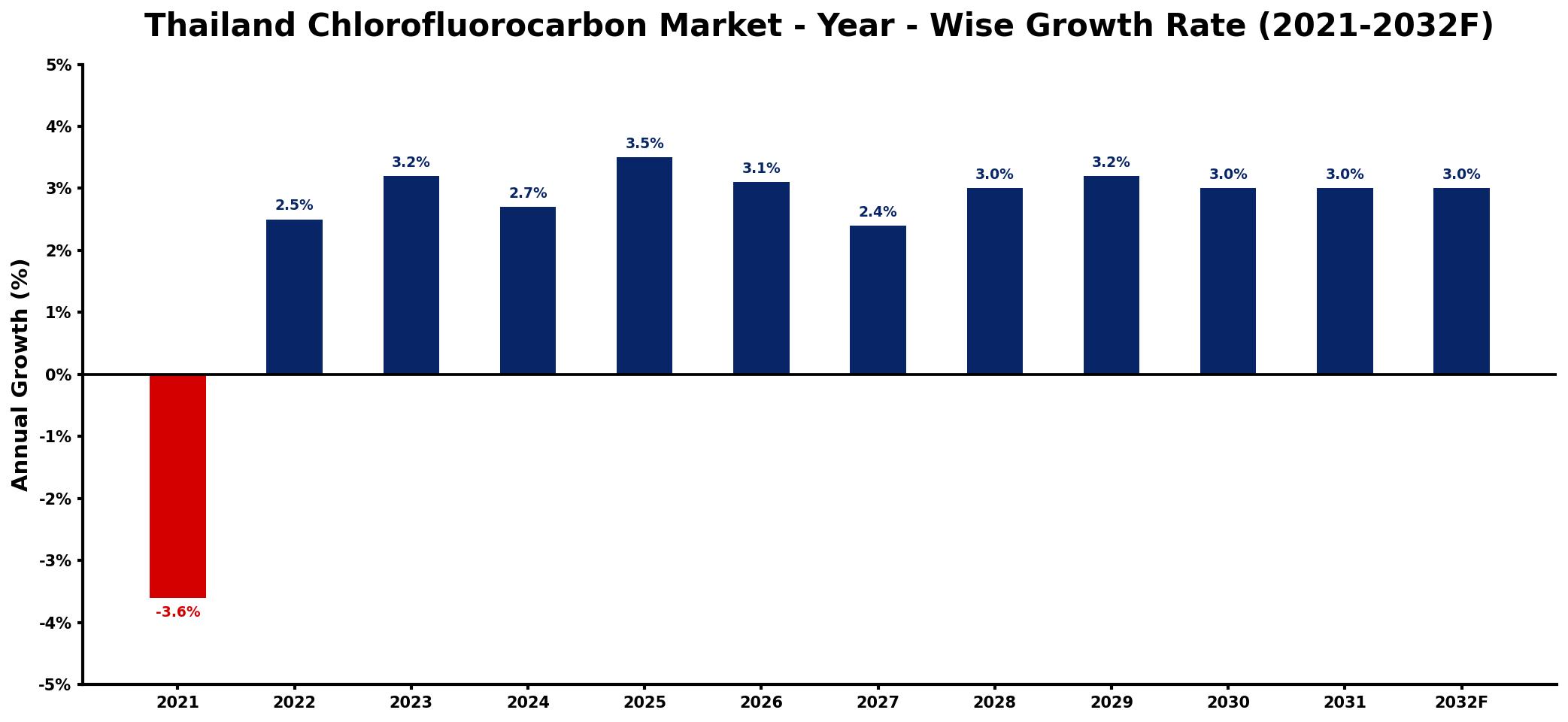
The table below presents the year‑wise growth rates along with the key drivers influencing the market
| Year | Growth Rate | Major Drivers |
| 2021 | -3.6% | Decreased industrial production activities |
| 2022 | 2.5% | Rising demand for refrigeration applications |
| 2023 | 3.2% | Increased investment in sustainable technologies |
| 2024 | 2.7% | Expansion of air conditioning sector |
| 2025 | 3.5% | Growth in automotive cooling systems |
| 2026 | 3.1% | Higher demand for insulation materials |
| 2027 | 2.4% | Emergence of new consumer markets |
| 2028 | 3.0% | Advancements in manufacturing processes |
| 2029 | 3.2% | Strengthening regulatory frameworks established |
| 2030 | 3.0% | Innovation in energy efficiency solutions |
| 2031 | 3.0% | Increased focus on environmental compliance |
| 2032 | 3.0% | Growing adoption of alternative substances |
Note: Market size estimations and growth projections presented in this report are based on 6Wresearch's proprietary forecasting methodology, utilizing the latest available industry data, government publications, and primary research inputs.
Thailand Chlorofluorocarbon Market Synopsis
The landscape of the Thailand Chlorofluorocarbon market is undergoing a significant transformation as the nation pivots toward environmental sustainability. This shift is largely a response to global initiatives aimed at phasing out ozone-depleting substances, positioning Thailand as an active participant in the global movement for climate action.
In light of these developments, the focus on reclamation, recycling, and responsible disposal of existing CFCs is intensifying. The country's regulatory framework encourages companies to innovate and invest in eco-friendly alternatives, paving the way for a sustainable future in the refrigeration and air conditioning sectors.
Thailand Chlorofluorocarbon Market Key Takeaways
- The market is driven by a commitment to environmental sustainability and compliance with international agreements.
- There is a growing need for proper disposal and recycling practices for existing CFCs.
- Post-COVID-19, the demand for eco-friendly refrigerants is expected to rise steadily.
- Key players are investing in innovative technologies to minimize environmental impact.
- The shift towards sustainable refrigerants is reshaping the industry landscape in Thailand.
Evaluation of Restraints in Thailand Chlorofluorocarbon Market
Despite the market's positive growth trajectory, certain restraints hinder its full potential. The stringent international regulations aimed at reducing ozone-depleting substances impose challenges for compliance, often requiring significant investments in technology and infrastructure. Additionally, transitioning from CFCs to alternative refrigerants can be complex and costly, which may deter some smaller players from fully participating in the evolving market landscape. Furthermore, the lingering effects of the COVID-19 pandemic have resulted in a cautious approach to investment and consumption, leading to slower-than-expected market recovery.
Thailand Chlorofluorocarbon Market Trends
Several trends are shaping the Thailand Chlorofluorocarbon market today. A significant shift towards regulatory compliance is being observed, where companies are prioritizing eco-friendly practices. Additionally, advancements in technology are enabling more efficient methods for CFC recycling and reclamation. A rise in consumer awareness regarding environmental issues is also fostering demand for sustainable refrigerant alternatives. Furthermore, the increasing focus on energy-efficient cooling systems is promoting the development of new, environmentally friendly refrigerants, which can replace CFCs.
Thailand Chlorofluorocarbon Market Opportunities
The market presents several growth opportunities, particularly in the realm of sustainable technology development. Companies that focus on innovation in refrigeration technologies and alternative refrigerants stand to benefit significantly. Moreover, partnerships with regulatory bodies to promote CFC recycling and reclamation practices can create synergies that enhance market growth. As the demand for environmentally sustainable cooling solutions rises, businesses that adapt to these evolving consumer preferences will likely thrive in the coming years.
Government Initiatives in the Thailand Chlorofluorocarbon Market
The Thai government is actively engaged in initiatives aimed at phasing out chlorofluorocarbons, aligning its policies with international agreements like the Montreal Protocol. Public spending on environmental sustainability programs is increasing, which supports businesses transitioning to eco-friendly refrigerants. Incentives for companies that invest in sustainable technologies and practices are being introduced, further promoting responsible disposal and recycling of CFCs. These government efforts are critical in steering the market towards a greener future.
Future Insights of the Thailand Chlorofluorocarbon Market
Looking ahead, the Thailand Chlorofluorocarbon market is poised for gradual yet steady growth from 2026 to 2032. The transition to alternative refrigerants will be a significant driver, with companies expected to ramp up their investments in eco-friendly technologies. Enhanced regulatory frameworks will continue to shape the industry, ensuring compliance with global standards. As consumer preferences shift towards sustainability, the market is expected to innovate continually, opening new avenues for investment and development in environmentally responsible practices.
Thailand Chlorofluorocarbon Market Latest Developments (2025 - 2026)
Recent months have seen a strong push toward the development of new eco-friendly refrigerant technologies in the Thailand Chlorofluorocarbon market. Companies are exploring innovative solutions to enhance the efficiency of cooling systems while minimizing environmental impacts. Collaborative efforts between private enterprises and governmental agencies are also on the rise, aiming to promote awareness around CFC recycling and proper disposal methods. Such developments signal a proactive approach to addressing the challenges facing the industry while fostering sustainable growth.
Thailand Chlorofluorocarbon Market - Key Attractiveness of the Report
- 10 Years of Market Numbers
- Historical Data Starting from 2022 to 2025
- Base Year: 2025
- Forecast Data until 2032
- Key Performance Indicators Impacting the Market
- Major Upcoming Developments and Projects
Key Highlights of the Report:
- Thailand Chlorofluorocarbon Market Outlook
- Market Size of Thailand Chlorofluorocarbon Market, 2025
- Forecast of Thailand Chlorofluorocarbon Market, 2032
- Historical Data and Forecast of Thailand Chlorofluorocarbon Revenues & Volume for the Period 2022-2032F
- Thailand Chlorofluorocarbon Market Trend Evolution
- Thailand Chlorofluorocarbon Market Drivers and Challenges
- Thailand Chlorofluorocarbon Price Trends
- Thailand Chlorofluorocarbon Porter's Five Forces
- Thailand Chlorofluorocarbon Industry Life Cycle
- Historical Data and Forecast of Thailand Chlorofluorocarbon Market Revenues & Volume By Type for the Period 2022-2032F
- Historical Data and Forecast of Thailand Chlorofluorocarbon Market Revenues & Volume By CFC-11 for the Period 2022-2032F
- Historical Data and Forecast of Thailand Chlorofluorocarbon Market Revenues & Volume By CFC-12 for the Period 2022-2032F
- Historical Data and Forecast of Thailand Chlorofluorocarbon Market Revenues & Volume By CFC-113 for the Period 2022-2032F
- Historical Data and Forecast of Thailand Chlorofluorocarbon Market Revenues & Volume By CFC-114 for the Period 2022-2032F
- Historical Data and Forecast of Thailand Chlorofluorocarbon Market Revenues & Volume By CFC-115 for the Period 2022-2032F
- Historical Data and Forecast of Thailand Chlorofluorocarbon Market Revenues & Volume By Others for the Period 2022-2032F
- Historical Data and Forecast of Thailand Chlorofluorocarbon Market Revenues & Volume By Application for the Period 2022-2032F
- Historical Data and Forecast of Thailand Chlorofluorocarbon Market Revenues & Volume By Aerosol Propellants for the Period 2022-2032F
- Historical Data and Forecast of Thailand Chlorofluorocarbon Market Revenues & Volume By Blowing Agent for the Period 2022-2032F
- Historical Data and Forecast of Thailand Chlorofluorocarbon Market Revenues & Volume By Refrigerants for the Period 2022-2032F
- Historical Data and Forecast of Thailand Chlorofluorocarbon Market Revenues & Volume By Others for the Period 2022-2032F
- Thailand Chlorofluorocarbon Import Export Trade Statistics
- Market Opportunity Assessment By Type
- Market Opportunity Assessment By Application
- Thailand Chlorofluorocarbon Top Companies Market Share
- Thailand Chlorofluorocarbon Competitive Benchmarking By Technical and Operational Parameters
- Thailand Chlorofluorocarbon Company Profiles
- Thailand Chlorofluorocarbon Key Strategic Recommendations






































