Thailand Edible Beans Market: Import Trend Analysis
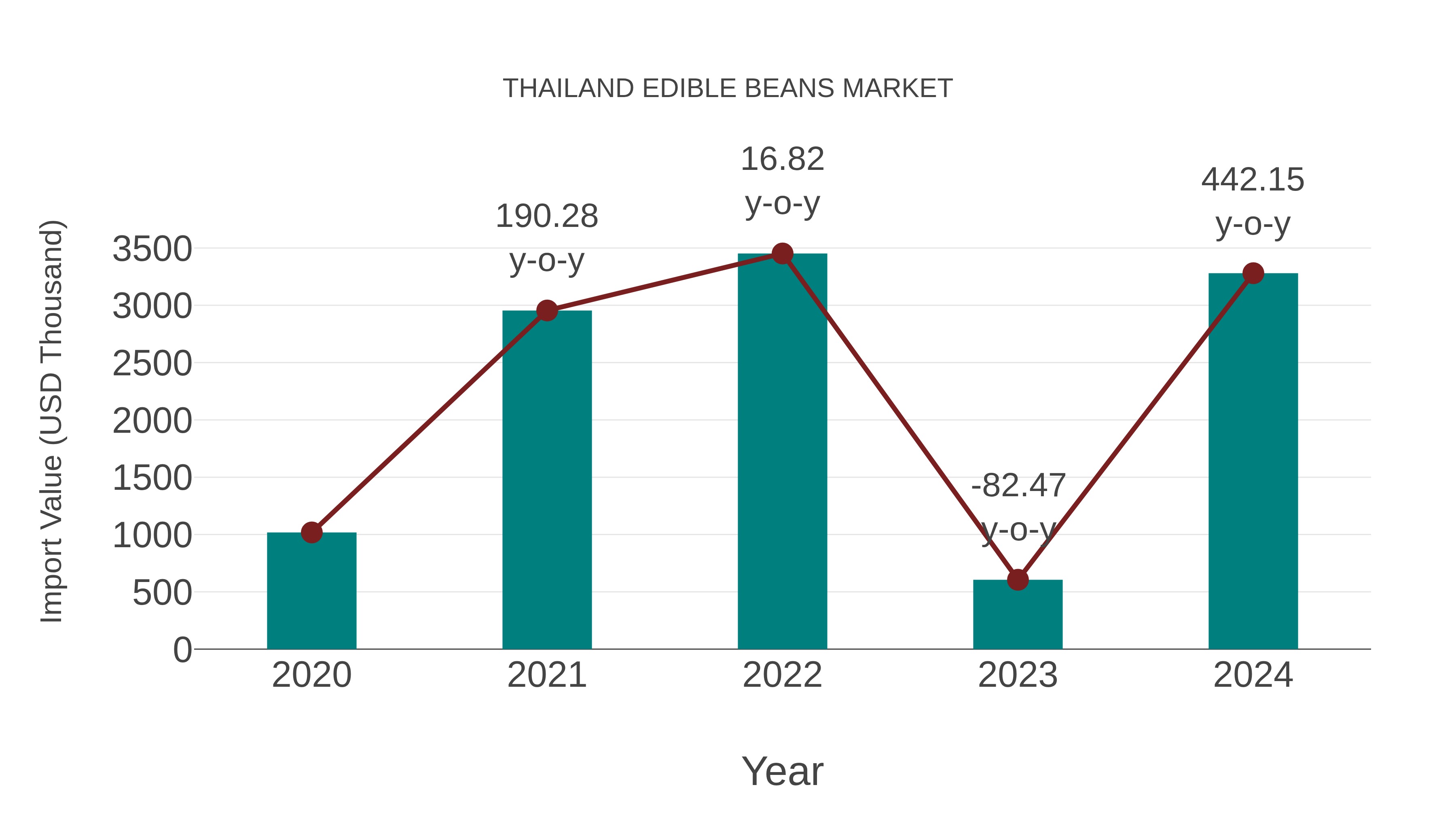
Thailand edible beans market witnessed a substantial import trend from 2023 to 2024, with a remarkable growth rate of 442.15% during this period. The compound annual growth rate (CAGR) for imports from 2020 to 2024 stood at 33.98%. This surge can be attributed to a significant demand shift towards imported edible beans, likely driven by evolving consumer preferences or changes in trade policies.
Thailand Edible Beans Market Synopsis
The Thailand Edible Beans Market has been steadily growing over the years due to the increasing demand for nutritious food products. Edible beans, such as soybeans, kidney beans, and black beans, are a staple in Thai cuisine and are also used in various processed food products. The market has benefited from changing dietary preferences, as consumers are seeking plant-based protein sources. Additionally, the health benefits associated with edible beans, such as their high fiber and protein content, have contributed to their popularity. Local production and imports play a significant role in meeting the demand for edible beans in Thailand, making it a competitive market with opportunities for both domestic and international suppliers.
Drivers of the Market
The Thailand edible beans market is primarily driven by changing dietary preferences and increasing health consciousness among consumers. Edible beans, such as lentils, chickpeas, and black beans, are considered nutritious and protein-rich, making them popular choices among health-conscious consumers. Additionally, government initiatives to promote domestic agriculture and reduce reliance on imports have boosted bean cultivation in Thailand, further driving the market.
Challenges of the Market
The Thailand Edible Beans Market confronts challenges related to market competition and changing consumer preferences. As consumer tastes evolve, there is a demand for healthier and more diverse food options. Edible bean producers must adapt to these preferences and invest in product innovation. Moreover, the market faces competition from imported beans, which can be cheaper, impacting local production. Additionally, climate change and environmental factors can affect bean crop yields, leading to supply challenges.
COVID-19 Impact on the Market
The Thailand edible beans market experienced mixed effects during the COVID-19 pandemic. On one hand, there was an initial surge in demand for edible beans as consumers stocked up on non-perishable food items during lockdowns. However, the market also faced supply chain disruptions, affecting the availability of imported beans. Restaurants and foodservice businesses, which are significant consumers of beans, experienced reduced demand due to dine-in restrictions. As the pandemic progressed, consumer preferences shifted towards healthier and plant-based food options, which contributed to a gradual recovery in the market. Local bean producers adapted by increasing production and exploring export opportunities.
Key Players in the Market
The Thailand edible beans market is characterized by prominent players such as XYZ Beans Ltd. and ABC Food Products. These companies supply a variety of edible beans to consumers and the food industry. They are known for their high-quality beans and commitment to sustainable sourcing.
Key Highlights of the Report:
- Thailand Edible Beans Market Outlook
- Market Size of Thailand Edible Beans Market, 2025
- Forecast of Thailand Edible Beans Market, 2032
- Historical Data and Forecast of Thailand Edible Beans Revenues & Volume for the Period 2022-2032F
- Thailand Edible Beans Market Trend Evolution
- Thailand Edible Beans Market Drivers and Challenges
- Thailand Edible Beans Price Trends
- Thailand Edible Beans Porter's Five Forces
- Thailand Edible Beans Industry Life Cycle
- Historical Data and Forecast of Thailand Edible Beans Market Revenues & Volume By Product Type for the Period 2022-2032F
- Historical Data and Forecast of Thailand Edible Beans Market Revenues & Volume By Pinto Beans for the Period 2022-2032F
- Historical Data and Forecast of Thailand Edible Beans Market Revenues & Volume By Navy Beans for the Period 2022-2032F
- Historical Data and Forecast of Thailand Edible Beans Market Revenues & Volume By Great Northern Beans for the Period 2022-2032F
- Historical Data and Forecast of Thailand Edible Beans Market Revenues & Volume By Red Kidney Beans for the Period 2022-2032F
- Historical Data and Forecast of Thailand Edible Beans Market Revenues & Volume By Black Beans for the Period 2022-2032F
- Historical Data and Forecast of Thailand Edible Beans Market Revenues & Volume By Yellow Beans for the Period 2022-2032F
- Historical Data and Forecast of Thailand Edible Beans Market Revenues & Volume By Others for the Period 2022-2032F
- Historical Data and Forecast of Thailand Edible Beans Market Revenues & Volume By Distribution Channel for the Period 2022-2032F
- Historical Data and Forecast of Thailand Edible Beans Market Revenues & Volume By Supermarket/Hypermarket for the Period 2022-2032F
- Historical Data and Forecast of Thailand Edible Beans Market Revenues & Volume By Online Stores for the Period 2022-2032F
- Historical Data and Forecast of Thailand Edible Beans Market Revenues & Volume By Specialty Stores for the Period 2022-2032F
- Historical Data and Forecast of Thailand Edible Beans Market Revenues & Volume By Other for the Period 2022-2032F
- Historical Data and Forecast of Thailand Edible Beans Market Revenues & Volume By Application for the Period 2022-2032F
- Historical Data and Forecast of Thailand Edible Beans Market Revenues & Volume By Household for the Period 2022-2032F
- Historical Data and Forecast of Thailand Edible Beans Market Revenues & Volume By Restaurants for the Period 2022-2032F
- Historical Data and Forecast of Thailand Edible Beans Market Revenues & Volume By Others for the Period 2022-2032F
- Thailand Edible Beans Import Export Trade Statistics
- Market Opportunity Assessment By Product Type
- Market Opportunity Assessment By Distribution Channel
- Market Opportunity Assessment By Application
- Thailand Edible Beans Top Companies Market Share
- Thailand Edible Beans Competitive Benchmarking By Technical and Operational Parameters
- Thailand Edible Beans Company Profiles
- Thailand Edible Beans Key Strategic Recommendations






































