Thailand EMEA IoT Market Size & Growth Rate (2026-2032)
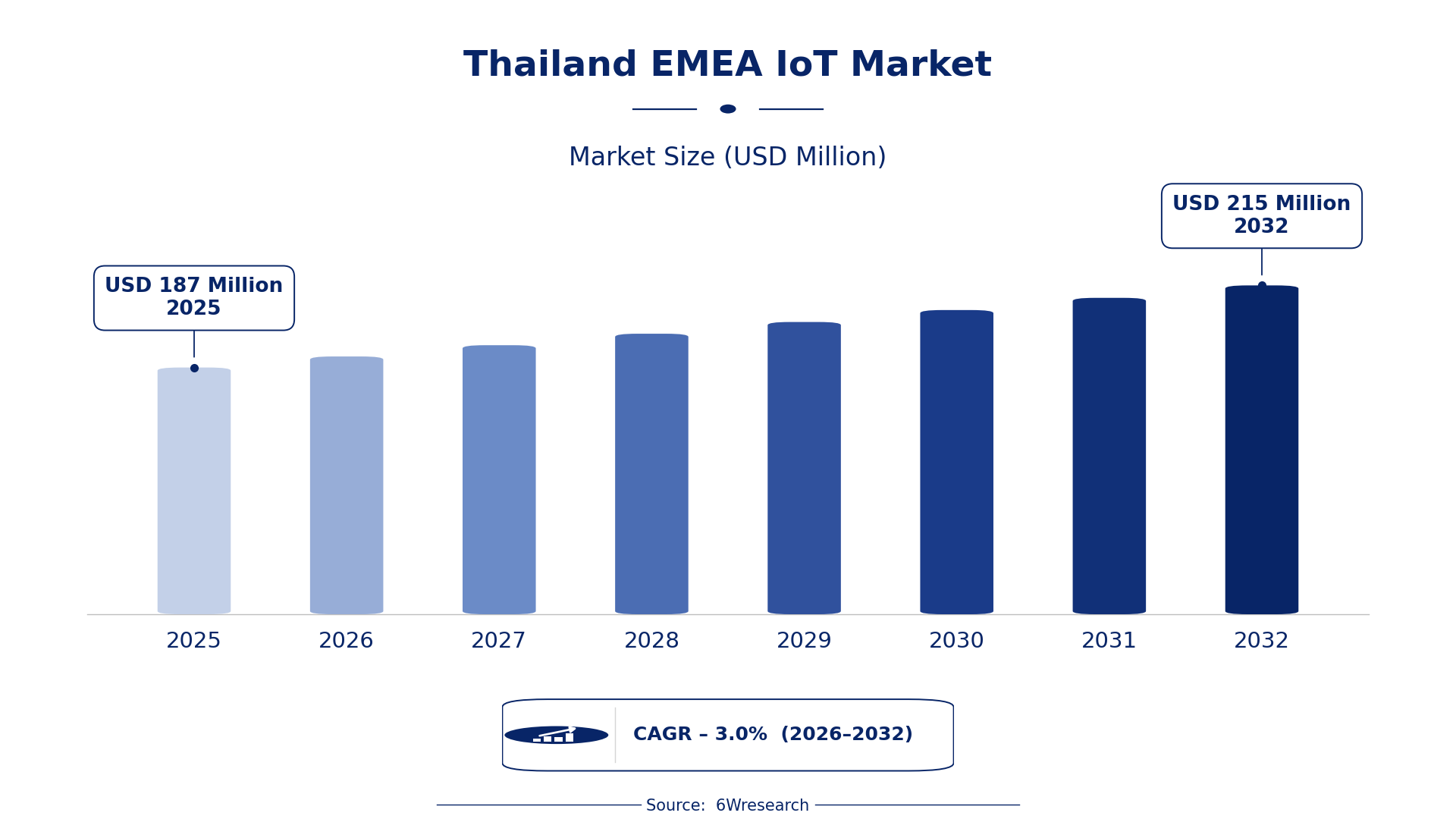
The Thailand EMEA IoT Market was estimated at USD 187 Million in 2025 and is projected to reach USD 215 Million by 2032, growing at a CAGR of 3.0% from 2026 to 2032.
Thailand EMEA IoT Market Synopsis
The Thailand EMEA IoT market has gained notable momentum in recent years, as various sectors eagerly adopt IoT technologies to drive operational enhancements. Looking forward, the integration of IoT solutions is set to deepen, with an emphasis on smart infrastructure and connected devices, aligning with regional and global standards.
As industries such as manufacturing and healthcare embrace digital transformation, the demand for IoT applications is escalating. This trend will position Thailand as a critical player in the EMEA region, creating a fertile ground for innovative services and connectivity solutions.
Thailand EMEA IoT Market Year-wise Growth Rate and Key Drivers
This graph illustrates the annual growth rates of the Thailand EMEA IoT Market from 2021 to 2032, highlighting a steady upward trajectory and projected expansion over the forecast period.
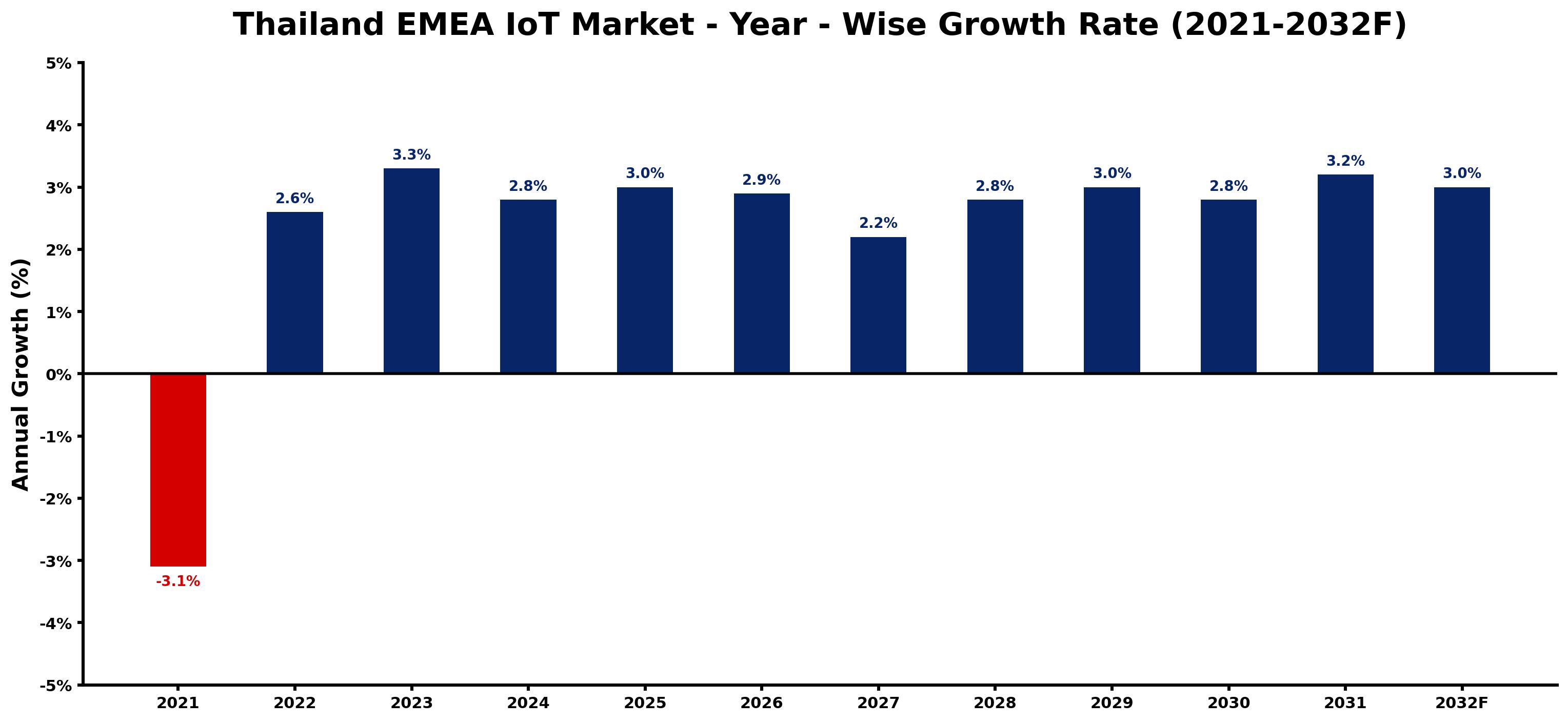
The table below presents the year‑wise growth rates along with the key drivers influencing the market
| Year | Growth Rate | Major Drivers |
| 2021 | -3.1% | Delayed 5G rollout hindering IoT adoption in Thailand |
| 2022 | 2.6% | Government Smart City initiatives promoting IoT adoption. |
| 2023 | 3.3% | Increased tech investments from Thailand's Digital Economy Policy. |
| 2024 | 2.8% | Local push for IoT in agricultural efficiency improvements. |
| 2025 | 3.0% | National Cybersecurity Strategy boosting IoT security solutions. |
| 2026 | 2.9% | Growing consumer electronics market driving smart home IoT. |
| 2027 | 2.2% | Urban infrastructure upgrades enhancing connectivity for IoT. |
| 2028 | 2.8% | Tourism sector embracing IoT for enhanced visitor experiences. |
| 2029 | 3.0% | Thai government promoting IoT in logistics and distribution. |
| 2030 | 2.8% | Increased mobile broadband access enabling widespread IoT use. |
| 2031 | 3.2% | Partnerships with local universities advancing IoT research projects. |
| 2032 | 3.0% | Local businesses adopting IoT for operational efficiency gains. |
Note: Market size estimations and growth projections presented in this report are based on 6Wresearch's proprietary forecasting methodology, utilizing the latest available industry data, government publications, and primary research inputs.
Thailand EMEA IoT Market Key Takeaways
Below are some of the specific key takeaways from the market, including:
- Increasing adoption of IoT technologies across manufacturing, healthcare, and smart cities.
- Growing need for businesses to align with EMEA standards for competitiveness and sustainability.
- Investment in smart infrastructure and connected devices is accelerating.
- Regulatory challenges present hurdles for IoT deployment in various sectors.
- COVID-19 has accelerated the push for technology-driven solutions in enterprise IoT management.
Evaluation of Restraints in Thailand EMEA IoT Market
The Thailand EMEA IoT market faces several restraints that hinder its growth. A primary concern is the complex regulatory environment, which varies across the EMEA region. Companies must navigate a patchwork of regulations that can stifle innovation and slow down deployment timelines. Additionally, the lack of standardization in IoT solutions complicates integration efforts, leaving businesses grappling with compatibility issues. These challenges necessitate a concerted effort from stakeholders to streamline regulations and develop coherent standards.
Thailand EMEA IoT Market Trends
Current trends indicate a robust shift towards automation and smart technologies across various sectors. With the rise of smart cities, urban infrastructure is increasingly incorporating IoT devices for improved efficiency and sustainability. on top of that, the healthcare sector is seeing a surge in remote patient monitoring solutions, driven by heightened demand for telehealth services. Data security and management are also becoming paramount, as organizations seek to protect sensitive information amid growing cyber threats.
Thailand EMEA IoT Market Opportunities
Genuine growth opportunities exist within the Thailand EMEA IoT market, particularly in sectors like agriculture and transportation. The push for smart agriculture solutions can enhance productivity and sustainability, while advancements in logistics and supply chain management through IoT can streamline operations. on top of that, collaboration between the public and private sectors can drive infrastructure improvements, facilitating broader IoT adoption. With the right investments, Thailand can capitalize on these trends to become a leader in IoT innovation.
Government Initiatives in the Thailand EMEA IoT Market
Government initiatives are critical to shaping the Thailand EMEA IoT market. The Thai government is focused on promoting digital transformation through supportive policies and infrastructure investments. By prioritizing IoT-friendly regulations and fostering public-private partnerships, the government aims to enhance the nation’s technological capabilities.
- A national digital infrastructure upgrade programme launched in early 2023 to enhance connectivity across urban and rural areas.
- Current initiatives to establish a regulatory framework for data privacy and IoT device interoperability are underway, aimed at improving compliance and security standards.
- A planned public-private initiative expected to expand IoT applications in agriculture by 2026, focusing on smart farming technologies.
- Recent development of a government-led project to create a national IoT platform, facilitating integration and collaboration among various sectors.
- Efforts to boost IoT education and workforce training programs are currently being implemented to prepare the next generation of IoT professionals.
Future Insights of the Thailand EMEA IoT Market
Between 2026 and 2032, the Thailand EMEA IoT market is expected to evolve significantly. As digital transformation accelerates, businesses will increasingly rely on IoT solutions to enhance efficiency and competitiveness. The integration of advanced technologies such as AI and machine learning will further bolster IoT applications, enabling more intelligent and responsive systems. With a supportive regulatory environment and a growing ecosystem of developers and providers, Thailand is well-positioned for sustained growth in the IoT sector.
Thailand EMEA IoT Market Latest Developments
In the past year, the Thailand EMEA IoT market has seen a flurry of activity, reflecting the urgency of businesses to adopt IoT solutions. Companies are investing in new technologies and partnerships to enhance their IoT capabilities, while the government is pushing for more integrated solutions across sectors.
- A major technology vendor announced an ongoing collaboration with local universities to foster IoT research and development, started in early 2023.
- A leading regional operator launched a new IoT platform for smart city applications in Q2 2023, aimed at enhancing urban management.
- In late 2022, a comprehensive IoT security framework was introduced, addressing the critical need for data protection in connected environments.
- A planned rollout of smart meters for energy management is expected to begin in mid-2026, targeting residential and commercial sectors.
- Recently, a consortium of industry players initiated a project to deploy IoT solutions in public transportation, enhancing operational efficiency and passenger experience.
Thailand EMEA IoT Market - Key Attractiveness of the Report
- 10 Years of Market Numbers
- Historical Data Starting from 2022 to 2025
- Base Year: 2025
- Forecast Data until 2032
- Key Performance Indicators Impacting the Market
- Major Upcoming Developments and Projects
Key Highlights of the Report:
- Thailand EMEA IoT Market Outlook
- Market Size of Thailand EMEA IoT Market, 2025
- Forecast of Thailand EMEA IoT Market, 2032
- Historical Data and Forecast of Thailand EMEA IoT Revenues & Volume for the Period 2022-2032F
- Thailand EMEA IoT Market Trend Evolution
- Thailand EMEA IoT Market Drivers and Challenges
- Thailand EMEA IoT Price Trends
- Thailand EMEA IoT Porter's Five Forces
- Thailand EMEA IoT Industry Life Cycle
- Historical Data and Forecast of Thailand EMEA IoT Market Revenues & Volume By Component for the Period 2022-2032F
- Historical Data and Forecast of Thailand EMEA IoT Market Revenues & Volume By Platform for the Period 2022-2032F
- Historical Data and Forecast of Thailand EMEA IoT Market Revenues & Volume By Service for the Period 2022-2032F
- Historical Data and Forecast of Thailand EMEA IoT Market Revenues & Volume By Software Solution for the Period 2022-2032F
- Historical Data and Forecast of Thailand EMEA IoT Market Revenues & Volume By Application for the Period 2022-2032F
- Historical Data and Forecast of Thailand EMEA IoT Market Revenues & Volume By Building & Home Automation for the Period 2022-2032F
- Historical Data and Forecast of Thailand EMEA IoT Market Revenues & Volume By Smart Energy for the Period 2022-2032F
- Historical Data and Forecast of Thailand EMEA IoT Market Revenues & Volume By Smart Manufacturing for the Period 2022-2032F
- Historical Data and Forecast of Thailand EMEA IoT Market Revenues & Volume By Connected Logistics for the Period 2022-2032F
- Historical Data and Forecast of Thailand EMEA IoT Market Revenues & Volume By Connected Health for the Period 2022-2032F
- Historical Data and Forecast of Thailand EMEA IoT Market Revenues & Volume By Smart Retail for the Period 2022-2032F
- Historical Data and Forecast of Thailand EMEA IoT Market Revenues & Volume By Smart Mobility & Transportation for the Period 2022-2032F
- Historical Data and Forecast of Thailand EMEA IoT Market Revenues & Volume By Security & Emergencies for the Period 2022-2032F
- Historical Data and Forecast of Thailand EMEA IoT Market Revenues & Volume By Platform for the Period 2022-2032F
- Historical Data and Forecast of Thailand EMEA IoT Market Revenues & Volume By Device Management Platform for the Period 2022-2032F
- Historical Data and Forecast of Thailand EMEA IoT Market Revenues & Volume By Application Management Software for the Period 2022-2032F
- Historical Data and Forecast of Thailand EMEA IoT Market Revenues & Volume By Network Management Software for the Period 2022-2032F
- Historical Data and Forecast of Thailand EMEA IoT Market Revenues & Volume By Software Solution for the Period 2022-2032F
- Historical Data and Forecast of Thailand EMEA IoT Market Revenues & Volume By Real-time Stream Analytics for the Period 2022-2032F
- Historical Data and Forecast of Thailand EMEA IoT Market Revenues & Volume By Security Solution for the Period 2022-2032F
- Historical Data and Forecast of Thailand EMEA IoT Market Revenues & Volume By Data Management for the Period 2022-2032F
- Historical Data and Forecast of Thailand EMEA IoT Market Revenues & Volume By Remote Monitoring System for the Period 2022-2032F
- Historical Data and Forecast of Thailand EMEA IoT Market Revenues & Volume By Network Bandwidth Management for the Period 2022-2032F
- Historical Data and Forecast of Thailand EMEA IoT Market Revenues & Volume By Service for the Period 2022-2032F
- Historical Data and Forecast of Thailand EMEA IoT Market Revenues & Volume By Professional Services for the Period 2022-2032F
- Historical Data and Forecast of Thailand EMEA IoT Market Revenues & Volume By Managed Services for the Period 2022-2032F
- Thailand EMEA IoT Import Export Trade Statistics
- Market Opportunity Assessment By Component
- Market Opportunity Assessment By Application
- Market Opportunity Assessment By Platform
- Market Opportunity Assessment By Software Solution
- Market Opportunity Assessment By Service
- Thailand EMEA IoT Top Companies Market Share
- Thailand EMEA IoT Competitive Benchmarking By Technical and Operational Parameters
- Thailand EMEA IoT Company Profiles
- Thailand EMEA IoT Key Strategic Recommendations






































