Thailand Flat-Rolled Stainless Steel Market Size, Share & Growth Rate
The Thailand Flat-Rolled Stainless Steel Market was estimated at USD 226 Million in 2025 and is projected to reach USD 299 Million by 2032, growing at a CAGR of 4.1% from 2026 to 2032. This growth trajectory is driven primarily by the booming construction sector, which is fueled by rapid urbanization and extensive infrastructure projects. Moreover, the rising demand for stainless steel in the automotive and food processing industries further reinforces the market's upward momentum.
Thailand Flat-Rolled Stainless Steel Market Year-wise Growth Rate and Key Drivers
This graph highlights how the Thailand Flat-Rolled Stainless Steel Market has steadily grown over the years, supported by major growth factors.
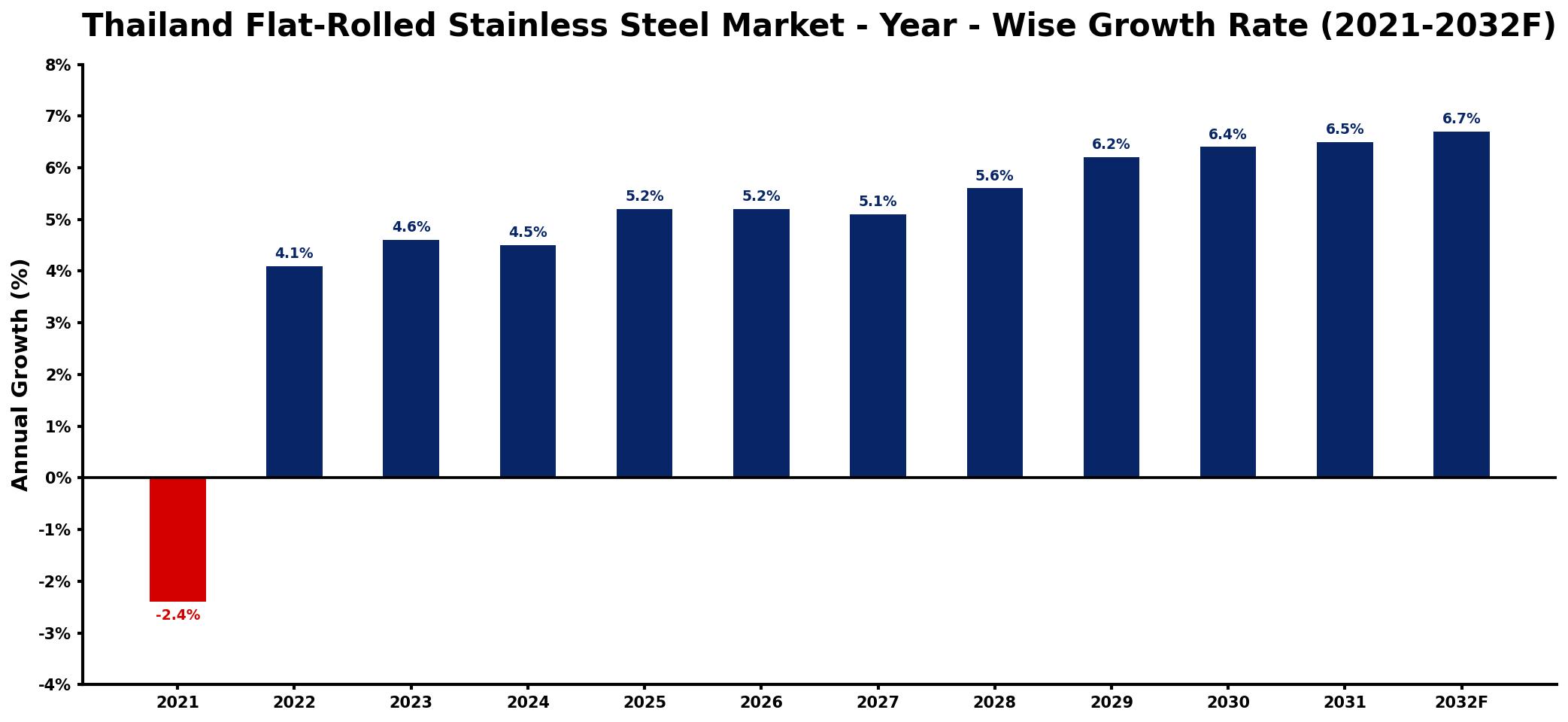
The table below presents the year‑wise growth rates along with the key drivers influencing the market
| Year | Growth Rate | Major Drivers |
| 2021 | -2.4% | decreased construction sector investment |
| 2022 | 4.1% | increased automotive manufacturing demand |
| 2023 | 4.6% | growing energy sector projects |
| 2024 | 4.5% | expansion in food processing industry |
| 2025 | 5.2% | rising consumer electronics production |
| 2026 | 5.2% | enhanced infrastructure development initiatives |
| 2027 | 5.1% | boost in renewable energy investments |
| 2028 | 5.6% | growing demand from healthcare sector |
| 2029 | 6.2% | increased aerospace industry activities |
| 2030 | 6.4% | surge in construction projects |
| 2031 | 6.5% | growth in marine applications sector |
| 2032 | 6.7% | expansion of transportation infrastructure |
Note: Market size estimations and growth projections presented in this report are based on 6Wresearch's proprietary forecasting methodology, utilizing the latest available industry data, government publications, and primary research inputs.
Thailand Flat-Rolled Stainless Steel Market Synopsis
The Thailand flat-rolled stainless steel market is distinguished by a significant demand for custom dimensions and surface finishes tailored to various applications. This is particularly evident in sectors like automotive manufacturing and kitchenware, where quality and durability are paramount. With a steady influx of both domestic production and imports, the market is well-equipped to meet the diverse needs of its end-users.
Additionally, the increasing adoption of flat-rolled stainless steel in architectural cladding and food processing equipment has become a focal point of growth. The combination of performance attributes, such as corrosion resistance and aesthetic appeal, positions stainless steel as a preferred material choice across multiple industries in Thailand.
Thailand Flat-Rolled Stainless Steel Market Key Takeaways
- The market is experiencing robust growth due to heightened demand from construction and automotive sectors.
- Customizability in dimensions and surface finishes is a key competitive edge for local producers.
- Stainless steel's hygiene benefits drive its usage in the food and beverage industry.
- Corrosion-resistant properties position flat-rolled stainless steel as a vital choice in marine applications.
- Price fluctuations in raw materials pose ongoing challenges for market players.
Evaluation of Restraints in Thailand Flat-Rolled Stainless Steel Market
Despite its promising growth prospects, the Thailand flat-rolled stainless steel market is impeded by several key restraints. One of the most significant challenges is the stiff competition from low-cost producers in regions with cheaper labor and raw material access. This dynamic forces local manufacturers to adopt competitive pricing strategies that can pressure profit margins. Additionally, the volatility in raw material prices, particularly for nickel and chromium, creates uncertainty in production costs, impacting financial planning. Environmental regulations are also becoming increasingly stringent, requiring investments in sustainable production technologies, which could further strain resources.
Thailand Flat-Rolled Stainless Steel Market Trends
The market is witnessing a shift towards advanced manufacturing processes, such as precision engineering and automated production systems, to enhance efficiency and product quality. A notable trend is the growing preference for eco-friendly practices, leading to innovations in recycling and sustainability in stainless steel production. Furthermore, the architectural sector is leaning towards sustainable building materials, amplifying the demand for flat-rolled stainless steel in construction projects.
Thailand Flat-Rolled Stainless Steel Market Opportunities
Investment opportunities abound in the Thailand flat-rolled stainless steel market, particularly in sectors poised for expansion, such as renewable energy and infrastructure. The government's focus on upgrading urban infrastructure presents a lucrative avenue for flat-rolled stainless steel applications in construction. Additionally, the increasing demand for high-end kitchen appliances and sanitary ware offers another growth channel. Companies that can leverage technology to provide innovative product solutions are likely to capitalize on emerging trends in design and sustainability.
Government Initiatives in the Thailand Flat-Rolled Stainless Steel Market
The Thai government has implemented various initiatives aimed at fostering industrial growth and enhancing the competitiveness of local manufacturers. Policies promoting infrastructure development and urbanization are contributing to the demand for stainless steel products. Additionally, incentives for sustainable practices in production and waste management are encouraging manufacturers to innovate while meeting environmental standards, ultimately boosting the flat-rolled stainless steel market.
Future Insights of the Thailand Flat-Rolled Stainless Steel Market
Looking ahead to 2026-2032, the Thailand flat-rolled stainless steel market is expected to evolve significantly. Factors such as increased urbanization, infrastructure projects, and the growth of the automotive industry will continue to drive demand. Furthermore, the integration of advanced technologies in manufacturing processes will enhance product quality and customer satisfaction. A strong focus on sustainability and environmental compliance will also shape the industrys future, encouraging innovations that align with global trends.
Thailand Flat-Rolled Stainless Steel Market Latest Developments (2025 - 2026)
Recent developments indicate a shift toward enhanced production capabilities within the Thai flat-rolled stainless steel sector. Companies are increasingly investing in technology upgrades and automation to meet the rising demand for customized products. Additionally, there has been a notable emphasis on establishing stronger supply chain networks to better manage raw material sourcing amidst market fluctuations. The overall direction points towards a more resilient and adaptive industry landscape.
Thailand Flat-Rolled Stainless Steel Market - Key Attractiveness of the Report
- 10 Years of Market Numbers
- Historical Data Starting from 2022 to 2025
- Base Year: 2025
- Forecast Data until 2032
- Key Performance Indicators Impacting the Market
- Major Upcoming Developments and Projects
Key Highlights of the Report:
- Thailand Flat-Rolled Stainless Steel Market Outlook
- Market Size of Thailand Flat-Rolled Stainless Steel Market, 2025
- Forecast of Thailand Flat-Rolled Stainless Steel Market, 2032
- Historical Data and Forecast of Thailand Flat-Rolled Stainless Steel Revenues & Volume for the Period 2022-2032F
- Thailand Flat-Rolled Stainless Steel Market Trend Evolution
- Thailand Flat-Rolled Stainless Steel Market Drivers and Challenges
- Thailand Flat-Rolled Stainless Steel Price Trends
- Thailand Flat-Rolled Stainless Steel Porter's Five Forces
- Thailand Flat-Rolled Stainless Steel Industry Life Cycle
- Historical Data and Forecast of Thailand Flat-Rolled Stainless Steel Market Revenues & Volume By Types for the Period 2022-2032F
- Historical Data and Forecast of Thailand Flat-Rolled Stainless Steel Market Revenues & Volume By Hot/Cold-Rolled Coil for the Period 2022-2032F
- Historical Data and Forecast of Thailand Flat-Rolled Stainless Steel Market Revenues & Volume By Hot/Cold-Rolled Strips for the Period 2022-2032F
- Historical Data and Forecast of Thailand Flat-Rolled Stainless Steel Market Revenues & Volume By Hot/Cold-Rolled Sheets for the Period 2022-2032F
- Historical Data and Forecast of Thailand Flat-Rolled Stainless Steel Market Revenues & Volume By Plates for the Period 2022-2032F
- Historical Data and Forecast of Thailand Flat-Rolled Stainless Steel Market Revenues & Volume By Others for the Period 2022-2032F
- Historical Data and Forecast of Thailand Flat-Rolled Stainless Steel Market Revenues & Volume By Applications for the Period 2022-2032F
- Historical Data and Forecast of Thailand Flat-Rolled Stainless Steel Market Revenues & Volume By Construction for the Period 2022-2032F
- Historical Data and Forecast of Thailand Flat-Rolled Stainless Steel Market Revenues & Volume By Automotive for the Period 2022-2032F
- Historical Data and Forecast of Thailand Flat-Rolled Stainless Steel Market Revenues & Volume By Capital and Consumer Goods for the Period 2022-2032F
- Historical Data and Forecast of Thailand Flat-Rolled Stainless Steel Market Revenues & Volume By Marine for the Period 2022-2032F
- Historical Data and Forecast of Thailand Flat-Rolled Stainless Steel Market Revenues & Volume By Medical for the Period 2022-2032F
- Thailand Flat-Rolled Stainless Steel Import Export Trade Statistics
- Market Opportunity Assessment By Types
- Market Opportunity Assessment By Applications
- Thailand Flat-Rolled Stainless Steel Top Companies Market Share
- Thailand Flat-Rolled Stainless Steel Competitive Benchmarking By Technical and Operational Parameters
- Thailand Flat-Rolled Stainless Steel Company Profiles
- Thailand Flat-Rolled Stainless Steel Key Strategic Recommendations






































