Thailand Fluorochemicals Market Size Growth Rate
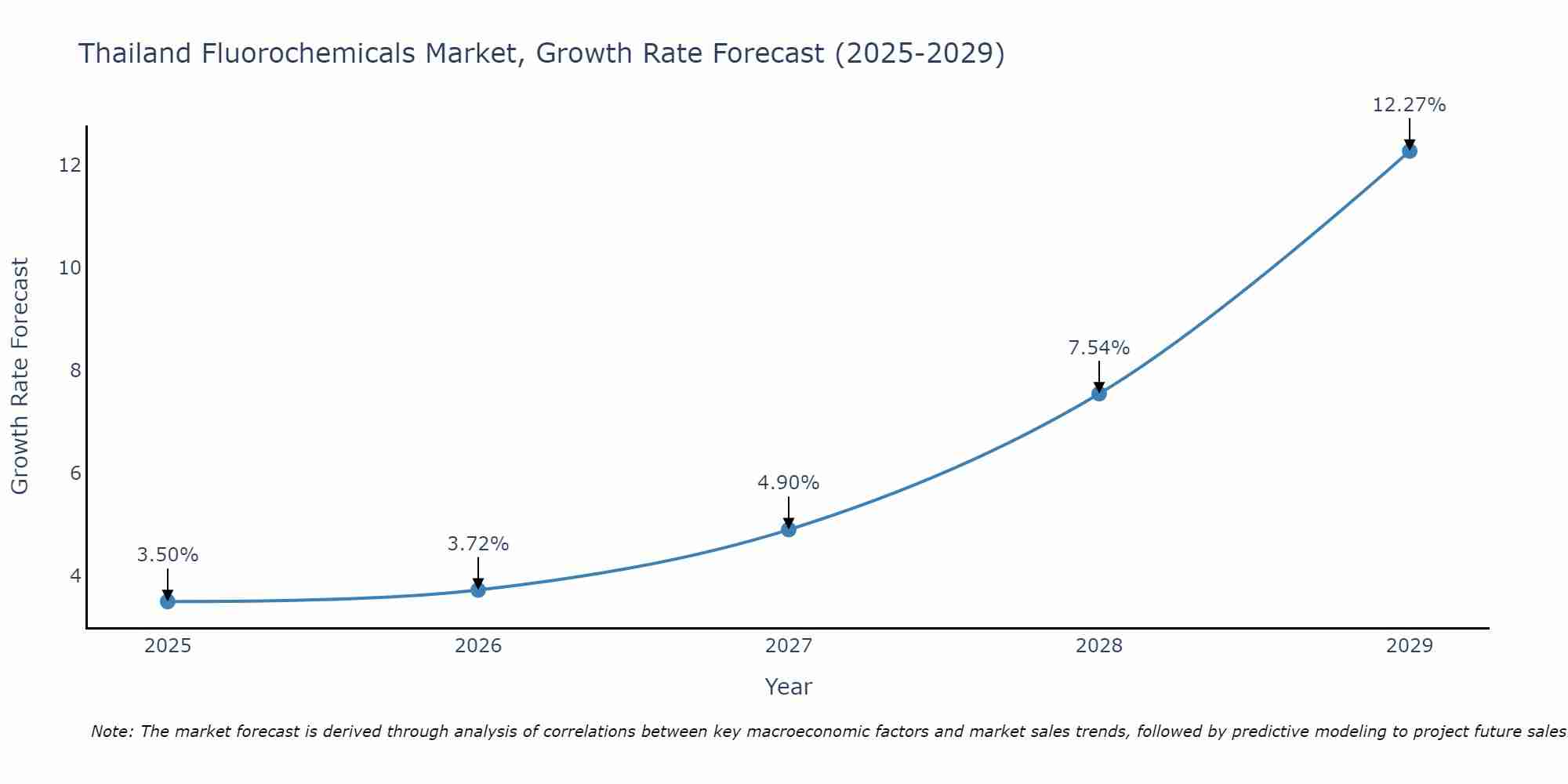
The Thailand Fluorochemicals Market is poised for steady growth rate improvements from 2025 to 2029. From 3.50% in 2025, the growth rate steadily ascends to 12.27% in 2029.
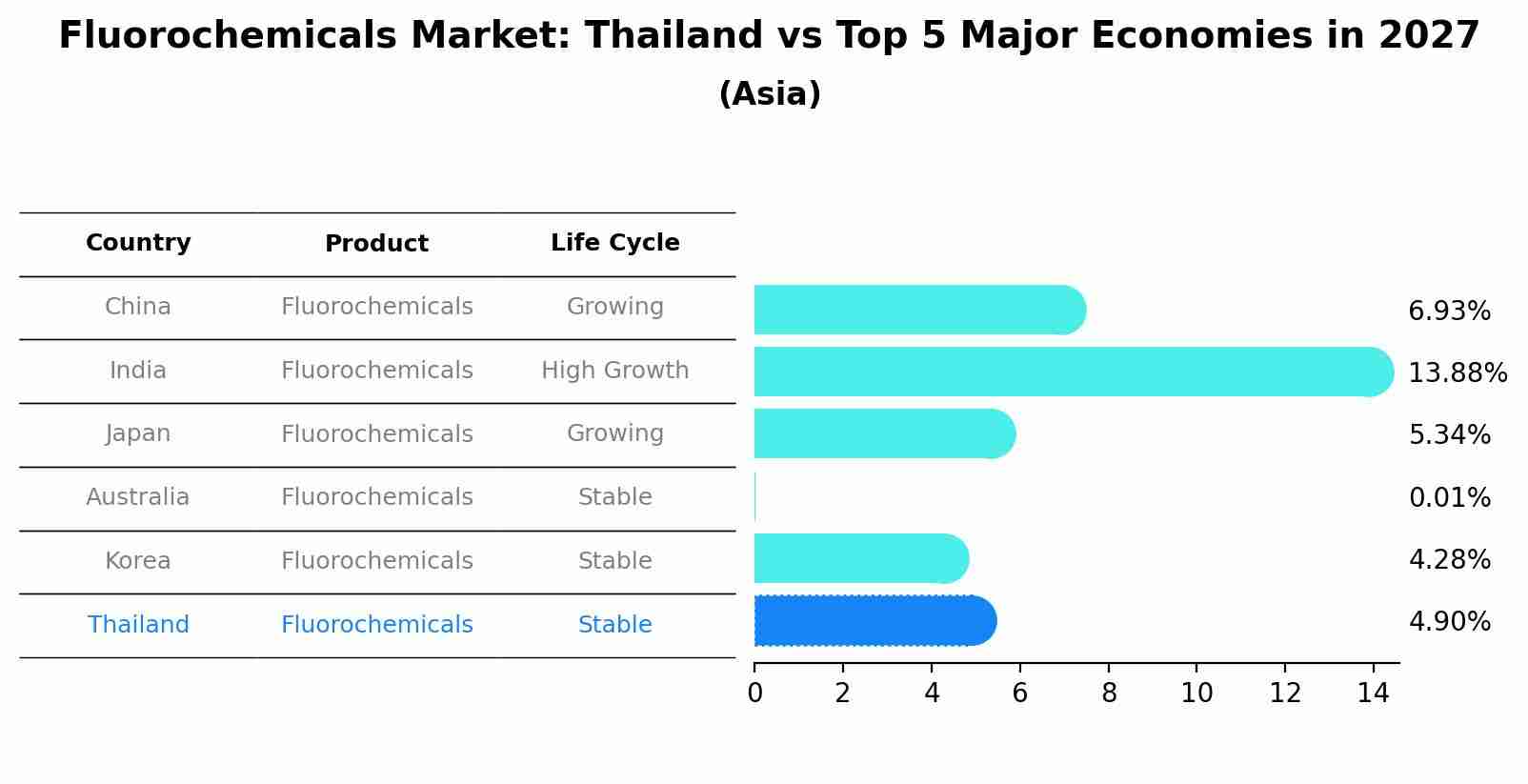
Fluorochemicals Market: Thailand vs Top 5 Major Economies in 2027 (Asia)
By 2027, the Fluorochemicals market in Thailand is anticipated to reach a growth rate of 4.90%, as part of an increasingly competitive Asia region, where China remains at the forefront, supported by India, Japan, Australia and South Korea, driving innovations and market adoption across sectors.
Thailand Fluorochemicals Market Synopsis
The Thailand fluorochemicals market is projected to experience growth in the foreseeable future. Fluorochemicals are compounds containing fluorine and are used in various industries, including refrigeration, air conditioning, electronics, and manufacturing. The market`s expansion is driven by the increasing demand for fluorochemicals in different applications and the growth of end-user industries in Thailand.
Market Drivers
One of the key drivers of the Thailand fluorochemicals market is the growing demand for refrigerants and cooling agents in the HVAC&R (heating, ventilation, air conditioning, and refrigeration) industry. Fluorochemicals, such as hydrofluorocarbons (HFCs) and hydrochlorofluorocarbons (HCFCs), are widely used as refrigerants in air conditioning and refrigeration systems. Moreover, the electronics industry`s growth in Thailand contributes to the demand for fluorochemicals for manufacturing semiconductors and electronic components. Additionally, the increasing adoption of fluorochemicals in the automotive sector for manufacturing airbags and components further fuels market growth.
Challenges of the Market
The Thailand fluorochemicals market faces challenges related to environmental concerns and regulatory changes. Some fluorochemicals, such as HFCs, are potent greenhouse gases, and their use has raised environmental concerns, leading to regulations and initiatives to phase out or limit their use. Another challenge is the need for developing sustainable and eco-friendly alternatives to replace high global warming potential (GWP) fluorochemicals.
Covid-19 Impact on the Market
The Covid-19 pandemic had an impact on the Thailand fluorochemicals market. During the pandemic, disruptions in manufacturing and industrial activities may have temporarily affected the demand for fluorochemicals. However, as economic activities resume and industries recover, the demand for fluorochemicals is expected to rebound. The versatile applications and importance of fluorochemicals in various industries remain relevant, driving the market`s growth in the post-pandemic period.
Key Players of the Market
Key players in the Thailand fluorochemicals market play a crucial role in providing high-quality and innovative products. Some key players in the market include The Chemours Company, Daikin Industries, Ltd., and Solvay (Thailand) Ltd. These companies offer a range of fluorochemicals, including refrigerants, fluoropolymers, and fluoroelastomers, to meet the diverse needs of customers in Thailand. As the demand for fluorochemicals continues to grow, these key players are expected to remain influential in shaping the fluorochemicals market in the country.
Key Highlights of the Report:
- Thailand Fluorochemicals Market Outlook
- Market Size of Thailand Fluorochemicals Market, 2024
- Forecast of Thailand Fluorochemicals Market, 2031
- Historical Data and Forecast of Thailand Fluorochemicals Revenues & Volume for the Period 2021-2031
- Thailand Fluorochemicals Market Trend Evolution
- Thailand Fluorochemicals Market Drivers and Challenges
- Thailand Fluorochemicals Price Trends
- Thailand Fluorochemicals Porter's Five Forces
- Thailand Fluorochemicals Industry Life Cycle
- Historical Data and Forecast of Thailand Fluorochemicals Market Revenues & Volume By Product for the Period 2021-2031
- Historical Data and Forecast of Thailand Fluorochemicals Market Revenues & Volume By Fuorocarbon for the Period 2021-2031
- Historical Data and Forecast of Thailand Fluorochemicals Market Revenues & Volume By Inorganic &Specialities for the Period 2021-2031
- Historical Data and Forecast of Thailand Fluorochemicals Market Revenues & Volume By Fluoropolymer for the Period 2021-2031
- Historical Data and Forecast of Thailand Fluorochemicals Market Revenues & Volume By Application for the Period 2021-2031
- Historical Data and Forecast of Thailand Fluorochemicals Market Revenues & Volume By Refrigerant for the Period 2021-2031
- Historical Data and Forecast of Thailand Fluorochemicals Market Revenues & Volume By Aluminium Production for the Period 2021-2031
- Historical Data and Forecast of Thailand Fluorochemicals Market Revenues & Volume By Blowing Agent for the Period 2021-2031
- Historical Data and Forecast of Thailand Fluorochemicals Market Revenues & Volume By Components & Others for the Period 2021-2031
- Thailand Fluorochemicals Import Export Trade Statistics
- Market Opportunity Assessment By Product
- Market Opportunity Assessment By Application
- Thailand Fluorochemicals Top Companies Market Share
- Thailand Fluorochemicals Competitive Benchmarking By Technical and Operational Parameters
- Thailand Fluorochemicals Company Profiles
- Thailand Fluorochemicals Key Strategic Recommendations






































