Thailand Herbs and Spices Market: Import Trend Analysis
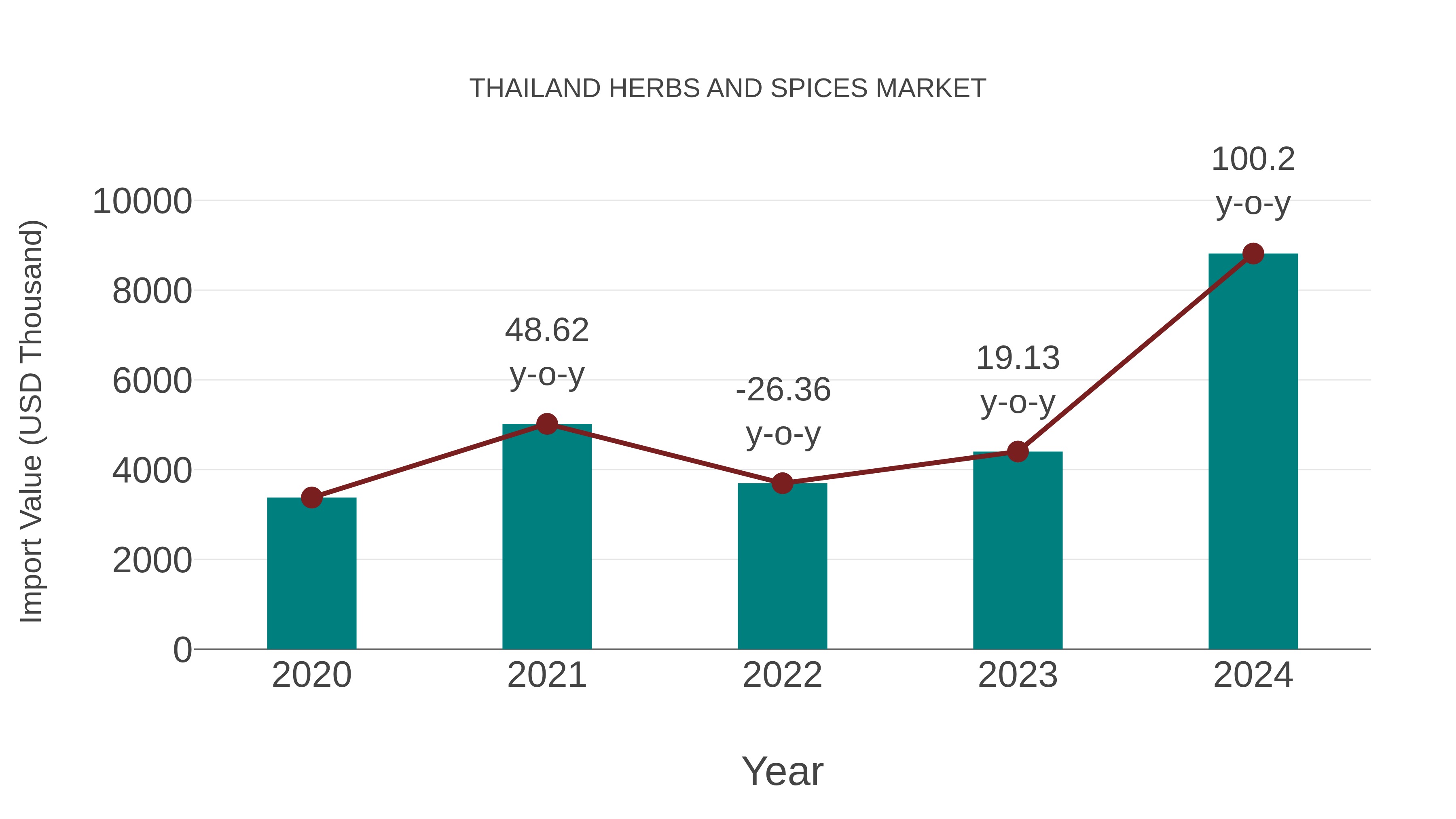
Thailand import trend for herbs and spices showed significant growth from 2023 to 2024, with a notable increase of 100.2%. The compound annual growth rate (CAGR) for the period 2020 to 2024 stood at 27.11%. This surge in imports can be attributed to a shift in consumer preferences towards exotic flavors and an increase in international trade agreements facilitating the flow of goods.
Thailand Herbs and Spices Market Synopsis
The Thailand herbs & spices market was valued at USD 3 billion in 2019 and is anticipated to expand significantly over the forecast period owing primarily due rise across food industries particularly within packaged foods applications thereby driving overall demand for herbs&spices worldwide. Additionally, rising trend towards incorporating flavorful ingredients not only enhance flavor but also provide additional health benefits including antioxidant properties thus further aiding its adoption across multiple end use segments consequently driving overall sales prospects slightly higher than previous forecasts although this may however fluctuate depending upon regional factors.
Drivers of the Market
The Thailand herbs and spices market is primarily fueled by the country`s rich agricultural heritage and the cultural importance of herbs and spices in Thai cuisine. The market is further boosted by the global demand for Thai flavors and culinary experiences, leading to increased cultivation and export of these aromatic ingredients.
Challenges of the Market
The herbs and spices market in Thailand encounters challenges related to sustainability and quality control. Sourcing and cultivating herbs and spices sustainably can be complex, given variations in weather conditions and increasing demand. Ensuring consistent quality and authenticity is also crucial, especially with the prevalence of counterfeit products.
Trends & Oppourtunites of the Market
Thai cuisine is renowned for its rich blend of flavors, making the herbs and spices market incredibly promising. Businesses can thrive by offering high-quality, locally sourced herbs and spices to both domestic consumers and the global culinary industry.
COVID-19 Impact on the Market
The Thailand Herbs and Spices Market experienced a mixed impact. While the demand for spices remained relatively stable due to their essential nature in cooking, the closure of markets and restrictions on movement affected the supply of fresh herbs. Export-dependent sectors saw fluctuations in demand as global trading patterns were disrupted.
Key Players in the Market
The Thailand herbs and spices market features entities like Thai Foods Product International Co., Ltd., and Theppadungporn Coconut Co., Ltd., actively involved in producing and supplying a diverse array of herbs and spices for culinary and medicinal purposes.
Key Highlights of the Report:
- Thailand Herbs and Spices Market Outlook
- Market Size of Thailand Herbs and Spices Market, 2025
- Forecast of Thailand Herbs and Spices Market, 2032
- Historical Data and Forecast of Thailand Herbs and Spices Revenues & Volume for the Period 2022 - 2032F
- Thailand Herbs and Spices Market Trend Evolution
- Thailand Herbs and Spices Market Drivers and Challenges
- Thailand Herbs and Spices Price Trends
- Thailand Herbs and Spices Porter's Five Forces
- Thailand Herbs and Spices Industry Life Cycle
- Historical Data and Forecast of Thailand Herbs and Spices Market Revenues & Volume By Product type for the Period 2022 - 2032F
- Historical Data and Forecast of Thailand Herbs and Spices Market Revenues & Volume By Herbs for the Period 2022 - 2032F
- Historical Data and Forecast of Thailand Herbs and Spices Market Revenues & Volume By Spices for the Period 2022 - 2032F
- Historical Data and Forecast of Thailand Herbs and Spices Market Revenues & Volume By Paprila for the Period 2022 - 2032F
- Historical Data and Forecast of Thailand Herbs and Spices Market Revenues & Volume By Cumin for the Period 2022 - 2032F
- Historical Data and Forecast of Thailand Herbs and Spices Market Revenues & Volume By End Use for the Period 2022 - 2032F
- Historical Data and Forecast of Thailand Herbs and Spices Market Revenues & Volume By Food for the Period 2022 - 2032F
- Historical Data and Forecast of Thailand Herbs and Spices Market Revenues & Volume By Beverage for the Period 2022 - 2032F
- Historical Data and Forecast of Thailand Herbs and Spices Market Revenues & Volume By Food Service for the Period 2022 - 2032F
- Historical Data and Forecast of Thailand Herbs and Spices Market Revenues & Volume By Retail for the Period 2022 - 2032F
- Historical Data and Forecast of Thailand Herbs and Spices Market Revenues & Volume By Form for the Period 2022 - 2032F
- Historical Data and Forecast of Thailand Herbs and Spices Market Revenues & Volume By Powder & Granules for the Period 2022 - 2032F
- Historical Data and Forecast of Thailand Herbs and Spices Market Revenues & Volume By Flakes for the Period 2022 - 2032F
- Historical Data and Forecast of Thailand Herbs and Spices Market Revenues & Volume By Paste for the Period 2022 - 2032F
- Historical Data and Forecast of Thailand Herbs and Spices Market Revenues & Volume By Whole/Fresh for the Period 2022 - 2032F
- Historical Data and Forecast of Thailand Herbs and Spices Market Revenues & Volume By Sales channel for the Period 2022 - 2032F
- Historical Data and Forecast of Thailand Herbs and Spices Market Revenues & Volume By Direct for the Period 2022 - 2032F
- Historical Data and Forecast of Thailand Herbs and Spices Market Revenues & Volume By Indirect for the Period 2022 - 2032F
- Historical Data and Forecast of Thailand Herbs and Spices Market Revenues & Volume By Nature for the Period 2022 - 2032F
- Historical Data and Forecast of Thailand Herbs and Spices Market Revenues & Volume By Organic for the Period 2022 - 2032F
- Historical Data and Forecast of Thailand Herbs and Spices Market Revenues & Volume By Vegan for the Period 2022 - 2032F
- Historical Data and Forecast of Thailand Herbs and Spices Market Revenues & Volume By Natural for the Period 2022 - 2032F
- Historical Data and Forecast of Thailand Herbs and Spices Market Revenues & Volume By Non-GMO for the Period 2022 - 2032F
- Historical Data and Forecast of Thailand Herbs and Spices Market Revenues & Volume By Conventional for the Period 2022 - 2032F
- Thailand Herbs and Spices Import Export Trade Statistics
- Market Opportunity Assessment By Product type
- Market Opportunity Assessment By End Use
- Market Opportunity Assessment By Form
- Market Opportunity Assessment By Sales channel
- Market Opportunity Assessment By Nature
- Thailand Herbs and Spices Top Companies Market Share
- Thailand Herbs and Spices Competitive Benchmarking By Technical and Operational Parameters
- Thailand Herbs and Spices Company Profiles
- Thailand Herbs and Spices Key Strategic Recommendations






































