Thailand Industrial Machinery Market Size, Share & Growth Rate
The Thailand Industrial Machinery Market was estimated at USD 112 Million in 2025 and is projected to reach USD 128 Million by 2032, growing at a CAGR of 1.9% from 2026 to 2032. This trajectory is propelled by Thailand's strategic positioning as a manufacturing hub in Southeast Asia, which has led to increased foreign investments. Furthermore, government initiatives promoting advanced manufacturing technologies and automation are fostering innovation and efficiency across various industries.
Thailand Industrial Machinery Market Year-wise Growth Rate and Key Drivers
This graph highlights how the Thailand Industrial Machinery Market has steadily grown over the years, supported by major growth factors.
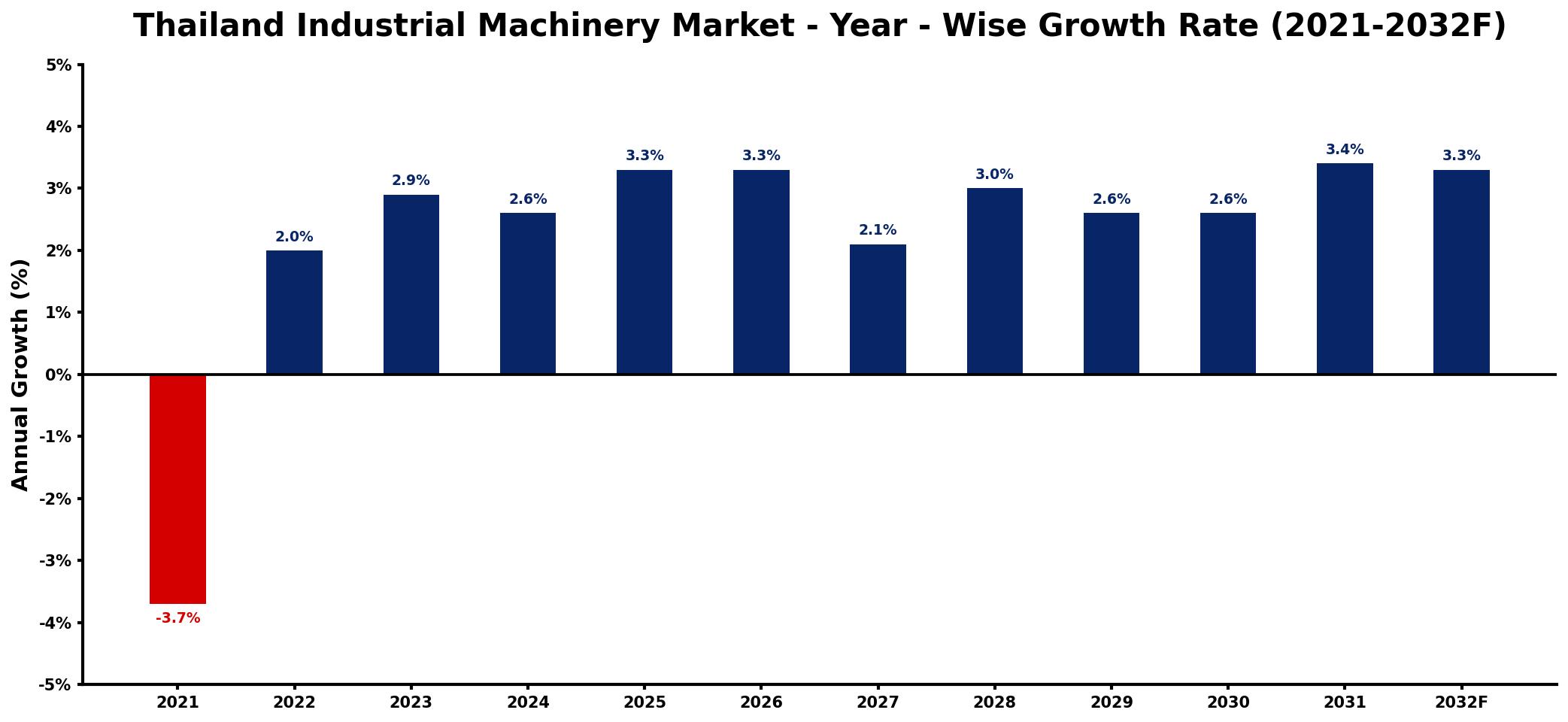
The table below presents the year‑wise growth rates along with the key drivers influencing the market
| Year | Growth Rate | Major Drivers |
| 2021 | -3.7% | decreased demand from construction sector |
| 2022 | 2.0% | rising investments in automation technologies |
| 2023 | 2.9% | expansion of renewable energy projects |
| 2024 | 2.6% | increased manufacturing capacity utilization |
| 2025 | 3.3% | growing exports to neighboring countries |
| 2026 | 3.3% | surge in infrastructure development projects |
| 2027 | 2.1% | enhanced focus on sustainable practices |
| 2028 | 3.0% | emergence of smart factory initiatives |
| 2029 | 2.6% | growing need for process optimization |
| 2030 | 2.6% | increased adoption of digital solutions |
| 2031 | 3.4% | growing automotive sector requirements |
| 2032 | 3.3% | rising demand for customized solutions |
Note: Market size estimations and growth projections presented in this report are based on 6Wresearch's proprietary forecasting methodology, utilizing the latest available industry data, government publications, and primary research inputs.
Thailand Industrial Machinery Market Synopsis
The Thailand industrial machinery market is witnessing robust growth, underpinned by a surge in manufacturing activities and a shift toward automation. As businesses adapt to global competition, there's a rising demand for sophisticated machinery that enhances productivity and quality.
Notably, the Thai government has been actively supporting the industrial sector, focusing on modernizing equipment and embracing Industry 4.0. As a result, a diverse array of machinery, including construction and agricultural equipment, is becoming increasingly critical to Thailands economic landscape.
Thailand Industrial Machinery Market Key Takeaways
- Strong growth forecast driven by strategic investments in manufacturing and automation.
- Government initiatives encouraging advanced industrial technologies are enhancing market dynamics.
- Increasing foreign investments are fueling demand for various machinery types.
- Flexibility and innovation are becoming essential for local manufacturers to remain competitive.
- Resilience shown post-COVID-19 has set the stage for further recovery and growth.
Evaluation of Restraints in Thailand Industrial Machinery Market
While the Thailand industrial machinery market shows immense potential, it faces certain restraints that could impact its growth trajectory. The fierce global competition requires local manufacturers to maintain not only cost competitiveness but also stringent quality standards. Additionally, rapid technological advancements necessitate ongoing investment in research and development, which can strain resources. Moreover, shifting consumer preferences and evolving regulatory environments demand adaptability from producers to meet market expectations efficiently.
Thailand Industrial Machinery Market Trends
Several key trends are shaping the Thailand industrial machinery market, particularly a strong shift toward automation and smart manufacturing. Industry 4.0 technologies, such as IoT and AI, are gaining traction, allowing companies to streamline operations and optimize production processes. Additionally, sustainability is becoming a focal point, with manufacturers increasingly seeking eco-friendly solutions and energy-efficient machinery to meet both regulatory requirements and consumer expectations.
Thailand Industrial Machinery Market Opportunities
There are substantial growth opportunities within the Thailand industrial machinery market, particularly in the sectors of automotive, electronics, and renewable energy. As Thailand solidifies its position as a manufacturing center, demand for cutting-edge machinery will likely surge. Moreover, as businesses pivot to adopt sustainable practices, the need for advanced, energy-efficient machinery presents a unique investment avenue for both local and international companies.
Government Initiatives in the Thailand Industrial Machinery Market
The Thai government has implemented several initiatives to enhance the industrial machinery sector's growth. Programs aimed at promoting industrialization, innovation, and technology adoption are central to these efforts. Incentives for investments in advanced machinery and automation are being offered, reflecting the government's commitment to fostering a competitive and modern industrial landscape. Public spending on infrastructure development also supports the growth of related industries, thereby stimulating demand for industrial machinery.
Future Insights of the Thailand Industrial Machinery Market
Looking ahead to 2026-2032, the Thailand industrial machinery market is poised for significant evolution. As the manufacturing sector adapts to global trends and local demands, a continuous push towards automation and technological integration will likely redefine operational frameworks. Furthermore, Thailand's growing reputation as a manufacturing powerhouse will attract more foreign investments, bolstering the demand for advanced industrial machinery and innovation.
Thailand Industrial Machinery Market Latest Developments (2025 - 2026)
Recent developments within the Thailand industrial machinery market highlight a renewed focus on innovation and efficiency. Companies are increasingly investing in automation technologies to improve production capabilities. Additionally, partnerships between local firms and international machinery providers are becoming more common, fostering knowledge transfer and enhancing technological prowess. The market is steadily responding to the post-COVID landscape by prioritizing digital transformations and sustainability initiatives.
Thailand Industrial Machinery Market - Key Attractiveness of the Report
- 10 Years of Market Numbers
- Historical Data Starting from 2022 to 2025
- Base Year: 2025
- Forecast Data until 2032
- Key Performance Indicators Impacting the Market
- Major Upcoming Developments and Projects
Key Highlights of the Report:
- Thailand Industrial Machinery Market Outlook
- Market Size of Thailand Industrial Machinery Market, 2025
- Forecast of Thailand Industrial Machinery Market, 2032
- Historical Data and Forecast of Thailand Industrial Machinery Revenues & Volume for the Period 2022-2032F
- Thailand Industrial Machinery Market Trend Evolution
- Thailand Industrial Machinery Market Drivers and Challenges
- Thailand Industrial Machinery Price Trends
- Thailand Industrial Machinery Porter's Five Forces
- Thailand Industrial Machinery Industry Life Cycle
- Historical Data and Forecast of Thailand Industrial Machinery Market Revenues & Volume By Application for the Period 2022-2032F
- Historical Data and Forecast of Thailand Industrial Machinery Market Revenues & Volume By Agriculture for the Period 2022-2032F
- Historical Data and Forecast of Thailand Industrial Machinery Market Revenues & Volume By Construction for the Period 2022-2032F
- Historical Data and Forecast of Thailand Industrial Machinery Market Revenues & Volume By Packaging for the Period 2022-2032F
- Historical Data and Forecast of Thailand Industrial Machinery Market Revenues & Volume By Food Processing for the Period 2022-2032F
- Historical Data and Forecast of Thailand Industrial Machinery Market Revenues & Volume By Mining for the Period 2022-2032F
- Historical Data and Forecast of Thailand Industrial Machinery Market Revenues & Volume By Semiconductor Manufacturing for the Period 2022-2032F
- Thailand Industrial Machinery Import Export Trade Statistics
- Market Opportunity Assessment By Application
- Thailand Industrial Machinery Top Companies Market Share
- Thailand Industrial Machinery Competitive Benchmarking By Technical and Operational Parameters
- Thailand Industrial Machinery Company Profiles
- Thailand Industrial Machinery Key Strategic Recommendations






































