Thailand Interior Design Market Size, Share & Growth Rate
The Thailand Interior Design Market was estimated at USD 195 Million in 2025 and is projected to reach USD 224 Million by 2032, growing at a CAGR of 2.0% from 2026 to 2032. This growth trajectory is fueled by a burgeoning urban population and an increasing appreciation for aesthetically pleasing, functional spaces in both residential and commercial sectors. As disposable incomes rise, more consumers are investing in home and office renovations, thus driving demand for professional interior design services.
Thailand Interior Design Market Year-wise Growth Rate and Key Drivers
This graph highlights how the Thailand Interior Design Market has steadily grown over the years, supported by major growth factors.
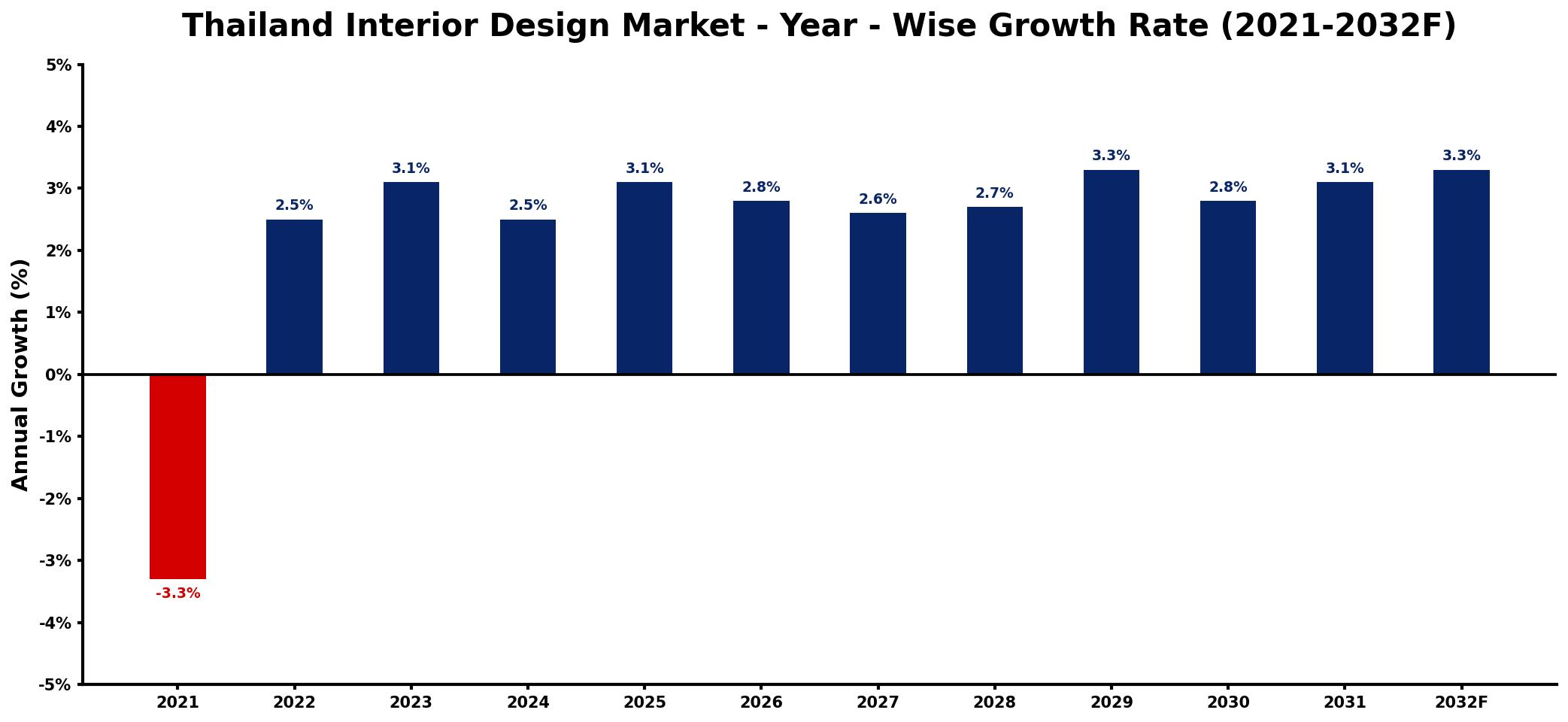
The table below presents the year‑wise growth rates along with the key drivers influencing the market
| Year | Growth Rate | Major Drivers |
| 2021 | -3.3% | decreased consumer spending on renovations |
| 2022 | 2.5% | rising interest in home aesthetics |
| 2023 | 3.1% | increased investment in residential upgrades |
| 2024 | 2.5% | growing popularity of sustainable materials |
| 2025 | 3.1% | expansion of online consultation services |
| 2026 | 2.8% | enhanced focus on wellness environments |
| 2027 | 2.6% | increased demand for multifunctional spaces |
| 2028 | 2.7% | growth in luxury property investments |
| 2029 | 3.3% | surge in urban redevelopment projects |
| 2030 | 2.8% | increased overall sector activity |
| 2031 | 3.1% | rising export shipment volumes |
| 2032 | 3.3% | increased focus on cultural aesthetics |
Note: Market size estimations and growth projections presented in this report are based on 6Wresearch's proprietary forecasting methodology, utilizing the latest available industry data, government publications, and primary research inputs.
Thailand Interior Design Market Synopsis
The most significant force shaping the Thailand Interior Design Market is the increasing urbanization coupled with a strong demand for personalized living and working environments. As cities expand and lifestyles evolve, consumers seek interior design solutions that not only meet their aesthetic preferences but also enhance their well-being and productivity.
Another vital aspect of this market is the growing awareness of how interior design influences mental and emotional health. This realization has led to an increasing emphasis on creating harmonious spaces that promote comfort and efficiency, further amplifying the demand for interior design services and products.
Thailand Interior Design Market Key Takeaways
- Growing urban population is a primary driver of market expansion.
- Consumers are increasingly investing in both home and office interior transformations.
- Awareness of the psychological benefits of good design is rising.
- Market adaptability during the COVID-19 pandemic has set a precedent for future resilience.
- Key players offer a comprehensive range of design services, catering to diverse client needs.
Evaluation of Restraints in Thailand Interior Design Market
Despite its growth potential, the Thailand Interior Design Market faces certain limitations. Variability in client preferences can make it challenging for designers to deliver universally appealing designs. Additionally, budget constraints can hinder the execution of innovative concepts. Economic fluctuations, particularly downturns, can also stifle demand for renovation and construction projects, leading to an inconsistent market flow. Furthermore, the fast-paced nature of design trends necessitates that interior designers continually innovate and adapt to stay relevant.
Thailand Interior Design Market Trends
Several trends are currently shaping the Thailand Interior Design Market. A prominent shift towards sustainable and eco-friendly design solutions is gaining traction, with consumers increasingly prioritizing environmentally responsible materials and practices. Additionally, the popularity of multifunctional spaces is on the rise, driven by the need for versatility in smaller urban dwellings. Technology integration in design is also becoming more prevalent, with smart home features being incorporated into residential projects.
Thailand Interior Design Market Opportunities
The Thailand Interior Design Market presents numerous avenues for growth and investment. Opportunities abound for designers who specialize in sustainable design, as demand for eco-conscious materials continues to grow. Additionally, the expanding market for home offices and remote workspaces creates a niche for services tailored to enhancing productivity at home. As urbanization progresses, there is also potential for new developments in both residential and commercial sectors, offering a ripe environment for innovative design solutions.
Government Initiatives in the Thailand Interior Design Market
The Thai government has been actively promoting urban development through various policies aimed at enhancing infrastructure and public spaces. Investment in sustainable building practices and eco-friendly initiatives is encouraged, benefiting the interior design sector by aligning with current trends towards sustainability. Public spending on urban renewal projects can further stimulate demand for professional interior design services, creating a favorable environment for market growth.
Future Insights of the Thailand Interior Design Market
Looking ahead, the Thailand Interior Design Market is poised for continued growth through 2032. As the urban population expands and consumer preferences evolve, the demand for personalized, functional spaces will likely intensify. The ongoing integration of technology and sustainability in design practices will shape future offerings, making adaptability a cornerstone for success in the market. With a focus on innovation and customer-centric solutions, stakeholders in this sector can expect to navigate future trends effectively and capitalize on emerging opportunities.
Thailand Interior Design Market Latest Developments (2025 - 2026)
Recent developments in the Thailand Interior Design Market indicate a robust recovery following the pandemic-induced slowdown. Many firms have adopted hybrid business models, combining virtual consultations with in-person services to meet client demands. Furthermore, there has been a noticeable increase in projects centered around wellness and sustainable living, reflecting shifting consumer priorities towards health-conscious and eco-friendly design.
Thailand Interior Design Market - Key Attractiveness of the Report
- 10 Years of Market Numbers
- Historical Data Starting from 2022 to 2025
- Base Year: 2025
- Forecast Data until 2032
- Key Performance Indicators Impacting the Market
- Major Upcoming Developments and Projects
Key Highlights of the Report:
- Thailand Interior Design Market Outlook
- Market Size of Thailand Interior Design Market, 2025
- Forecast of Thailand Interior Design Market, 2032
- Historical Data and Forecast of Thailand Interior Design Revenues & Volume for the Period 2022-2032F
- Thailand Interior Design Market Trend Evolution
- Thailand Interior Design Market Drivers and Challenges
- Thailand Interior Design Price Trends
- Thailand Interior Design Porter's Five Forces
- Thailand Interior Design Industry Life Cycle
- Historical Data and Forecast of Thailand Interior Design Market Revenues & Volume By End Use for the Period 2022-2032F
- Historical Data and Forecast of Thailand Interior Design Market Revenues & Volume By Commercial for the Period 2022-2032F
- Historical Data and Forecast of Thailand Interior Design Market Revenues & Volume By Residential for the Period 2022-2032F
- Historical Data and Forecast of Thailand Interior Design Market Revenues & Volume By Decoration Type for the Period 2022-2032F
- Historical Data and Forecast of Thailand Interior Design Market Revenues & Volume By New for the Period 2022-2032F
- Historical Data and Forecast of Thailand Interior Design Market Revenues & Volume By Renovations for the Period 2022-2032F
- Thailand Interior Design Import Export Trade Statistics
- Market Opportunity Assessment By End Use
- Market Opportunity Assessment By Decoration Type
- Thailand Interior Design Top Companies Market Share
- Thailand Interior Design Competitive Benchmarking By Technical and Operational Parameters
- Thailand Interior Design Company Profiles
- Thailand Interior Design Key Strategic Recommendations






































