Thailand Lithium compounds Market Size, Share & Growth Rate
The Thailand Lithium compounds Market was estimated at USD 227 Million in 2025 and is projected to reach USD 261 Million by 2032, growing at a CAGR of 2.0% from 2026 to 2032. The driving force behind this growth trajectory is primarily the burgeoning demand for lithium-ion batteries, propelled by the electric vehicle sector and advancements in consumer electronics. As Thailand positions itself as a key player in the electric vehicle landscape, the need for reliable lithium sources becomes increasingly critical, fostering a robust market environment.
Thailand Lithium compounds Market Year-wise Growth Rate and Key Drivers
This graph highlights how the Thailand Lithium compounds Market has steadily grown over the years, supported by major growth factors.
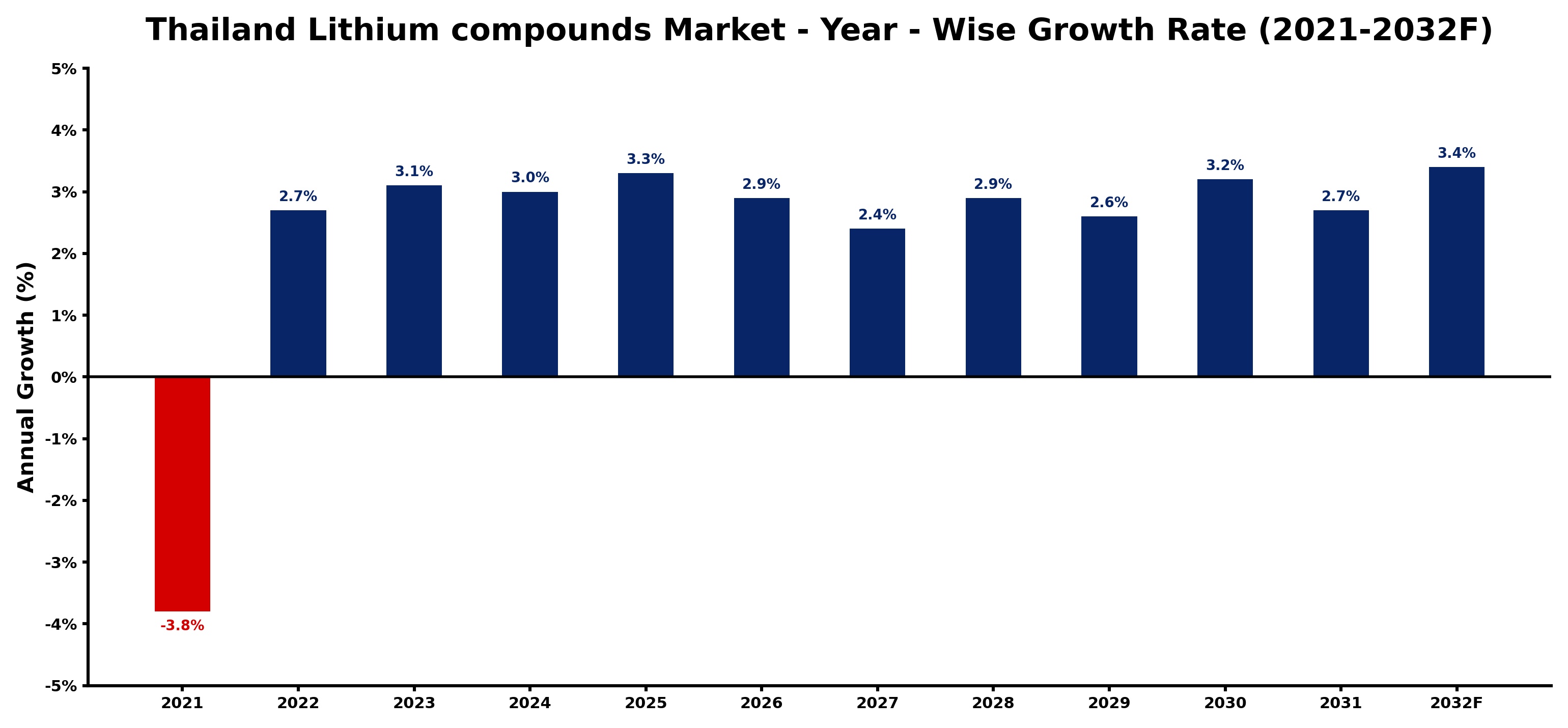
The table below presents the year‑wise growth rates along with the key drivers influencing the market
| Year | Growth Rate | Major Drivers |
| 2021 | -3.8% | Expansion of transportation and logistics networks |
| 2022 | 2.7% | Rapid growth in telecom and data center sectors |
| 2023 | 3.1% | Government infrastructure modernization initiatives |
| 2024 | 3.0% | Rising electricity demand across industries |
| 2025 | 3.3% | Increasing industrial infrastructure investments |
| 2026 | 2.9% | Expansion of transportation and logistics networks |
| 2027 | 2.4% | Rapid growth in telecom and data center sectors |
| 2028 | 2.9% | Expansion of manufacturing activities |
| 2029 | 2.6% | Growing urbanization and commercial development |
| 2030 | 3.2% | Government infrastructure modernization initiatives |
| 2031 | 2.7% | Expansion of manufacturing activities |
| 2032 | 3.4% | Rapid growth in telecom and data center sectors |
Note - Market size estimations and growth projections presented in this report are based on 6Wresearch’s advanced forecasting approach, validated with industry datasets as of June 2026.
Thailand Lithium compounds Market Synopsis
The most significant force shaping the Thailand Lithium compounds market today is the escalating demand from the electric vehicle industry. As global trends shift toward sustainability, local manufacturers and suppliers are aligning themselves with the evolving landscape of clean energy, making lithium compounds essential for powering future technologies.
With imports constituting a staggering 91% of the overall market supply, Thailand remains heavily reliant on foreign sources of lithium compounds. This reliance underscores the importance of maintaining strong trade relations, particularly with leading suppliers from Australia, Canada, and Chile, which are pivotal in sustaining local production and supply chains.
Thailand Lithium compounds Market Key Takeaways
- The market is anticipated to witness steady growth driven by the electric vehicle industry and electronics manufacturing.
- Domestic production currently constitutes only 9% of the total market, revealing significant opportunities for local manufacturing investment.
- Supply chain dynamics are influenced heavily by international trade, particularly with major exporting countries.
- Technological advancements in battery development are shaping future demand for specific types of lithium compounds.
- The market's growth is challenged by supply chain reliability and geopolitical risks associated with raw material sourcing.
Evaluation of Restraints in Thailand Lithium compounds Market
While the prospects for the Thailand Lithium compounds market are promising, there are notable restraints that could hinder growth. One primary concern is the reliability of the supply chain, heavily dependent on imports from a few key countries. Geopolitical tensions can disrupt these supply lines, leading to fluctuations in availability and price. Furthermore, as battery technologies evolve, the demand for specific lithium compounds may shift, requiring market participants to adapt swiftly to changing preferences and requirements.
Thailand Lithium compounds Market Trends
Currently, the trend towards sustainable energy solutions is driving innovations in battery technologies, particularly lithium-ion systems. As manufacturers seek to enhance energy density and reduce costs, the development of advanced lithium compounds is gaining traction. Additionally, an increased focus on recycling and sustainability within the supply chain is prompting stakeholders to explore more eco-friendly production processes and sourcing strategies.
Thailand Lithium compounds Market Opportunities
Investment opportunities are emerging within the Thailand Lithium compounds market as demand continues to swell. Local producers are encouraged to explore partnerships with international suppliers to bolster domestic production capabilities. Furthermore, the government's commitment to fostering the electric vehicle sector presents a ripe environment for innovation, enabling new entrants to capture market share by providing tailored lithium solutions.
Government Initiatives in the Thailand Lithium compounds Market
The Thai government has implemented several initiatives aimed at promoting the electric vehicle industry, which inherently drives demand for lithium compounds. Incentives for electric vehicle adoption, infrastructure development for charging stations, and support for local manufacturing capabilities are critical components of these initiatives. Through these efforts, Thailand aims to position itself as a regional hub for sustainable automotive technology.
Future Insights of the Thailand Lithium compounds Market
Looking ahead to the period from 2026 to 2032, the Thailand Lithium compounds market is expected to experience steady growth fueled by the ongoing transition to electric mobility. As consumer preferences shift towards greener technologies, the importance of lithium compounds will only increase. The evolution of local production capabilities, driven by government incentives and foreign partnerships, will play a pivotal role in shaping the competitive landscape of the market.
Thailand Lithium compounds Market Latest Developments (May 2025 - June 2026)
Recent developments within the Thailand Lithium compounds market highlight a growing focus on domestic production and sustainable sourcing. Local enterprises are increasingly engaging with international stakeholders to enhance their supply chains, while innovative approaches to lithium extraction and processing are being prioritized. These trends indicate a proactive response to global market demands and a commitment to positioning Thailand as a significant player in the regional lithium landscape.
Thailand Lithium compounds Market - Key Attractiveness of the Report
- 10 Years of Market Numbers
- Historical Data Starting from 2022 to 2025
- Base Year: 2025
- Forecast Data until 2032
- Key Performance Indicators Impacting the Market
- Major Upcoming Developments and Projects
Key Highlights of the Report:
- Thailand Lithium compounds Market Outlook
- Market Size of Thailand Lithium compounds Market, 2025
- Forecast of Thailand Lithium compounds Market, 2032
- Historical Data and Forecast of Thailand Lithium compounds Revenues & Volume for the Period 2022-2032F
- Thailand Lithium compounds Market Trend Evolution
- Thailand Lithium compounds Market Drivers and Challenges
- Thailand Lithium compounds Price Trends
- Thailand Lithium compounds Porter's Five Forces
- Thailand Lithium compounds Industry Life Cycle
- Historical Data and Forecast of Thailand Lithium compounds Market Revenues & Volume By Derivative for the Period 2022-2032F
- Historical Data and Forecast of Thailand Lithium compounds Market Revenues & Volume By Hydrides for the Period 2022-2032F
- Historical Data and Forecast of Thailand Lithium compounds Market Revenues & Volume By Fluorides for the Period 2022-2032F
- Historical Data and Forecast of Thailand Lithium compounds Market Revenues & Volume By Chlorides for the Period 2022-2032F
- Historical Data and Forecast of Thailand Lithium compounds Market Revenues & Volume By Bromides for the Period 2022-2032F
- Historical Data and Forecast of Thailand Lithium compounds Market Revenues & Volume By Iodides for the Period 2022-2032F
- Historical Data and Forecast of Thailand Lithium compounds Market Revenues & Volume By Oxides for the Period 2022-2032F
- Historical Data and Forecast of Thailand Lithium compounds Market Revenues & Volume By Carbonates for the Period 2022-2032F
- Historical Data and Forecast of Thailand Hydrides Lithium compounds Market Revenues & Volume By Others for the Period 2022-2032F
- Historical Data and Forecast of Thailand Lithium compounds Market Revenues & Volume By Application for the Period 2022-2032F
- Historical Data and Forecast of Thailand Lithium compounds Market Revenues & Volume By Rechargeable & Non-Rechargeable Batteries for the Period 2022-2032F
- Historical Data and Forecast of Thailand Lithium compounds Market Revenues & Volume By Air Conditioning for the Period 2022-2032F
- Historical Data and Forecast of Thailand Lithium compounds Market Revenues & Volume By Industrial Drying System for the Period 2022-2032F
- Historical Data and Forecast of Thailand Lithium compounds Market Revenues & Volume By Glass & Ceramics for the Period 2022-2032F
- Historical Data and Forecast of Thailand Lithium compounds Market Revenues & Volume By Metallurgy for the Period 2022-2032F
- Historical Data and Forecast of Thailand Lithium compounds Market Revenues & Volume By Polymers for the Period 2022-2032F
- Historical Data and Forecast of Thailand Lithium compounds Market Revenues & Volume By Others for the Period 2022-2032F
- Historical Data and Forecast of Thailand Lithium compounds Market Revenues & Volume By Industry Vertical for the Period 2022-2032F
- Historical Data and Forecast of Thailand Lithium compounds Market Revenues & Volume By Aerospace and Defense for the Period 2022-2032F
- Historical Data and Forecast of Thailand Lithium compounds Market Revenues & Volume By Automobile for the Period 2022-2032F
- Historical Data and Forecast of Thailand Lithium compounds Market Revenues & Volume By Energy for the Period 2022-2032F
- Historical Data and Forecast of Thailand Lithium compounds Market Revenues & Volume By Chemicals for the Period 2022-2032F
- Historical Data and Forecast of Thailand Lithium compounds Market Revenues & Volume By Engineering Machinery for the Period 2022-2032F
- Historical Data and Forecast of Thailand Lithium compounds Market Revenues & Volume By Pharmaceuticals for the Period 2022-2032F
- Historical Data and Forecast of Thailand Lithium compounds Market Revenues & Volume By Others for the Period 2022-2032F
- Thailand Lithium compounds Import Export Trade Statistics
- Market Opportunity Assessment By Derivative
- Market Opportunity Assessment By Application
- Market Opportunity Assessment By Industry Vertical
- Thailand Lithium compounds Top Companies Market Share
- Thailand Lithium compounds Competitive Benchmarking By Technical and Operational Parameters
- Thailand Lithium compounds Company Profiles
- Thailand Lithium compounds Key Strategic Recommendations






































