Thailand Lithium Ion Battery Market: Import Trend Analysis
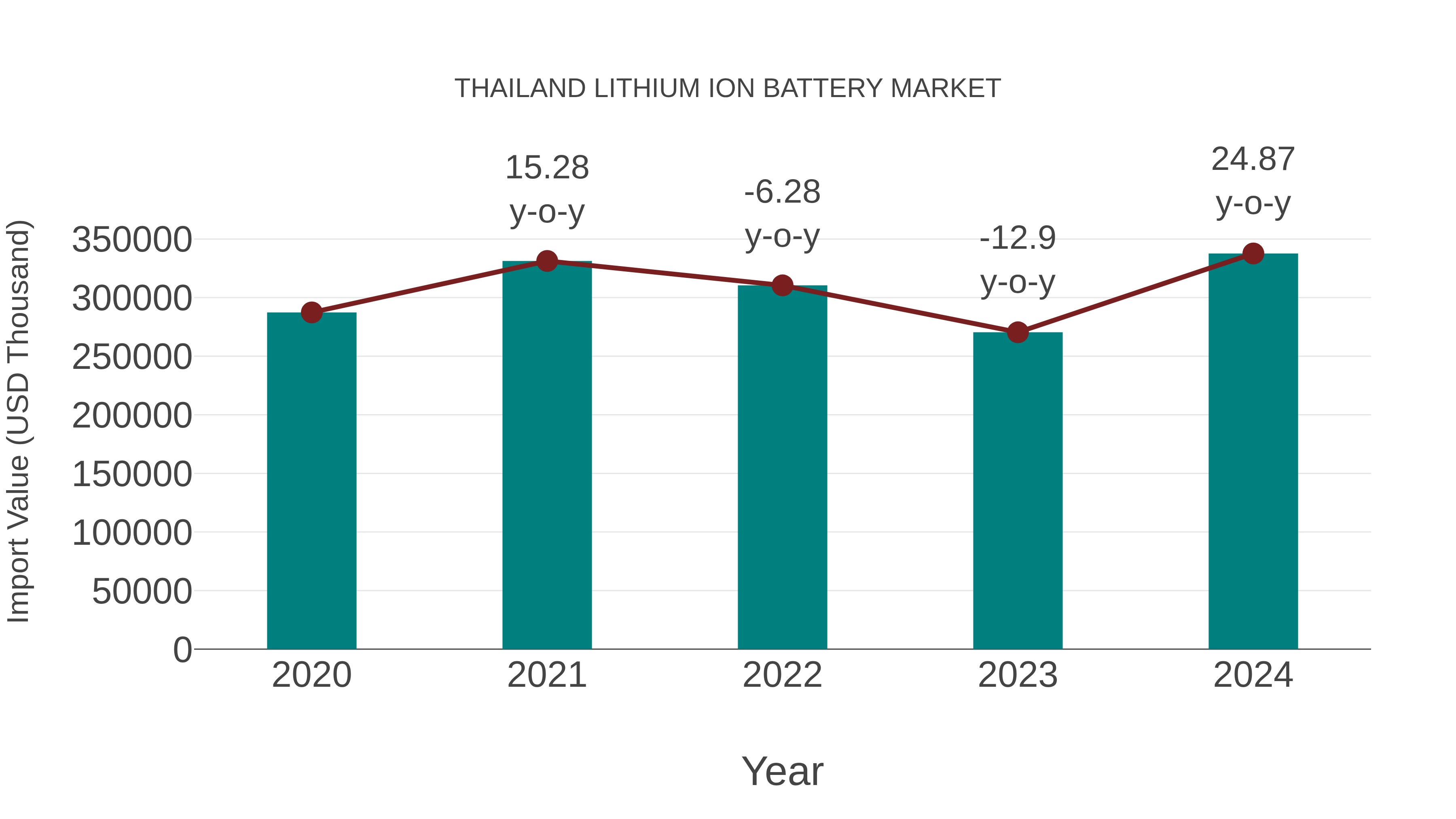
In the Thailand lithium-ion battery market, the import trend exhibited a notable growth rate of 24.87% from 2023 to 2024, with a compound annual growth rate (CAGR) of 4.12% from 2020 to 2024. This import momentum can be attributed to the increasing demand for electric vehicles in the region, driving the need for lithium-ion batteries.
Lithium Ion Battery Market: Thailand vs Top 5 Major Economies in 2027 (Asia)
By 2027, Thailand's Lithium Ion Battery market is forecasted to achieve a stable growth rate of 0.10%, with China leading the Asia region, followed by India, Japan, Australia and South Korea.

Thailand Lithium Ion Battery Market Growth Rate
According to 6Wresearch internal database and industry insights, the Thailand Lithium Ion Battery Market is projected to grow at a compound annual growth rate (CAGR) of 11.4% during the forecast period (2026-2032).
Topics Covered in the Thailand Lithium Ion Battery Market Report
The Thailand Lithium Ion Battery Market report thoroughly covers the market by type, Power Capacity, Application and Form. The market report provides an unbiased and detailed analysis of ongoing market trends, opportunities/high growth areas, and market drivers, which help stakeholders devise and align their market strategies according to the current and future market dynamics.
Thailand Lithium Ion Battery Market Highlights
| Report Name | Thailand Lithium Ion Battery Market |
| Forecast period | 2026-2032 |
| CAGR | 11.4% |
| Growing Sector | Automotive OEMs |
Thailand Lithium Ion Battery Market Synopsis
Thailand Lithium Ion Battery Market is witnessing strong momentum driven by the rapid electrification of transportation, growing demand for energy-efficient storage systems, and the country's strategic focus on becoming a regional EV manufacturing hub, while continuous advancements in battery technologies and increasing investments from global players are further enhancing production capabilities and supply chains, thereby enabling wider adoption across automotive, consumer electronics, and industrial sectors, ultimately positioning the market as a critical component of Thailand's evolving clean energy and mobility ecosystem.
Evaluation of Growth Drivers in the Thailand Lithium Ion Battery Market
Below mentioned are some prominent drivers and their influence on the market dynamics:
| Drivers | Primary Segments Affected | Why it Matters (Evidence) |
| EV Adoption Growth | Automotive OEMs, NMC & LFP | Government EV incentives drive battery demand for electric vehicles. |
| Renewable Energy Integration | Battery Storage, LFP | There needs to be enough battery storage for the implementation of solar and wind power systems. |
| Plant Capacity Enhancement | All Battery Types, OEM | The local production of batteries eliminates the need for importing batteries. |
| Rise in Consumer Electronics Consumption | 0-300 mAH, 3,000-10,000 mAH | The increase in consumer electronics consumption drives up battery consumption. |
| Technological Innovations | NCA, LTO, All Applications | Increased battery efficiency improves longevity and effectiveness. |
Thailand Lithium Ion Battery Market is expected to grow at the CAGR of 11.4% during the forecast period of 2026-2032. Growth will be fueled by an increase in EV penetration, growth in renewable energy storage investment, and an increase in domestic battery production capacity, while favorable government policies and technology will continue to improve the efficiency and cost-effectiveness of batteries.
Evaluation of Restraints in the Thailand Lithium Ion Battery Market
Below mentioned are some major restraints and their influence on the market dynamics:
| Restraints | Primary Segments Affected | What This Means (Evidence) |
| Expensive Raw Material | NCM, NCA, Vehicles | Variability in the price of lithium and cobalt influences production costs. |
| Insufficient Recycling Facilities | All Types, Other Products | Few recycling facilities pose environmental risks. |
| Dependency on Imports | All Uses | Reliance on imports hampers a reliable supply chain. |
| Safety Concerns | Consumer Electronics, Automotive | Risk of overheating affects consumer trust and adoption. |
| Technological Barriers | Industrial OEMs, Energy Storage | High R&D costs limit advanced battery deployment. |
Thailand Lithium Ion Battery Market Challenges
Despite considerable expansion and advancements, there are a number of obstacles for the Thailand Lithium Ion Battery Industry, which includes variations in raw material costs, inability to source locally, and changing regulatory standards, in addition to other constraints like safety considerations, absence of efficient recycling technologies, and higher capital costs, thus impacting Thailand Lithium Ion Battery Market Growth.
Thailand Lithium Ion Battery Market Trends
Important market trends impacting the Thailand Lithium-Ion Battery Industry are:
- EV Battery Manufacturing Trend: The increasing trend toward EV battery manufacturing will create a robust domestic supply chain and decrease dependence on foreign suppliers.
- Fast Charging Solutions Progress: Rapid charging solutions are making the batteries more efficient and convenient for users.
- Energy Storage Systems Popularity: More lithium-ion batteries are being used in renewable energy projects, thus creating more energy storage systems.
- Sustainable Batteries Emphasis: Companies are concentrating on sustainable batteries that utilize environmentally friendly materials.
Investment Opportunities in the Thailand Lithium Ion Battery Market
Some important areas for investments within the Thailand Lithium Ion Battery Market are:
- EV Battery Manufacturing Facilities - To develop manufacturing units in order to fulfill rising requirements for electric vehicles.
- Energy Storage Facilities – Investments could be made in battery systems in order to store energy generated through renewable sources.
- Battery Recycling Facilities – Advanced technologies should be developed for recycling batteries.
- R&D for New Battery Chemistries – Research and Development activities could be carried out in order to develop better battery chemistries.
Top 5 Leading Players in the Thailand Lithium Ion Battery Market
Key companies shaping the Thailand Lithium Ion Battery Market include:
1. CATL (Contemporary Amperex Technology Co. Limited)
| Company Name | CATL (Contemporary Amperex Technology Co. Limited) |
| Established Year | 2011 |
| Headquarters | Ningde, China |
| Official Website | Click Here |
CATL is a global leader in lithium-ion battery manufacturing, offering advanced battery solutions for EVs and energy storage systems, while continuously investing in innovation and expanding its footprint across Asia, including Thailand, to support growing regional demand.
2. LG Energy Solution
| Company Name | LG Energy Solution |
| Established Year | 2020 |
| Headquarters | Seoul, South Korea |
| Official Website | Click Here |
LG Energy Solution specializes in high-performance lithium-ion batteries for automotive and consumer electronics, providing cutting-edge battery technologies that enhance energy density and lifecycle performance, while actively supporting EV ecosystem development in Southeast Asia.
3. Panasonic Corporation
| Company Name | Panasonic Corporation |
| Established Year | 1918 |
| Headquarters | Osaka, Japan |
| Official Website | Click Here |
Panasonic develops reliable lithium-ion battery systems widely used in automotive and industrial applications, focusing on innovation, quality, and sustainability, while maintaining strong partnerships with EV manufacturers to support growing electrification trends in Thailand.
4. BYD Company Limited
| Company Name | BYD Company Limited |
| Established Year | 1995 |
| Headquarters | Shenzhen, China |
| Official Website | Click Here |
BYD offers integrated lithium-ion battery solutions for electric vehicles and energy storage, leveraging its expertise in battery technology and manufacturing to support Thailand's transition toward clean energy and sustainable transportation systems.
5. Samsung SDI
| Company Name | Samsung SDI |
| Established Year | 1970 |
| Headquarters | Yongin, South Korea |
| Official Website | Click Here |
Samsung SDI produces advanced lithium-ion batteries for automotive, electronics, and energy storage sectors, emphasizing safety, performance, and innovation, while expanding its presence in emerging markets like Thailand to meet rising demand.
Government Regulations Introduced in the Thailand Lithium Ion Battery Market
According to Thailand Government Data, the Thailand Lithium Ion Battery Market is driven by factors including government strategies like the 2021 Electric Vehicle Promotion Strategy that seeks to establish Thailand as an EV hub through promoting the manufacture of batteries, as well as the BOI (Board of Investment) that offers tax concessions to battery manufacturers, and the Alternative Energy Development Plan, which drives energy storage usage, hence improving infrastructure, increasing foreign investment, and guaranteeing the sustainable growth of the batteries market.
Future Insights of the Thailand Lithium Ion Battery Market
Thailand Lithium Ion Battery Market is expected to witness substantial growth driven by increasing EV adoption, advancements in battery technologies, and rising investments in renewable energy storage, while continuous improvements in supply chain efficiency, expansion of manufacturing capabilities, and growing focus on sustainability will further accelerate Thailand Lithium Ion Battery Market Growth, positioning the country as a key player in the Southeast Asian battery industry.
Market Segmentation Analysis
The report offers a comprehensive study of the subsequent market segments and their leading categories:
Lithium Nickel Manganese Cobalt (LI-NMC) to Dominate the Market- By Type
According to Amrita, Senior Research Analyst, 6Wresearch, Lithium Nickel Manganese Cobalt batteries are expected to dominate the Thailand Lithium Ion Battery Industry due to their high energy density and widespread adoption in electric vehicles, while their balanced performance and longer lifecycle make them a preferred choice across automotive and energy storage applications.
10,000-60,000 mAH to Dominate the Market- By Power Capacity
This segment is leading the Thailand Lithium Ion Battery Market as it caters extensively to electric vehicles and large-scale energy storage systems, while offering optimal performance, longer usage duration, and higher efficiency, making it suitable for both industrial and automotive applications.
Automotive OEMs to Dominate the Market- By Application
Automotive OEMs are estimated to capture leadership in the Thailand Lithium Ion Battery market, driven by the growing adoption of EVs, backed by the presence of favorable government initiatives and increasing preference of consumers towards eco-friendly transportation solutions in the country.
Prismatic Batteries to Dominate the Market- By Form
Prismatic batteries are witnessing increasing prominence in the Thailand Lithium Ion Battery Market share, thanks to their smaller form factor, effective space management, and increased safety, thereby making them an ideal choice for automotive and industrial applications.
Key Attractiveness of the Report
- 10 Years of Market Numbers.
- Historical Data Starting from 2022 to 2025.
- Base Year: 2025.
- Forecast Data until 2032.
- Key Performance Indicators Impacting the Market.
- Major Upcoming Developments and Projects.
Key Highlights of the Report:
- Thailand Lithium Ion Battery Market Outlook
- Market Size of Thailand Lithium Ion Battery Market, 2025
- Forecast of Thailand Lithium Ion Battery Market, 2032
- Historical Data and Forecast of Thailand Lithium Ion Battery Revenues & Volume for the Period 2022-2032F
- Thailand Lithium Ion Battery Market Trend Evolution
- Thailand Lithium Ion Battery Market Drivers and Challenges
- Thailand Lithium Ion Battery Price Trends
- Thailand Lithium Ion Battery Porter's Five Forces
- Thailand Lithium Ion Battery Industry Life Cycle
- Historical Data and Forecast of Thailand Lithium Ion Battery Market Revenues & Volume By Type for the Period 2022-2032F
- Historical Data and Forecast of Thailand Lithium Ion Battery Market Revenues & Volume By Lithium Nickel Magnesium Cobalt (LI-NMC) for the Period 2022-2032F
- Historical Data and Forecast of Thailand Lithium Ion Battery Market Revenues & Volume By Lithium Ferro Phosphate (LFP) for the Period 2022-2032F
- Historical Data and Forecast of Thailand Lithium Ion Battery Market Revenues & Volume By Lithium Cobalt Oxide (LCO) for the Period 2022-2032F
- Historical Data and Forecast of Thailand Lithium Ion Battery Market Revenues & Volume By Lithium Titanate Oxide (LTO) for the Period 2022-2032F
- Historical Data and Forecast of Thailand Lithium Ion Battery Market Revenues & Volume By Lithium Manganese Oxide (LMO) for the Period 2022-2032F
- Historical Data and Forecast of Thailand Lithium Ion Battery Market Revenues & Volume By Lithium Nickel Cobalt Aluminum Oxide (NCA) for the Period 2022-2032F
- Historical Data and Forecast of Thailand Lithium Ion Battery Market Revenues & Volume By Power Capacity for the Period 2022-2032F
- Historical Data and Forecast of Thailand Lithium Ion Battery Market Revenues & Volume By 0-300 mAH for the Period 2022-2032F
- Historical Data and Forecast of Thailand Lithium Ion Battery Market Revenues & Volume By 3,000-10,000 mAH for the Period 2022-2032F
- Historical Data and Forecast of Thailand Lithium Ion Battery Market Revenues & Volume By 10,000-60,000 mAH for the Period 2022-2032F
- Historical Data and Forecast of Thailand Lithium Ion Battery Market Revenues & Volume By More than 60,000 mAH for the Period 2022-2032F
- Historical Data and Forecast of Thailand Lithium Ion Battery Market Revenues & Volume By Application for the Period 2022-2032F
- Historical Data and Forecast of Thailand Lithium Ion Battery Market Revenues & Volume By Consumer Electronics OEMs for the Period 2022-2032F
- Historical Data and Forecast of Thailand Lithium Ion Battery Market Revenues & Volume By Automotive OEMs for the Period 2022-2032F
- Historical Data and Forecast of Thailand Lithium Ion Battery Market Revenues & Volume By Energy Storage for the Period 2022-2032F
- Historical Data and Forecast of Thailand Lithium Ion Battery Market Revenues & Volume By Industrial OEMs for the Period 2022-2032F
- Historical Data and Forecast of Thailand Lithium Ion Battery Market Revenues & Volume By Other OEMs for the Period 2022-2032F
- Historical Data and Forecast of Thailand Lithium Ion Battery Market Revenues & Volume By Aftermarket for the Period 2022-2032F
- Historical Data and Forecast of Thailand Lithium Ion Battery Market Revenues & Volume By Form for the Period 2022-2032F
- Historical Data and Forecast of Thailand Lithium Ion Battery Market Revenues & Volume By Pouch for the Period 2022-2032F
- Historical Data and Forecast of Thailand Lithium Ion Battery Market Revenues & Volume By Cylindrical for the Period 2022-2032F
- Historical Data and Forecast of Thailand Lithium Ion Battery Market Revenues & Volume By Elliptical for the Period 2022-2032F
- Historical Data and Forecast of Thailand Lithium Ion Battery Market Revenues & Volume By Prismatic for the Period 2022-2032F
- Historical Data and Forecast of Thailand Lithium Ion Battery Market Revenues & Volume By Custom Design for the Period 2022-2032F
- Thailand Lithium Ion Battery Import Export Trade Statistics
- Market Opportunity Assessment By Type
- Market Opportunity Assessment By Power Capacity
- Market Opportunity Assessment By Application
- Market Opportunity Assessment By Form
- Thailand Lithium Ion Battery Top Companies Market Share
- Thailand Lithium Ion Battery Competitive Benchmarking By Technical and Operational Parameters
- Thailand Lithium Ion Battery Company Profiles
- Thailand Lithium Ion Battery Key Strategic Recommendations
Market Covered
The report offers a comprehensive study of the subsequent market segments:
By Type
- Lithium Nickel Manganese Cobalt (LI-NMC)
- Lithium Ferro Phosphate (LFP)
- Lithium Cobalt Oxide (LCO)
- Lithium Titanate Oxide (LTO)
- Lithium Manganese Oxide (LMO)
- Lithium Nickel Cobalt Aluminum Oxide (NCA)
By Power Capacity
- 0-300 mAH
- 3,000-10,000 mAH
- 10,000-60,000 mAH
- More than 60,000 mAH
By Application
- Consumer Electronics OEMs
- Automotive OEMs
- Energy Storage
- Industrial OEMs
- Other OEMs
- Aftermarket
By Form
- Pouch
- Cylindrical
- Elliptical
- Prismatic
- Custom Design






































