Thailand Lithium Iron Phosphate Batteries Market Size, Share & Growth Rate
The Thailand Lithium Iron Phosphate Batteries Market was estimated at USD 214 Million in 2025 and is projected to reach USD 245 Million by 2032, growing at a CAGR of 2.0% from 2026 to 2032. This growth is primarily fueled by a rising shift towards electric vehicles and renewable energy solutions, driving demand for reliable energy storage systems. Additionally, government initiatives aimed at promoting clean energy are reinforcing market expansion.
Thailand Lithium Iron Phosphate Batteries Market Year-wise Growth Rate and Key Drivers
This graph highlights how the Thailand Lithium Iron Phosphate Batteries Market has steadily grown over the years, supported by major growth factors.
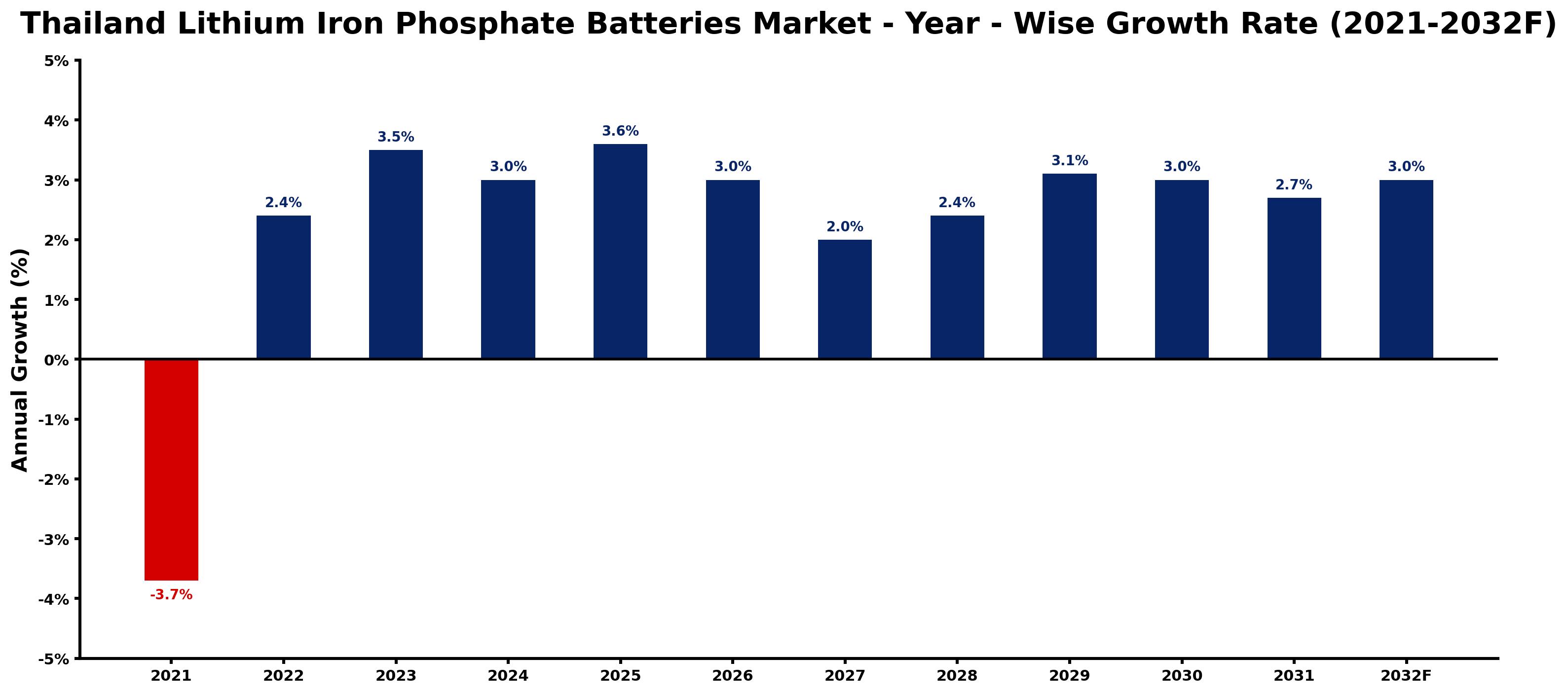
The table below presents the year‑wise growth rates along with the key drivers influencing the market
| Year | Growth Rate | Major Drivers |
| 2021 | -3.7% | decreased industrial production rates |
| 2022 | 2.4% | rising electric vehicle adoption |
| 2023 | 3.5% | expanding renewable energy sector |
| 2024 | 3.0% | increased government incentives programs |
| 2025 | 3.6% | growing energy storage applications |
| 2026 | 3.0% | enhanced supply chain efficiency |
| 2027 | 2.0% | emerging technology innovations trends |
| 2028 | 2.4% | increased demand for clean energy |
| 2029 | 3.1% | strengthening international trade agreements |
| 2030 | 3.0% | broadening consumer electronics market |
| 2031 | 2.7% | growing telecommunications infrastructure investments |
| 2032 | 3.0% | enhanced recycling initiatives adoption |
Note: Market size estimations and growth projections presented in this report are based on 6Wresearch's proprietary forecasting methodology, utilizing the latest available industry data, government publications, and primary research inputs.
Thailand Lithium Iron Phosphate Batteries Market Synopsis
In Thailand, the increasing adoption of lithium iron phosphate (LFP) batteries aligns closely with the nations broader energy transition goals. Electric vehicle manufacturers are notably pivoting towards LFP technology due to its enhanced safety and cycle life, positioning these batteries as a preferred choice in the automotive sector.
Energy storage systems (ESS) are equally benefiting from LFP batteries, which are becoming integral in managing intermittent renewable energy sources. The demand for sustainable storage solutions is rising, driven by both industry needs and regulatory pressures for cleaner energy technologies.
Thailand Lithium Iron Phosphate Batteries Market Key Takeaways
- The market is experiencing a shift driven by increased electric vehicle adoption and energy storage needs.
- Government policies are increasingly supportive of clean energy technologies, facilitating market growth.
- Key applications include electric vehicles and energy storage systems, which are critical for sustainable development.
- Competitive pressures remain from alternative battery technologies, necessitating improvements in energy density and cost-efficiency.
- The market is resilient, showing signs of recovery following pandemic-related disruptions.
Evaluation of Restraints in Thailand Lithium Iron Phosphate Batteries Market
Despite the promising growth trajectory, the Thailand lithium iron phosphate batteries market faces several constraints. A significant challenge is the lower energy density of LFP batteries compared to traditional lithium-ion batteries, limiting their appeal in high-performance applications. Furthermore, the market contends with fierce competition from various battery technologies, creating a need for ongoing innovation. Cost-effectiveness remains a crucial factor as industry players strive to enhance performance while keeping prices competitive to attract a broader customer base.
Thailand Lithium Iron Phosphate Batteries Market Trends
Several trends are currently shaping the Thailand lithium iron phosphate batteries market. A noticeable trend is the technological advancement in battery management systems, which optimize the performance and safety of LFP batteries. Additionally, there is a growing emphasis on integrating LFP batteries into large-scale renewable energy projects, enhancing their application in grid energy storage solutions. Consumer awareness and demand for sustainable products are also driving manufacturers to enhance the environmental profiles of their offerings.
Thailand Lithium Iron Phosphate Batteries Market Opportunities
Investment opportunities are abundant in the Thailand lithium iron phosphate batteries market. As electric vehicle manufacturing ramps up, there is significant potential for partnerships between battery suppliers and automotive companies. Furthermore, the expansion of renewable energy initiatives presents a lucrative avenue for battery application in energy storage systems. Companies focusing on R&D to improve battery efficiency and reduce costs can expect to gain a competitive edge in this evolving market.
Government Initiatives in the Thailand Lithium Iron Phosphate Batteries Market
The Thai government has implemented various initiatives aimed at bolstering the adoption of clean energy solutions, which directly benefit the lithium iron phosphate battery market. Policies promoting electric vehicle usage and renewable energy projects, along with subsidies for battery production, are noteworthy. Furthermore, public investment in infrastructure supporting these technologies is crucial for establishing a sustainable energy ecosystem in Thailand.
Future Insights of the Thailand Lithium Iron Phosphate Batteries Market
Looking ahead to 2026-2032, the Thailand lithium iron phosphate batteries market is poised for steady growth, driven by enhanced consumer acceptance of electric vehicles and increased regulatory support for clean energy initiatives. As manufacturers innovate to improve battery performance and address cost barriers, LFP batteries are likely to find broader applications in both transportation and energy storage. The market will also benefit from ongoing collaborations between industry stakeholders focused on sustainability and technological advancement.
Thailand Lithium Iron Phosphate Batteries Market Latest Developments (2025 - 2026)
Recent developments in the Thailand lithium iron phosphate batteries market indicate a strong push towards innovation, particularly in battery efficiency and safety enhancements. Companies are actively engaging in partnerships to accelerate product development and leverage technological advancements. In addition, market players are focusing on scaling up production capabilities to meet rising domestic and export demands, particularly in the electric vehicle segment.
Thailand Lithium Iron Phosphate Batteries Market - Key Attractiveness of the Report
- 10 Years of Market Numbers
- Historical Data Starting from 2022 to 2025
- Base Year: 2025
- Forecast Data until 2032
- Key Performance Indicators Impacting the Market
- Major Upcoming Developments and Projects
Key Highlights of the Report:
- Thailand Lithium Iron Phosphate Batteries Market Outlook
- Market Size of Thailand Lithium Iron Phosphate Batteries Market, 2025
- Forecast of Thailand Lithium Iron Phosphate Batteries Market, 2032
- Historical Data and Forecast of Thailand Lithium Iron Phosphate Batteries Revenues & Volume for the Period 2022-2032F
- Thailand Lithium Iron Phosphate Batteries Market Trend Evolution
- Thailand Lithium Iron Phosphate Batteries Market Drivers and Challenges
- Thailand Lithium Iron Phosphate Batteries Price Trends
- Thailand Lithium Iron Phosphate Batteries Porter's Five Forces
- Thailand Lithium Iron Phosphate Batteries Industry Life Cycle
- Historical Data and Forecast of Thailand Lithium Iron Phosphate Batteries Market Revenues & Volume By Power Capacity for the Period 2022-2032F
- Historical Data and Forecast of Thailand Lithium Iron Phosphate Batteries Market Revenues & Volume By 0??16,250 mAh for the Period 2022-2032F
- Historical Data and Forecast of Thailand Lithium Iron Phosphate Batteries Market Revenues & Volume By 16,251??50,000 mAh for the Period 2022-2032F
- Historical Data and Forecast of Thailand Lithium Iron Phosphate Batteries Market Revenues & Volume By 50,001??100,000 mAh for the Period 2022-2032F
- Historical Data and Forecast of Thailand Lithium Iron Phosphate Batteries Market Revenues & Volume By 100,001??540,000 mAh for the Period 2022-2032F
- Historical Data and Forecast of Thailand Lithium Iron Phosphate Batteries Market Revenues & Volume By Industry for the Period 2022-2032F
- Historical Data and Forecast of Thailand Lithium Iron Phosphate Batteries Market Revenues & Volume By Automotive for the Period 2022-2032F
- Historical Data and Forecast of Thailand Lithium Iron Phosphate Batteries Market Revenues & Volume By Power for the Period 2022-2032F
- Historical Data and Forecast of Thailand Lithium Iron Phosphate Batteries Market Revenues & Volume By Industrial for the Period 2022-2032F
- Historical Data and Forecast of Thailand Lithium Iron Phosphate Batteries Market Revenues & Volume By Others for the Period 2022-2032F
- Historical Data and Forecast of Thailand Lithium Iron Phosphate Batteries Market Revenues & Volume By Application for the Period 2022-2032F
- Historical Data and Forecast of Thailand Lithium Iron Phosphate Batteries Market Revenues & Volume By Portable for the Period 2022-2032F
- Historical Data and Forecast of Thailand Lithium Iron Phosphate Batteries Market Revenues & Volume By Stationary for the Period 2022-2032F
- Thailand Lithium Iron Phosphate Batteries Import Export Trade Statistics
- Market Opportunity Assessment By Power Capacity
- Market Opportunity Assessment By Industry
- Thailand Lithium Iron Phosphate Batteries Top Companies Market Share
- Thailand Lithium Iron Phosphate Batteries Competitive Benchmarking By Technical and Operational Parameters
- Thailand Lithium Iron Phosphate Batteries Company Profiles
- Thailand Lithium Iron Phosphate Batteries Key Strategic Recommendations






































