Thailand Medical X-Ray Market Size Growth Rate
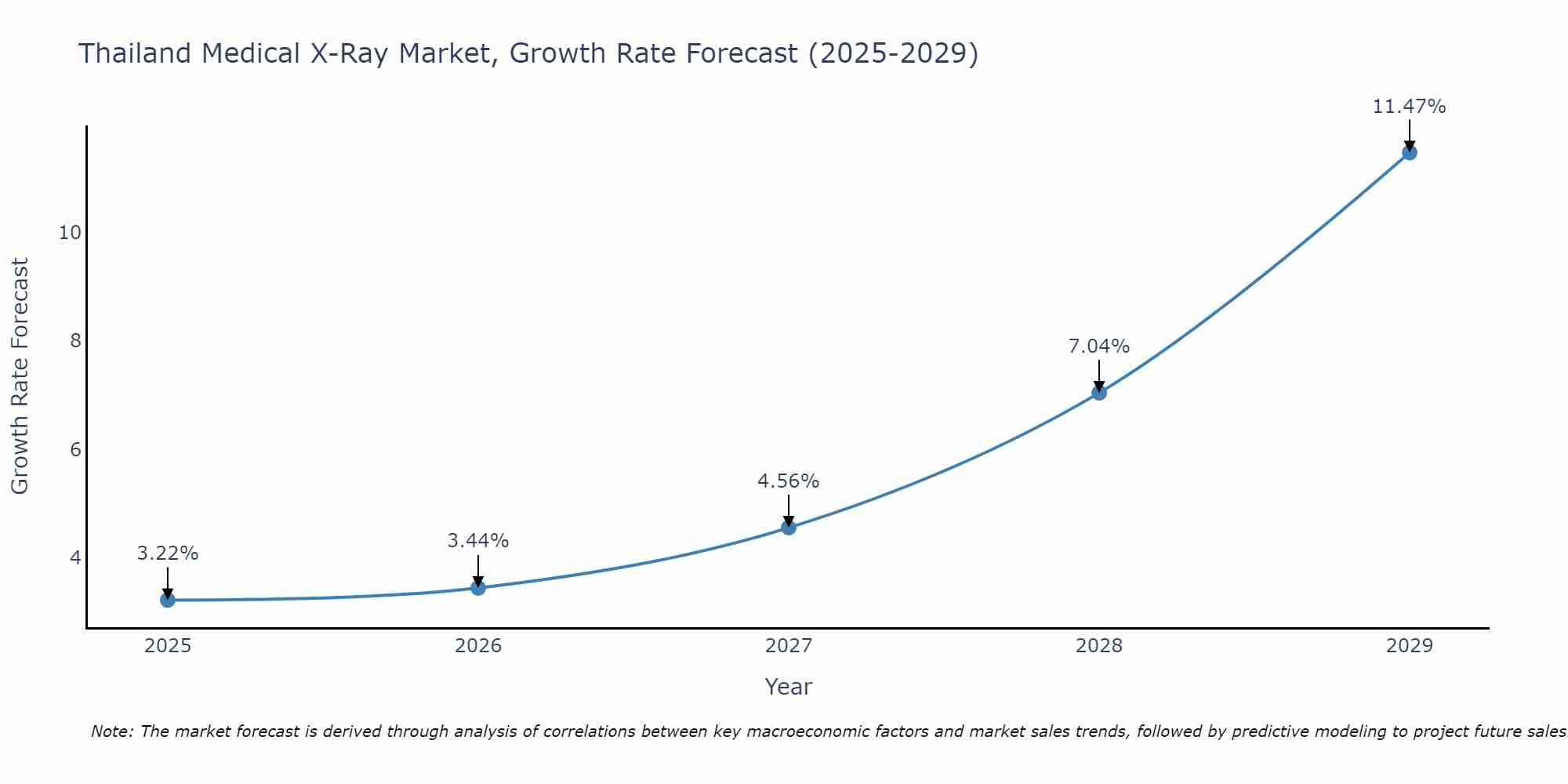
The Thailand Medical X-Ray Market is likely to experience consistent growth rate gains over the period 2025 to 2029. The growth rate starts at 3.22% in 2025 and reaches 11.47% by 2029.
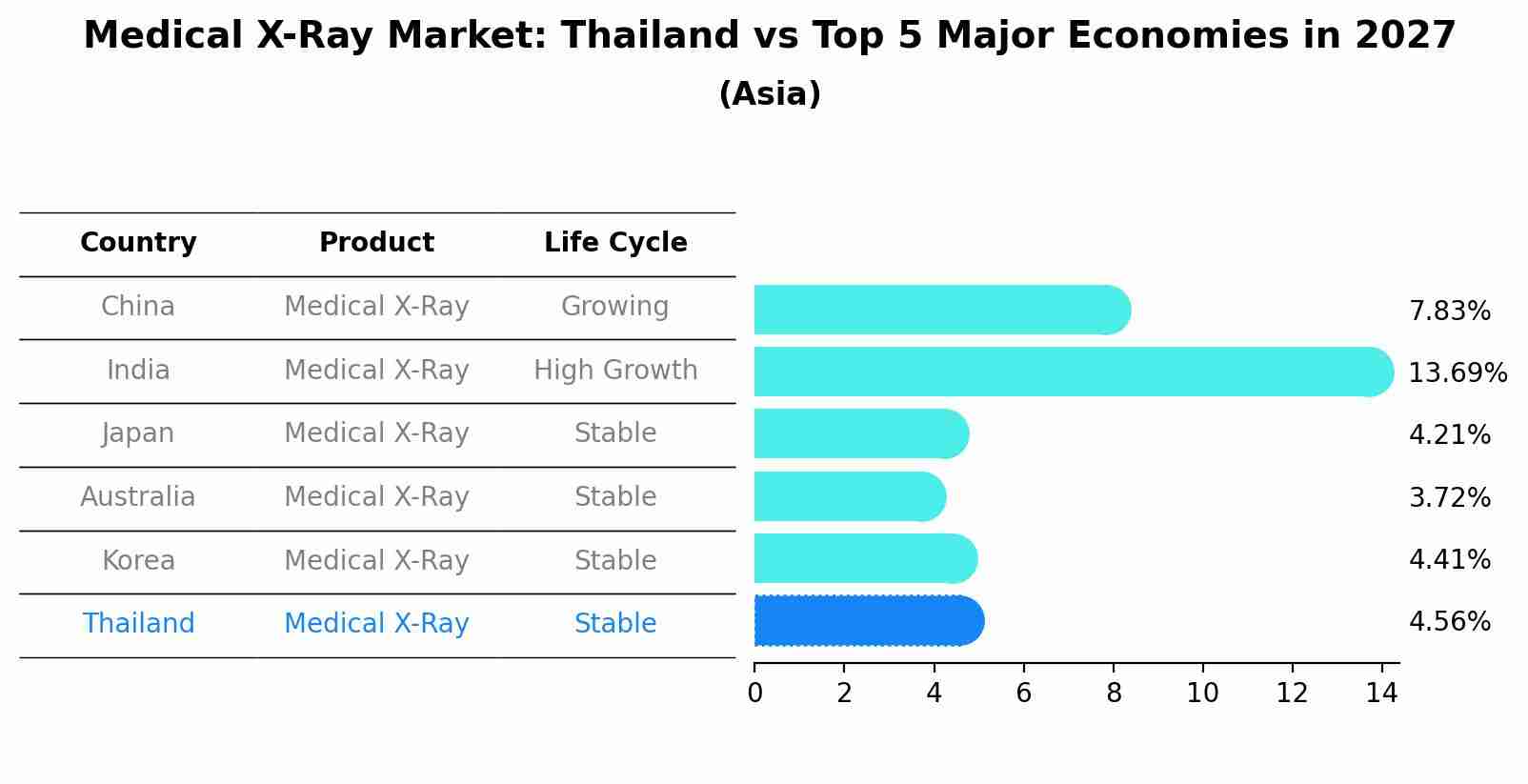
Medical X-Ray Market: Thailand vs Top 5 Major Economies in 2027 (Asia)
The Medical X-Ray market in Thailand is projected to grow at a stable growth rate of 4.56% by 2027, within the Asia region led by China, along with other countries like India, Japan, Australia and South Korea, collectively shaping a dynamic and evolving market environment driven by innovation and increasing adoption of emerging technologies.
Thailand Medical X Ray Market Synopsis
The Thailand medical X-ray market is on an upward trajectory, driven by the increasing demand for diagnostic imaging in healthcare. X-ray technology is essential for diagnosing a wide range of medical conditions and injuries. The market offers a diverse range of X-ray machines, including traditional analog systems and advanced digital radiography (DR) and computed tomography (CT) scanners. Thailand healthcare sector is expanding to meet the needs of its growing population, and this expansion includes the adoption of state-of-the-art diagnostic equipment, contributing to the growth of the medical X-ray market.
Drivers of the Market
The Thailand medical X-ray market is experiencing growth due to several key drivers. Firstly, X-ray imaging is a fundamental diagnostic tool in healthcare, used for a wide range of medical conditions, from fractures to cancer detection. As the demand for healthcare services grows, so does the need for X-ray equipment. Secondly, the government`s investments in expanding healthcare infrastructure and upgrading equipment in public healthcare facilities have contributed to market growth. Thirdly, the development of digital X-ray technology has improved image quality, reduced radiation exposure, and streamlined workflow, making it an attractive option for healthcare providers. Lastly, the rise in medical tourism has increased the utilization of X-ray services in Thailand.
Challenges of the Market
The Thailand Medical X-ray market is not without its challenges. Firstly, there is a need for continuous technological upgrades to keep up with evolving healthcare demands and standards, which can be costly. Second, the market faces the challenge of ensuring radiation safety and minimizing patient exposure, necessitating advanced shielding and dose reduction techniques. Third, healthcare infrastructure disparities across the country can hinder equitable access to X-ray services, posing challenges to market expansion. Finally, the market must grapple with regulatory hurdles and reimbursement issues that can impact the adoption of new X-ray technologies.
COVID-19 Impact on the Market
The Thailand Medical X-ray market witnessed disruptions during the pandemic. Elective X-ray procedures were postponed, and resources were redirected to COVID-19 care. As the healthcare system regained stability and vaccination efforts progressed, the market began to recover, with an emphasis on clearing the backlog of postponed medical imaging procedures.
Key Players in the Market
Leading companies in the Thai medical X-ray market include Canon Medical Systems Corporation, Carestream Health, Siemens Healthineers, and Fujifilm Holdings Corporation. They offer a range of X-ray imaging solutions used in hospitals, clinics, and diagnostic centers throughout Thailand.
Key Highlights of the Report:
- Thailand Medical X-Ray Market Outlook
- Market Size of Thailand Medical X-Ray Market, 2024
- Forecast of Thailand Medical X-Ray Market, 2031
- Historical Data and Forecast of Thailand Medical X-Ray Revenues & Volume for the Period 2021-2031
- Thailand Medical X-Ray Market Trend Evolution
- Thailand Medical X-Ray Market Drivers and Challenges
- Thailand Medical X-Ray Price Trends
- Thailand Medical X-Ray Porter's Five Forces
- Thailand Medical X-Ray Industry Life Cycle
- Historical Data and Forecast of Thailand Medical X-Ray Market Revenues & Volume By Type for the Period 2021-2031
- Historical Data and Forecast of Thailand Medical X-Ray Market Revenues & Volume By Digital for the Period 2021-2031
- Historical Data and Forecast of Thailand Medical X-Ray Market Revenues & Volume By Analog for the Period 2021-2031
- Historical Data and Forecast of Thailand Medical X-Ray Market Revenues & Volume By Technology for the Period 2021-2031
- Historical Data and Forecast of Thailand Medical X-Ray Market Revenues & Volume By Film-based radiography for the Period 2021-2031
- Historical Data and Forecast of Thailand Medical X-Ray Market Revenues & Volume By Computed radiography (CR) for the Period 2021-2031
- Historical Data and Forecast of Thailand Medical X-Ray Market Revenues & Volume By Direct radiography (DR) for the Period 2021-2031
- Historical Data and Forecast of Thailand Medical X-Ray Market Revenues & Volume By Portability for the Period 2021-2031
- Historical Data and Forecast of Thailand Medical X-Ray Market Revenues & Volume By Fixed for the Period 2021-2031
- Historical Data and Forecast of Thailand Medical X-Ray Market Revenues & Volume By Portable for the Period 2021-2031
- Historical Data and Forecast of Thailand Medical X-Ray Market Revenues & Volume By Application for the Period 2021-2031
- Historical Data and Forecast of Thailand Medical X-Ray Market Revenues & Volume By Dental for the Period 2021-2031
- Historical Data and Forecast of Thailand Medical X-Ray Market Revenues & Volume By Veterinary for the Period 2021-2031
- Historical Data and Forecast of Thailand Medical X-Ray Market Revenues & Volume By Mammography for the Period 2021-2031
- Historical Data and Forecast of Thailand Medical X-Ray Market Revenues & Volume By Chest for the Period 2021-2031
- Historical Data and Forecast of Thailand Medical X-Ray Market Revenues & Volume By Cardiovascular for the Period 2021-2031
- Historical Data and Forecast of Thailand Medical X-Ray Market Revenues & Volume By Orthopedics for the Period 2021-2031
- Historical Data and Forecast of Thailand Medical X-Ray Market Revenues & Volume By Others for the Period 2021-2031
- Historical Data and Forecast of Thailand Medical X-Ray Market Revenues & Volume By End-use for the Period 2021-2031
- Historical Data and Forecast of Thailand Medical X-Ray Market Revenues & Volume By Hospitals for the Period 2021-2031
- Historical Data and Forecast of Thailand Medical X-Ray Market Revenues & Volume By Diagnostic centers for the Period 2021-2031
- Historical Data and Forecast of Thailand Medical X-Ray Market Revenues & Volume By Others for the Period 2021-2031
- Thailand Medical X-Ray Import Export Trade Statistics
- Market Opportunity Assessment By Type
- Market Opportunity Assessment By Technology
- Market Opportunity Assessment By Portability
- Market Opportunity Assessment By Application
- Market Opportunity Assessment By End-use
- Thailand Medical X-Ray Top Companies Market Share
- Thailand Medical X-Ray Competitive Benchmarking By Technical and Operational Parameters
- Thailand Medical X-Ray Company Profiles
- Thailand Medical X-Ray Key Strategic Recommendations






































