Thailand Nail Polish Market Size, Share & Growth Rate
The Thailand Nail Polish Market was estimated at USD 322 Million in 2025 and is projected to reach USD 427 Million by 2032, growing at a CAGR of 4.1% from 2026 to 2032. This robust growth trajectory is driven by a surge in fashion-forward consumers who increasingly view nail polish as an essential part of personal expression. The influence of social media, particularly beauty influencers showcasing innovative nail art, further propels the demand for diverse nail polish products.
Thailand Nail Polish Market Year-wise Growth Rate and Key Drivers
This graph highlights how the Thailand Nail Polish Market has steadily grown over the years, supported by major growth factors.
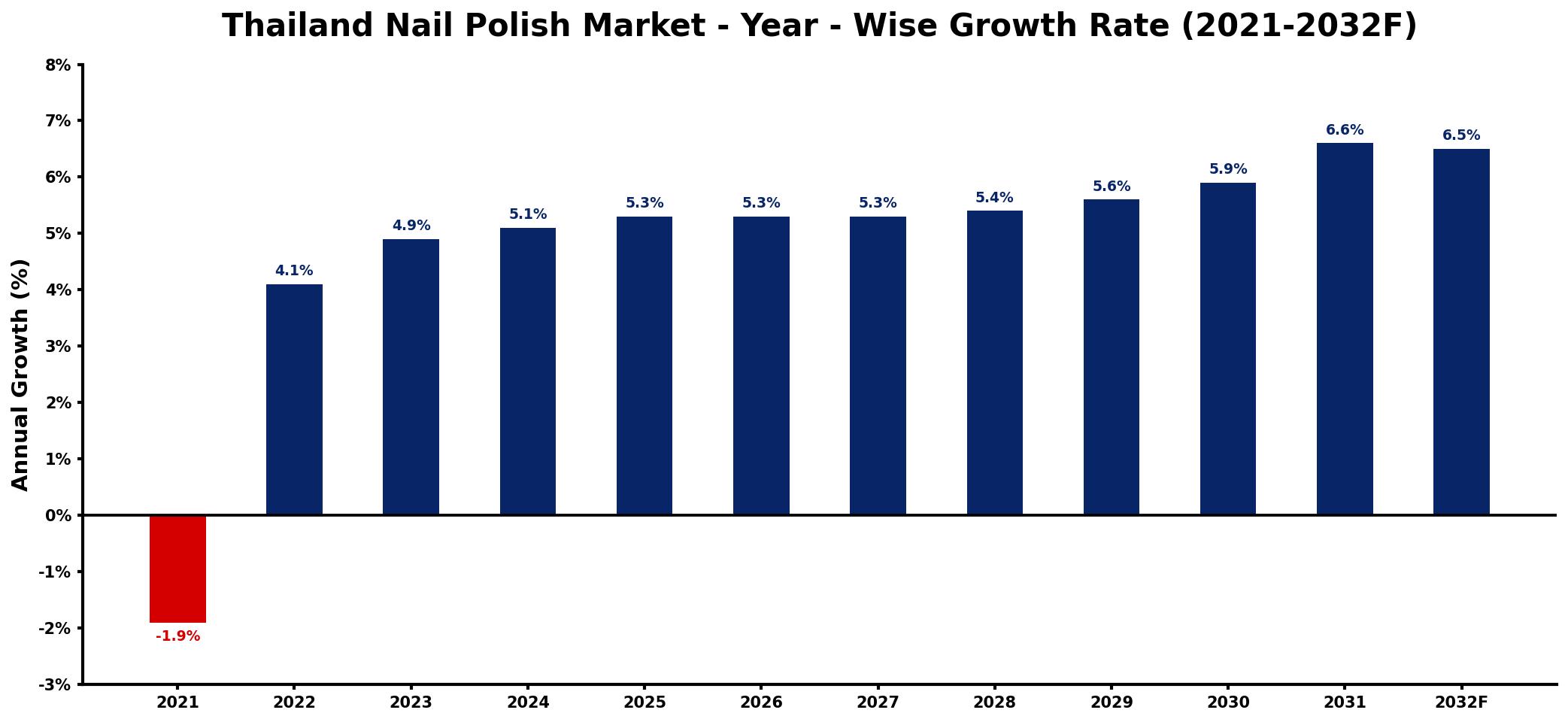
The table below presents the year‑wise growth rates along with the key drivers influencing the market
| Year | Growth Rate | Major Drivers |
| 2021 | -1.9% | decreased consumer spending on cosmetics |
| 2022 | 4.1% | rising popularity of beauty trends |
| 2023 | 4.9% | increased online shopping convenience |
| 2024 | 5.1% | growing influence of social media |
| 2025 | 5.3% | expansion of retail distribution channels |
| 2026 | 5.3% | introduction of eco-friendly formulations |
| 2027 | 5.3% | increased awareness of personal grooming |
| 2028 | 5.4% | emergence of new beauty influencers |
| 2029 | 5.6% | increased pharmaceutical industry usage |
| 2030 | 5.9% | expanding healthcare application demand |
| 2031 | 6.6% | increased participation in beauty events |
| 2032 | 6.5% | rising demand for innovative products |
Note: Market size estimations and growth projections presented in this report are based on 6Wresearch's proprietary forecasting methodology, utilizing the latest available industry data, government publications, and primary research inputs.
Thailand Nail Polish Market Synopsis
Currently, the strongest force shaping the Thailand Nail Polish Market is the growing beauty consciousness among Thai consumers. This cultural shift emphasizes self-expression through vibrant colors and unique nail designs, appealing to a wide demographic. Furthermore, the emergence of long-lasting and chip-resistant formulas has positioned nail polish as not just a cosmetic but a fashion accessory, resulting in an increasingly competitive landscape.
As consumers gravitate towards eco-friendly products, nail polish brands are responding with innovative chemical-free options, reflecting a commitment to sustainability. This consumer preference is an important consideration for manufacturers, compelling them to align their offerings with evolving market demands while ensuring compliance with safety regulations.
Thailand Nail Polish Market Key Takeaways
- The market is expanding due to heightened beauty awareness and the influence of fashion trends.
- Social media platforms and influencers significantly drive consumer interest in nail art.
- Product innovation focuses on long-lasting formulas and eco-friendly options.
- Nail salons and beauty retailers serve as crucial distribution channels for nail polish products.
- Competitive dynamics are influenced by both international and local brands.
Evaluation of Restraints in Thailand Nail Polish Market
Despite the positive market outlook, the Thailand Nail Polish Market faces certain constraints. The demand for chemical-free and eco-friendly options poses a challenge for manufacturers seeking to innovate while adhering to stringent safety regulations. Additionally, ever-shifting fashion trends necessitate quick adaptation and product development, which can strain resources for smaller brands. As consumer preferences continue to evolve, companies must find a delicate balance between staying trendy and maintaining safety standards.
Thailand Nail Polish Market Trends
A notable trend in the Thailand Nail Polish Market is the increasing demand for personalized nail art, fueled by social media exposure. Consumers are now more inclined to experiment with intricate designs and vibrant color palettes, encouraging brands to introduce a wider array of shades and finishes. Additionally, the rise of DIY beauty has resulted in an uptick in sales for at-home nail care products, as individuals embrace self-expression through manicures. Moreover, collaborations between beauty brands and fashion influencers are becoming more prevalent, allowing for unique collections that resonate with consumers.
Thailand Nail Polish Market Opportunities
The Thailand Nail Polish Market presents numerous opportunities for growth, particularly in the realm of sustainable beauty products. As environmental consciousness rises, brands focusing on eco-friendly formulations are likely to capture a loyal consumer base. Additionally, the continued expansion of online retail offers a platform for brands to reach a broader audience, enhancing visibility and sales potential. Furthermore, as the DIY trend persists, investment in educational content and tutorials could serve to strengthen customer engagement and brand loyalty.
Government Initiatives in the Thailand Nail Polish Market
The Thai government has taken steps to promote the cosmetics sector, including nail care products, through various initiatives aimed at encouraging local manufacturing and innovation. Policies aimed at supporting sustainable practices in the beauty industry are becoming increasingly relevant, especially as consumer demand shifts towards greener products. Public investments in health and safety regulations further ensure that products meet international standards, fostering consumer confidence in domestic brands.
Future Insights of the Thailand Nail Polish Market
Looking forward, the Thailand Nail Polish Market is poised for continued growth driven by evolving consumer preferences. The expected rise in disposable income among the middle class will likely enhance spending on beauty products, including nail polish. Moreover, as brands innovate and cater to the demand for eco-friendly options, they will remain competitive in this vibrant market. By 2032, the increasing significance of personal grooming and self-care rituals will solidify nail polish as a staple cosmetic item within the Thai beauty landscape.
Thailand Nail Polish Market Latest Developments (2025 - 2026)
Recent developments in the Thailand Nail Polish Market highlight a strong shift towards online sales channels, with many brands enhancing their e-commerce platforms to meet rising consumer demand for at-home beauty solutions. Moreover, collaborations with local artists and fashion designers are becoming a strategic focus, allowing brands to differentiate their products in a competitive marketplace. There is also an increasing emphasis on marketing campaigns promoting the benefits of DIY nail care, which resonate strongly with the home-focused beauty trends emerging from the pandemic.
Thailand Nail Polish Market - Key Attractiveness of the Report
- 10 Years of Market Numbers
- Historical Data Starting from 2022 to 2025
- Base Year: 2025
- Forecast Data until 2032
- Key Performance Indicators Impacting the Market
- Major Upcoming Developments and Projects
Key Highlights of the Report:
- Thailand Nail Polish Market Outlook
- Market Size of Thailand Nail Polish Market, 2025
- Forecast of Thailand Nail Polish Market, 2032
- Historical Data and Forecast of Thailand Nail Polish Revenues & Volume for the Period 2022-2032F
- Thailand Nail Polish Market Trend Evolution
- Thailand Nail Polish Market Drivers and Challenges
- Thailand Nail Polish Price Trends
- Thailand Nail Polish Porter's Five Forces
- Thailand Nail Polish Industry Life Cycle
- Historical Data and Forecast of Thailand Nail Polish Market Revenues & Volume By Product for the Period 2022-2032F
- Historical Data and Forecast of Thailand Nail Polish Market Revenues & Volume By Regular Nail Polish for the Period 2022-2032F
- Historical Data and Forecast of Thailand Nail Polish Market Revenues & Volume By Gel Nail Polish for the Period 2022-2032F
- Historical Data and Forecast of Thailand Nail Polish Market Revenues & Volume By Others for the Period 2022-2032F
- Historical Data and Forecast of Thailand Nail Polish Market Revenues & Volume By Distribution Channel for the Period 2022-2032F
- Historical Data and Forecast of Thailand Nail Polish Market Revenues & Volume By Hypermarkets & Supermarkets for the Period 2022-2032F
- Historical Data and Forecast of Thailand Nail Polish Market Revenues & Volume By Specialty Stores for the Period 2022-2032F
- Historical Data and Forecast of Thailand Nail Polish Market Revenues & Volume By E-commerce for the Period 2022-2032F
- Historical Data and Forecast of Thailand Nail Polish Market Revenues & Volume By Others for the Period 2022-2032F
- Thailand Nail Polish Import Export Trade Statistics
- Market Opportunity Assessment By Product
- Market Opportunity Assessment By Distribution Channel
- Thailand Nail Polish Top Companies Market Share
- Thailand Nail Polish Competitive Benchmarking By Technical and Operational Parameters
- Thailand Nail Polish Company Profiles
- Thailand Nail Polish Key Strategic Recommendations






































