Thailand Oil & Gas Pumps Market Size, Share & Growth Rate
The Thailand Oil & Gas Pumps Market was estimated at USD 126 Million in 2025 and is projected to reach USD 144 Million by 2032, growing at a CAGR of 1.9% from 2026 to 2032. This growth trajectory is fueled by the increasing energy demand driven by urbanization and industrial activities in Thailand. Moreover, the governments commitment to enhancing the energy infrastructure and attracting foreign investment in this sector further amplifies the need for advanced pumping solutions.
Thailand Oil & Gas Pumps Market Year-wise Growth Rate and Key Drivers
This graph highlights how the Thailand Oil & Gas Pumps Market has steadily grown over the years, supported by major growth factors.
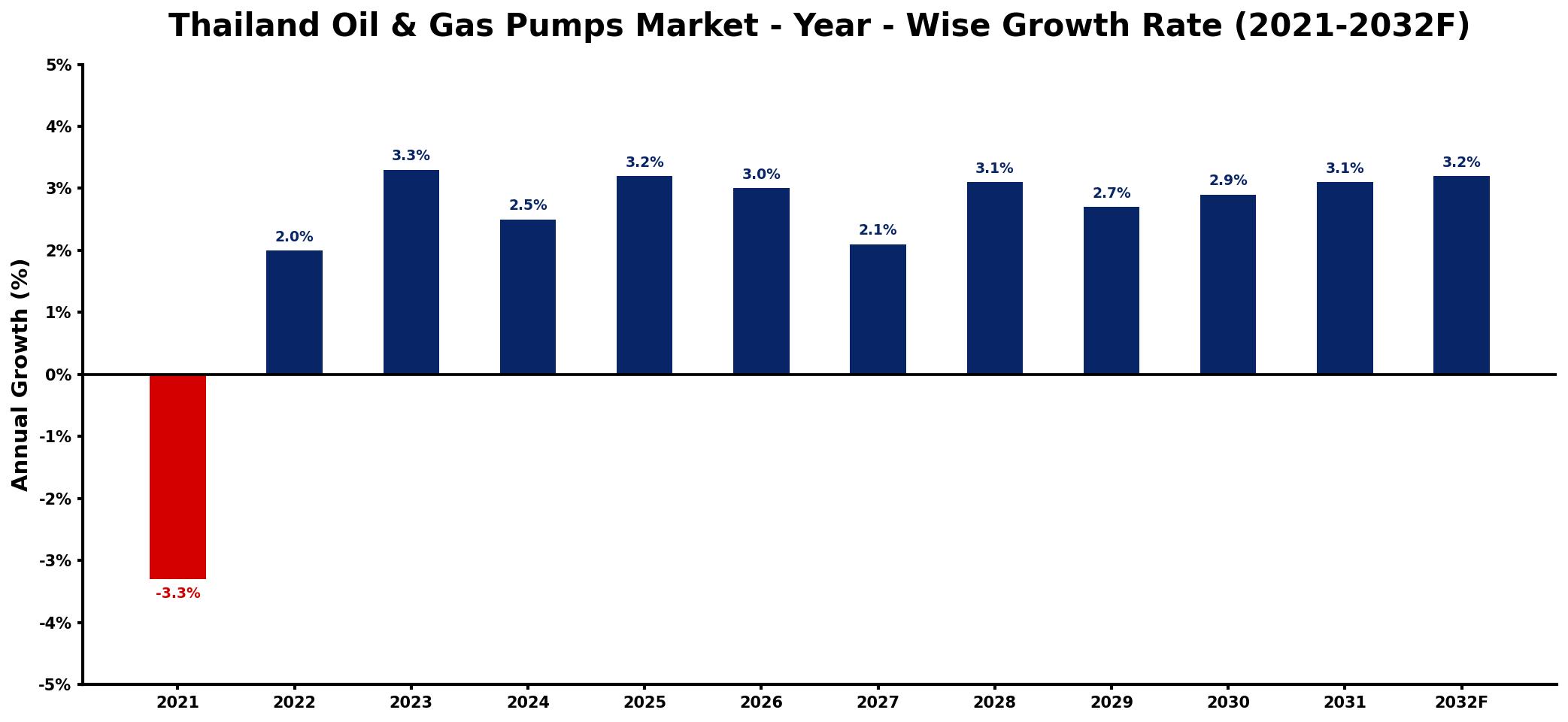
The table below presents the year‑wise growth rates along with the key drivers influencing the market
| Year | Growth Rate | Major Drivers |
| 2021 | -3.3% | decreased industrial investment activity |
| 2022 | 2.0% | increased infrastructure development projects |
| 2023 | 3.3% | growing energy sector investments |
| 2024 | 2.5% | expansion of transportation networks |
| 2025 | 3.2% | rising demand for renewable energy |
| 2026 | 3.0% | enhanced manufacturing capabilities growth |
| 2027 | 2.1% | increased urbanization and development |
| 2028 | 3.1% | growing international trade volumes |
| 2029 | 2.7% | increased overall sector activity |
| 2030 | 2.9% | increased domestic energy production |
| 2031 | 3.1% | growth in export markets demand |
| 2032 | 3.2% | rising technological advancements adoption |
Note: Market size estimations and growth projections presented in this report are based on 6Wresearch's proprietary forecasting methodology, utilizing the latest available industry data, government publications, and primary research inputs.
Thailand Oil & Gas Pumps Market Synopsis
In Thailand, the oil and gas pumps market plays a vital role in ensuring the efficient extraction and transportation of resources vital to the country's economy. The demand for high-performance pumps is further magnified by the ongoing exploration activities in Thailand's oil and gas fields, where reliability and durability are paramount.
As industrial sectors expand, the need for innovative pump technologies is becoming increasingly critical. This includes the rise of smart, energy-efficient pumps that not only optimize performance but also align with the government's sustainability goals.
- The market is projected to grow steadily, reflecting increasing energy requirements.
- Technological advancements in pump efficiency and safety are gaining traction.
- Government initiatives are fostering investment in energy infrastructure.
- Reliability and performance remain key factors influencing purchasing decisions.
- The rebound of oil prices post-COVID-19 is expected to stimulate market recovery.
While the Thailand Oil & Gas Pumps market shows promising growth potential, it faces several restraints that could impede its progress. Fluctuations in global oil prices create uncertainty, which can affect capital investments by energy companies. Additionally, the demand for energy-efficient solutions is ever-present, pushing manufacturers to innovate continuously. Compliance with stringent safety and environmental regulations requires ongoing investment, which can burden smaller players in the market.
Current trends in the Thailand Oil & Gas Pumps market include a shift towards digitalization and automation. Many companies are investing in smart pump technologies that provide real-time monitoring and predictive maintenance capabilities. This enhances operational efficiency and minimizes downtime. Moreover, there is a growing emphasis on eco-friendly pumping solutions that reduce environmental impact while meeting energy demands.
Opportunities for growth in the Thailand Oil & Gas Pumps market lie in the development of renewable energy projects and the enhancement of existing oil and gas infrastructure. As the government seeks to diversify energy sources, investments in pumping systems that support this transition can yield significant returns. Additionally, collaboration between local and international firms can lead to technological innovations that address the evolving needs of the industry.
The Thai government is actively working to bolster the energy sector through various initiatives aimed at enhancing efficiency and sustainability. Policies encouraging foreign direct investment and public-private partnerships are crucial for modernizing the countrys oil and gas infrastructure. Furthermore, regulatory frameworks are being established to ensure that new projects adhere to environmental standards, thus promoting sustainable growth in the oil and gas pumps market.
Looking ahead to 2026-2032, the Thailand Oil & Gas Pumps market is anticipated to benefit from continued advancements in pump technology and an increasing focus on energy efficiency. As exploration activities gain momentum, coupled with government support for renewable energy, the market is expected to attract significant investments. This positive outlook positions the market for sustained growth, driven by both traditional and emerging energy sources.
Recent developments in the Thailand Oil & Gas Pumps market highlight a renewed focus on innovation and sustainability. Companies are unveiling new pumping solutions that leverage cutting-edge technology to enhance performance and reduce environmental impact. Strategic partnerships aimed at research and development are emerging, indicating a collaborative approach to tackling industry challenges and meeting future demand.
- 10 Years of Market Numbers
- Historical Data Starting from 2022 to 2025
- Base Year: 2025
- Forecast Data until 2032
- Key Performance Indicators Impacting the Market
- Major Upcoming Developments and Projects
Key Highlights of the Report:
- Thailand Oil & Gas Pumps Market Outlook
- Market Size of Thailand Oil & Gas Pumps Market, 2025
- Forecast of Thailand Oil & Gas Pumps Market, 2032
- Historical Data and Forecast of Thailand Oil & Gas Pumps Revenues & Volume for the Period 2022-2032F
- Thailand Oil & Gas Pumps Market Trend Evolution
- Thailand Oil & Gas Pumps Market Drivers and Challenges
- Thailand Oil & Gas Pumps Price Trends
- Thailand Oil & Gas Pumps Porter's Five Forces
- Thailand Oil & Gas Pumps Industry Life Cycle
- Historical Data and Forecast of Thailand Oil & Gas Pumps Market Revenues & Volume By Type for the Period 2022-2032F
- Historical Data and Forecast of Thailand Oil & Gas Pumps Market Revenues & Volume By Submersible Pumps for the Period 2022-2032F
- Historical Data and Forecast of Thailand Oil & Gas Pumps Market Revenues & Volume By Non-submersible Pumps for the Period 2022-2032F
- Historical Data and Forecast of Thailand Oil & Gas Pumps Market Revenues & Volume By Pump Type for the Period 2022-2032F
- Historical Data and Forecast of Thailand Oil & Gas Pumps Market Revenues & Volume By Centrifugal Pump for the Period 2022-2032F
- Historical Data and Forecast of Thailand Oil & Gas Pumps Market Revenues & Volume By Positive Displacement Pump for the Period 2022-2032F
- Historical Data and Forecast of Thailand Oil & Gas Pumps Market Revenues & Volume By Cryogenic Pump for the Period 2022-2032F
- Historical Data and Forecast of Thailand Oil & Gas Pumps Market Revenues & Volume By Application for the Period 2022-2032F
- Historical Data and Forecast of Thailand Oil & Gas Pumps Market Revenues & Volume By Upstream for the Period 2022-2032F
- Historical Data and Forecast of Thailand Oil & Gas Pumps Market Revenues & Volume By Midstream for the Period 2022-2032F
- Historical Data and Forecast of Thailand Oil & Gas Pumps Market Revenues & Volume By Downstream for the Period 2022-2032F
- Thailand Oil & Gas Pumps Import Export Trade Statistics
- Market Opportunity Assessment By Type
- Market Opportunity Assessment By Pump Type
- Market Opportunity Assessment By Application
- Thailand Oil & Gas Pumps Top Companies Market Share
- Thailand Oil & Gas Pumps Competitive Benchmarking By Technical and Operational Parameters
- Thailand Oil & Gas Pumps Company Profiles
- Thailand Oil & Gas Pumps Key Strategic Recommendations






































