Thailand Online Grocery Market Size, Share & Growth Rate
The Thailand Online Grocery Market was estimated at USD 144 Million in 2025 and is projected to reach USD 166 Million by 2032, growing at a CAGR of 2.1% from 2026 to 2032. This steady growth trajectory is primarily fueled by the increasing internet penetration across the nation, which provides consumers with easier access to online platforms. Moreover, the rising number of working professionals seeking quick and convenient shopping solutions is reshaping purchasing behaviors, driving demand for online grocery services.
Thailand Online Grocery Market Year-wise Growth Rate and Key Drivers
This graph highlights how the Thailand Online Grocery Market has steadily grown over the years, supported by major growth factors.
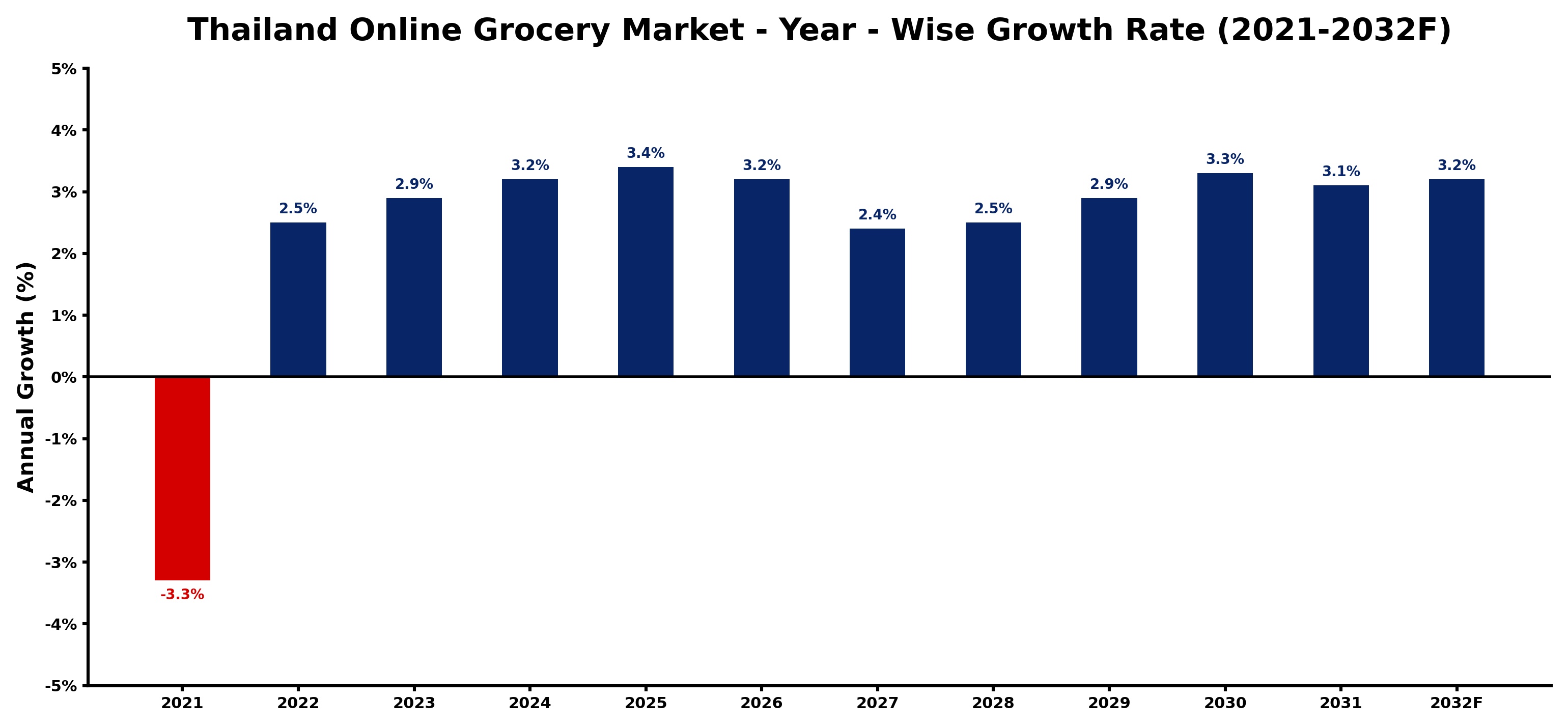
The table below presents the year‑wise growth rates along with the key drivers influencing the market
| Year | Growth Rate | Major Drivers |
| 2021 | -3.3% | Consumer spending decreased significantly |
| 2022 | 2.5% | E-commerce adoption accelerated rapidly |
| 2023 | 2.9% | Mobile shopping convenience increased sales |
| 2024 | 3.2% | Subscription services gained popularity |
| 2025 | 3.4% | Local sourcing enhanced product variety |
| 2026 | 3.2% | Sustainability trends influenced purchasing decisions |
| 2027 | 2.4% | Digital marketing strategies improved engagement |
| 2028 | 2.5% | Health-conscious products attracted consumers |
| 2029 | 2.9% | Innovative delivery options expanded reach |
| 2030 | 3.3% | Loyalty programs enhanced customer retention |
| 2031 | 3.1% | Social media influence drove sales |
| 2032 | 3.2% | Collaborations with local brands flourished |
Note - Market size estimations and growth projections presented in this report are based on 6Wresearch’s advanced forecasting approach, validated with industry datasets as of June 2026.
Thailand Online Grocery Market Synopsis
The rapid shift towards e-commerce is the most potent force transforming the Thailand Online Grocery Market today. As consumers gravitate towards the convenience and speed of online shopping, grocery retailers are adapting their strategies to cater to this demand, creating a more engaging shopping experience.
Additionally, government initiatives aimed at promoting digital payments are playing a crucial role in encouraging consumers to embrace online grocery shopping. The alignment of these forces sets a promising foundation for market expansion in the coming years.
Thailand Online Grocery Market Key Takeaways
- Convenience and time-saving benefits are driving the adoption of online grocery shopping.
- Growing internet accessibility facilitates a more extensive reach for online grocery platforms.
- Favorable government policies support the evolution of digital payment systems.
- Consumer preferences are shifting towards quality assurance and product freshness in online purchases.
- The COVID-19 pandemic significantly accelerated the transition to online grocery shopping.
Evaluation of Restraints in Thailand Online Grocery Market
Despite the evident growth potential, the Thailand Online Grocery Market faces notable restraints that could impede its trajectory. Concerns surrounding product freshness and quality remain critical, as consumers are hesitant to fully trust the online shopping experience when it comes to perishable goods. Moreover, the logistics of timely delivery can present significant challenges for retailers, as any delays may directly affect customer satisfaction and loyalty. These factors necessitate a strategic focus on enhancing operational efficiencies and building consumer confidence.
Thailand Online Grocery Market Trends
The digital revolution is ushering in transformative trends in the Thailand Online Grocery Market. Increasingly, consumers are looking for personalized shopping experiences facilitated by advanced analytics and AI technology, which provide tailored recommendations based on individual preferences. Another trend is the rising demand for sustainable and locally sourced products, as environmental consciousness continues to shape consumer purchasing decisions. Furthermore, innovations in delivery methods, such as same-day service and subscription models, are becoming more popular as companies seek to differentiate themselves in a competitive landscape.
Thailand Online Grocery Market Opportunities
The market offers substantial growth opportunities, particularly for new entrants willing to innovate. Investing in robust e-commerce platforms that focus on user-friendly interfaces and seamless logistics can capture the growing consumer base. Additionally, entrepreneurs can tap into the increasing demand for organic and health-focused grocery items, which resonate with the health-conscious demographic. By adopting eco-friendly practices and promoting local partnerships, businesses can further enhance their appeal and foster long-term growth.
Government Initiatives in the Thailand Online Grocery Market
The Thai government is actively supporting the digital economy, which directly influences the online grocery sector. Initiatives aimed at enhancing digital infrastructure and encouraging digital payment adoption are pivotal in facilitating smoother transactions for consumers. Moreover, efforts to promote local businesses through subsidies and grants create a conducive environment for the growth of online grocery retailers, allowing them to compete more effectively in the market.
Future Insights of the Thailand Online Grocery Market
Looking ahead to 2026-2032, the Thailand Online Grocery Market is poised for continued evolution. As consumer behaviors become increasingly entrenched in the digital realm, businesses that prioritize technology and consumer experience are likely to thrive. The integration of cutting-edge delivery solutions and automation will further streamline operations, while an emphasis on customer-centric practices will solidify brand loyalty. The interplay between consumer expectations and technological advancements will ultimately shape the future landscape of grocery shopping in Thailand.
Thailand Online Grocery Market Latest Developments (May 2025 - June 2026)
Recent developments in the Thailand Online Grocery Market underscore a shift towards enhanced customer engagement strategies. Companies are increasingly investing in loyalty programs that reward repeat purchases, thus fostering a community of dedicated consumers. Moreover, the expansion of delivery networks is being prioritized, enabling quicker service and greater coverage across urban and rural areas. Innovations in mobile applications are also a focal point, aimed at providing users with a more intuitive shopping experience and personalized content.
Thailand Online Grocery Market - Key Attractiveness of the Report
- 10 Years of Market Numbers
- Historical Data Starting from 2022 to 2025
- Base Year: 2025
- Forecast Data until 2032
- Key Performance Indicators Impacting the Market
- Major Upcoming Developments and Projects
Key Highlights of the Report:
- Thailand Online Grocery Market Outlook
- Market Size of Thailand Online Grocery Market, 2025
- Forecast of Thailand Online Grocery Market, 2032
- Historical Data and Forecast of Thailand Online Grocery Revenues & Volume for the Period 2022-2032F
- Thailand Online Grocery Market Trend Evolution
- Thailand Online Grocery Market Drivers and Challenges
- Thailand Online Grocery Price Trends
- Thailand Online Grocery Porter's Five Forces
- Thailand Online Grocery Industry Life Cycle
- Historical Data and Forecast of Thailand Online Grocery Market Revenues & Volume By Product Type for the Period 2022-2032F
- Historical Data and Forecast of Thailand Online Grocery Market Revenues & Volume By Food Grains for the Period 2022-2032F
- Historical Data and Forecast of Thailand Online Grocery Market Revenues & Volume By Bread, Bakery and Dairy Products for the Period 2022-2032F
- Historical Data and Forecast of Thailand Online Grocery Market Revenues & Volume By Fruits and Vegetables for the Period 2022-2032F
- Historical Data and Forecast of Thailand Online Grocery Market Revenues & Volume By Personal Care for the Period 2022-2032F
- Historical Data and Forecast of Thailand Online Grocery Market Revenues & Volume By Dry and Baking Products for the Period 2022-2032F
- Historical Data and Forecast of Thailand Online Grocery Market Revenues & Volume By Household Products for the Period 2022-2032F
- Historical Data and Forecast of Thailand Online Grocery Market Revenues & Volume By Meat and Meat Products for the Period 2022-2032F
- Historical Data and Forecast of Thailand Food Grains Online Grocery Market Revenues & Volume By Others for the Period 2022-2032F
- Historical Data and Forecast of Thailand Online Grocery Market Revenues & Volume By Platform for the Period 2022-2032F
- Historical Data and Forecast of Thailand Online Grocery Market Revenues & Volume By App-based for the Period 2022-2032F
- Historical Data and Forecast of Thailand Online Grocery Market Revenues & Volume By Web-based for the Period 2022-2032F
- Thailand Online Grocery Import Export Trade Statistics
- Market Opportunity Assessment By Product Type
- Market Opportunity Assessment By Platform
- Thailand Online Grocery Top Companies Market Share
- Thailand Online Grocery Competitive Benchmarking By Technical and Operational Parameters
- Thailand Online Grocery Company Profiles
- Thailand Online Grocery Key Strategic Recommendations






































