Thailand Optical Measurement Market: Import Trend Analysis
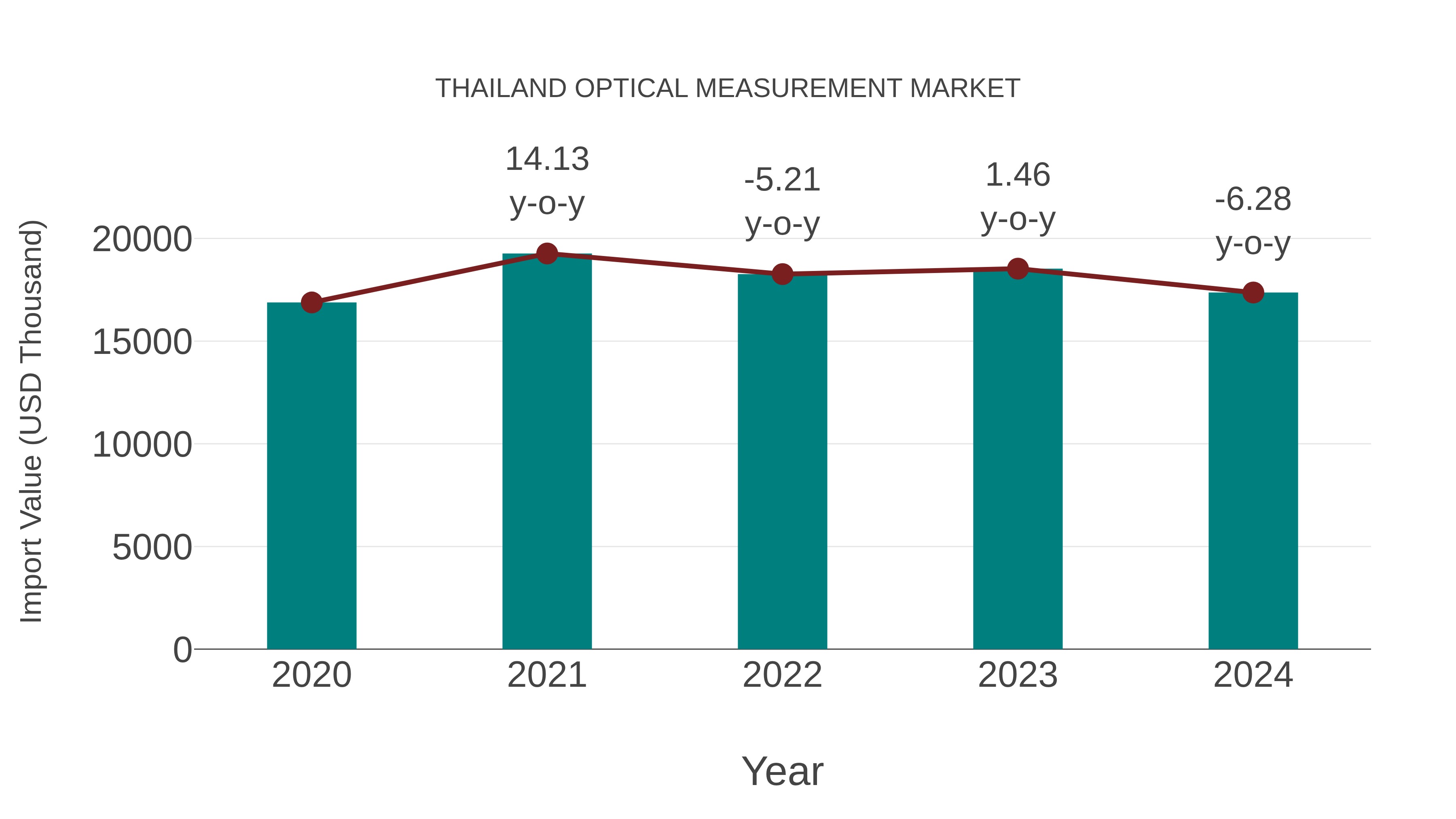
Thailand import trend for the optical measurement market experienced a decline, with a growth rate of -6.28% from 2023 to 2024. The compound annual growth rate (CAGR) for 2020-2024 stood at 0.71%. This negative momentum can be attributed to shifts in demand dynamics or changes in trade policies affecting market stability.
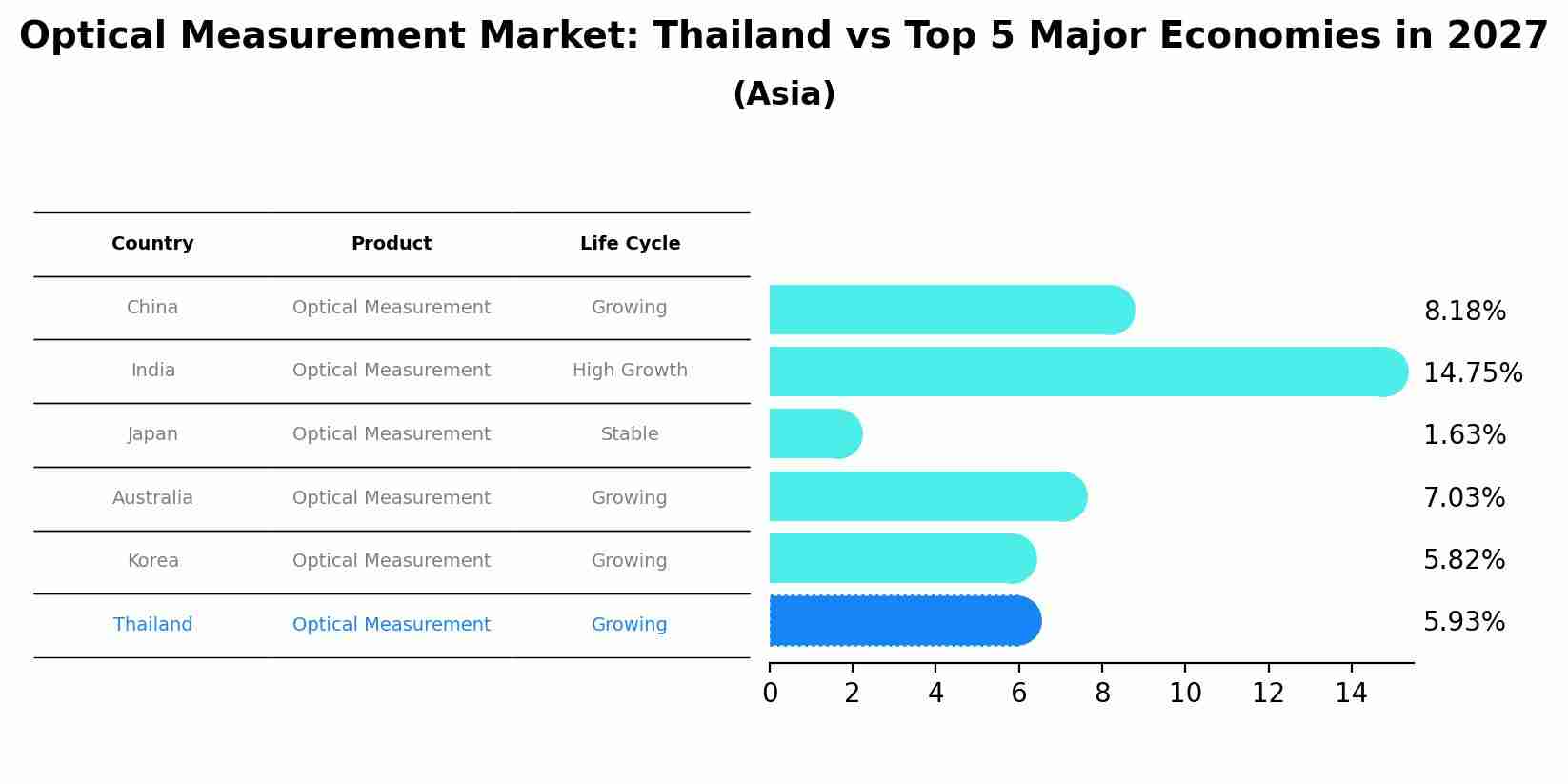
Optical Measurement Market: Thailand vs Top 5 Major Economies in 2027 (Asia)
The Optical Measurement market in Thailand is projected to grow at a growing growth rate of 5.93% by 2027, highlighting the country's increasing focus on advanced technologies within the Asia region, where China holds the dominant position, followed closely by India, Japan, Australia and South Korea, shaping overall regional demand.
Thailand Optical Measurement Market Synopsis
The Thailand Optical Measurement Market is an integral part of the country`s manufacturing and quality control sectors. Optical measurement systems are employed across various industries, including aerospace, automotive, electronics, and precision engineering, to ensure accurate and reliable measurements. These systems utilize optical principles, such as interferometry and laser scanning, to measure dimensions, surface profiles, and other critical parameters. The market`s growth is driven by the need for precision engineering and quality assurance in manufacturing processes. As industries in Thailand continue to advance and embrace automation, optical measurement technologies are poised to play a vital role in enhancing productivity and product quality.
Drivers of the Market
The Thailand optical measurement market is witnessing growth due to its applications across various industries. Precision measurement and inspection are crucial in manufacturing, healthcare, and research sectors. The demand for high-precision optical measurement equipment is on the rise, driven by the need to ensure quality control, accuracy, and efficiency in production processes. Furthermore, advancements in optical measurement technologies, such as 3D scanning and imaging systems, are expanding the market`s potential. Industries like aerospace, automotive, and electronics are particularly reliant on optical measurement solutions, contributing to sustained market growth.
Challenges of the Market
The optical measurement market in Thailand faces several challenges. One key issue is the need for continuous calibration and maintenance of optical measurement equipment to ensure accuracy, which can be costly and time-consuming for businesses. A lack of skilled technicians and engineers proficient in optical measurement technology can hinder its effective utilization. Moreover, competition from alternative measurement technologies like laser and ultrasound can limit the growth potential of the optical measurement market. Lastly, regulatory compliance and standards can be complex and may require significant investments in documentation and quality assurance.
COVID-19 Impact on the Market
The optical measurement market in Thailand was affected by disruptions in supply chains and reduced industrial activities during the COVID-19 pandemic. Many manufacturing sectors experienced slowdowns or temporary closures, leading to a decreased demand for optical measurement equipment. Businesses also faced financial challenges, impacting their willingness to invest in new measurement technologies. However, as industries adapted to the new normal and digitalization efforts increased, there was a gradual recovery in demand for optical measurement solutions.
Key Players in the Market
The optical measurement market in Thailand features notable players like Keyence Corporation, a leader in optical measurement and automation solutions. Keyence`s advanced measurement systems are widely used in industries ranging from manufacturing to research.
Key Highlights of the Report:
- Thailand Optical Measurement Market Outlook
- Market Size of Thailand Optical Measurement Market, 2025
- Forecast of Thailand Optical Measurement Market, 2032
- Historical Data and Forecast of Thailand Optical Measurement Revenues & Volume for the Period 2022-2032F
- Thailand Optical Measurement Market Trend Evolution
- Thailand Optical Measurement Market Drivers and Challenges
- Thailand Optical Measurement Price Trends
- Thailand Optical Measurement Porter's Five Forces
- Thailand Optical Measurement Industry Life Cycle
- Historical Data and Forecast of Thailand Optical Measurement Market Revenues & Volume By Offering for the Period 2022-2032F
- Historical Data and Forecast of Thailand Optical Measurement Market Revenues & Volume By Hardware for the Period 2022-2032F
- Historical Data and Forecast of Thailand Optical Measurement Market Revenues & Volume By Software for the Period 2022-2032F
- Historical Data and Forecast of Thailand Optical Measurement Market Revenues & Volume By Services for the Period 2022-2032F
- Historical Data and Forecast of Thailand Optical Measurement Market Revenues & Volume By Component for the Period 2022-2032F
- Historical Data and Forecast of Thailand Optical Measurement Market Revenues & Volume By Autocollimators for the Period 2022-2032F
- Historical Data and Forecast of Thailand Optical Measurement Market Revenues & Volume By Measuring Microscopes for the Period 2022-2032F
- Historical Data and Forecast of Thailand Optical Measurement Market Revenues & Volume By Profile Projectors for the Period 2022-2032F
- Historical Data and Forecast of Thailand Optical Measurement Market Revenues & Volume By Optical Digitizers and Scanners for the Period 2022-2032F
- Historical Data and Forecast of Thailand Optical Measurement Market Revenues & Volume By Coordinate Measuring Machines for the Period 2022-2032F
- Historical Data and Forecast of Thailand Optical Measurement Market Revenues & Volume By Video Measuring Machines for the Period 2022-2032F
- Historical Data and Forecast of Thailand Optical Measurement Market Revenues & Volume By Vertical for the Period 2022-2032F
- Historical Data and Forecast of Thailand Optical Measurement Market Revenues & Volume By Automotive for the Period 2022-2032F
- Historical Data and Forecast of Thailand Optical Measurement Market Revenues & Volume By Aerospace & Defense for the Period 2022-2032F
- Historical Data and Forecast of Thailand Optical Measurement Market Revenues & Volume By Energy and Power for the Period 2022-2032F
- Historical Data and Forecast of Thailand Optical Measurement Market Revenues & Volume By Electronics Manufacturing for the Period 2022-2032F
- Historical Data and Forecast of Thailand Optical Measurement Market Revenues & Volume By Industrial for the Period 2022-2032F
- Historical Data and Forecast of Thailand Optical Measurement Market Revenues & Volume By Others for the Period 2022-2032F
- Thailand Optical Measurement Import Export Trade Statistics
- Market Opportunity Assessment By Offering
- Market Opportunity Assessment By Component
- Market Opportunity Assessment By Vertical
- Thailand Optical Measurement Top Companies Market Share
- Thailand Optical Measurement Competitive Benchmarking By Technical and Operational Parameters
- Thailand Optical Measurement Company Profiles
- Thailand Optical Measurement Key Strategic Recommendations






































