Thailand Ore & Alloys Market Size, Share & Growth Rate
The Thailand Ore & Alloys Market was estimated at USD 168 Million in 2025 and is projected to reach USD 193 Million by 2032, growing at a CAGR of 2.0% from 2026 to 2032. This growth trajectory is primarily driven by Thailand's expanding industrial and manufacturing sectors, particularly in construction and automotive applications. As advancements in alloy production technologies continue to emerge, their integration into various manufacturing processes will likely enhance market growth.
Thailand Ore & Alloys Market Year-wise Growth Rate and Key Drivers
This graph highlights how the Thailand Ore & Alloys Market has steadily grown over the years, supported by major growth factors.
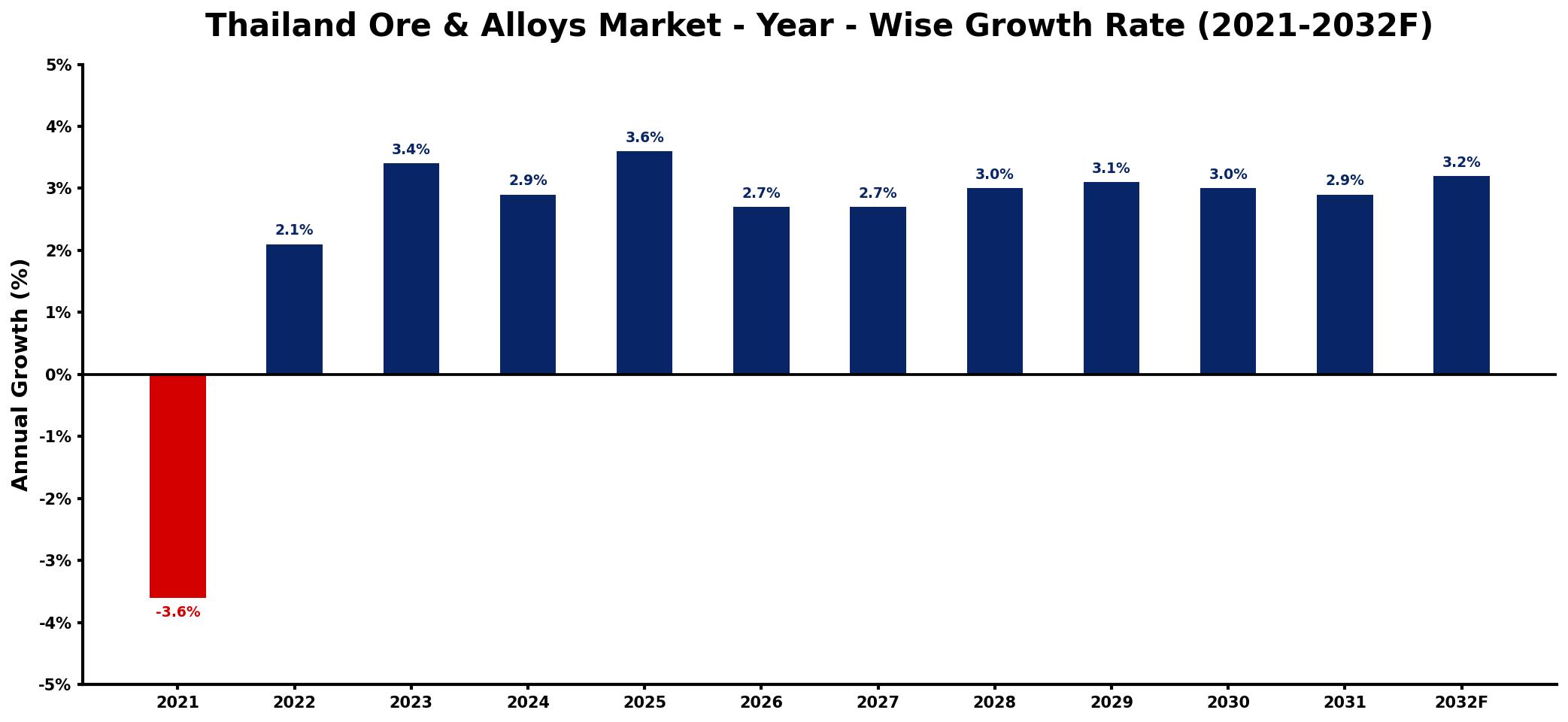
The table below presents the year‑wise growth rates along with the key drivers influencing the market
| Year | Growth Rate | Major Drivers |
| 2021 | -3.6% | Decreased industrial production activities |
| 2022 | 2.1% | Revival in construction projects |
| 2023 | 3.4% | strengthening underlying market demand |
| 2024 | 2.9% | Growth in renewable energy sector |
| 2025 | 3.6% | Rising demand from automotive industry |
| 2026 | 2.7% | Expansion of manufacturing capabilities |
| 2027 | 2.7% | Technological advancements in production |
| 2028 | 3.0% | Surge in export opportunities |
| 2029 | 3.1% | Strengthening of domestic industries |
| 2030 | 3.0% | Growing focus on sustainability |
| 2031 | 2.9% | Increased government infrastructure spending |
| 2032 | 3.2% | Emergence of new market entrants |
Note: Market size estimations and growth projections presented in this report are based on 6Wresearch's proprietary forecasting methodology, utilizing the latest available industry data, government publications, and primary research inputs.
Thailand Ore & Alloys Market Synopsis
In recent years, Thailand's Ore & Alloys Market has witnessed significant activity, propelled by the demand for high-quality alloys in metallurgy. Key alloys produced from ores such as ferrochrome, ferromanganese, and ferrosilicon are integral to various industrial applications, cementing their role within the Thai industrial landscape.
The country's ongoing infrastructure projects, alongside a thriving automotive sector, has further enhanced the appetite for ore alloys. As construction activities ramp up, the need for stronger and more durable materials becomes critical, thus supporting the growth of this vital market.
- Steady growth expected in the Thailand Ore & Alloys Market driven by industrial demand.
- Technological advancements in alloy production enhance strength and market competitiveness.
- Export opportunities to neighboring countries bolster market expansion.
- Government-led infrastructure projects are anticipated to revive demand post-pandemic.
- Environmental regulations present ongoing challenges for ore sourcing and production.
The Thailand Ore & Alloys Market faces several restraints that could limit its potential. Fluctuating global demand for alloys often leads to unpredictable price movements, complicating financial planning for producers and consumers alike. Moreover, the reliance on imported ores can escalate costs and introduce supply chain vulnerabilities, particularly if sourcing quality materials domestically proves challenging. Additionally, increasing scrutiny regarding environmental impacts of ore extraction and processing poses significant hurdles, prompting manufacturers to adopt more sustainable practices while balancing operational costs.
Several trends are shaping the Thailand Ore & Alloys Market, including the push for green technologies in alloy production. Manufacturers are increasingly focusing on reducing carbon footprints, leading to innovations in processing techniques and material recycling. Furthermore, the rising demand for high-performance alloys in sectors such as automotive and construction is prompting research into new alloy compositions that offer improved characteristics. The trend towards automation in production facilities is also enhancing efficiency and reducing human error.
Investment opportunities within the Thailand Ore & Alloys Market are expected to flourish, particularly in sectors involving advanced manufacturing processes. The ongoing government initiatives to promote infrastructure development present a significant opportunity for companies involved in alloy production. Additionally, as regional demand for high-strength materials grows, domestic producers can capitalize on export potential, especially to ASEAN markets where construction and industrial activities are increasing.
The Thai government has implemented several initiatives aimed at bolstering the industrial sector, which includes the ore alloys market. These initiatives encompass funding for infrastructure projects and incentives for manufacturers to adopt environmentally friendly practices. Additionally, policies encouraging research and development in alloy technologies are designed to elevate the domestic manufacturing landscape and enhance competitiveness on a global scale. Furthermore, ongoing governmental support aims to facilitate smoother trade relations with neighboring countries, thereby enhancing export opportunities for alloy products.
Looking ahead to 2026-2032, the Thailand Ore & Alloys Market is poised for measured growth as industrial activities rebound following the disruptions caused by the pandemic. Demand for ferroalloys is anticipated to surge as construction projects gain momentum, particularly with governmental infrastructure investments. As innovation in alloy production continues, manufacturers that adapt swiftly to market needs and invest in sustainable practices will likely emerge as leaders in a competitive landscape.
In the latest developments within the Thailand Ore & Alloys Market, companies have been actively exploring new partnerships to enhance their supply chains and mitigate the challenges posed by imported ores. Additionally, several firms are adopting cutting-edge technologies to improve production efficiency and reduce environmental impact. The ongoing recovery of the construction sector is leading to increased inquiries and contracts for alloy products, indicating a positive shift in market sentiment.
- 10 Years of Market Numbers
- Historical Data Starting from 2022 to 2025
- Base Year: 2025
- Forecast Data until 2032
- Key Performance Indicators Impacting the Market
- Major Upcoming Developments and Projects
Key Highlights of the Report:
- Thailand Ore & Alloys Market Outlook
- Market Size of Thailand Ore & Alloys Market, 2025
- Forecast of Thailand Ore & Alloys Market, 2032
- Historical Data and Forecast of Thailand Ore & Alloys Revenues & Volume for the Period 2022-2032F
- Thailand Ore & Alloys Market Trend Evolution
- Thailand Ore & Alloys Market Drivers and Challenges
- Thailand Ore & Alloys Price Trends
- Thailand Ore & Alloys Porter's Five Forces
- Thailand Ore & Alloys Industry Life Cycle
- Historical Data and Forecast of Thailand Ore & Alloys Market Revenues & Volume By Product Type for the Period 2022-2032F
- Historical Data and Forecast of Thailand Ore & Alloys Market Revenues & Volume By Chrome Ore for the Period 2022-2032F
- Historical Data and Forecast of Thailand Ore & Alloys Market Revenues & Volume By Manganese Ore for the Period 2022-2032F
- Historical Data and Forecast of Thailand Ore & Alloys Market Revenues & Volume By Ferro-chrome for the Period 2022-2032F
- Historical Data and Forecast of Thailand Ore & Alloys Market Revenues & Volume By Ferro-manganese for the Period 2022-2032F
- Historical Data and Forecast of Thailand Ore & Alloys Market Revenues & Volume By Ferro-nickel for the Period 2022-2032F
- Historical Data and Forecast of Thailand Ore & Alloys Market Revenues & Volume By Ferro- Silicon for the Period 2022-2032F
- Historical Data and Forecast of Thailand Ore & Alloys Market Revenues & Volume By Silico-manganese for the Period 2022-2032F
- Historical Data and Forecast of Thailand Chrome Ore Ore & Alloys Market Revenues & Volume By Others for the Period 2022-2032F
- Historical Data and Forecast of Thailand Ore & Alloys Market Revenues & Volume By Application for the Period 2022-2032F
- Historical Data and Forecast of Thailand Ore & Alloys Market Revenues & Volume By Automobiles for the Period 2022-2032F
- Historical Data and Forecast of Thailand Ore & Alloys Market Revenues & Volume By Surgical Tools for the Period 2022-2032F
- Historical Data and Forecast of Thailand Ore & Alloys Market Revenues & Volume By Aerospace Industry for the Period 2022-2032F
- Historical Data and Forecast of Thailand Ore & Alloys Market Revenues & Volume By Buildings for the Period 2022-2032F
- Historical Data and Forecast of Thailand Ore & Alloys Market Revenues & Volume By Others for the Period 2022-2032F
- Thailand Ore & Alloys Import Export Trade Statistics
- Market Opportunity Assessment By Product Type
- Market Opportunity Assessment By Application
- Thailand Ore & Alloys Top Companies Market Share
- Thailand Ore & Alloys Competitive Benchmarking By Technical and Operational Parameters
- Thailand Ore & Alloys Company Profiles
- Thailand Ore & Alloys Key Strategic Recommendations






































