Thailand Paper bags and sacks packaging Market Summary
The thailand paper bags and sacks packaging market was estimated at USD 236 Million in 2025 and is projected to reach USD 270 Million by 2032, growing at a CAGR of 3.1% from 2026 to 2032.
Thailand Paper bags and sacks packaging Market Year-wise Growth Rate and Key Drivers
This graph highlights how the Thailand Paper bags and sacks packaging Market has steadily grown over the past five years, supported by major growth factors.
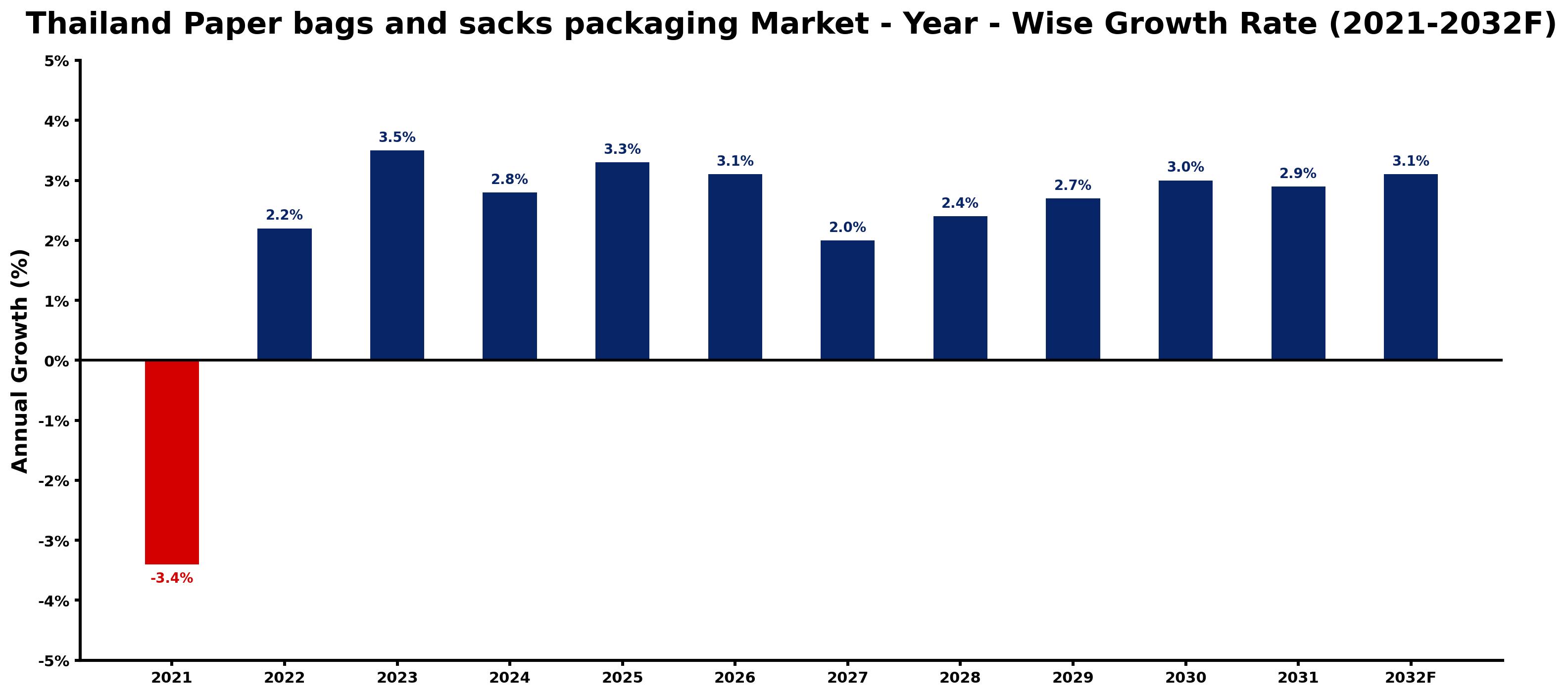
The table below presents the year wise growth rates along with the key drivers influencing the market
| Year | Growth Rate | Major Drivers |
| 2021 | -3.4% | Increased digitalization led businesses to shift towards sustainable, lowcost packaging alternatives over traditional paper options. |
| 2022 | 2.2% | Consumer preferences shifted towards biodegradable options, enhancing paper bag market appeal. |
| 2023 | 3.5% | Retailers embraced paper bags to enhance brand image and customer experience initiatives. |
| 2024 | 2.8% | Growing e-commerce activities increased demand for versatile and lightweight packaging solutions. |
| 2025 | 3.3% | Local production capabilities strengthened, reducing import dependency and bolstering market resilience. |
| 2026 | 3.1% | Innovative designs in paper bags captivated consumers, encouraging brand differentiation strategies. |
| 2027 | 2.0% | Collaboration between brands and suppliers fostered ecosystems that promoted sustainable sourcing practices. |
| 2028 | 2.4% | Public awareness campaigns highlighted environmental impacts, further pushing paper bag preferences. |
| 2029 | 2.7% | Investment into biodegradable materials optimized production processes for enhanced efficiency. |
| 2030 | 3.0% | Education about recycling practices became crucial for boosting paper bag lifecycle awareness. |
| 2031 | 2.9% | Urbanization trends created opportunities for retail expansion, boosting packaging demand significantly. |
| 2032 | 3.1% | Technological advancements in printing offered customized solutions, aligning with consumer branding desires. |
Note - Market size estimations and growth projections presented in this report are based on 6Wresearch's advanced forecasting approach, validated with industry datasets as of June 2026.
Thailand Paper bags and sacks packaging Market Synopsis
The Thailand Paper bags and sacks packaging Market is projected to reach 3.1% and witness significant growth during the forecast period (2026-2032). This market encompasses the production, distribution, and utilization of paper-based packaging solutions across various sectors including retail, food and beverage, and pharmaceuticals. Paper bags and sacks are integral for packaging purposes such as product carrying, goods storage, and item protection during transportation. The market includes a diverse range of offerings, from plain to printed paper bags and sacks, catering to the increasing complexities of packaging demands.
Thailand Paper bags and sacks packaging Market Growth Drivers
Several factors are driving the growth of the Thailand Paper bags and sacks packaging Market. One primary driver is the increasing focus on sustainability and environmental stewardship. As consumers become more eco-conscious, there's a marked shift toward renewable and recyclable materials, with paper being a clear choice over plastic or non-renewable alternatives. This trend is further amplified by the expansion of the retail sector, including the rise of e-commerce, which enhances the demand for paper packaging solutions among consumers who prefer sustainable options.
- Increased awareness of environmental issues is prompting businesses to adopt paper-based solutions that align with ecologically responsible practices.
- The growth in online shopping accelerates the need for effective, secure paper packaging that complements consumer preferences.
- Government regulations promoting the reduction of plastic usage are encouraging companies to shift to paper for compliance and consumer acceptance.
- Innovations in paper manufacturing technology are yielding stronger, more versatile products that appeal to a wider range of industries.
- Expansion of food and beverage sectors, particularly takeaway services, is driving demand for high-quality paper bags and sacks that can meet hygiene standards.
Thailand Paper bags and sacks packaging Market Challenges and Restraints
Despite the positive growth outlook, the Thailand Paper bags and sacks packaging Market faces several challenges. The primary competitor remains plastic packaging, which often offers benefits such as lower production costs, enhanced durability, and moisture resistance. As a result, paper packaging must be competitively positioned in terms of pricing and performance. Additionally, fluctuations in the cost of raw materials used in paper production can affect overall market pricing and profitability.
- The need for manufacturers to highlight the sustainability advantages of paper packaging over plastic is crucial for market penetration.
- Maintaining cost-effective production processes while ensuring high quality and sustainability standards is a persistent challenge.
- Supply chain disruptions can affect the availability and pricing of raw materials essential for paper production.
- Environmental regulations can impose additional costs on manufacturers, impacting pricing structures and market competitiveness.
- Consumer preferences are dynamic, requiring ongoing innovation and adaptation in packaging designs to meet changing demands.
Thailand Paper bags and sacks packaging Market Government Investment and Initiatives
The Thai government has recognized the importance of sustainable packaging solutions, leading to various initiatives aimed at promoting the use of paper-based products. Policies directing public spending toward sustainable development and environmental conservation are pivotal to this market. The government has implemented programs to support the recycling of paper materials and enhance the overall efficiency of the supply chain. Additionally, incentives for companies that adopt eco-friendly practices underscore a commitment to reducing plastic waste and promoting renewable resources in packaging.
- Government policies encouraging sustainable packaging alternatives are fostering investment in the paper sector.
- Funding for research and development in eco-friendly packaging technologies is being prioritized to advance product innovation.
- Public awareness campaigns regarding plastic waste are increasing consumer advocacy for paper packaging solutions.
- Partnerships between government entities and industry stakeholders are essential for developing comprehensive recycling programs.
- Regulatory frameworks are evolving to facilitate smoother transitions to sustainable packaging practices across sectors.
Thailand Paper bags and sacks packaging Market Latest Developments (May 2025 - June 2026)
Recent developments in the Thailand Paper bags and sacks packaging Market portray a dynamic landscape, driven by evolving consumer behaviors and market trends. The aftermath of the COVID-19 pandemic has prompted significant shifts, with many consumers increasingly preferring online shopping and demanding sustainable packaging solutions. Notably, there has been an increase in collaborations among businesses aimed at enhancing the supply chain for paper products, emphasizing efficiency and sustainability. Investment in automation and technological advancements in production processes has also been a key focus, enabling manufacturers to meet rising demand while maintaining quality standards.
- The industry is witnessing an uptick in strategic partnerships aimed at optimizing the paper supply chain and distribution channels.
- Advancements in production technologies are making it easier for manufacturers to enhance quality while reducing environmental impact.
- Consumer feedback is increasingly shaping product offerings, pushing companies to innovate in design and functionality.
- There is a marked emphasis on enhancing the visibility of sustainable practices through marketing efforts.
- Market players are leveraging online platforms to boost engagement and streamline purchasing processes amidst a growing digital retail landscape.
Thailand Paper bags and sacks packaging Market - Key Attractiveness of the Report
- 10 Years of Market Numbers
- Historical Data Starting from 2022 to 2025
- Base Year: 2025
- Forecast Data until 2032
- Key Performance Indicators Impacting the Market
- Major Upcoming Developments and Projects
Key Highlights of the Report:
- Thailand Paper bags and sacks packaging Market Outlook
- Market Size of Thailand Paper bags and sacks packaging Market, 2025
- Forecast of Thailand Paper bags and sacks packaging Market, 2032
- Historical Data and Forecast of Thailand Paper bags and sacks packaging Revenues & Volume for the Period 2022-2032F
- Thailand Paper bags and sacks packaging Market Trend Evolution
- Thailand Paper bags and sacks packaging Market Drivers and Challenges
- Thailand Paper bags and sacks packaging Price Trends
- Thailand Paper bags and sacks packaging Porter's Five Forces
- Thailand Paper bags and sacks packaging Industry Life Cycle
- Historical Data and Forecast of Thailand Paper bags and sacks packaging Market Revenues & Volume By Product for the Period 2022-2032F
- Historical Data and Forecast of Thailand Paper bags and sacks packaging Market Revenues & Volume By Flat Paper Bag for the Period 2022-2032F
- Historical Data and Forecast of Thailand Paper bags and sacks packaging Market Revenues & Volume By Multi-wall Paper Sacks for the Period 2022-2032F
- Historical Data and Forecast of Thailand Paper bags and sacks packaging Market Revenues & Volume By Other for the Period 2022-2032F
- Historical Data and Forecast of Thailand Paper bags and sacks packaging Market Revenues & Volume By Application for the Period 2022-2032F
- Historical Data and Forecast of Thailand Paper bags and sacks packaging Market Revenues & Volume By Food & Beverage for the Period 2022-2032F
- Historical Data and Forecast of Thailand Paper bags and sacks packaging Market Revenues & Volume By Pharmaceutical for the Period 2022-2032F
- Historical Data and Forecast of Thailand Paper bags and sacks packaging Market Revenues & Volume By Retail for the Period 2022-2032F
- Historical Data and Forecast of Thailand Paper bags and sacks packaging Market Revenues & Volume By Construction for the Period 2022-2032F
- Historical Data and Forecast of Thailand Paper bags and sacks packaging Market Revenues & Volume By Chemicals for the Period 2022-2032F
- Historical Data and Forecast of Thailand Paper bags and sacks packaging Market Revenues & Volume By Others for the Period 2022-2032F
- Thailand Paper bags and sacks packaging Import Export Trade Statistics
- Market Opportunity Assessment By Product
- Market Opportunity Assessment By Application
- Thailand Paper bags and sacks packaging Top Companies Market Share
- Thailand Paper bags and sacks packaging Competitive Benchmarking By Technical and Operational Parameters
- Thailand Paper bags and sacks packaging Company Profiles
- Thailand Paper bags and sacks packaging Key Strategic Recommendations






































