Thailand Parking Meter Market Size, Share & Growth Rate
The Thailand Parking Meter Market was estimated at USD 106 Million in 2025 and is projected to reach USD 122 Million by 2032, growing at a CAGR of 2.0% from 2026 to 2032. This growth trajectory is fueled by increasing urbanization and the pressing need for efficient parking management solutions in congested urban centers across the country. As Thailand's cities grapple with rising vehicular traffic, the demand for innovative parking systems that integrate digital payment methods and real-time monitoring capabilities is becoming increasingly essential.
Thailand Parking Meter Market Year-wise Growth Rate and Key Drivers
This graph highlights how the Thailand Parking Meter Market has steadily grown over the years, supported by major growth factors.
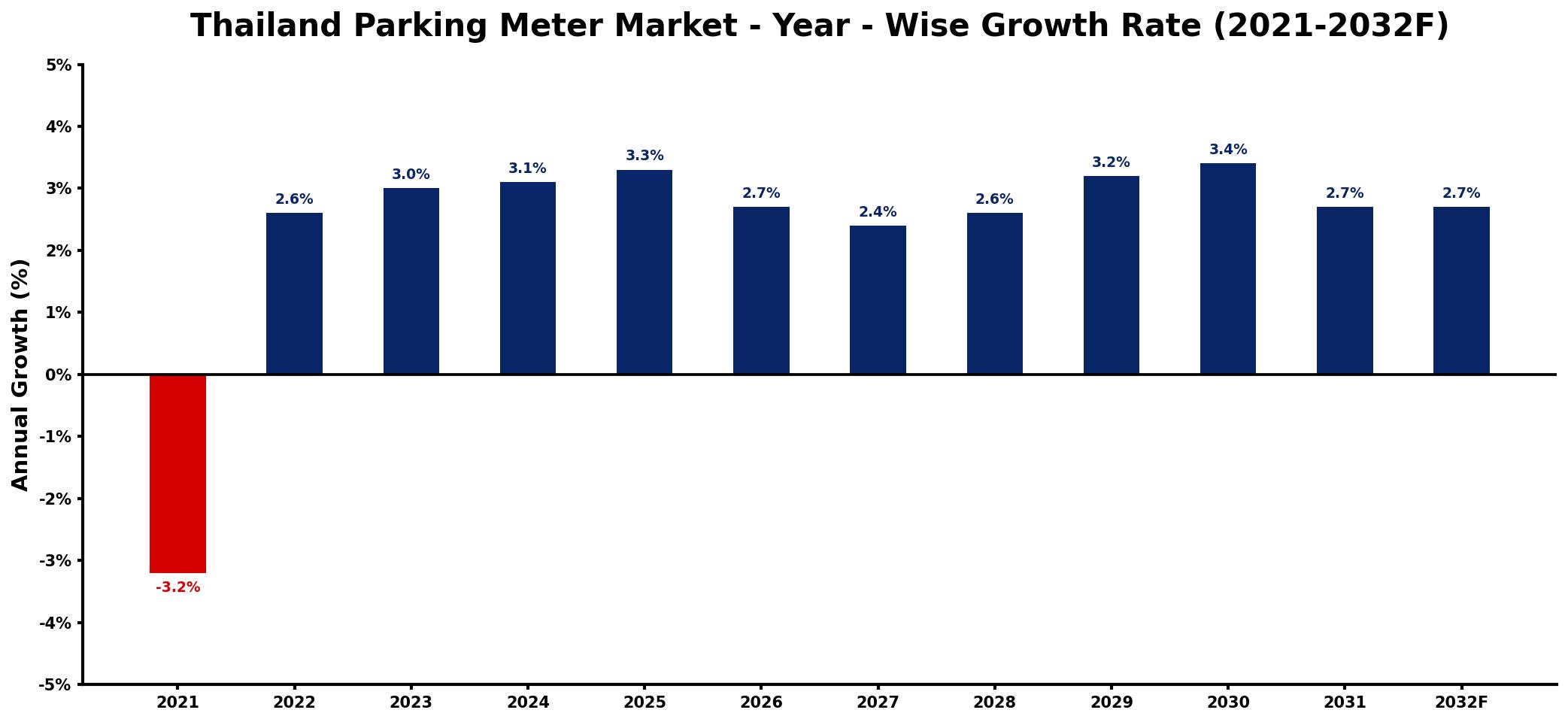
The table below presents the year‑wise growth rates along with the key drivers influencing the market
| Year | Growth Rate | Major Drivers |
| 2021 | -3.2% | decrease in public infrastructure investment |
| 2022 | 2.6% | rise in urban mobility solutions |
| 2023 | 3.0% | increased adoption of smart technologies |
| 2024 | 3.1% | growth in urban population density |
| 2025 | 3.3% | expansion of electric vehicle usage |
| 2026 | 2.7% | enhanced government regulation enforcement |
| 2027 | 2.4% | development of alternative transport modes |
| 2028 | 2.6% | surge in tourism and travel |
| 2029 | 3.2% | investment in renewable energy initiatives |
| 2030 | 3.4% | growing preference for automated solutions |
| 2031 | 2.7% | emphasis on sustainable urban development |
| 2032 | 2.7% | improvement in city planning strategies |
Note: Market size estimations and growth projections presented in this report are based on 6Wresearch's proprietary forecasting methodology, utilizing the latest available industry data, government publications, and primary research inputs.
Thailand Parking Meter Market Synopsis
In recent years, the Thailand parking meter market has experienced a significant shift toward modernization, driven by technological advancements and changing consumer behaviors. The move toward smart city initiatives is redefining how parking is managed, making it more responsive to the needs of urban drivers.
Looking ahead, the market is set to expand further, capitalizing on the adoption of electronic payment systems and the integration of mobile applications. This evolution not only supports municipalities in revenue generation but also enhances the overall parking experience for users, making it a crucial aspect of urban mobility planning in Thailand.
Thailand Parking Meter Market Key Takeaways
- The market is transitioning from traditional coin-operated meters to advanced electronic systems with mobile payment capabilities.
- Urbanization is a major driver, with growing congestion necessitating efficient parking management solutions.
- Real-time monitoring technologies are being adopted to optimize parking space usage and reduce traffic congestion.
- The impact of the COVID-19 pandemic has accelerated the demand for touchless payment options.
- Municipalities are increasingly recognizing the revenue potential associated with modern parking solutions.
Evaluation of Restraints in Thailand Parking Meter Market
The Thailand parking meter market is hindered by challenges linked to urban congestion and the need for comprehensive infrastructure development. While innovative technologies can enhance parking management, municipalities face constraints in effectively implementing these solutions. Issues such as high initial investments and the complexity of transitioning existing systems to newer technologies create hurdles. Moreover, accommodating diverse payment preferences, especially as digital adoption increases, remains a pressing challenge for ensuring user convenience and satisfaction.
Thailand Parking Meter Market Trends
Emerging trends within the Thailand parking meter market indicate a clear shift towards digitalization. The integration of mobile payment platforms and real-time data analytics is becoming standard practice, allowing for smarter resource allocation and improved user experiences. Furthermore, sustainability concerns are prompting cities to invest in eco-friendly parking solutions, including solar-powered meters and systems that promote electric vehicle charging. These trends align with broader urban development goals, contributing to the creation of smarter, more connected urban spaces.
Thailand Parking Meter Market Opportunities
Significant growth opportunities exist in developing smart parking solutions tailored for Thailand's urban landscape. As cities strive to alleviate congestion and improve the efficiency of parking systems, providers of innovative technologies will find ample scope to expand their offerings. Collaboration with local governments to pilot smart parking projects can enhance visibility and drive adoption, while investments in training and support services will be crucial for ensuring successful implementation and maintenance of new systems.
Government Initiatives in the Thailand Parking Meter Market
The Thai government is actively promoting policies aimed at improving urban transportation management, including initiatives focused on smart city development. Public spending is increasingly directed towards enhancing urban infrastructure, with a specific emphasis on integrating technology into parking solutions. Local authorities are also exploring partnerships with technology providers to foster innovation in parking management systems, offering incentives for municipalities to adopt modern parking meters that facilitate efficient revenue collection and user convenience.
Future Insights of the Thailand Parking Meter Market
From 2026 to 2032, the Thailand parking meter market is poised for steady growth, as urban centers continue to evolve in response to increasing vehicular density. The adoption of smart technologies will be at the forefront, driving demand for sophisticated parking solutions that not only optimize space but also enhance user engagement through improved payment options and real-time feedback mechanisms. Municipalities that embrace these developments stand to benefit significantly, both in terms of revenue generation and the overall improvement of urban mobility.
Thailand Parking Meter Market Latest Developments (2025 - 2026)
Recent developments in the Thailand parking meter market have highlighted a shift towards enhanced user experiences, with a growing number of municipalities piloting advanced parking solutions. Key initiatives include the deployment of touchless payment systems and the integration of mobile apps that offer real-time availability updates. Additionally, industry players are beginning to collaborate with local governments to streamline parking regulations and improve overall infrastructure management.
Thailand Parking Meter Market - Key Attractiveness of the Report
- 10 Years of Market Numbers
- Historical Data Starting from 2022 to 2025
- Base Year: 2025
- Forecast Data until 2032
- Key Performance Indicators Impacting the Market
- Major Upcoming Developments and Projects
Key Highlights of the Report:
- Thailand Parking Meter Market Outlook
- Market Size of Thailand Parking Meter Market, 2025
- Forecast of Thailand Parking Meter Market, 2032
- Historical Data and Forecast of Thailand Parking Meter Revenues & Volume for the Period 2022-2032F
- Thailand Parking Meter Market Trend Evolution
- Thailand Parking Meter Market Drivers and Challenges
- Thailand Parking Meter Price Trends
- Thailand Parking Meter Porter's Five Forces
- Thailand Parking Meter Industry Life Cycle
- Historical Data and Forecast of Thailand Parking Meter Market Revenues & Volume By Technology for the Period 2022-2032F
- Historical Data and Forecast of Thailand Parking Meter Market Revenues & Volume By Parking Meter (Single Space) for the Period 2022-2032F
- Historical Data and Forecast of Thailand Parking Meter Market Revenues & Volume By Parking Kiosks (Multi Space) for the Period 2022-2032F
- Historical Data and Forecast of Thailand Parking Meter Market Revenues & Volume By Government Institutions for the Period 2022-2032F
- Historical Data and Forecast of Thailand Parking Meter Market Revenues & Volume By Application for the Period 2022-2032F
- Historical Data and Forecast of Thailand Parking Meter Market Revenues & Volume By Hospitals for the Period 2022-2032F
- Historical Data and Forecast of Thailand Parking Meter Market Revenues & Volume By Parks for the Period 2022-2032F
- Historical Data and Forecast of Thailand Parking Meter Market Revenues & Volume By Transit Systems for the Period 2022-2032F
- Historical Data and Forecast of Thailand Parking Meter Market Revenues & Volume By Malls & Stadiums for the Period 2022-2032F
- Historical Data and Forecast of Thailand Parking Meter Market Revenues & Volume By Others for the Period 2022-2032F
- Historical Data and Forecast of Thailand Parking Meter Market Revenues & Volume By Parking Mode for the Period 2022-2032F
- Historical Data and Forecast of Thailand Parking Meter Market Revenues & Volume By Pay & Display for the Period 2022-2032F
- Historical Data and Forecast of Thailand Parking Meter Market Revenues & Volume By Plate for the Period 2022-2032F
- Historical Data and Forecast of Thailand Parking Meter Market Revenues & Volume By Space for the Period 2022-2032F
- Historical Data and Forecast of Thailand Parking Meter Market Revenues & Volume By Others for the Period 2022-2032F
- Thailand Parking Meter Import Export Trade Statistics
- Market Opportunity Assessment By Technology
- Market Opportunity Assessment By Application
- Market Opportunity Assessment By Parking Mode
- Thailand Parking Meter Top Companies Market Share
- Thailand Parking Meter Competitive Benchmarking By Technical and Operational Parameters
- Thailand Parking Meter Company Profiles
- Thailand Parking Meter Key Strategic Recommendations






































