Thailand Polypropylene Woven Bags and Sacks Market: Import Trend Analysis
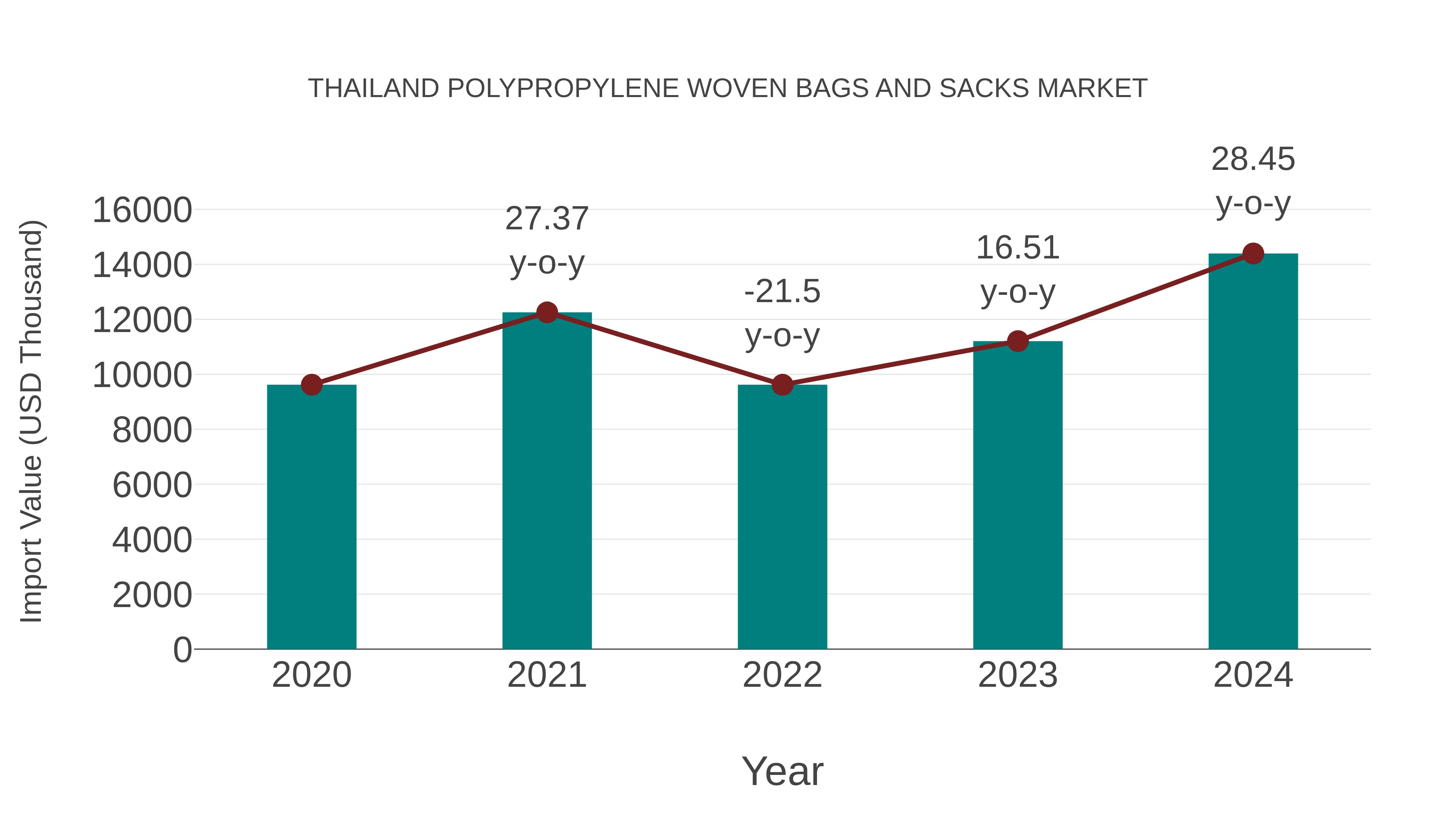
Thailand import trend for polypropylene woven bags and sacks market saw a notable growth rate of 28.45% from 2023 to 2024, with a compound annual growth rate (CAGR) of 10.6% for the period of 2020-2024. This substantial increase in imports can be attributed to the rising demand for durable packaging solutions in various industries, indicating a positive market stability and demand shift towards polypropylene woven bags and sacks in Thailand.
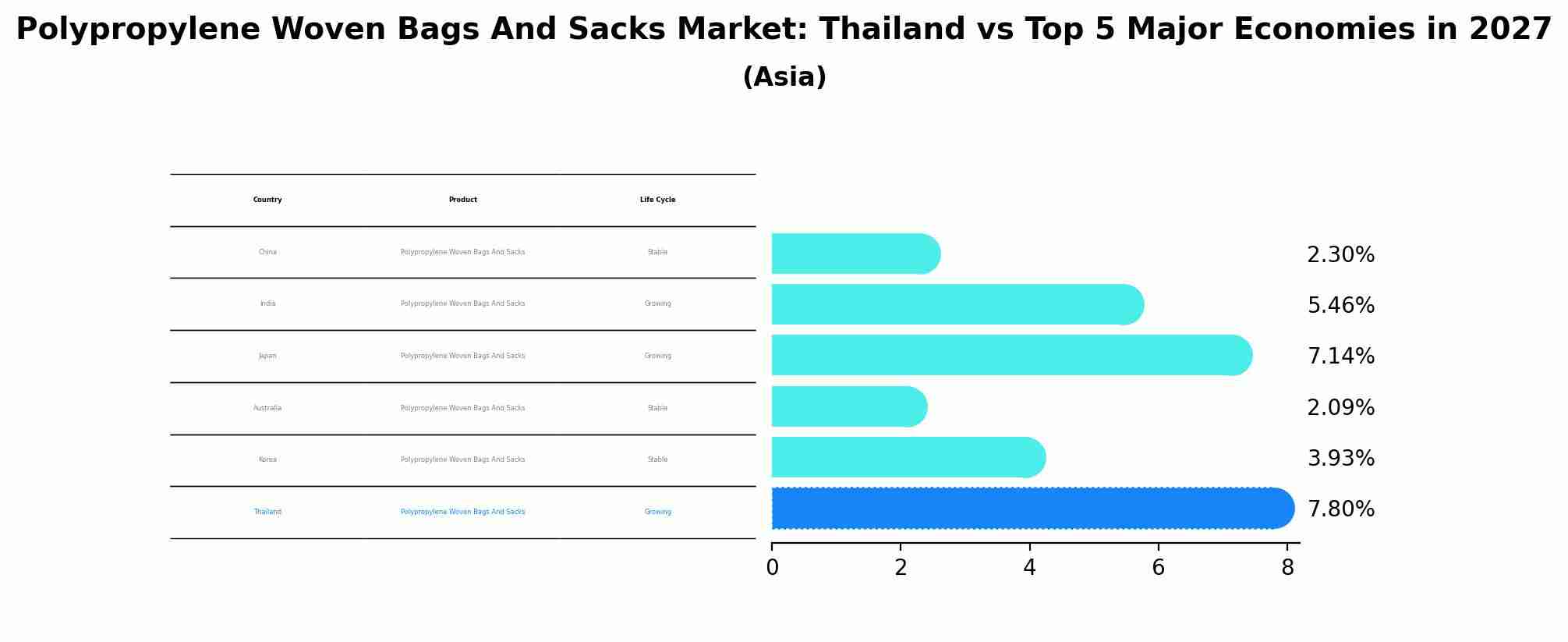
Polypropylene Woven Bags And Sacks Market: Thailand vs Top 5 Major Economies in 2027 (Asia)
By 2027, Thailand's Polypropylene Woven Bags And Sacks market is forecasted to achieve a growing growth rate of 7.80%, with China leading the Asia region, followed by India, Japan, Australia and South Korea.
Thailand Polypropylene Woven Bags and Sacks Market Synopsis
Thailand polypropylene woven bags and sacks market has experienced significant growth due to the country`s thriving agricultural sector. These bags are widely used for packaging grains, rice, fertilizers, and other agricultural products. As Thailand continues to be a major agricultural producer and exporter in the region, the demand for polypropylene woven bags and sacks is expected to remain strong. Additionally, the market may see innovations in bag design and materials to enhance durability and sustainability.
Drivers of the Market
The Thailand polypropylene woven bags and sacks market is primarily propelled by the country`s robust agricultural sector. These bags and sacks are widely used for packaging agricultural produce such as rice, sugar, and grains. The growth of the agricultural industry, coupled with increasing exports of these products, drives the demand for polypropylene woven bags. Moreover, the construction sector`s reliance on these bags for transporting construction materials like sand and cement contributes to the market`s expansion.
Challenges of the Market
The Thailand Polypropylene Woven Bags and Sacks market faces several challenges in its growth and sustainability. One of the primary challenges is the increasing competition from alternative packaging materials, such as paper and jute bags, which are considered more environmentally friendly. Additionally, the market grapples with fluctuating raw material prices, which can affect production costs and pricing strategies. Quality control and ensuring the durability of these bags in tropical climates pose another challenge, as customers demand products that can withstand harsh conditions. Moreover, the industry must address sustainability concerns and invest in eco-friendly production processes to remain competitive in an evolving market landscape.
COVID-19 Impact on the Market
The polypropylene woven bags and sacks market in Thailand experienced fluctuations during the pandemic. Initially, demand waned as businesses scaled down operations and international trade slowed. However, the market saw a resurgence as the need for packaging materials for essential goods and agricultural products surged. The industry adapted by implementing safety measures and exploring new applications for woven bags, such as in healthcare and pharmaceutical sectors.
Key Players in the Market
Leading players in the Thailand polypropylene woven bags and sacks market include United Polyresins, Inc., and Thai Plastics & Chemicals Public Company Limited. These companies specialize in manufacturing polypropylene woven bags and sacks used for packaging various products. Their products are known for their durability and versatility, making them preferred choices for packaging solutions.
Key Highlights of the Report:
- Thailand Polypropylene Woven Bags And Sacks Market Outlook
- Market Size of Thailand Polypropylene Woven Bags And Sacks Market, 2025
- Forecast of Thailand Polypropylene Woven Bags And Sacks Market, 2032
- Historical Data and Forecast of Thailand Polypropylene Woven Bags And Sacks Revenues & Volume for the Period 2022-2032F
- Thailand Polypropylene Woven Bags And Sacks Market Trend Evolution
- Thailand Polypropylene Woven Bags And Sacks Market Drivers and Challenges
- Thailand Polypropylene Woven Bags And Sacks Price Trends
- Thailand Polypropylene Woven Bags And Sacks Porter's Five Forces
- Thailand Polypropylene Woven Bags And Sacks Industry Life Cycle
- Historical Data and Forecast of Thailand Polypropylene Woven Bags And Sacks Market Revenues & Volume By Product Type for the Period 2022-2032F
- Historical Data and Forecast of Thailand Polypropylene Woven Bags And Sacks Market Revenues & Volume By Valve Bags for the Period 2022-2032F
- Historical Data and Forecast of Thailand Polypropylene Woven Bags And Sacks Market Revenues & Volume By Gusseted Bags for the Period 2022-2032F
- Historical Data and Forecast of Thailand Polypropylene Woven Bags And Sacks Market Revenues & Volume By Block Bottom Bags for the Period 2022-2032F
- Historical Data and Forecast of Thailand Polypropylene Woven Bags And Sacks Market Revenues & Volume By Pinch Bottom Bags for the Period 2022-2032F
- Historical Data and Forecast of Thailand Polypropylene Woven Bags And Sacks Market Revenues & Volume By Open Mouth Bags for the Period 2022-2032F
- Historical Data and Forecast of Thailand Polypropylene Woven Bags And Sacks Market Revenues & Volume By Other Product Type for the Period 2022-2032F
- Historical Data and Forecast of Thailand Polypropylene Woven Bags And Sacks Market Revenues & Volume By Bag Type for the Period 2022-2032F
- Historical Data and Forecast of Thailand Polypropylene Woven Bags And Sacks Market Revenues & Volume By Laminated Polypropylene Woven Bags for the Period 2022-2032F
- Historical Data and Forecast of Thailand Polypropylene Woven Bags And Sacks Market Revenues & Volume By Non Laminated Polypropylene Woven Bags for the Period 2022-2032F
- Historical Data and Forecast of Thailand Polypropylene Woven Bags And Sacks Market Revenues & Volume By End-Use for the Period 2022-2032F
- Historical Data and Forecast of Thailand Polypropylene Woven Bags And Sacks Market Revenues & Volume By Building & Construction for the Period 2022-2032F
- Historical Data and Forecast of Thailand Polypropylene Woven Bags And Sacks Market Revenues & Volume By Agriculture & Allied Industries for the Period 2022-2032F
- Historical Data and Forecast of Thailand Polypropylene Woven Bags And Sacks Market Revenues & Volume By Food for the Period 2022-2032F
- Historical Data and Forecast of Thailand Polypropylene Woven Bags And Sacks Market Revenues & Volume By Retail & Shopping for the Period 2022-2032F
- Historical Data and Forecast of Thailand Polypropylene Woven Bags And Sacks Market Revenues & Volume By Other End-Use for the Period 2022-2032F
- Thailand Polypropylene Woven Bags And Sacks Import Export Trade Statistics
- Market Opportunity Assessment By Product Type
- Market Opportunity Assessment By Bag Type
- Market Opportunity Assessment By End-Use
- Thailand Polypropylene Woven Bags And Sacks Top Companies Market Share
- Thailand Polypropylene Woven Bags And Sacks Competitive Benchmarking By Technical and Operational Parameters
- Thailand Polypropylene Woven Bags And Sacks Company Profiles
- Thailand Polypropylene Woven Bags And Sacks Key Strategic Recommendations






































