Thailand Railway Maintenance Machinery Market Size, Share & Growth Rate
The Thailand Railway Maintenance Machinery Market was estimated at USD 379 Million in 2025 and is projected to reach USD 502 Million by 2032, growing at a CAGR of 4.1% from 2026 to 2032. This robust growth trajectory is primarily driven by significant government investments aimed at expanding and modernizing the railway network, coupled with a growing focus on enhancing safety and operational efficiency in rail operations.
Thailand Railway Maintenance Machinery Market Year-wise Growth Rate and Key Drivers
This graph highlights how the Thailand Railway Maintenance Machinery Market has steadily grown over the years, supported by major growth factors.
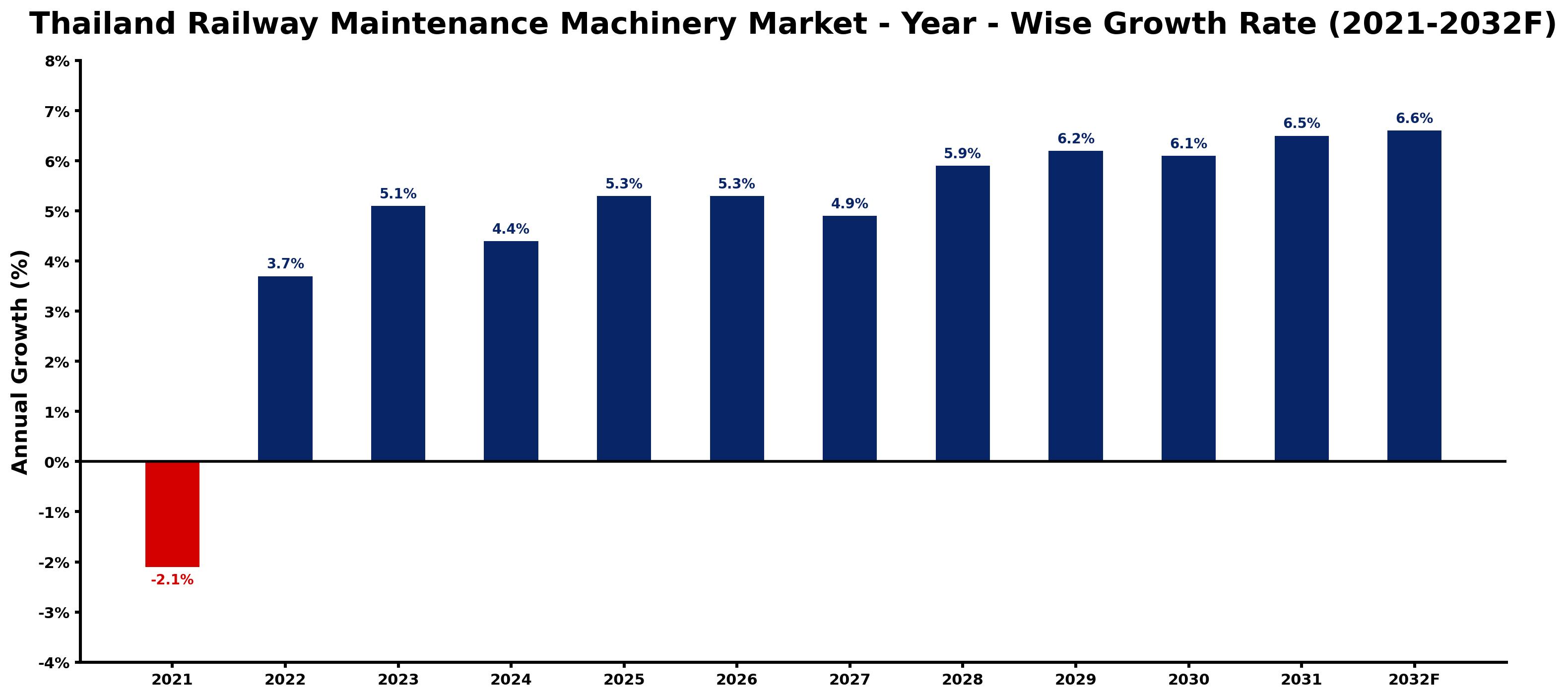
The table below presents the year‑wise growth rates along with the key drivers influencing the market
| Year | Growth Rate | Major Drivers |
| 2021 | -2.1% | Increasing smart city development projects |
| 2022 | 3.7% | Expansion of manufacturing activities |
| 2023 | 5.1% | Increasing industrial automation investments |
| 2024 | 4.4% | Increasing smart city development projects |
| 2025 | 5.3% | Increasing smart city development projects |
| 2026 | 5.3% | Expansion of transportation and logistics networks |
| 2027 | 4.9% | Increasing smart city development projects |
| 2028 | 5.9% | Increasing industrial infrastructure investments |
| 2029 | 6.2% | Increasing smart city development projects |
| 2030 | 6.1% | Increasing industrial infrastructure investments |
| 2031 | 6.5% | Government infrastructure modernization initiatives |
| 2032 | 6.6% | Expansion of transportation and logistics networks |
Note - Market size estimations and growth projections presented in this report are based on 6Wresearch’s advanced forecasting approach, validated with industry datasets as of June 2026.
Thailand Railway Maintenance Machinery Market Synopsis
The expansion of Thailand's railway infrastructure is the most potent force currently shaping the railway maintenance machinery market. With high-speed rail projects and urban transit systems on the rise, the demand for advanced machinery to support these developments is escalating rapidly.
Additionally, the increasing urbanization within Thailand necessitates an efficient public transportation system, further driving the need for reliable maintenance and repair solutions. This evolving landscape presents a significant opportunity for stakeholders invested in railway maintenance machinery.
Thailand Railway Maintenance Machinery Market Key Takeaways
- The market is experiencing a significant boost due to government-funded railway expansion projects.
- Modernization efforts aim to enhance safety, reliability, and operational efficiency in railway maintenance.
- The trend towards urbanization is driving substantial investments in public transportation systems.
- Essential maintenance operations remained a priority during the Covid-19 pandemic, indicating resilience in the sector.
- The market is characterized by a few key players, limiting competitive dynamics but ensuring quality and reliability.
Evaluation of Restraints in Thailand Railway Maintenance Machinery Market
While the market for railway maintenance machinery is burgeoning, it faces certain restraints that could impede its growth. The requirement for substantial upfront investments poses a significant barrier, particularly for smaller railway operators who may lack sufficient capital. Furthermore, the shift to advanced maintenance machinery necessitates technical training and expertise, which can be difficult to obtain in the current labor market. Lastly, limited competition due to established players dominating the field can stifle innovation and price competition, restricting access to cutting-edge technologies.
Thailand Railway Maintenance Machinery Market Trends
Several trends are shaping the Thailand Railway Maintenance Machinery Market. A notable shift is towards digitalization, where the integration of IoT (Internet of Things) technology is enabling predictive maintenance and real-time monitoring of railway conditions. Additionally, there is an increasing demand for environmentally friendly machinery as sustainability becomes a priority for both operators and government authorities. Furthermore, advancements in automation are also influencing the market, leading to more efficient maintenance operations.
Thailand Railway Maintenance Machinery Market Opportunities
The landscape for investment opportunities in the Thailand Railway Maintenance Machinery Market is promising. As the government continues to prioritize railway infrastructure development, companies have the chance to innovate and introduce cutting-edge maintenance solutions. Moreover, the potential for public-private partnerships presents a unique opportunity to leverage resources and expertise, enabling efficient project execution. Targeting urban areas poised for rapid transit expansion can also yield lucrative opportunities in the coming years.
Government Initiatives in the Thailand Railway Maintenance Machinery Market
The Thai government has launched several initiatives aimed at enhancing railway infrastructure, which directly impacts the maintenance machinery market. Significant public spending on rail projects, including high-speed rail systems and urban transit initiatives, indicates a sustained commitment to improving national transportation networks. Moreover, governmental support for technological advancements and safety regulations in rail operations fosters a conducive environment for investment in modern maintenance machinery.
Future Insights of the Thailand Railway Maintenance Machinery Market
Looking ahead to the period from 2026 to 2032, the Thailand Railway Maintenance Machinery Market is poised for continued growth. As the government intensifies its focus on public transportation and aims for infrastructural excellence, demand for modern maintenance solutions is set to rise. The integration of smart technologies and automation will likely play a crucial role in enhancing operational efficiencies. Moreover, sustained urbanization trends will perpetuate the need for improved and efficient railway systems, further solidifying the market's growth potential.
Thailand Railway Maintenance Machinery Market Latest Developments (May 2025 - June 2026)
Recent industry developments within the Thailand Railway Maintenance Machinery Market reflect a strong commitment to modernization and safety. Various initiatives are underway to enhance railway infrastructure, with a focus on deploying innovative maintenance technologies. Additionally, collaborations between public and private sectors are expected to facilitate the rapid deployment of advanced maintenance equipment in alignment with ongoing rail projects.
Thailand Railway Maintenance Machinery Market - Key Attractiveness of the Report
- 10 Years of Market Numbers
- Historical Data Starting from 2022 to 2025
- Base Year: 2025
- Forecast Data until 2032
- Key Performance Indicators Impacting the Market
- Major Upcoming Developments and Projects
Key Highlights of the Report:
- Thailand Railway Maintenance Machinery Market Outlook
- Market Size of Thailand Railway Maintenance Machinery Market, 2025
- Forecast of Thailand Railway Maintenance Machinery Market, 2032
- Historical Data and Forecast of Thailand Railway Maintenance Machinery Revenues & Volume for the Period 2022-2032F
- Thailand Railway Maintenance Machinery Market Trend Evolution
- Thailand Railway Maintenance Machinery Market Drivers and Challenges
- Thailand Railway Maintenance Machinery Price Trends
- Thailand Railway Maintenance Machinery Porter's Five Forces
- Thailand Railway Maintenance Machinery Industry Life Cycle
- Historical Data and Forecast of Thailand Railway Maintenance Machinery Market Revenues & Volume By Type for the Period 2022-2032F
- Historical Data and Forecast of Thailand Railway Maintenance Machinery Market Revenues & Volume By Tamping Machine for the Period 2022-2032F
- Historical Data and Forecast of Thailand Railway Maintenance Machinery Market Revenues & Volume By Stabilizing Machinery for the Period 2022-2032F
- Historical Data and Forecast of Thailand Railway Maintenance Machinery Market Revenues & Volume By Rail Handling Machinery for the Period 2022-2032F
- Historical Data and Forecast of Thailand Railway Maintenance Machinery Market Revenues & Volume By Ballast Cleaning Machine for the Period 2022-2032F
- Historical Data and Forecast of Thailand Railway Maintenance Machinery Market Revenues & Volume By Other for the Period 2022-2032F
- Historical Data and Forecast of Thailand Railway Maintenance Machinery Market Revenues & Volume By Applications for the Period 2022-2032F
- Historical Data and Forecast of Thailand Railway Maintenance Machinery Market Revenues & Volume By Ballast Track for the Period 2022-2032F
- Historical Data and Forecast of Thailand Railway Maintenance Machinery Market Revenues & Volume By Ballastless Track for the Period 2022-2032F
- Thailand Railway Maintenance Machinery Import Export Trade Statistics
- Market Opportunity Assessment By Type
- Market Opportunity Assessment By Applications
- Thailand Railway Maintenance Machinery Top Companies Market Share
- Thailand Railway Maintenance Machinery Competitive Benchmarking By Technical and Operational Parameters
- Thailand Railway Maintenance Machinery Company Profiles
- Thailand Railway Maintenance Machinery Key Strategic Recommendations






































