Thailand Renewable Chemicals Market Size, Share & Growth Rate
The Thailand Renewable Chemicals Market was estimated at USD 161 Million in 2025 and is projected to reach USD 184 Million by 2032, growing at a CAGR of 1.9% from 2026 to 2032. This growth trajectory reflects a heightened emphasis on sustainability and the pressing need for industries to transition from traditional petrochemical sources to more environmentally friendly alternatives. A supportive governmental framework, coupled with increasing consumer demand for green products, is propelling the market forward.
Thailand Renewable Chemicals Market Year-wise Growth Rate and Key Drivers
This graph highlights how the Thailand Renewable Chemicals Market has steadily grown over the years, supported by major growth factors.
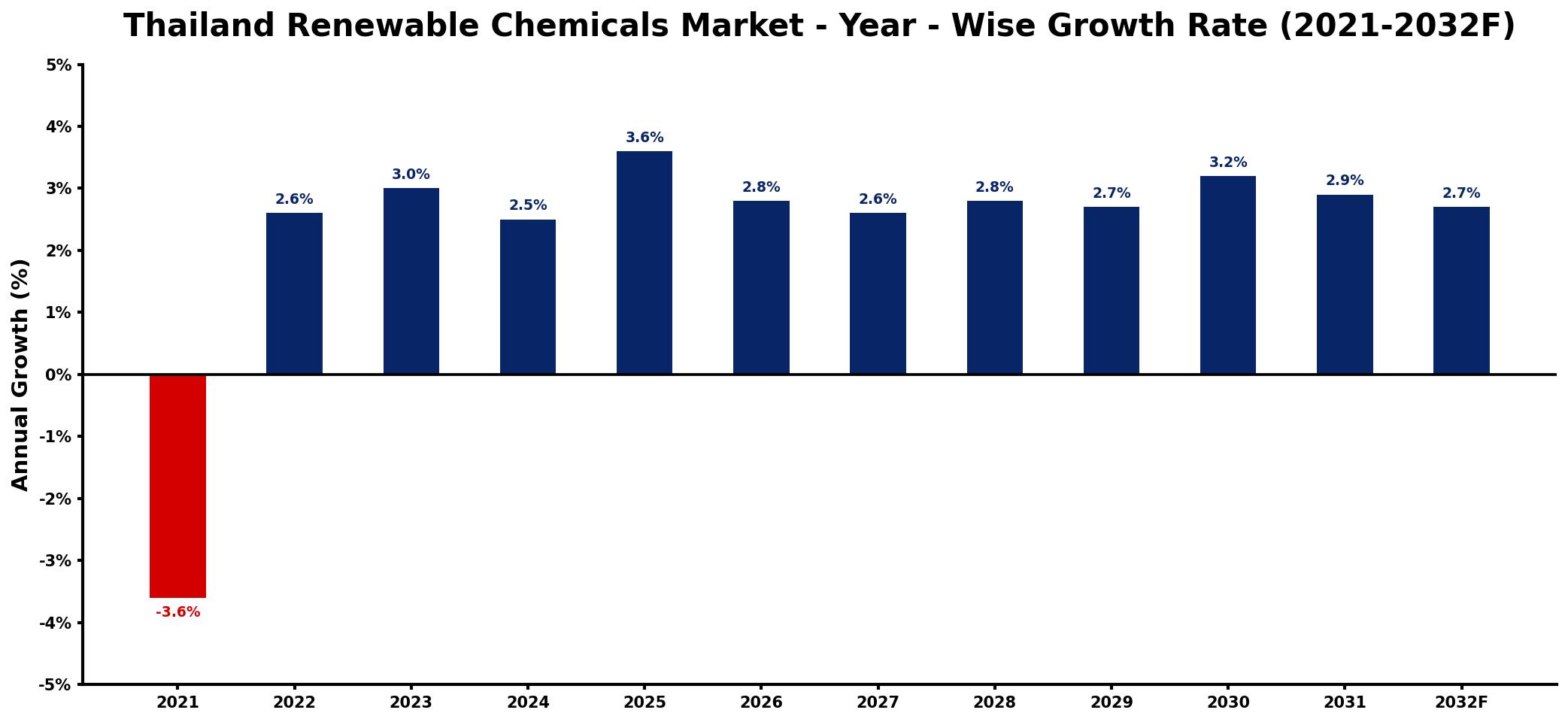
The table below presents the year‑wise growth rates along with the key drivers influencing the market
| Year | Growth Rate | Major Drivers |
| 2021 | -3.6% | decrease in consumer spending habits |
| 2022 | 2.6% | rise in sustainable packaging demand |
| 2023 | 3.0% | increased investment in green technologies |
| 2024 | 2.5% | growth in bio-based product applications |
| 2025 | 3.6% | expansion of government incentives programs |
| 2026 | 2.8% | enhanced public awareness initiatives |
| 2027 | 2.6% | surge in corporate sustainability commitments |
| 2028 | 2.8% | development of new biodegradable materials |
| 2029 | 2.7% | increased collaboration among industries |
| 2030 | 3.2% | growing demand for eco-friendly solutions |
| 2031 | 2.9% | expanding healthcare application demand |
| 2032 | 2.7% | heightened focus on circular economy |
Note: Market size estimations and growth projections presented in this report are based on 6Wresearch's proprietary forecasting methodology, utilizing the latest available industry data, government publications, and primary research inputs.
Thailand Renewable Chemicals Market Synopsis
The strongest force shaping the Thailand Renewable Chemicals Market is the countrys increasing commitment to sustainability and environmental conservation. As businesses become more aware of the environmental consequences associated with conventional chemical production, the shift towards renewable chemicals derived from biomass and other sustainable sources is intensifying.
Government incentives play a pivotal role in the market's evolution, promoting the adoption of renewable chemicals across various sectors. These initiatives are essential in overcoming the challenges of scaling production and achieving cost competitiveness, setting the stage for future innovations in the sector.
Thailand Renewable Chemicals Market Key Takeaways
- Significant market growth is driven by government policies incentivizing the use of renewable chemicals.
- Consumer demand for eco-friendly products is a key factor influencing market dynamics.
- Research and development investments are vital for developing sustainable feedstocks.
- Competition with traditional petrochemicals presents ongoing challenges for the industry.
- The market is poised for growth as awareness of sustainability continues to rise.
Evaluation of Restraints in Thailand Renewable Chemicals Market
Despite its promising outlook, the Thailand Renewable Chemicals Market faces several restraints that could hinder its growth. One significant challenge is the need for substantial investment in research and development to create sustainable feedstocks and efficient production processes. Furthermore, achieving cost competitiveness with traditional petrochemicals remains a hurdle. Environmental regulations and evolving sustainability goals require companies to adopt greener practices, often necessitating a complete overhaul of existing operations. Additionally, the competitive landscape poses challenges as firms vie for a share of the market amid changing consumer preferences.
Thailand Renewable Chemicals Market Trends
Current trends in the Thailand Renewable Chemicals Market include an increasing focus on bio-based alternatives and a growing circular economy approach. Companies are investing in technologies that enhance the efficiency of converting biomass into chemicals, which is expected to lead to the development of innovative products. Moreover, a shift in consumer behavior towards sustainable goods is driving brands to prioritize eco-friendly materials in their offerings. This alignment of industry practices with consumer expectations is crucial for the market's sustainable growth.
Thailand Renewable Chemicals Market Opportunities
The Thailand Renewable Chemicals Market presents numerous growth opportunities, particularly in sectors such as agriculture and plastics, where the demand for sustainable alternatives is accelerating. Investment in advanced production technologies and sustainable feedstock development can enhance market competitiveness. Additionally, partnerships between industry stakeholders and research institutions can foster innovation, ultimately leading to breakthroughs in renewable chemical production. As awareness of environmental issues continues to rise, new market entrants have the chance to capitalize on the transition toward greener chemical solutions.
Government Initiatives in the Thailand Renewable Chemicals Market
The Thai government has implemented several initiatives aimed at boosting the renewable chemicals sector. These policies include financial incentives for manufacturers adopting sustainable practices, support for research and development projects, and regulations that encourage the use of bio-based chemicals. By creating a conducive environment for investments, the government is laying the groundwork for a robust renewable chemicals market that aligns with national sustainability goals.
Future Insights of the Thailand Renewable Chemicals Market
Looking ahead to 2026-2032, the Thailand Renewable Chemicals Market is expected to experience a gradual yet significant transformation as sustainability remains a core focus for both consumers and industries. Advancements in technology will likely drive down production costs and enhance the viability of bio-based chemicals, making them increasingly competitive against traditional petrochemicals. Continued governmental support and growing public awareness will further accelerate the adoption of renewable chemicals across diverse applications, establishing Thailand as a key player in the global renewable chemicals landscape.
Thailand Renewable Chemicals Market Latest Developments (2025 - 2026)
Recent developments in the Thailand Renewable Chemicals Market indicate a shift towards greater investment in bio-based chemical production. The emergence of collaborative efforts between industry stakeholders is fostering innovation, with several initiatives aimed at enhancing the efficiency of renewable chemical processes. Furthermore, heightened public discourse around sustainability is influencing consumer preferences, prompting businesses to align their product offerings with eco-friendly principles. This convergence of market dynamics is poised to shape the future direction of the industry.
Thailand Renewable Chemicals Market - Key Attractiveness of the Report
- 10 Years of Market Numbers
- Historical Data Starting from 2022 to 2025
- Base Year: 2025
- Forecast Data until 2032
- Key Performance Indicators Impacting the Market
- Major Upcoming Developments and Projects
Key Highlights of the Report:
- Thailand Renewable Chemicals Market Outlook
- Market Size of Thailand Renewable Chemicals Market, 2025
- Forecast of Thailand Renewable Chemicals Market, 2032
- Historical Data and Forecast of Thailand Renewable Chemicals Revenues & Volume for the Period 2022-2032F
- Thailand Renewable Chemicals Market Trend Evolution
- Thailand Renewable Chemicals Market Drivers and Challenges
- Thailand Renewable Chemicals Price Trends
- Thailand Renewable Chemicals Porter's Five Forces
- Thailand Renewable Chemicals Industry Life Cycle
- Historical Data and Forecast of Thailand Renewable Chemicals Market Revenues & Volume By Product Type for the Period 2022-2032F
- Historical Data and Forecast of Thailand Renewable Chemicals Market Revenues & Volume By Alcohols for the Period 2022-2032F
- Historical Data and Forecast of Thailand Renewable Chemicals Market Revenues & Volume By Organic Acids for the Period 2022-2032F
- Historical Data and Forecast of Thailand Renewable Chemicals Market Revenues & Volume By Ketones for the Period 2022-2032F
- Historical Data and Forecast of Thailand Renewable Chemicals Market Revenues & Volume By Platform Chemicals for the Period 2022-2032F
- Historical Data and Forecast of Thailand Renewable Chemicals Market Revenues & Volume By Biopolymers for the Period 2022-2032F
- Historical Data and Forecast of Thailand Renewable Chemicals Market Revenues & Volume By Others for the Period 2022-2032F
- Historical Data and Forecast of Thailand Renewable Chemicals Market Revenues & Volume By Applications for the Period 2022-2032F
- Historical Data and Forecast of Thailand Renewable Chemicals Market Revenues & Volume By Transportation for the Period 2022-2032F
- Historical Data and Forecast of Thailand Renewable Chemicals Market Revenues & Volume By Textiles for the Period 2022-2032F
- Historical Data and Forecast of Thailand Renewable Chemicals Market Revenues & Volume By Food safety for the Period 2022-2032F
- Historical Data and Forecast of Thailand Renewable Chemicals Market Revenues & Volume By Environment for the Period 2022-2032F
- Historical Data and Forecast of Thailand Renewable Chemicals Market Revenues & Volume By Communication for the Period 2022-2032F
- Historical Data and Forecast of Thailand Renewable Chemicals Market Revenues & Volume By Housing for the Period 2022-2032F
- Historical Data and Forecast of Thailand Renewable Chemicals Market Revenues & Volume By Recreation for the Period 2022-2032F
- Historical Data and Forecast of Thailand Renewable Chemicals Market Revenues & Volume By Other Applications for the Period 2022-2032F
- Thailand Renewable Chemicals Import Export Trade Statistics
- Market Opportunity Assessment By Product Type
- Market Opportunity Assessment By Applications
- Thailand Renewable Chemicals Top Companies Market Share
- Thailand Renewable Chemicals Competitive Benchmarking By Technical and Operational Parameters
- Thailand Renewable Chemicals Company Profiles
- Thailand Renewable Chemicals Key Strategic Recommendations






































