Thailand Semiconductor Silicon Wafer Market: Import Trend Analysis
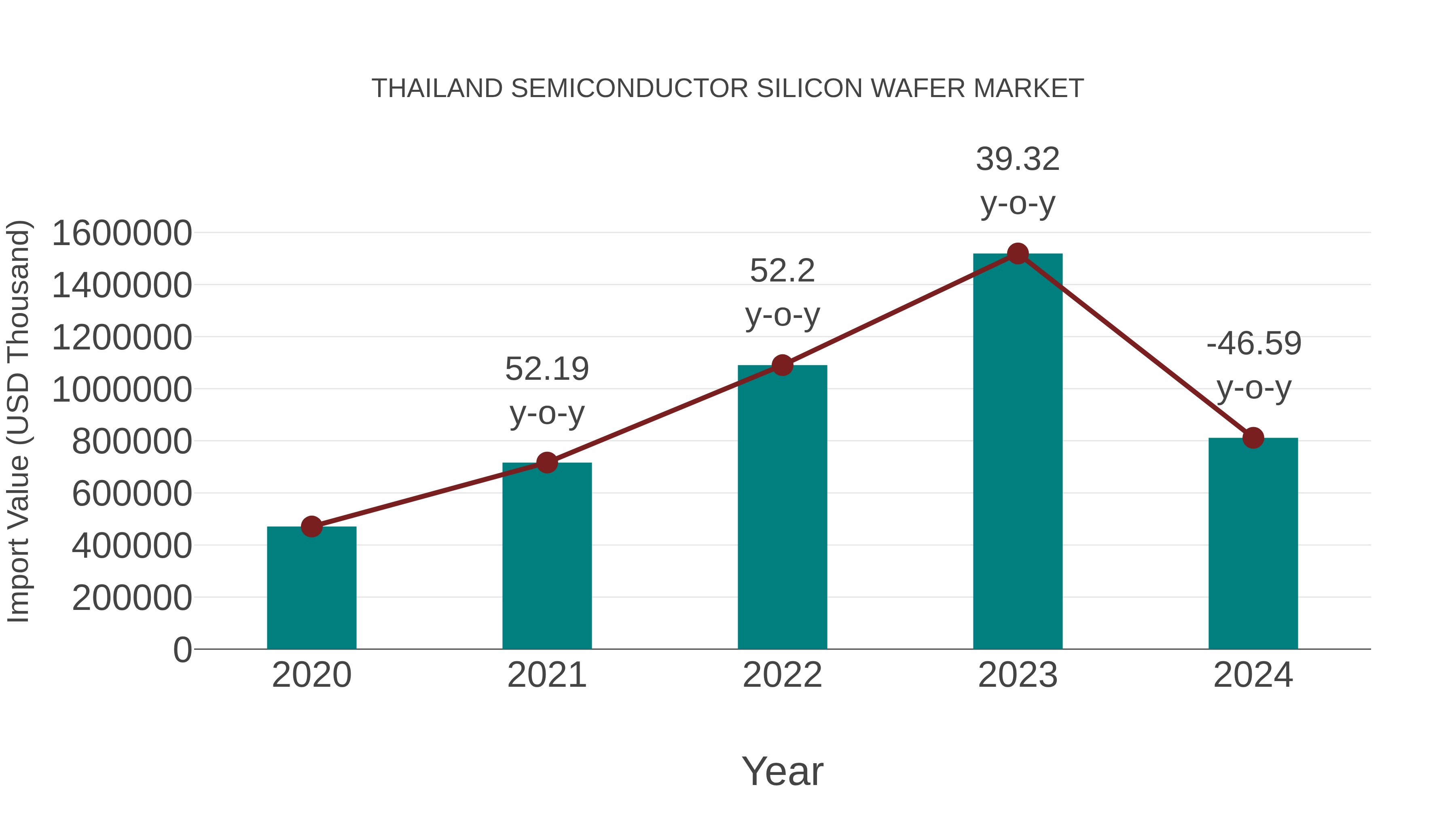
Thailand import trend for the semiconductor silicon wafer market experienced a notable decline from 2023 to 2024, with a growth rate of -46.59%. However, the compound annual growth rate (CAGR) for 2020-2024 stood at a respectable 14.58%. This significant decrease in import momentum in 2024 could be attributed to shifts in demand dynamics or changes in trade policies impacting market stability.
Thailand Semiconductor Silicon Wafer Market Overview
The Thailand Semiconductor Silicon Wafer Market is experiencing steady growth, driven by increasing demand for consumer electronics, automotive components, and industrial applications. The market is primarily dominated by key players such as GlobalWafers Co., Ltd., Siltronic AG, and Shin-Etsu Chemical Co., Ltd. The country`s robust manufacturing sector, favorable government policies, and investments in research and development are further propelling market growth. Additionally, the rise of emerging technologies like Artificial Intelligence, Internet of Things, and 5G is creating opportunities for silicon wafer manufacturers in Thailand. With a focus on innovation and sustainability, the market is expected to continue expanding in the coming years, attracting both domestic and international players seeking to capitalize on the growing demand for semiconductor silicon wafers in the region.
Thailand Semiconductor Silicon Wafer Market Trends and Opportunities
The Thailand Semiconductor Silicon Wafer Market is experiencing growth driven by the increasing demand for electronic devices across various industries such as automotive, consumer electronics, and healthcare. Key trends include the adoption of advanced technologies like 5G, IoT, and AI, leading to a greater need for higher-performance semiconductor devices. Opportunities lie in the development of innovative wafer manufacturing techniques, collaborations between local and international semiconductor companies, and government initiatives to promote the semiconductor industry. With Thailand`s strategic location and supportive business environment, the market is poised for expansion, offering potential for both local and foreign semiconductor wafer manufacturers to capitalize on these trends and opportunities for growth.
Thailand Semiconductor Silicon Wafer Market Challenges
The Thailand Semiconductor Silicon Wafer Market faces several challenges, including increasing competition from other Asian countries that offer lower production costs, limited domestic manufacturing capabilities leading to dependency on imports, lack of skilled workforce in the semiconductor industry, and inconsistent government policies affecting the investment climate. Additionally, the market is vulnerable to global economic fluctuations and geopolitical tensions, impacting demand for silicon wafers. Companies operating in Thailand`s semiconductor sector also encounter challenges related to technology advancements, intellectual property protection, and environmental regulations. Overcoming these obstacles will require strategic collaborations, investments in research and development, workforce training programs, and supportive government policies to foster a competitive and sustainable semiconductor industry in Thailand.
Thailand Semiconductor Silicon Wafer Market Drivers
The Thailand Semiconductor Silicon Wafer Market is primarily driven by the growing demand for consumer electronics, automotive applications, and the increasing adoption of internet of things (IoT) devices. The expansion of the semiconductor industry in Thailand, supported by government initiatives and investments, is also a significant driver. Additionally, the rising demand for advanced technologies such as artificial intelligence, 5G networks, and autonomous vehicles is fueling the need for high-quality silicon wafers in the country. The trend towards miniaturization of electronic devices and the development of innovative semiconductor materials further contribute to the growth of the market. Overall, the Thailand Semiconductor Silicon Wafer Market is expected to witness steady growth due to these driving factors.
Thailand Semiconductor Silicon Wafer Market Government Policies
In Thailand, government policies related to the semiconductor silicon wafer market focus on promoting investment in research and development, fostering innovation and technological advancements, and enhancing the country`s competitiveness in the global semiconductor industry. The government offers incentives such as tax breaks, grants, and subsidies to attract semiconductor companies to establish manufacturing facilities in Thailand. Additionally, there are initiatives to strengthen the workforce through training programs and partnerships with educational institutions to develop a skilled labor force capable of supporting the semiconductor industry. The government also aims to create a favorable regulatory environment and infrastructure to support the growth of the semiconductor sector, positioning Thailand as a key player in the global semiconductor silicon wafer market.
Thailand Semiconductor Silicon Wafer Market Future Outlook
The Thailand Semiconductor Silicon Wafer Market is expected to witness steady growth in the coming years driven by the increasing demand for consumer electronics, automotive applications, and emerging technologies such as 5G, Internet of Things (IoT), and artificial intelligence. The market is likely to benefit from the country`s growing semiconductor industry, favorable government initiatives to promote the electronics manufacturing sector, and the presence of key players in the region. Additionally, the expansion of semiconductor fabs and the rising adoption of advanced technologies are anticipated to further boost the demand for silicon wafers in Thailand. However, challenges such as fluctuating raw material prices, geopolitical tensions, and competition from other emerging markets may impact the market`s growth trajectory. Overall, the Thailand Semiconductor Silicon Wafer Market is poised for steady expansion in the foreseeable future.
Key Highlights of the Report:
- Thailand Semiconductor Silicon Wafer Market Outlook
- Market Size of Thailand Semiconductor Silicon Wafer Market, 2025
- Forecast of Thailand Semiconductor Silicon Wafer Market, 2032
- Historical Data and Forecast of Thailand Semiconductor Silicon Wafer Revenues & Volume for the Period 2022 - 2032F
- Thailand Semiconductor Silicon Wafer Market Trend Evolution
- Thailand Semiconductor Silicon Wafer Market Drivers and Challenges
- Thailand Semiconductor Silicon Wafer Price Trends
- Thailand Semiconductor Silicon Wafer Porter's Five Forces
- Thailand Semiconductor Silicon Wafer Industry Life Cycle
- Historical Data and Forecast of Thailand Semiconductor Silicon Wafer Market Revenues & Volume By Diameter for the Period 2022 - 2032F
- Historical Data and Forecast of Thailand Semiconductor Silicon Wafer Market Revenues & Volume By Less Than 150 Mm for the Period 2022 - 2032F
- Historical Data and Forecast of Thailand Semiconductor Silicon Wafer Market Revenues & Volume By 200 Mm for the Period 2022 - 2032F
- Historical Data and Forecast of Thailand Semiconductor Silicon Wafer Market Revenues & Volume By 300 Mm and Above for the Period 2022 - 2032F
- Historical Data and Forecast of Thailand Semiconductor Silicon Wafer Market Revenues & Volume By Product for the Period 2022 - 2032F
- Historical Data and Forecast of Thailand Semiconductor Silicon Wafer Market Revenues & Volume By Logic for the Period 2022 - 2032F
- Historical Data and Forecast of Thailand Semiconductor Silicon Wafer Market Revenues & Volume By Memory for the Period 2022 - 2032F
- Historical Data and Forecast of Thailand Semiconductor Silicon Wafer Market Revenues & Volume By Analog for the Period 2022 - 2032F
- Historical Data and Forecast of Thailand Semiconductor Silicon Wafer Market Revenues & Volume By Application for the Period 2022 - 2032F
- Historical Data and Forecast of Thailand Semiconductor Silicon Wafer Market Revenues & Volume By Consumer Electronics for the Period 2022 - 2032F
- Historical Data and Forecast of Thailand Semiconductor Silicon Wafer Market Revenues & Volume By Industrial for the Period 2022 - 2032F
- Historical Data and Forecast of Thailand Semiconductor Silicon Wafer Market Revenues & Volume By Telecommunication for the Period 2022 - 2032F
- Historical Data and Forecast of Thailand Semiconductor Silicon Wafer Market Revenues & Volume By Automotive for the Period 2022 - 2032F
- Thailand Semiconductor Silicon Wafer Import Export Trade Statistics
- Market Opportunity Assessment By Diameter
- Market Opportunity Assessment By Product
- Market Opportunity Assessment By Application
- Thailand Semiconductor Silicon Wafer Top Companies Market Share
- Thailand Semiconductor Silicon Wafer Competitive Benchmarking By Technical and Operational Parameters
- Thailand Semiconductor Silicon Wafer Company Profiles
- Thailand Semiconductor Silicon Wafer Key Strategic Recommendations






































