Thailand Ship Building and Repairing Market Summary
The thailand ship building and repairing market was estimated at USD 326 Million in 2025 and is projected to reach USD 431 Million by 2032, growing at a CAGR of 5.0% from 2026 to 2032.
Thailand Ship Building and Repairing Market Year-wise Growth Rate and Key Drivers
This graph highlights how the Thailand Ship Building and Repairing Market has steadily grown over the past five years, supported by major growth factors.
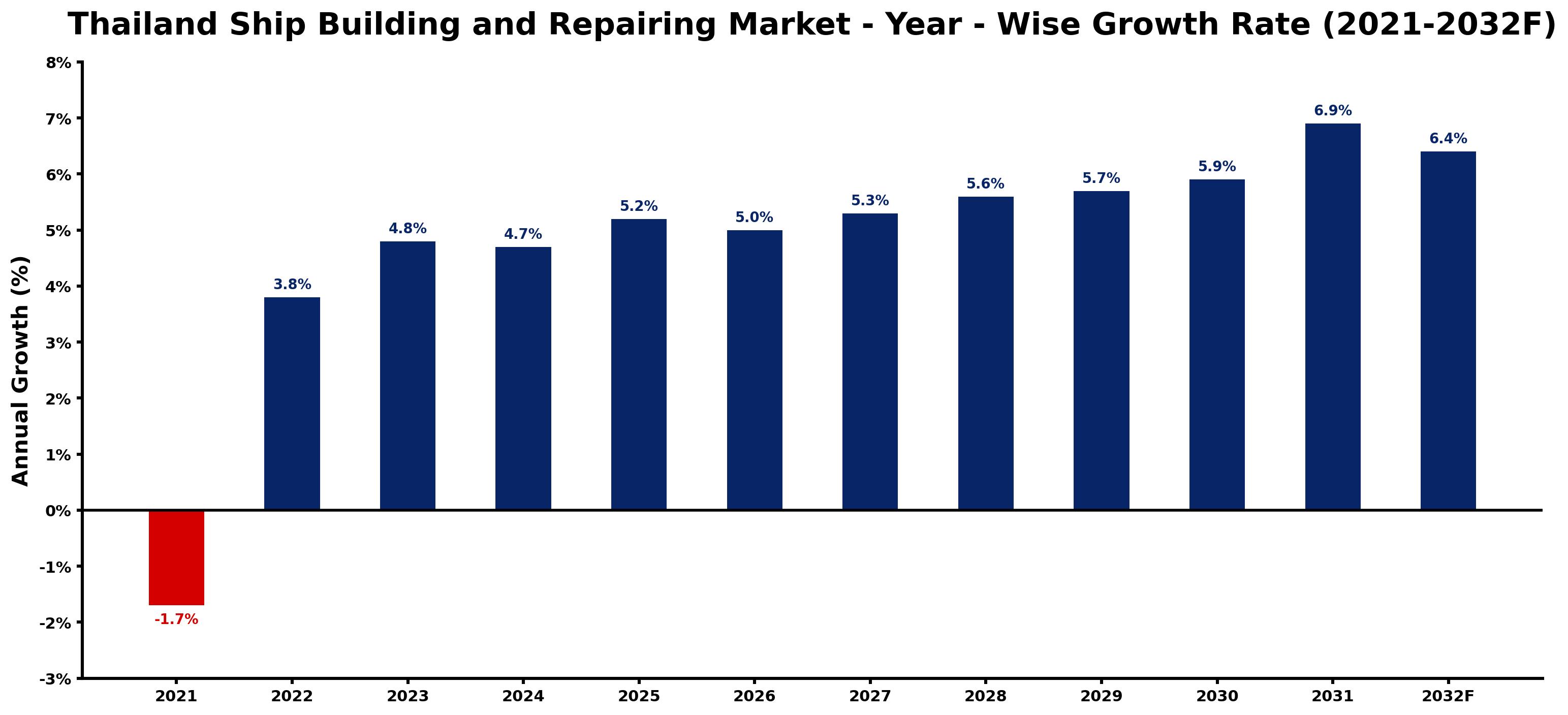
The table below presents the year wise growth rates along with the key drivers influencing the market
| Year | Growth Rate | Major Drivers |
| 2021 | -1.7% | Supply chain disruptions due to global shipping challenges hindered timely vessel repairs and new construction projects. |
| 2022 | 3.8% | Emergence of new technologies like robotics improved productivity in ship repair processes. |
| 2023 | 4.8% | Thailand's strategic location in Southeast Asia boosted international shipping traffic significantly. |
| 2024 | 4.7% | Investment in marine infrastructure attracted foreign players to local shipbuilding ventures. |
| 2025 | 5.2% | Sustainability pressures encouraged shipbuilders to incorporate eco-friendly materials and processes. |
| 2026 | 5.0% | Expansion of regional trade agreements increased demand for local shipbuilding and repairs. |
| 2027 | 5.3% | Technological partnerships with global firms introduced innovative ship design methodologies. |
| 2028 | 5.6% | Growing tourism sector prompted investments in leisure and luxury yacht construction. |
| 2029 | 5.7% | Domestic freight and logistics companies sought to modernize fleets, boosting repair contracts. |
| 2030 | 5.9% | Increased naval spending signaled government support for a stronger maritime defense industry. |
| 2031 | 6.9% | New educational programs targeted skill development for the next generation of shipbuilders. |
| 2032 | 6.4% | Emerging markets in neighboring countries provided additional opportunities for regional collaboration. |
Note - Market size estimations and growth projections presented in this report are based on 6Wresearch's advanced forecasting approach, validated with industry datasets as of June 2026.
Thailand Ship Building and Repairing Market Synopsis
The Thailand Ship Building and Repairing Market is projected to reach 5.0% and witness significant growth during the forecast period (2026-2032). This growth trajectory is anticipated to be driven by an increase in maritime trade activities, an escalating demand for commercial vessels and passenger ships, and enhancements to port infrastructure in the region. Additionally, government initiatives aimed at bolstering maritime infrastructure, as well as heightened investments in exploration and production activities by oil companies, are expected to catalyze the development of offshore service vessel construction and local repair yards.
Thailand Ship Building and Repairing Market Growth Drivers
The growth of the Thailand Ship Building and Repairing Market can be attributed to several key drivers:
- The rising volume of global maritime trade is significantly enhancing the demand for new ship construction and repair services.
- Increased investment in port infrastructure is facilitating larger capacities for vessel repair and construction, thereby attracting more business.
- The demand for passenger liners and commercial vessels, such as bulk carriers and container ships, is surging, which is creating additional opportunities for local shipyards.
- The shift towards sustainable and efficient shipping solutions is prompting the industry to adapt and innovate, resulting in new business avenues.
- Government policies that support the maritime industry are fostering an encouraging environment for investment and development.
Thailand Ship Building and Repairing Market Challenges and Restraints
Despite the promising growth potential, the Thailand Ship Building and Repairing Market faces challenges that could impact its trajectory:
- The industry has to manage the complexities of global supply chain disruptions, which can threaten operational efficiency and project timelines.
- Competition from neighboring countries with established shipbuilding sectors may pose challenges to market share and pricing strategies.
- The need for skilled labor in shipbuilding and repair is critical; shortages could hinder production capabilities.
- Fluctuations in global oil prices can affect investment decisions in the maritime sector, particularly for offshore services.
- Regulatory hurdles associated with environmental compliance and safety standards could impose additional costs on shipbuilders and repair facilities.
Thailand Ship Building and Repairing Market Government Investment and Initiatives
The government of Thailand has recognized the strategic importance of the maritime industry to the national economy and is implementing various investment initiatives aimed at enhancing the shipbuilding and repairing sector. These initiatives include:
- Substantial public spending on port infrastructure improvements, which are crucial for accommodating larger vessels and increasing repair capabilities.
- Support programs aimed at encouraging foreign and domestic investments in shipbuilding technologies and facilities.
- Grants and incentives for local companies looking to expand their operations or invest in new technologies.
- Collaboration with academic institutions to develop training programs that address labor shortages and enhance skills in maritime engineering and construction.
- Long-term strategic plans that prioritize the development of a sustainable maritime ecosystem through innovation and technology adoption.
Thailand Ship Building and Repairing Market Latest Developments (May 2025 - June 2026)
The period from May 2025 to June 2026 has seen several noteworthy developments in the Thailand Ship Building and Repairing Market, reflecting ongoing industry evolution:
- Increased investments in modernizing existing shipyards to enhance efficiency and expand production capabilities.
- A notable rise in joint ventures between local shipyards and international firms, facilitating technology transfer and knowledge sharing.
- Implementation of stricter environmental regulations has spurred innovation in ship designs focused on sustainability.
- Growing emphasis on research and development in the field of eco-friendly shipbuilding technologies.
- The establishment of industry forums and associations aimed at addressing common challenges and promoting best practices among stakeholders.
Thailand Ship Building and Repairing Market - Key Attractiveness of the Report
- 10 Years of Market Numbers
- Historical Data Starting from 2022 to 2025
- Base Year: 2025
- Forecast Data until 2032
- Key Performance Indicators Impacting the Market
- Major Upcoming Developments and Projects
Key Highlights of the Report:
- Thailand Ship Building and Repairing Market Outlook
- Market Size of Thailand Ship Building and Repairing Market, 2025
- Forecast of Thailand Ship Building and Repairing Market, 2032
- Historical Data and Forecast of Thailand Ship Building and Repairing Revenues & Volume for the Period 2022-2032F
- Thailand Ship Building and Repairing Market Trend Evolution
- Thailand Ship Building and Repairing Market Drivers and Challenges
- Thailand Ship Building and Repairing Price Trends
- Thailand Ship Building and Repairing Porter's Five Forces
- Thailand Ship Building and Repairing Industry Life Cycle
- Historical Data and Forecast of Thailand Ship Building and Repairing Market Revenues & Volume By Type for the Period 2022-2032F
- Historical Data and Forecast of Thailand Ship Building and Repairing Market Revenues & Volume By Ship Building for the Period 2022-2032F
- Historical Data and Forecast of Thailand Ship Building and Repairing Market Revenues & Volume By Ship Repairing for the Period 2022-2032F
- Historical Data and Forecast of Thailand Ship Building and Repairing Market Revenues & Volume By Vessel Types for the Period 2022-2032F
- Historical Data and Forecast of Thailand Ship Building and Repairing Market Revenues & Volume By Oil And Chemical Tankers for the Period 2022-2032F
- Historical Data and Forecast of Thailand Ship Building and Repairing Market Revenues & Volume By Container Ships for the Period 2022-2032F
- Historical Data and Forecast of Thailand Ship Building and Repairing Market Revenues & Volume By Gas Carriers for the Period 2022-2032F
- Historical Data and Forecast of Thailand Ship Building and Repairing Market Revenues & Volume By Offshore Vessels for the Period 2022-2032F
- Historical Data and Forecast of Thailand Ship Building and Repairing Market Revenues & Volume By Passenger Ships And Ferries for the Period 2022-2032F
- Historical Data and Forecast of Thailand Ship Building and Repairing Market Revenues & Volume By Applications for the Period 2022-2032F
- Historical Data and Forecast of Thailand Ship Building and Repairing Market Revenues & Volume By General Services for the Period 2022-2032F
- Historical Data and Forecast of Thailand Ship Building and Repairing Market Revenues & Volume By Dockage for the Period 2022-2032F
- Historical Data and Forecast of Thailand Ship Building and Repairing Market Revenues & Volume By Hull Part for the Period 2022-2032F
- Historical Data and Forecast of Thailand Ship Building and Repairing Market Revenues & Volume By Engine Parts for the Period 2022-2032F
- Historical Data and Forecast of Thailand Ship Building and Repairing Market Revenues & Volume By Electric Works for the Period 2022-2032F
- Historical Data and Forecast of Thailand Ship Building and Repairing Market Revenues & Volume By Auxiliary Services for the Period 2022-2032F
- Thailand Ship Building and Repairing Import Export Trade Statistics
- Market Opportunity Assessment By Type
- Market Opportunity Assessment By Vessel Types
- Market Opportunity Assessment By Applications
- Thailand Ship Building and Repairing Top Companies Market Share
- Thailand Ship Building and Repairing Competitive Benchmarking By Technical and Operational Parameters
- Thailand Ship Building and Repairing Company Profiles
- Thailand Ship Building and Repairing Key Strategic Recommendations






































