Thailand Soybean Oil Market Size Growth Rate
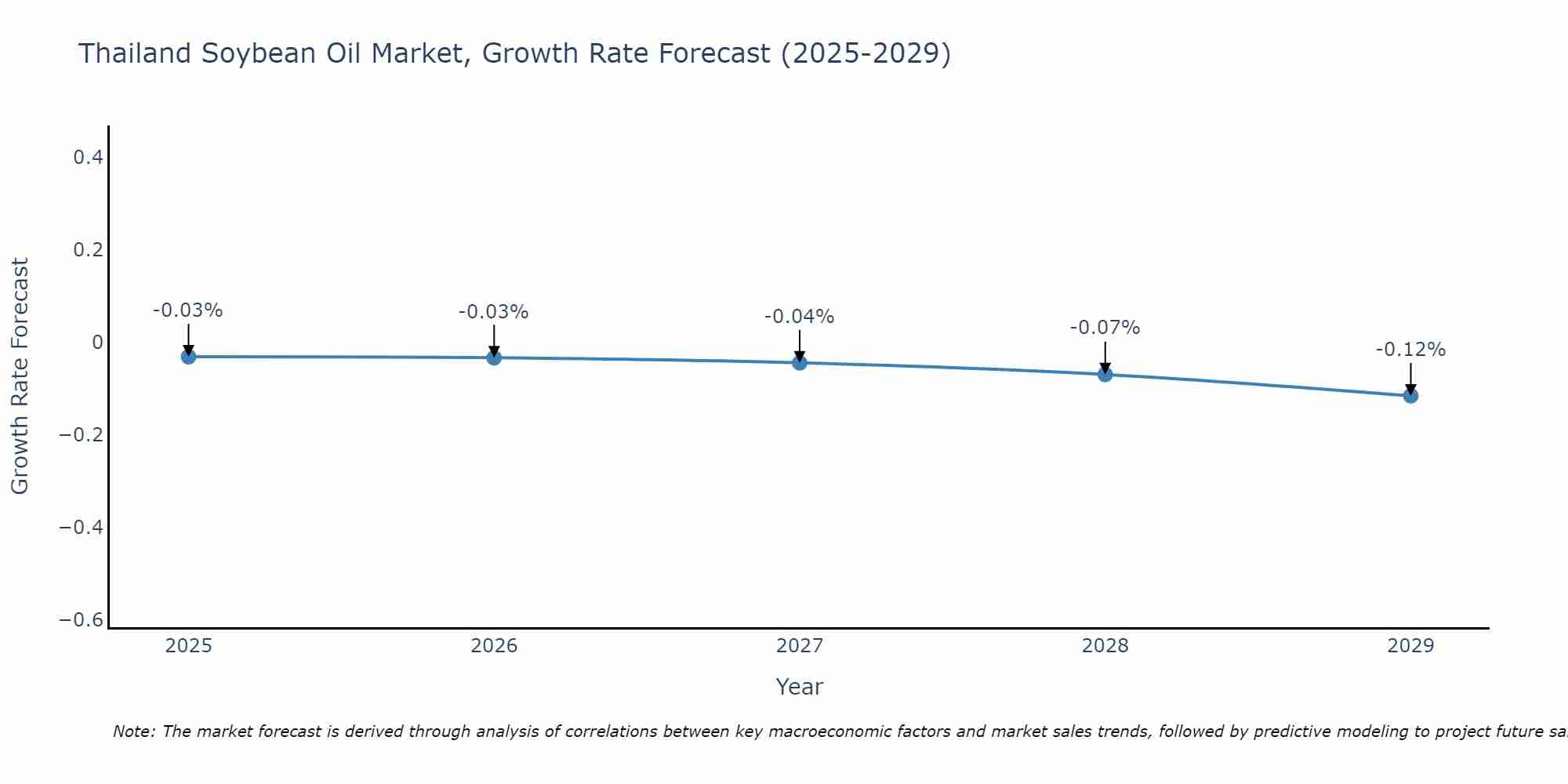
The Thailand Soybean Oil Market could see a tapering of growth rates over 2025 to 2029. Although the growth rate starts strong at -0.03% in 2025, it steadily loses momentum, ending at -0.12% by 2029.
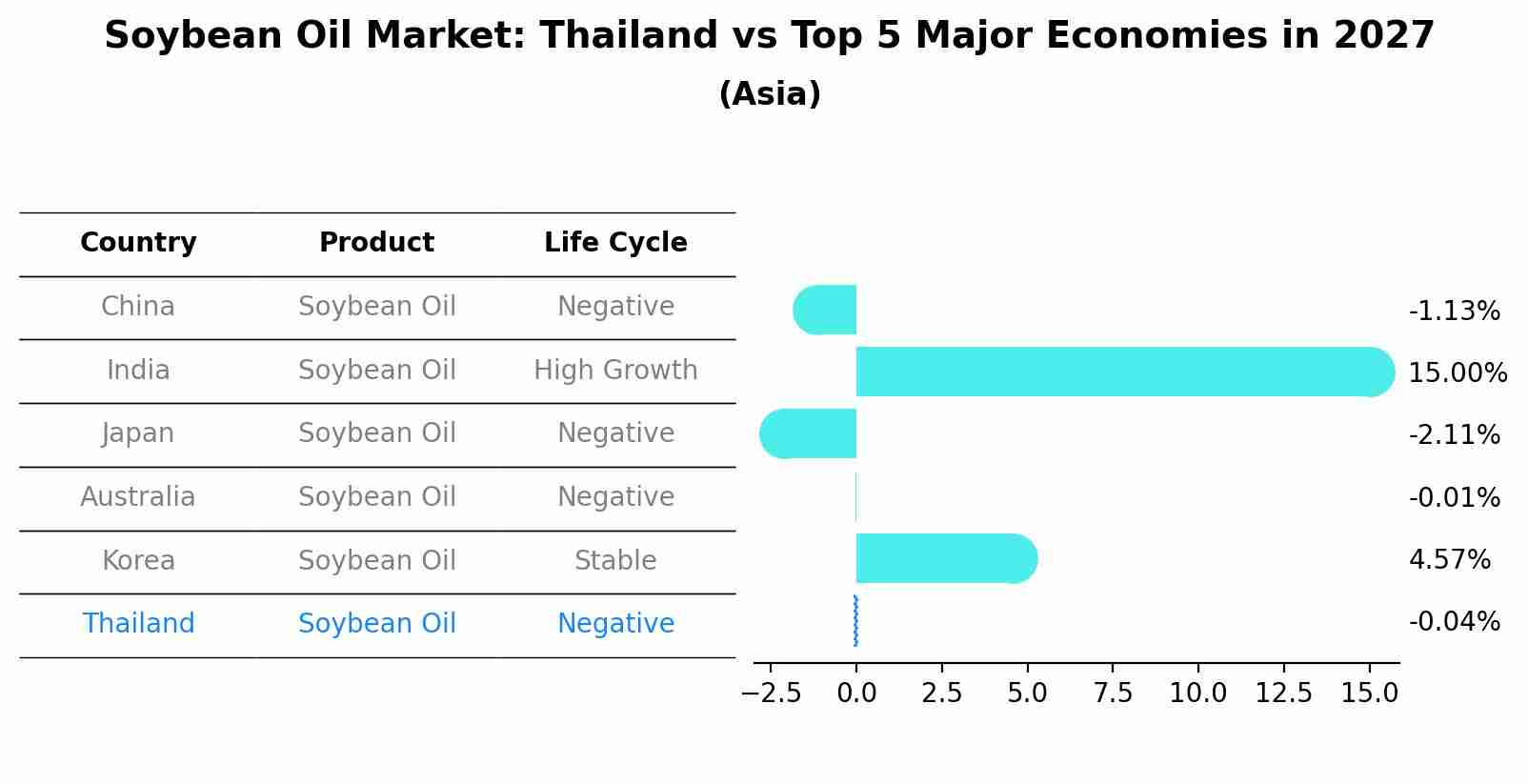
Soybean Oil Market: Thailand vs Top 5 Major Economies in 2027 (Asia)
The Soybean Oil market in Thailand is projected to grow at a negative growth rate of -0.04% by 2027, highlighting the country's increasing focus on advanced technologies within the Asia region, where China holds the dominant position, followed closely by India, Japan, Australia and South Korea, shaping overall regional demand.
Thailand Soybean Oil Market Synopsis
Soybean oil is a vital cooking and food processing ingredient in Thailand. The market for soybean oil is influenced by domestic consumption patterns and the food industry`s requirements. As health-conscious consumers seek healthier cooking oils, there is a growing interest in soybean oil due to its relatively low saturated fat content.
Drivers of the Market
The Thailand soybean oil market is driven by its widespread use in cooking and food processing. As the population continues to grow and urbanize, there is a rising demand for convenience foods and cooking oils. Soybean oil, known for its neutral flavor and versatility, is a popular choice among consumers. Health-conscious consumers seeking alternatives to traditional cooking oils have also contributed to its market growth.
Challenges of the Market
The Thailand soybean oil market faces several challenges, starting with fluctuating global oil prices and their impact on domestic pricing. Price volatility can make it challenging for producers to plan and invest in the soybean oil industry. Additionally, the market contends with changing consumer preferences towards healthier oils, which has prompted a shift towards alternatives like palm oil or healthier soybean oil varieties. The need for sustainable and environmentally friendly soybean oil production methods is also a pressing challenge, as concerns about deforestation and land use practices associated with soybean cultivation are under scrutiny. Moreover, competition from other edible oils, such as sunflower and canola oil, further intensifies market dynamics.
COVID-19 Impact on the Market
The soybean oil market in Thailand experienced fluctuations in demand during the COVID-19 pandemic. Changes in consumer behavior, including increased home cooking, led to shifts in consumption patterns. While demand initially surged, it later stabilized as the situation normalized. Manufacturers adapted by promoting the health benefits of soybean oil and diversifying product offerings to meet changing consumer preferences.
Key Players in the Market
In the Thai soybean oil market, major players include Thai Vegetable Oil Public Co., Ltd. and Lam Soon (Thailand) Public Co., Ltd. These companies are renowned for their production of high-quality soybean oil, which serves as a staple cooking and frying oil in Thailand culinary industry.
Key Highlights of the Report:
- Thailand Soybean Oil Market Outlook
- Market Size of Thailand Soybean Oil Market, 2024
- Forecast of Thailand Soybean Oil Market, 2031
- Historical Data and Forecast of Thailand Soybean Oil Revenues & Volume for the Period 2021-2031
- Thailand Soybean Oil Market Trend Evolution
- Thailand Soybean Oil Market Drivers and Challenges
- Thailand Soybean Oil Price Trends
- Thailand Soybean Oil Porter's Five Forces
- Thailand Soybean Oil Industry Life Cycle
- Historical Data and Forecast of Thailand Soybean Oil Market Revenues & Volume By End-Use for the Period 2021-2031
- Historical Data and Forecast of Thailand Soybean Oil Market Revenues & Volume By Food for the Period 2021-2031
- Historical Data and Forecast of Thailand Soybean Oil Market Revenues & Volume By Feed for the Period 2021-2031
- Historical Data and Forecast of Thailand Soybean Oil Market Revenues & Volume By Industrial for the Period 2021-2031
- Thailand Soybean Oil Import Export Trade Statistics
- Market Opportunity Assessment By End-Use
- Thailand Soybean Oil Top Companies Market Share
- Thailand Soybean Oil Competitive Benchmarking By Technical and Operational Parameters
- Thailand Soybean Oil Company Profiles
- Thailand Soybean Oil Key Strategic Recommendations






































