Thailand Stainless Steel Wire Rods Market Size, Share & Growth Rate
The Thailand Stainless Steel Wire Rods Market was estimated at USD 335 Million in 2025 and is projected to reach USD 446 Million by 2032, growing at a CAGR of 4.2% from 2026 to 2032. This growth trajectory is primarily driven by the expanding construction industry, which increasingly leverages stainless steel for structural integrity. Additionally, the automotive sector's shift towards lightweight, corrosion-resistant materials is fostering demand, aligning with evolving industry standards.
Thailand Stainless Steel Wire Rods Market Year-wise Growth Rate and Key Drivers
This graph highlights how the Thailand Stainless Steel Wire Rods Market has steadily grown over the years, supported by major growth factors.
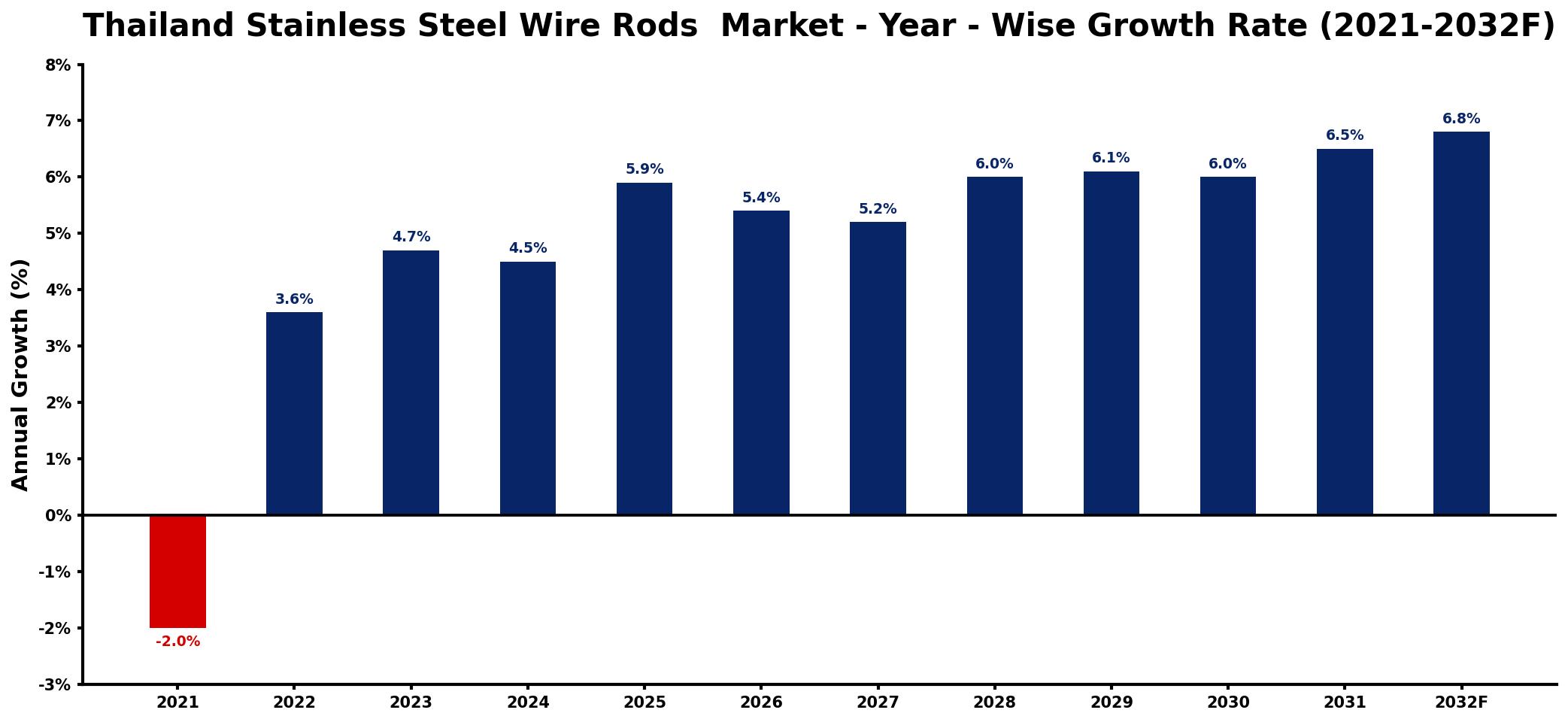
The table below presents the year‑wise growth rates along with the key drivers influencing the market
| Year | Growth Rate | Major Drivers |
| 2021 | -2.0% | decreased construction project investments |
| 2022 | 3.6% | increased automotive manufacturing demands |
| 2023 | 4.7% | growing renewable energy sector |
| 2024 | 4.5% | expansion in industrial automation |
| 2025 | 5.9% | rising consumer electronics production |
| 2026 | 5.4% | increased infrastructure development projects |
| 2027 | 5.2% | boost in export activities |
| 2028 | 6.0% | growing demand from aerospace |
| 2029 | 6.1% | advancements in medical technology |
| 2030 | 6.0% | increased focus on sustainability |
| 2031 | 6.5% | rising export shipment volumes |
| 2032 | 6.8% | expansion of electric vehicle market |
Note: Market size estimations and growth projections presented in this report are based on 6Wresearch's proprietary forecasting methodology, utilizing the latest available industry data, government publications, and primary research inputs.
Thailand Stainless Steel Wire Rods Market Synopsis
The market for stainless steel wire rods in Thailand is uniquely positioned due to the nation's robust manufacturing capabilities and rising quality expectations. These wire rods serve as crucial inputs in the production of various end-products, particularly in construction and automotive applications, signifying their importance in the domestic supply chain.
Thailand's stainless steel wire rods are increasingly favored for their durability and versatility, meeting the high standards set forth by various industries. As manufacturers aim to fulfill customer demands amid growing competition, there is a concerted focus on innovation and adherence to international quality certifications.
Thailand Stainless Steel Wire Rods Market Key Takeaways
- The market is benefitting from increased demand across key sectors, particularly construction and automotive.
- Stainless steel wire rods are essential for ensuring quality in applications such as electronics and food processing.
- Domestic production faces challenges from lower-cost imports but strives to meet high-quality standards.
- Raw material price fluctuations remain a critical concern for manufacturers in maintaining profitability.
- The evolving regulatory landscape necessitates compliance with stringent international standards.
Evaluation of Restraints in Thailand Stainless Steel Wire Rods Market
Despite a favorable growth outlook, the Thailand stainless steel wire rods market encounters significant constraints. One of the primary challenges is the volatility of raw material prices, which can undermine profit margins and operational stability for manufacturers. Furthermore, intense competition from low-cost producers in neighboring Asian countries poses a threat to market share, compelling local manufacturers to enhance efficiency and innovation. Additionally, the necessity of meeting stringent international quality standards can elevate production costs, creating further hurdles for market entrants.
Thailand Stainless Steel Wire Rods Market Trends
Emerging trends within the Thailand stainless steel wire rods market point towards increasing automation in production processes, enhancing both efficiency and product quality. The integration of advanced technologies, such as IoT and AI, is anticipated to revolutionize manufacturing capabilities, fostering real-time monitoring and optimization. Moreover, sustainability initiatives are gaining traction, leading to a greater focus on recycling and the use of eco-friendly materials in the production of stainless steel wire rods.
Thailand Stainless Steel Wire Rods Market Opportunities
Opportunities for growth within the Thailand stainless steel wire rods market are significant. With the construction sector expanding, there is a rising demand for high-quality stainless steel for reinforcement applications. Additionally, the automotive industrys transition towards more sustainable and lightweight materials is presenting new avenues for growth. Investment in R&D for innovative product development and the exploration of international markets could provide substantial returns for manufacturers willing to adapt to changing industry dynamics.
Government Initiatives in the Thailand Stainless Steel Wire Rods Market
The Thai government has implemented various initiatives aimed at bolstering the manufacturing sector, including stainless steel production. Policies promoting foreign investment, infrastructure development, and technology upgrades are designed to enhance competitive advantages. Additionally, incentives for sustainable practices in manufacturing are being introduced, encouraging businesses to adopt eco-friendly technologies and processes.
Future Insights of the Thailand Stainless Steel Wire Rods Market
Looking ahead to 2026-2032, the Thailand stainless steel wire rods market is poised for a period of evolution driven by technological advancements and shifting consumer preferences. As sustainability becomes increasingly paramount, manufacturers will need to prioritize eco-friendly practices in their operations. Continued investment in innovative production techniques will not only help to mitigate costs but also enhance product quality, ultimately aligning with the rising standards of both domestic and international markets.
Thailand Stainless Steel Wire Rods Market Latest Developments (2025 - 2026)
Recent developments in the Thailand stainless steel wire rods market have centered around technological advancements aimed at improving production efficiency. Manufacturers are increasingly adopting automated solutions to streamline operations, while collaborations with research institutions are fostering innovation in product development. There has also been a notable shift towards prioritizing sustainable manufacturing practices, reflecting global trends and growing consumer demands.
Thailand Stainless Steel Wire Rods Market - Key Attractiveness of the Report
- 10 Years of Market Numbers
- Historical Data Starting from 2022 to 2025
- Base Year: 2025
- Forecast Data until 2032
- Key Performance Indicators Impacting the Market
- Major Upcoming Developments and Projects
Key Highlights of the Report:
- Thailand Stainless Steel Wire Rods Market Outlook
- Market Size of Thailand Stainless Steel Wire Rods Market, 2025
- Forecast of Thailand Stainless Steel Wire Rods Market, 2032
- Historical Data and Forecast of Thailand Stainless Steel Wire Rods Revenues & Volume for the Period 2022-2032F
- Thailand Stainless Steel Wire Rods Market Trend Evolution
- Thailand Stainless Steel Wire Rods Market Drivers and Challenges
- Thailand Stainless Steel Wire Rods Price Trends
- Thailand Stainless Steel Wire Rods Porter's Five Forces
- Thailand Stainless Steel Wire Rods Industry Life Cycle
- Historical Data and Forecast of Thailand Stainless Steel Wire Rods Market Revenues & Volume By Types for the Period 2022-2032F
- Historical Data and Forecast of Thailand Stainless Steel Wire Rods Market Revenues & Volume By 12mm for the Period 2022-2032F
- Historical Data and Forecast of Thailand Stainless Steel Wire Rods Market Revenues & Volume By 10mm for the Period 2022-2032F
- Historical Data and Forecast of Thailand Stainless Steel Wire Rods Market Revenues & Volume By 8mm for the Period 2022-2032F
- Historical Data and Forecast of Thailand Stainless Steel Wire Rods Market Revenues & Volume By 6mm for the Period 2022-2032F
- Historical Data and Forecast of Thailand Stainless Steel Wire Rods Market Revenues & Volume By Others for the Period 2022-2032F
- Historical Data and Forecast of Thailand Stainless Steel Wire Rods Market Revenues & Volume By Applications for the Period 2022-2032F
- Historical Data and Forecast of Thailand Stainless Steel Wire Rods Market Revenues & Volume By Steel Fasteners for the Period 2022-2032F
- Historical Data and Forecast of Thailand Stainless Steel Wire Rods Market Revenues & Volume By Steel Wire for the Period 2022-2032F
- Historical Data and Forecast of Thailand Stainless Steel Wire Rods Market Revenues & Volume By Steel Bright Bars for the Period 2022-2032F
- Historical Data and Forecast of Thailand Stainless Steel Wire Rods Market Revenues & Volume By Others for the Period 2022-2032F
- Thailand Stainless Steel Wire Rods Import Export Trade Statistics
- Market Opportunity Assessment By Types
- Market Opportunity Assessment By Applications
- Thailand Stainless Steel Wire Rods Top Companies Market Share
- Thailand Stainless Steel Wire Rods Competitive Benchmarking By Technical and Operational Parameters
- Thailand Stainless Steel Wire Rods Company Profiles
- Thailand Stainless Steel Wire Rods Key Strategic Recommendations






































