Thailand Talc and Steatite Market Size, Share & Growth Rate
The Thailand Talc and Steatite Market was estimated at USD 239 Million in 2025 and is projected to reach USD 273 Million by 2032, growing at a CAGR of 1.9% from 2026 to 2032. This growth trajectory is primarily attributed to the increasing demand across diverse industries, including cosmetics, automotive, and construction. The continued industrialization in Thailand, along with a growing focus on quality and safety in product formulations, is further bolstering the market's expansion.
Thailand Talc and Steatite Market Year-wise Growth Rate and Key Drivers
This graph highlights how the Thailand Talc and Steatite Market has steadily grown over the years, supported by major growth factors.
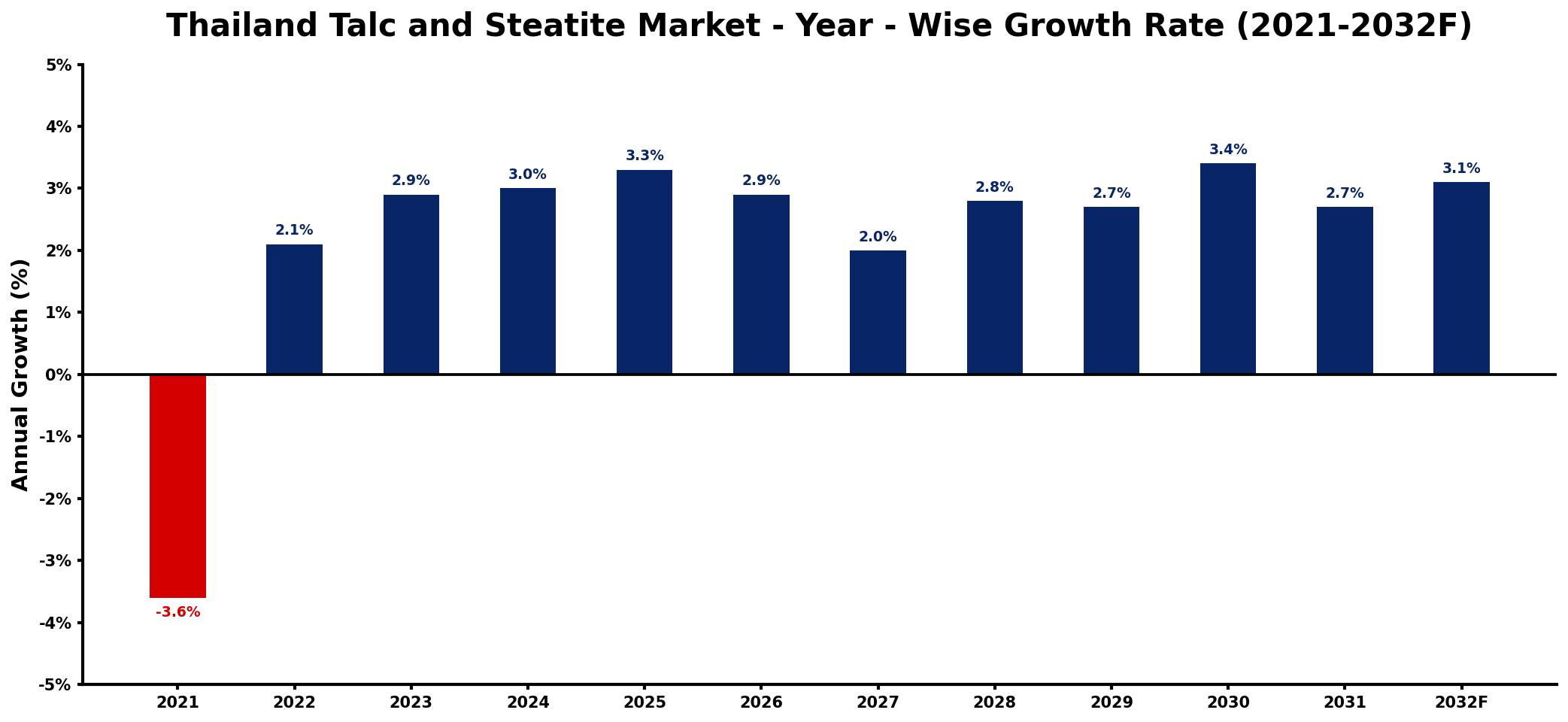
The table below presents the year‑wise growth rates along with the key drivers influencing the market
| Year | Growth Rate | Major Drivers |
| 2021 | -3.6% | Reduced industrial production activities |
| 2022 | 2.1% | Increased demand from cosmetics industry |
| 2023 | 2.9% | Growth in personal care products |
| 2024 | 3.0% | Expansion of construction sector investments |
| 2025 | 3.3% | Rising applications in plastics manufacturing |
| 2026 | 2.9% | Higher consumption in paper industry |
| 2027 | 2.0% | Strengthened demand from automotive sector |
| 2028 | 2.8% | increased domestic production output |
| 2029 | 2.7% | Increased usage in pharmaceuticals sector |
| 2030 | 3.4% | improved raw material availability |
| 2031 | 2.7% | Rising adoption in agriculture sector |
| 2032 | 3.1% | Growing investments in renewable energy |
Note: Market size estimations and growth projections presented in this report are based on 6Wresearch's proprietary forecasting methodology, utilizing the latest available industry data, government publications, and primary research inputs.
Thailand Talc and Steatite Market Synopsis
Thailand's talc and steatite market stands as a critical pillar in the industrial landscape, underpinned by the country's rich deposits of these minerals. The unique properties of talc, such as its softness and chemical inertness, coupled with steatite's thermal and electrical insulation capabilities, render them invaluable across multiple applications.
The market is characterized by a strong domestic manufacturing base that caters to sectors such as cosmetics, ceramics, and automotive components. As the global demand for high-quality talc and steatite continues to rise, Thailand's role as a leading supplier becomes increasingly significant, offering export opportunities that enhance its competitive edge.
Thailand Talc and Steatite Market Key Takeaways
- Robust growth driven by extensive applications in cosmetics, automotive, and construction industries.
- High-quality mineral deposits position Thailand favorably in the global talc and steatite landscape.
- Increased focus on product purity and compliance with international standards enhances market competitiveness.
- Opportunities for expansion in export markets as global demand for these minerals escalates.
- Continued industrialization and technological advancements are paving the way for innovative uses of talc and steatite.
Evaluation of Restraints in Thailand Talc and Steatite Market
Despite its strong performance, the Thailand talc and steatite market faces certain constraints that could hinder growth. The challenge of sourcing high-quality raw materials is paramount, as impurities can significantly impact product performance and market acceptance. Additionally, adherence to evolving environmental and safety regulations requires constant vigilance and adaptation from industry players. The competition posed by alternative materials, particularly in sectors like cosmetics and plastics, further complicates market dynamics, necessitating continuous innovation and improvement in existing processes.
Thailand Talc and Steatite Market Trends
Emerging trends in the Thailand talc and steatite market highlight a shift towards sustainability and eco-friendly applications. There is a growing preference for natural and organic formulations in the cosmetics sector, leading to increased interest in talc as a safe ingredient. Furthermore, advancements in technology are enabling more efficient mining and processing methods, which contribute to reduced environmental impact. The construction industry's evolving requirements, such as increased demand for lightweight and durable materials, also influence the adoption of talc and steatite in new applications.
Thailand Talc and Steatite Market Opportunities
Significant growth opportunities lie in diversifying applications of talc and steatite beyond traditional sectors. The burgeoning market for electric vehicles presents a lucrative avenue for high-performance talc in lightweight plastics and insulation materials. Additionally, exploring new markets in Southeast Asia can enhance export potential, driven by the increasing regional manufacturing capabilities. Investments in research and development to innovate and create value-added products could lead to substantial competitive advantages for manufacturers in Thailand.
Government Initiatives in the Thailand Talc and Steatite Market
The Thai government has implemented various initiatives to promote the mining and processing of talc and steatite. Policies aimed at improving mining regulations and investing in infrastructure development are pivotal in enhancing the operational efficiency of this sector. Moreover, there are programs focused on environmental sustainability that encourage companies to adopt greener practices, ensuring compliance with international standards while fostering a responsible mining approach.
Future Insights of the Thailand Talc and Steatite Market
Looking ahead to 2026-2032, the Thailand talc and steatite market is poised for sustained growth as industries continue to adapt to changing consumer demands and regulatory frameworks. Innovations in product applications, particularly in the context of sustainability, will play a crucial role in shaping the market landscape. As manufacturing capabilities expand and export opportunities increase, Thailand is likely to solidify its position as a key player in the global talc and steatite supply chain.
Thailand Talc and Steatite Market Latest Developments (2025 - 2026)
Recent developments in the Thailand talc and steatite market reflect a dynamic industry adapting to global trends. Companies are increasingly focusing on enhancing product quality and developing innovative applications to meet the evolving needs of end-users. Furthermore, efforts to strengthen supply chains and minimize environmental impacts have gained momentum, aligning with broader industry shifts towards sustainability. The reopening of industries following pandemic-related disruptions has also resulted in a renewed focus on operational resilience and market expansion.
Thailand Talc and Steatite Market - Key Attractiveness of the Report
- 10 Years of Market Numbers
- Historical Data Starting from 2022 to 2025
- Base Year: 2025
- Forecast Data until 2032
- Key Performance Indicators Impacting the Market
- Major Upcoming Developments and Projects
Key Highlights of the Report:
- Thailand Talc and Steatite Market Outlook
- Market Size of Thailand Talc and Steatite Market, 2025
- Forecast of Thailand Talc and Steatite Market, 2032
- Historical Data and Forecast of Thailand Talc and Steatite Revenues & Volume for the Period 2022-2032F
- Thailand Talc and Steatite Market Trend Evolution
- Thailand Talc and Steatite Market Drivers and Challenges
- Thailand Talc and Steatite Price Trends
- Thailand Talc and Steatite Porter's Five Forces
- Thailand Talc and Steatite Industry Life Cycle
- Historical Data and Forecast of Thailand Talc and Steatite Market Revenues & Volume By Product Type for the Period 2022-2032F
- Historical Data and Forecast of Thailand Talc and Steatite Market Revenues & Volume By Crushed for the Period 2022-2032F
- Historical Data and Forecast of Thailand Talc and Steatite Market Revenues & Volume By Powdered for the Period 2022-2032F
- Thailand Talc and Steatite Import Export Trade Statistics
- Market Opportunity Assessment By Product Type
- Thailand Talc and Steatite Top Companies Market Share
- Thailand Talc and Steatite Competitive Benchmarking By Technical and Operational Parameters
- Thailand Talc and Steatite Company Profiles
- Thailand Talc and Steatite Key Strategic Recommendations






































